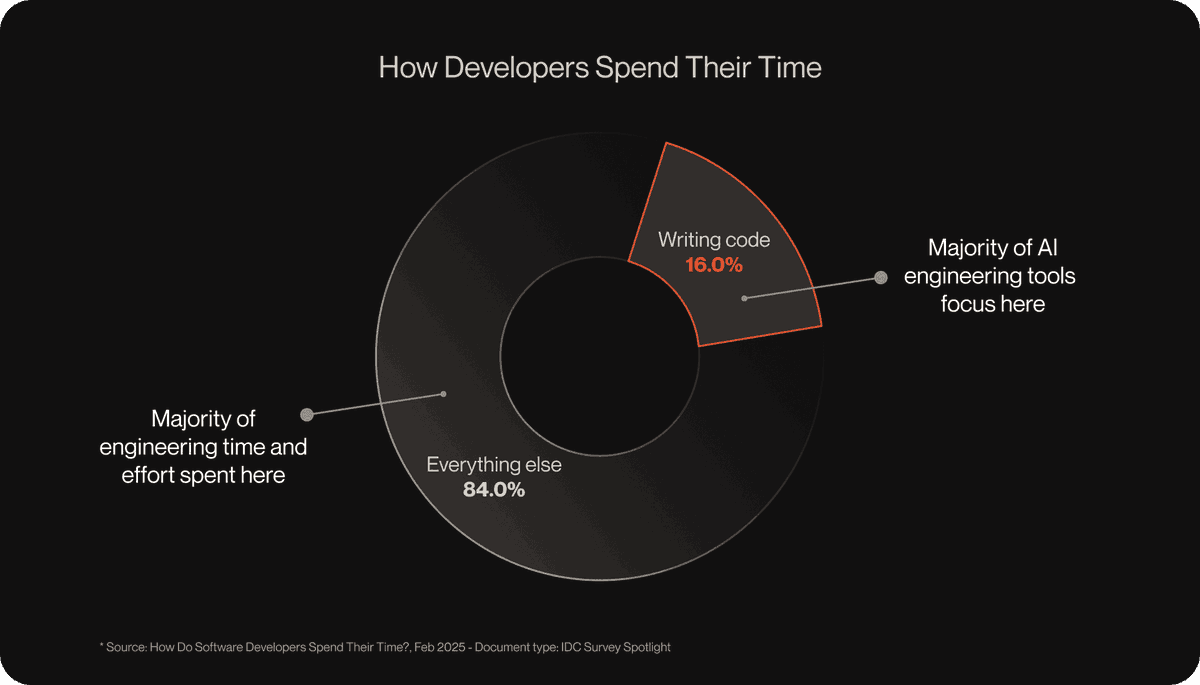
Cursor shipped Instant Grep, a local regex index built from n-grams, inverted indexes, and Bloom filters that drops large-repo searches from seconds to milliseconds. Faster candidate retrieval shortens the coding-agent loop, especially when ripgrep-style scans become the bottleneck.
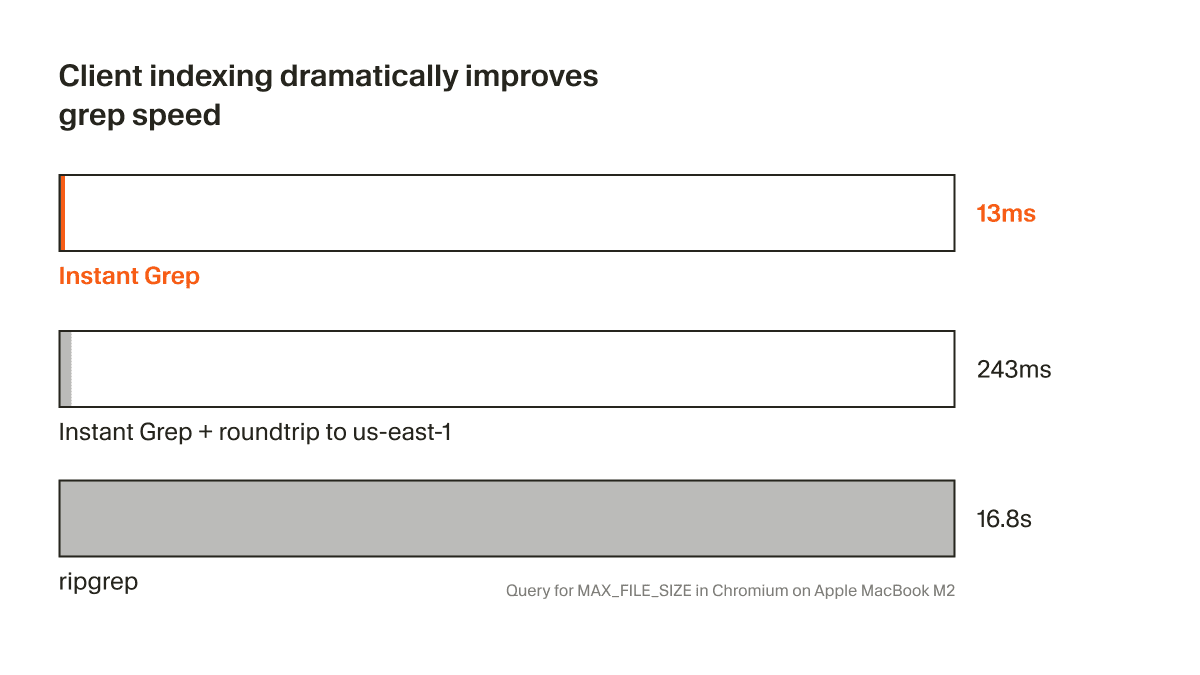
MAX_FILE_SIZE from 16.8s with ripgrep to 13ms locally, or 243ms with a network roundtrip, as shown in the benchmark summary.Cursor's launch thread says Instant Grep is now part of Cursor and lets the editor search across “millions of files” in milliseconds. The company ties that directly to agent performance: faster grep means agents spend less time blocked on code retrieval and more time executing tasks.
The attached technical writeup makes the target use case explicit. Regex search still matters for queries that syntax-aware indexes and LSP-based navigation do not cover well, especially in monorepos where plain ripgrep can take “over 15 seconds” on large projects technical writeup.
The benchmark circulating with the launch uses a Chromium query on an Apple MacBook M2. In that test, the chart shows Instant Grep at 13ms, Instant Grep plus a us-east-1 roundtrip at 243ms, and ripgrep at 16.8s.
Cursor's technical post describes Instant Grep as a local text index built for regex retrieval. The core idea is to precompute an inverted index over character-level fragments, then decompose an incoming regex into pieces that are likely required, fetch only files containing those fragments, and run the real regex engine on that smaller candidate set.
That matters because, as Rohan Paul's summary notes, the system is “not mainly a faster regex matcher” so much as a better candidate finder. The writeup starts from classic trigrams, then moves to sparse n-grams to reduce index noise and size while preserving filtering power technical post.
The harder problem is query decomposition. A quoted excerpt from the post says simple heuristics produce too many candidate documents, while complex heuristics can require loading “dozens — perhaps hundreds” of trigrams, erasing the win. Cursor's answer is a weighted sparse n-gram scheme plus Bloom filters to sharpen lookups before disk reads benchmark summary.
The systems design is as important as the indexing theory. The technical summary says the index stays on the developer's machine for freshness and latency, keyed off a Git commit plus a live-change layer, with posting lists on disk and a compact memory-mapped lookup table. That makes repeated agent searches cheap enough to sit inside the edit-search-edit loop instead of feeling like a remote retrieval step.
Practitioner responses also framed the constraints more broadly than “use a trigram index.” In one reply, Jediah Katz argues the real challenge is balancing disk usage, weak client hardware, extremely large repos, and regexes generated by agents rather than humans. A separate reply from Yacine MTB says similar laptop-local systems can hit “sub 50ms keystroke search” on a large codebase, which reinforces that the differentiator here is productizing that class of index inside an AI-native editor.
If Cursor's benchmark holds up across real monorepos, Instant Grep removes one of the quiet bottlenecks in agentic coding: broad text retrieval that is too fuzzy for symbol search but too frequent to tolerate multi-second scans developer reaction.
Claude can now drive macOS apps, browser tabs, the keyboard, and the mouse from Claude Cowork and Claude Code, with permission prompts when it needs direct screen access. That makes legacy desktop workflows automatable, and Anthropic is pairing the push with more background-task support for longer agent loops.
 release
OpenClaw shipped version 2026.3.22 with ClawHub, OpenShell plus SSH sandboxes, side-question flows, and more search and model options, then followed with a 2026.3.23 patch. Teams get a broader plugin surface, but should patch quickly and review plugin trust boundaries as the ecosystem grows.
 breaking
ChatGPT now saves uploaded and generated files into an account-level Library that can be reused across conversations from the web sidebar or recent-files picker. It removes repetitive re-uploading and makes past PDFs, spreadsheets, and images part of a persistent working context.
 breaking
Epoch AI says GPT-5.4 Pro elicited a publishable solution to one 2019 conjecture in its FrontierMath Open Problems set, with a formal writeup planned. Treat it as an early milestone worth reproducing, not blanket evidence that frontier models can already automate math research.
 breaking
Claude can now drive macOS apps, browser tabs, the keyboard, and the mouse from Claude Cowork and Claude Code, with permission prompts when it needs direct screen access. That makes legacy desktop workflows automatable, and Anthropic is pairing the push with more background-task support for longer agent loops.
Cursor can now search millions of files and find results in milliseconds. This dramatically speeds up how fast agents complete tasks. We're sharing how we built Instant Grep, including the algorithms and tradeoffs behind the design.

Learn more: cursor.com/blog/fast-rege…
Sounds like you didn't understand the entire post (skill issue?). Trigrams was just the baby example.

Cursor now uses Instant Grep to instantly search across codebases and it helps execute agentic coding tasks significantly faster.


Learn more: cursor.com/blog/fast-rege…
I am a mere ant compared to the author (vmg was an early github eng and developed these techniques for their code search). But as I understand, the additional constraints are: - users might be running toasters, and they also don't like it when we take up all their disk space for Show more