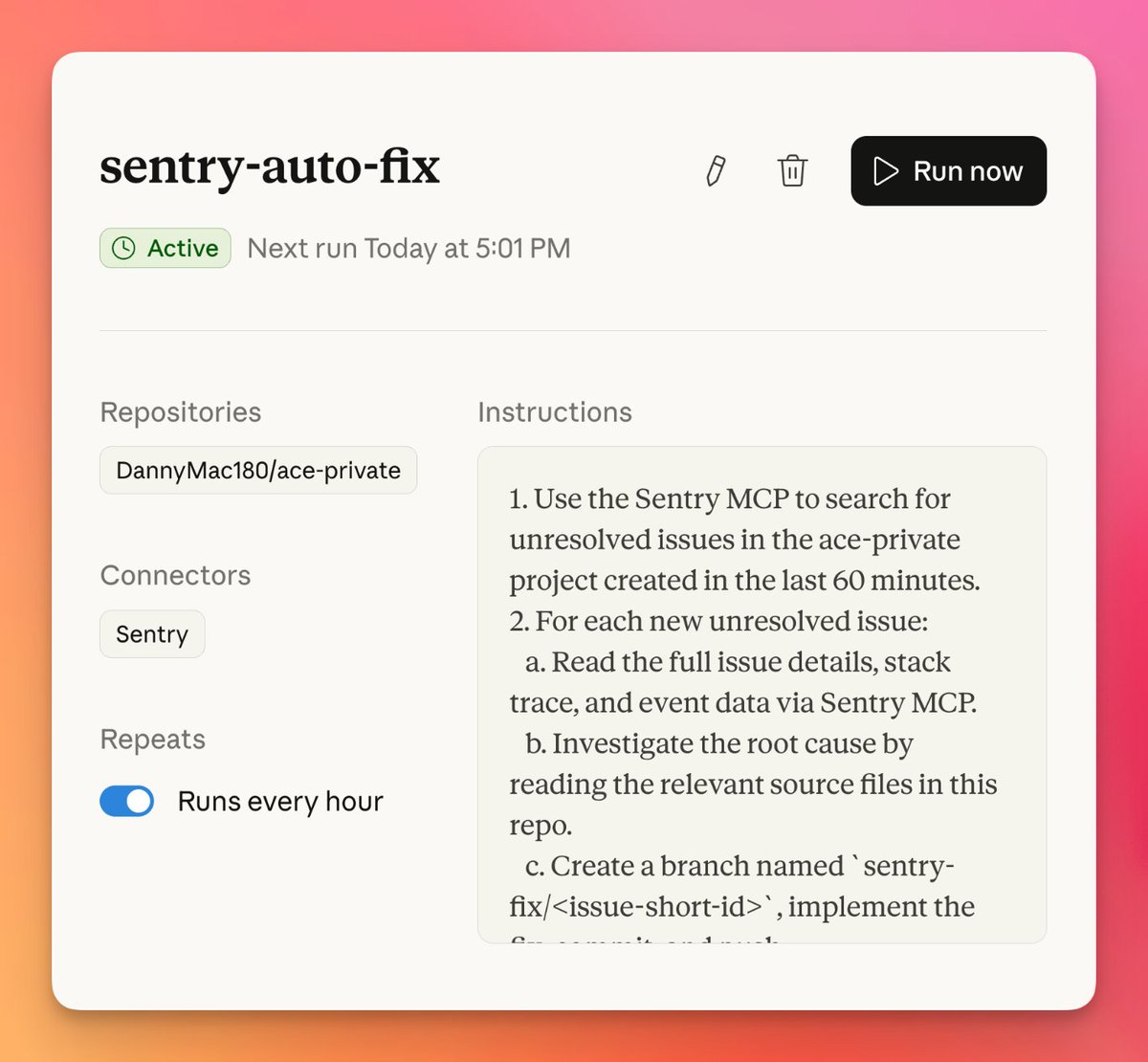
Hankweave shipped budget controls that cap spend, tokens, and elapsed time globally or per step, including loop budgets and shared pools. Use them to prototype or productionize long agent runs without hand-managing model switches and failure states.
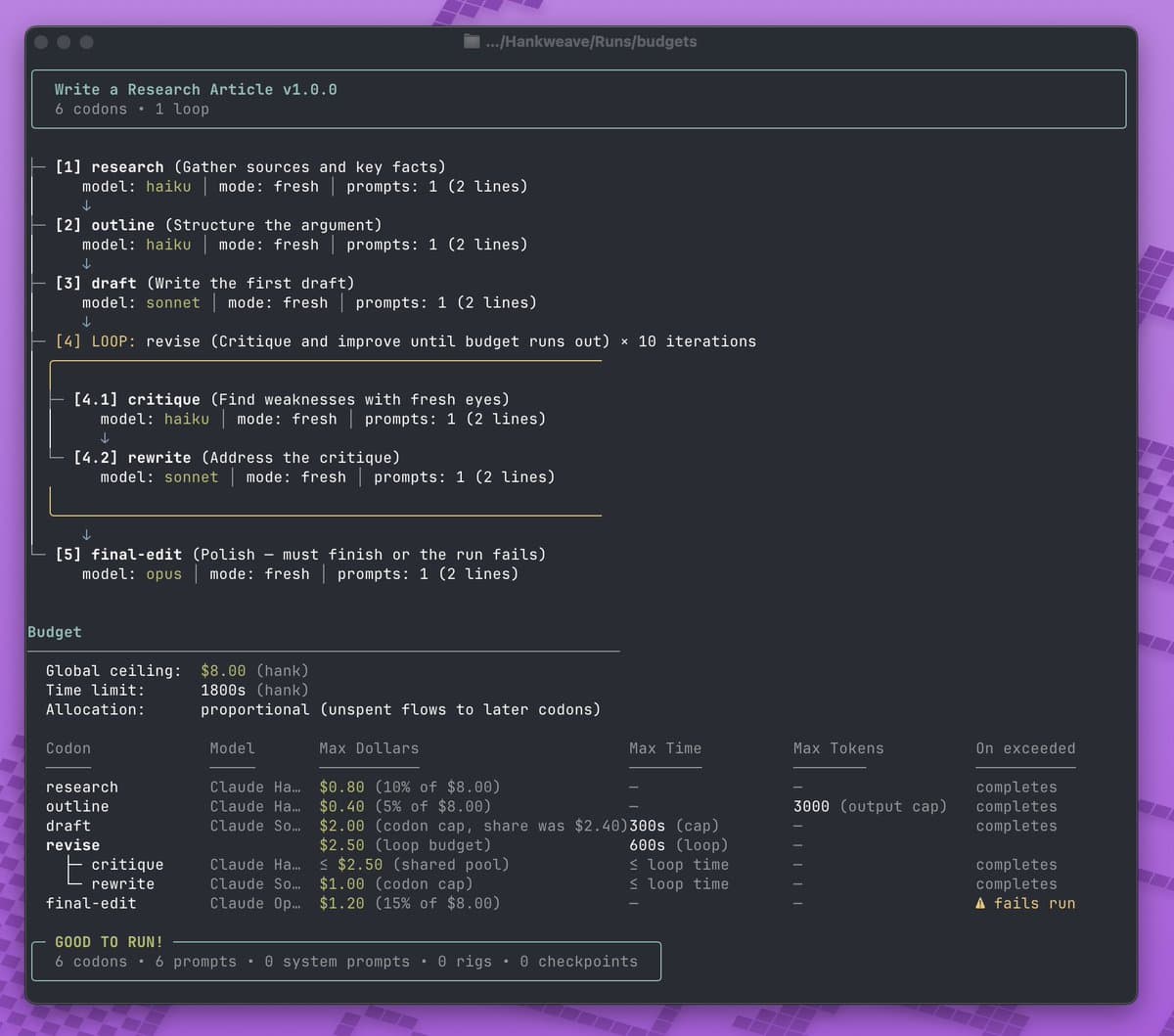
-m haiku --max-cost 0.50, while Hankweave handles model switches and cost management under the hood, per the launch thread.Hankweave added budget controls for long agentic runs across “the 3 primary costs involved in AI — time, dollars and tokens,” in the words of the launch thread. The new controls work at both runtime and build time: runtime users can set hard ceilings like “Don’t spend more than $100” or “Don’t take longer than 15 hours or 750K tokens,” while workflow authors can express per-step constraints inside the pipeline itself.
The technical payload is more than a global max. According to the follow-up thread, builders can give one step “20% of the budget,” loop steps until a dollar threshold is reached, reserve money for a later must-complete step, and “distribute token costs from a shared pool” across related steps. The budgets docs position this as a way to encode execution policy directly into the run graph rather than hand-tuning each model invocation.
The runtime computes budgets before execution. As the follow-up thread puts it, “the preflight check calculates the budget and shared pool for each codon ahead of time,” then warns if constraints are inconsistent or if “a hank is going to fail because of a conflict.” That matters for long multi-step jobs where a late-stage failure can waste both tokens and wall-clock time.
The screenshots in the launch thread and the follow-up thread show the allocation model in more detail: a global ceiling and time limit, proportional allocation where “unspent flows to later codons,” loop-level budgets, per-step token caps, and explicit failure behavior on overrun. In one example, a final-edit step on Opus is marked “must finish or the run fails,” while earlier research and revision steps are allowed to complete within shared or capped pools. That makes the feature useful for both cheap proof-of-concept runs and production pipelines with critical terminal steps.
MiniMax introduced a flat-rate Token Plan that covers text, speech, music, video, and image APIs under one subscription. It gives teams one predictable bill across modalities and can be used in third-party harnesses, not just MiniMax apps.
 release
OpenClaw shipped version 2026.3.22 with ClawHub, OpenShell plus SSH sandboxes, side-question flows, and more search and model options, then followed with a 2026.3.23 patch. Teams get a broader plugin surface, but should patch quickly and review plugin trust boundaries as the ecosystem grows.
 release
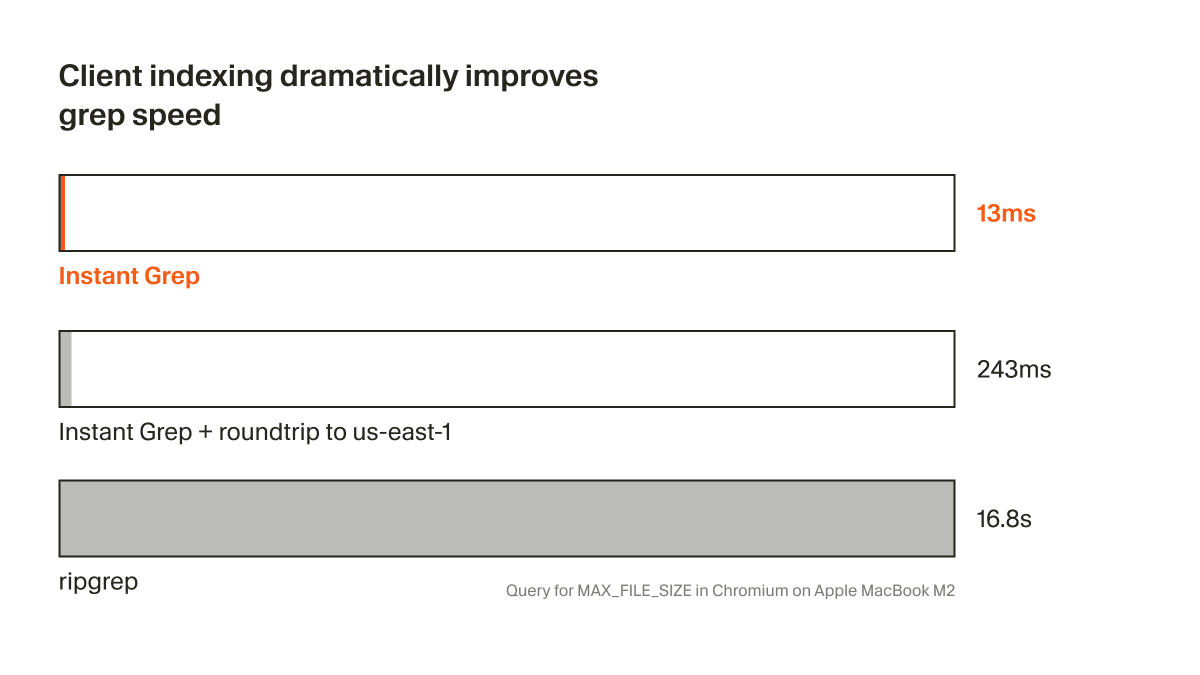
Cursor shipped Instant Grep, a local regex index built from n-grams, inverted indexes, and Bloom filters that drops large-repo searches from seconds to milliseconds. Faster candidate retrieval shortens the coding-agent loop, especially when ripgrep-style scans become the bottleneck.
 breaking
ChatGPT now saves uploaded and generated files into an account-level Library that can be reused across conversations from the web sidebar or recent-files picker. It removes repetitive re-uploading and makes past PDFs, spreadsheets, and images part of a persistent working context.
 breaking
Epoch AI says GPT-5.4 Pro elicited a publishable solution to one 2019 conjecture in its FrontierMath Open Problems set, with a formal writeup planned. Treat it as an early milestone worth reproducing, not blanket evidence that frontier models can already automate math research.
When we set out to build large agentic data systems, we were sure we needed three things: 1. Some way to manage extremely long agentic runs. This became hankweave. 2. Some abstraction so that we could modify, debug and improve the prompts, code and context engineering for Show more

My personal most awaited feature in Hankweave is out: budgets! With budgets, users at runtime can say • Don't spend more than $100 • Don't take longer than 15 hours or 750K tokens With budgets, builders at build-time can say • Give this step 20% of the budget • Loop steps 1 Show more