OpenAI shipped GPT-5.4 mini to ChatGPT, Codex, and the API, and GPT-5.4 nano to the API, with 400K context, lower prices, and stronger coding and computer-use scores. Route subagents and high-volume tasks to the smaller tiers to cut spend without giving up much capability.
OpenAI's launch thread and the matching developer post split the release cleanly: GPT-5.4 mini is live in ChatGPT, Codex, and the API, while GPT-5.4 nano is available in the API only. The product positioning is also explicit. Mini is the “strongest mini model yet” for coding, computer use, multimodal understanding, and subagents; nano is the smallest and cheapest GPT-5.4 variant for lighter workloads.
The API shape matters as much as the launch list. According to OpenAI's availability post, GPT-5.4 mini gets a 400k context window, and the model card shown in the Playground screenshot lists 128k max output tokens. Community screenshots for nano show the same 400k context and 128k output ceiling nano specs. A release-note roundup from btibor91's summary also says ChatGPT routes mini differently by plan: Free and Go users reach it through “Thinking,” while higher tiers get it as a fallback for GPT-5.4 Thinking.
The token prices are straightforward. OpenAI's release details, echoed in the release summary, put GPT-5.4 mini at $0.75 input and $4.50 output per 1M tokens, and GPT-5.4 nano at $0.20 input and $1.25 output. A comparison screenshot in the pricing chart shows why this matters operationally: full GPT-5.4 is $2.50 input and $15 output, so mini lands at roughly one-third the flagship price and nano at roughly one-tenth.
Codex usage is the more interesting lever for engineering teams. OpenAI says in its Codex note that GPT-5.4 mini uses only 30% of GPT-5.4 quota, which makes simpler coding tasks cost “about one-third” as much in bundled usage terms. That lines up with practitioner framing from dkundel's post, which calls mini “excellent for spinning up new subagents” and says it yields “~3.3x more usage” on Codex tasks. Nano, by contrast, drops some agent-facing features: the summary thread says it supports compaction but not tool search or built-in computer use.
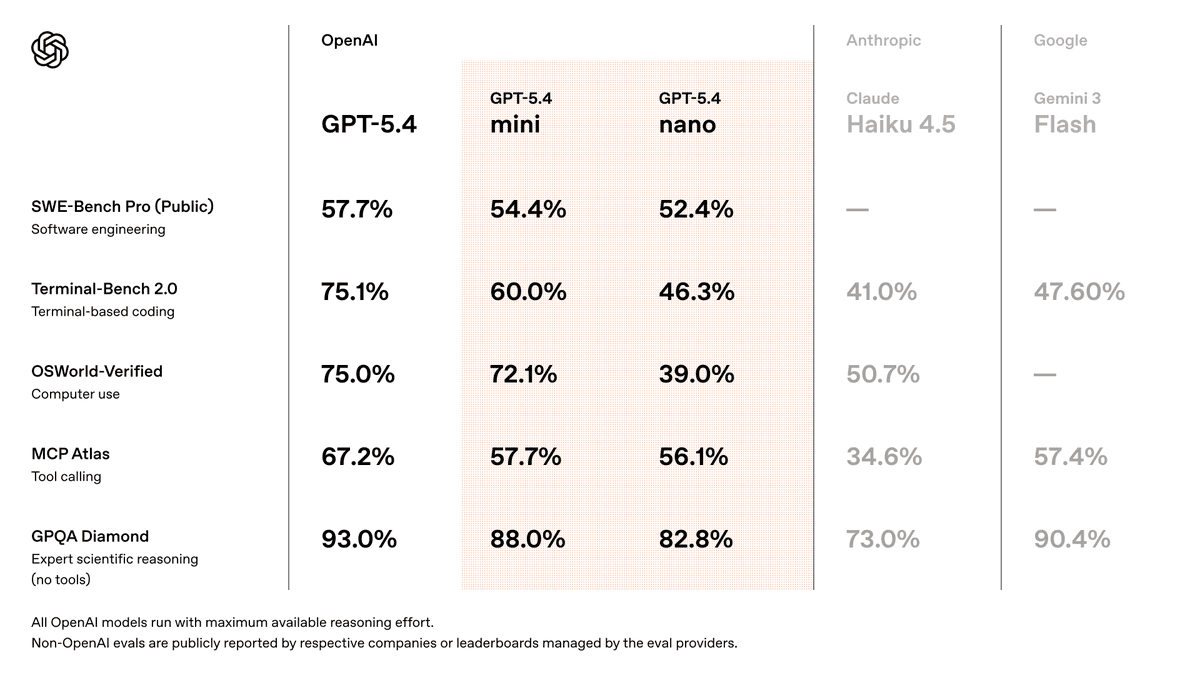
OpenAI is pitching mini as a near-flagship small model rather than a cheap fallback. In the benchmark post, the company says GPT-5.4 mini “approaches the performance” of full GPT-5.4 on SWE-Bench Pro and OSWorld-Verified. The benchmark table in
backs that up: SWE-Bench Pro is 54.4% for mini versus 57.7% for GPT-5.4, and OSWorld-Verified is 72.1% versus 75.0%.
The same table shows mini materially ahead of other small-model references on some agentic tasks, including 60.0% on Terminal-Bench 2.0 versus 41.0% for Claude Haiku 4.5 and 57.7% on MCP Atlas versus 57.4% for Gemini 3 Flash OpenAI benchmark table. Third-party evals point in the same direction, if with caveats. ValsAI's ranking places GPT-5.4 mini at “equivalent performance to GPT-5,” and their methodology note says most runs used temperature xhigh, with Terminal Bench 2 using high reasoning. OpenAI also appears to expose that higher reasoning tier on the new small models: a model screenshot says mini and nano now support an “xhigh compute setting.”
The release is already flowing into aggregation and gateway layers. Vercel says in its rollout post that both models are on AI Gateway now, with direct identifiers for openai/gpt-5.4-mini and openai/gpt-5.4-nano, and frames them as built for “sub-agent workflows.” That is useful for teams standardizing model routing behind a single provider abstraction.
OpenRouter has also listed both models, and its early-testing note says mini's speedup was useful for “staying in the loop for coding agents” and improved UX for chat apps that let models perform agent tasks mid-conversation. Between the native API launch, Codex quota discounting, and immediate gateway support, the practical release story is less about adding two more SKUs and more about giving agent systems a cheaper routing tier with long context and credible coding benchmarks.
Epoch AI says GPT-5.4 Pro elicited a publishable solution to one 2019 conjecture in its FrontierMath Open Problems set, with a formal writeup planned. Treat it as an early milestone worth reproducing, not blanket evidence that frontier models can already automate math research.
 release
OpenClaw shipped version 2026.3.22 with ClawHub, OpenShell plus SSH sandboxes, side-question flows, and more search and model options, then followed with a 2026.3.23 patch. Teams get a broader plugin surface, but should patch quickly and review plugin trust boundaries as the ecosystem grows.
 release
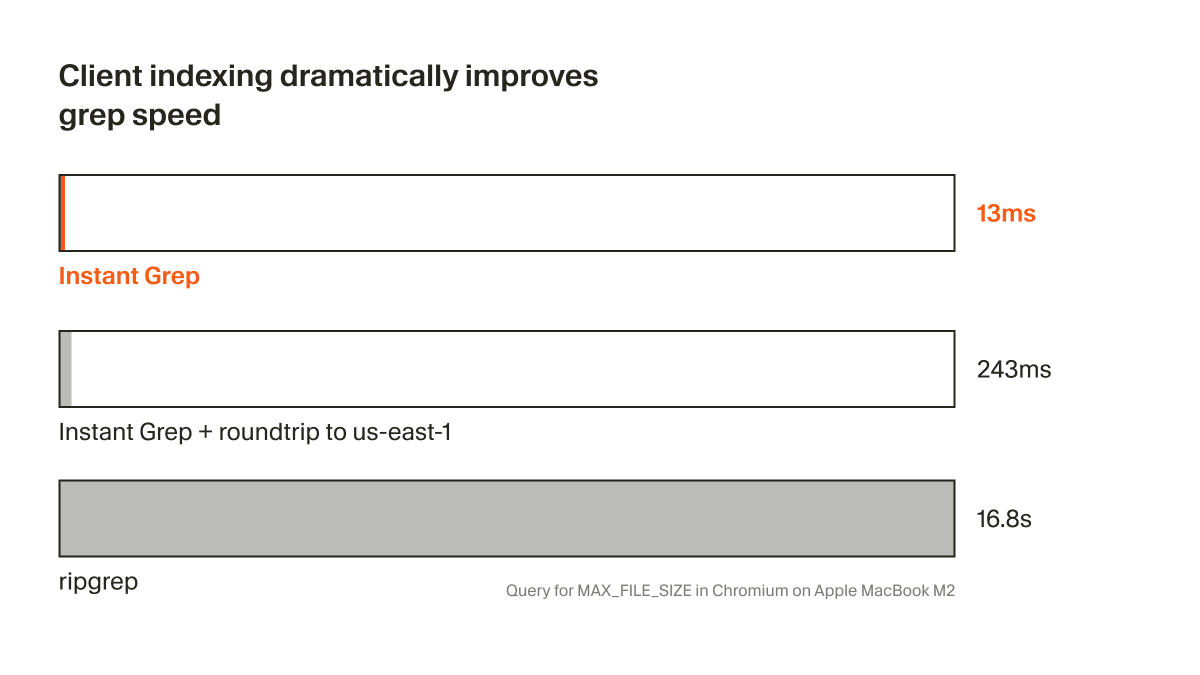
Cursor shipped Instant Grep, a local regex index built from n-grams, inverted indexes, and Bloom filters that drops large-repo searches from seconds to milliseconds. Faster candidate retrieval shortens the coding-agent loop, especially when ripgrep-style scans become the bottleneck.
 breaking
ChatGPT now saves uploaded and generated files into an account-level Library that can be reused across conversations from the web sidebar or recent-files picker. It removes repetitive re-uploading and makes past PDFs, spreadsheets, and images part of a persistent working context.
 breaking
Epoch AI says GPT-5.4 Pro elicited a publishable solution to one 2019 conjecture in its FrontierMath Open Problems set, with a formal writeup planned. Treat it as an early milestone worth reproducing, not blanket evidence that frontier models can already automate math research.
GPT-5.4 mini is available today in ChatGPT, Codex, and the API. Optimized for coding, computer use, multimodal understanding, and subagents. And it’s 2x faster than GPT-5 mini. openai.com/index/introduc…

GPT-5.4 mini is available today in the API, Codex, and ChatGPT. In the API, it has a 400k context window. In Codex, it uses only 30% of the GPT-5.4 quota, letting you handle simpler coding tasks for about one-third of the cost. GPT-5.4 nano is only available in the API.
GPT 5.4 Mini comes in at #13 on the Vals Index - equivalent performance to GPT 5 🚀

OpenAI released GPT-5.4 mini and GPT-5.4 nano, simplified the ChatGPT model selector and the retry menu, and sunsetted the "Nerdy" base style - GPT-5.4 mini improves over GPT-5 mini across coding, reasoning, multimodal understanding and tool use, runs over 2x faster, supports Show more


GPT-5.4 mini approaches the performance of the larger GPT-5.4 model on several evaluations, including SWE-Bench Pro and OSWorld-Verified.

GPT-5.4 mini is available today in ChatGPT, Codex, and the API. Optimized for coding, computer use, multimodal understanding, and subagents. And it’s 2x faster than GPT-5 mini. openai.com/index/introduc…
Use Mini now: openrouter.ai/openai/gpt-5.4…
GPT-5.4 Mini uses only 30% of the GPT-5.4 quota for Codex x.com/OpenAIDevs/sta…


GPT-5.4 mini is available today in the API, Codex, and ChatGPT. In the API, it has a 400k context window. In Codex, it uses only 30% of the GPT-5.4 quota, letting you handle simpler coding tasks for about one-third of the cost. GPT-5.4 nano is only available in the API.
GPT-5.4 Mini and Nano just landed on Vercel AI Gateway, with fast state-of the-art coding and computer use for the size. Built for sub-agent workflows, try it now with 𝚖𝚘𝚍𝚎𝚕: '𝚘𝚙𝚎𝚗𝚊𝚒/𝚐𝚙𝚝-𝟻.𝟺-𝚖𝚒𝚗𝚒' or '𝚘𝚙𝚎𝚗𝚊𝚒/𝚐𝚙𝚝-𝟻.𝟺-𝚗𝚊𝚗𝚘'.
GPT-5.4 mini is available today in ChatGPT, Codex, and the API. Optimized for coding, computer use, multimodal understanding, and subagents. And it’s 2x faster than GPT-5 mini. openai.com/index/introduc…


