OpenClaw-RL released a fully asynchronous online training stack that turns live interaction feedback into ongoing agent updates with binary rewards and token-level OPD corrections. Use it as a starting point for online agent improvement only if you can score rollouts reliably and manage privacy risk.
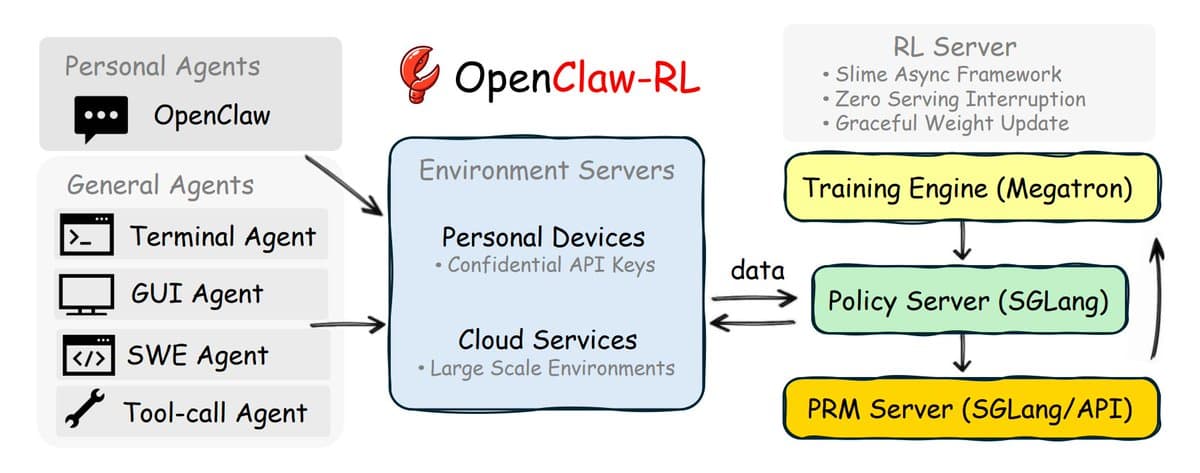
OpenClaw-RL is out as both a research paper and a public codebase, with the paper and the GitHub repo linked directly from the release post. The project frames itself as a fully asynchronous reinforcement-learning system for live agents, rather than an offline RL recipe that waits for a batch of trajectories before updating.
The headline claim from the announcement thread is that the agent can "improve just by being used." That is a stronger claim than standard posthoc fine-tuning because the training signal comes from ordinary interaction flow: the model acts, the environment responds, and that response becomes training data. In the repo summary attached to the GitHub card, the system is described as intercepting live multi-turn conversations through an OpenAI-compatible API and optimizing in the background without interrupting ongoing use.
The technical novelty is not just online RL, but what the system extracts from the next state. In the signal breakdown, the next state carries both "evaluative signals" and "directive signals": one can be collapsed into reward, while the other tells the model what it should have done differently. The method summary says those become two learning paths: binary RL for simple good/bad credit assignment, and OPD for token-level corrections.
The OPD path is the more implementation-relevant detail. As the OPD explanation describes it, the system pulls a correction hint from the next-state feedback, appends that hint to the prompt, reruns the model to obtain a hint-aware teacher distribution, and then uses the difference from the original output as a token-level training signal. That gives denser supervision than a single trajectory reward. Combined with the four decoupled components in the architecture post—policy serving, environment collection, PRM judging, and policy training—the design lets judging and updates happen while the model is still serving new requests.
The paper's scope is broader than chatbot personalization. The applicability post explicitly lists chat assistants, coding agents, terminal agents, GUI agents, SWE agents, and tool-call agents, arguing that any setup that produces a meaningful next state can feed the same loop. That matters for engineering teams because it treats environment reactions, tool outputs, and user corrections as one training interface instead of separate pipelines.
The operational promise is low-overhead continuous learning. The async description says the system can serve one request while a previous response is being judged and a trainer applies updates simultaneously, so "no part of the system blocks another." The repo summary in the GitHub card adds two practical constraints behind that promise: OpenClaw-RL assumes you can run judges and trainers on your own infrastructure, and it leans on self-hosting for privacy and data security because the training loop is built from live user interaction data.
OpenClaw's maintainer asked users to switch to the dev channel and stress normal workflows before a large release that may break plugins. Watch harness speed, context plugins, and permission boundaries closely while the SDK refactor lands.
 release
OpenClaw shipped version 2026.3.22 with ClawHub, OpenShell plus SSH sandboxes, side-question flows, and more search and model options, then followed with a 2026.3.23 patch. Teams get a broader plugin surface, but should patch quickly and review plugin trust boundaries as the ecosystem grows.
 release
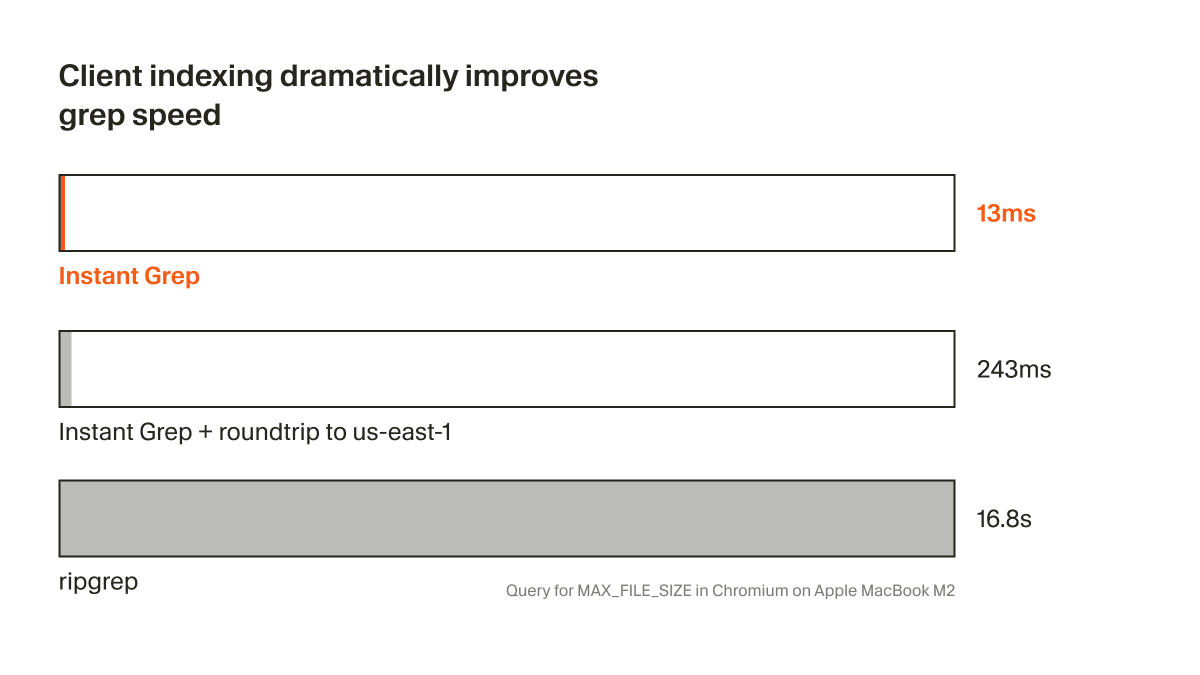
Cursor shipped Instant Grep, a local regex index built from n-grams, inverted indexes, and Bloom filters that drops large-repo searches from seconds to milliseconds. Faster candidate retrieval shortens the coding-agent loop, especially when ripgrep-style scans become the bottleneck.
 breaking
ChatGPT now saves uploaded and generated files into an account-level Library that can be reused across conversations from the web sidebar or recent-files picker. It removes repetitive re-uploading and makes past PDFs, spreadsheets, and images part of a persistent working context.
 breaking
Epoch AI says GPT-5.4 Pro elicited a publishable solution to one 2019 conjecture in its FrontierMath Open Problems set, with a formal writeup planned. Treat it as an early milestone worth reproducing, not blanket evidence that frontier models can already automate math research.
A very interesting paper from @Princeton They propose OpenClaw-RL, a system where the AI improves just by being used. An agent learns directly from its own interactions. It is a way to finally use the full information contained in the next state – the agent and environment Show more

7. The same framework can train agents in many environments, such as • chat assistants • coding agents • terminal agents • GUI agents • SWE agents • tool-call agents Since all of these produce next-state signals, they can be used for training.
2. OpenClaw-RL is built around 4 components, that run in parallel: - Policy serving: the agent serves real users - Environment: interactions are collected - PRM Judge evaluates them - Policy training: updates the model continuously with RL
6. How OPD works It extracts a correction hint from the next-state feedback, adds it to the prompt, and runs the model again to get a hint-aware teacher distribution. The difference between this and the original output gives a token-level training signal showing which tokens Show more
3. Technically these elements run as asynchronous loops enabling continuous online learning. For example: • The model can serve a new user request • While the previous response is being judged • And training updates are happening simultaneously No part of the system blocks Show more