The White House published a national AI legislative framework covering minors, infrastructure permitting, copyright, and federal preemption. Engineers building for regulated or public-sector environments should watch how these proposals shape deployment constraints.
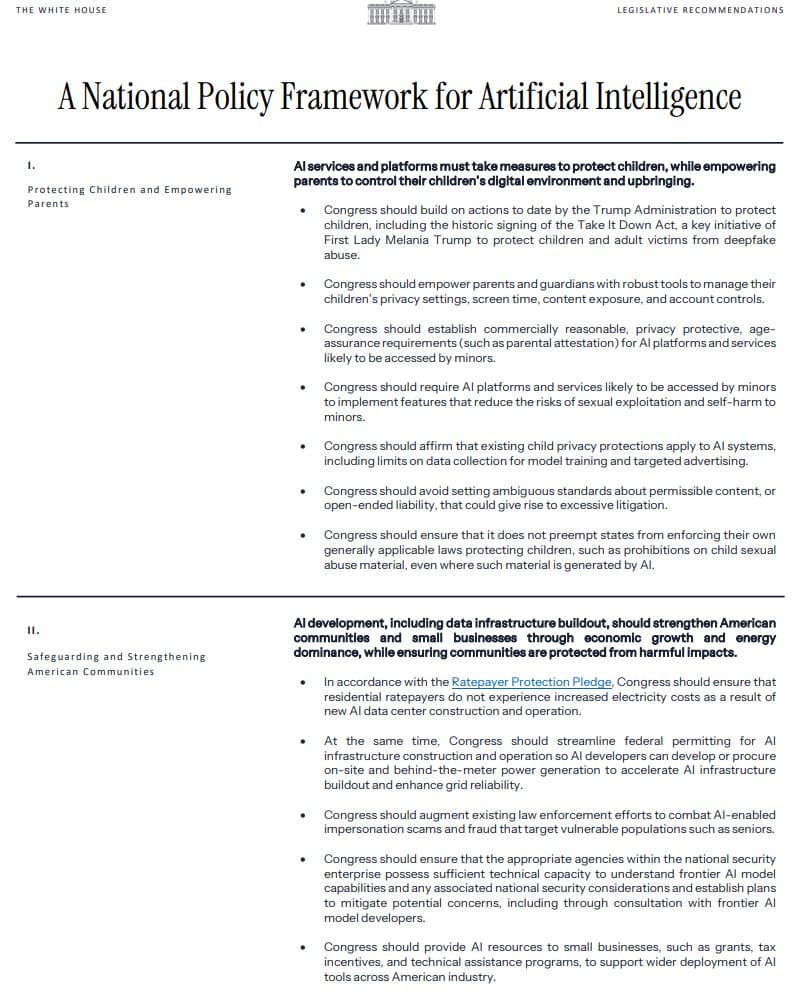
The White House's legislative recommendations frame AI policy around federal preemption: one national ruleset for AI, with states still retaining control over zoning, police powers, and their own procurement decisions. For engineers shipping across multiple jurisdictions, that is the biggest structural signal in the thread summary: the administration is arguing against a state-by-state compliance model.
The same package bundles several deployment-facing requirements. According to the document post, Congress is being urged to require parental control tools, age checks, and minor-safety features on AI platforms; speed federal approval for AI infrastructure; and establish federal rules against unauthorized AI replicas of a person's voice or face. The copyright piece is narrower than a new statute on training data: the summary thread says the framework would let courts continue deciding whether training on copyrighted works is legal.
This is still a legislative framework, not an enacted rulebook, but it points to where future implementation constraints may land. Teams building consumer AI products should watch the child-safety and identity-replica provisions, because those map directly to account flows, content safeguards, and model outputs. The infrastructure language also matters for operators: the policy thread says the White House wants faster approval for data-center and power buildouts while ensuring ordinary ratepayers do not absorb the cost.
The governance approach is also notable. Rather than proposing a new federal AI agency, the document post says the framework would rely on existing expert agencies and create "safe testing zones" for new technology. That combination suggests a compliance environment shaped less by one new AI-specific regulator and more by sector regulators, procurement rules, and court decisions.
LangSmith Fleet introduces shared agents with edit and run permissions, agent identity, human approvals, and tracing. That matters because enterprise agent rollout is shifting from single-user demos to governed, auditable deployment surfaces.
 release
OpenClaw shipped version 2026.3.22 with ClawHub, OpenShell plus SSH sandboxes, side-question flows, and more search and model options, then followed with a 2026.3.23 patch. Teams get a broader plugin surface, but should patch quickly and review plugin trust boundaries as the ecosystem grows.
 release
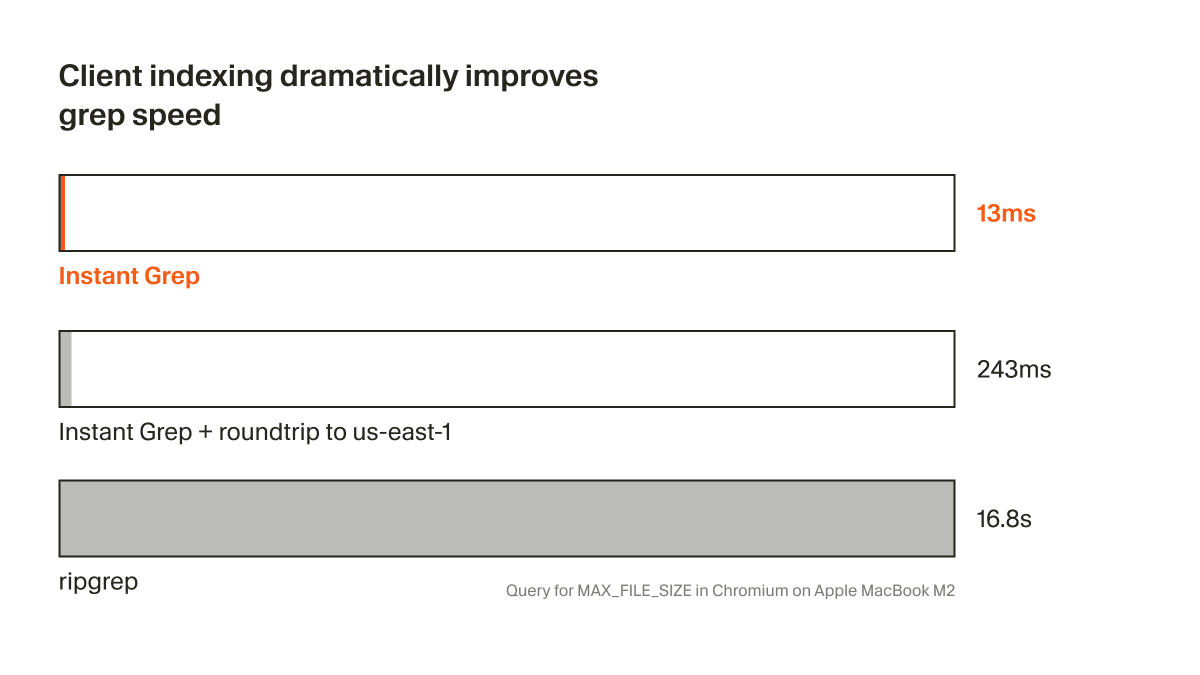
Cursor shipped Instant Grep, a local regex index built from n-grams, inverted indexes, and Bloom filters that drops large-repo searches from seconds to milliseconds. Faster candidate retrieval shortens the coding-agent loop, especially when ripgrep-style scans become the bottleneck.
 breaking
ChatGPT now saves uploaded and generated files into an account-level Library that can be reused across conversations from the web sidebar or recent-files picker. It removes repetitive re-uploading and makes past PDFs, spreadsheets, and images part of a persistent working context.
 breaking
Epoch AI says GPT-5.4 Pro elicited a publishable solution to one 2019 conjecture in its FrontierMath Open Problems set, with a formal writeup planned. Treat it as an early milestone worth reproducing, not blanket evidence that frontier models can already automate math research.
White House released "National Policy Framework for Artificial Intelligence" legislative recommendations. overarching goal is to establish a unified federal AI policy and avoid a fragmented state-by-state regulatory approach. - Require AI platforms to give parents control Show more


Today, the @WhiteHouse released a commonsense National AI Policy Framework that ensures every American benefits from AI. As @POTUS has said — we need one federal AI policy, not a 50 state patchwork. This gets us there. Eager to work with Congress on this important legislation.