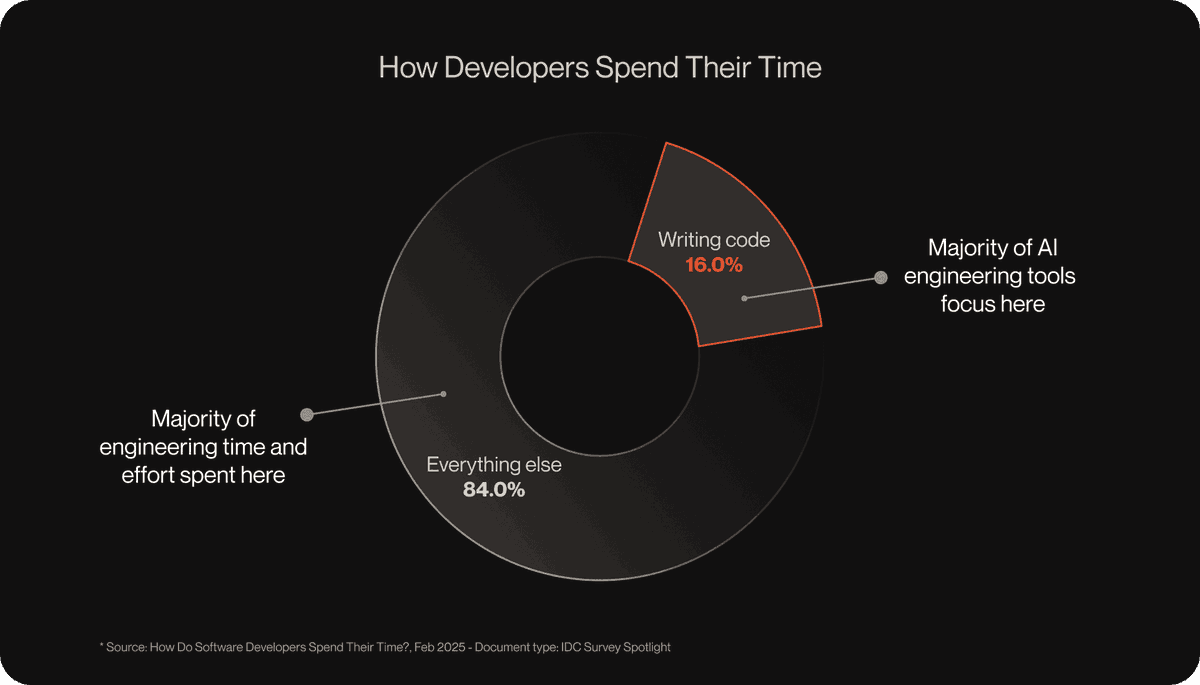
OpenAI rolled out native subagents in Codex so a main agent can spawn specialized parallel threads and return results to one session. Try it for larger code reviews and feature builds where you want to split work without polluting the main context.
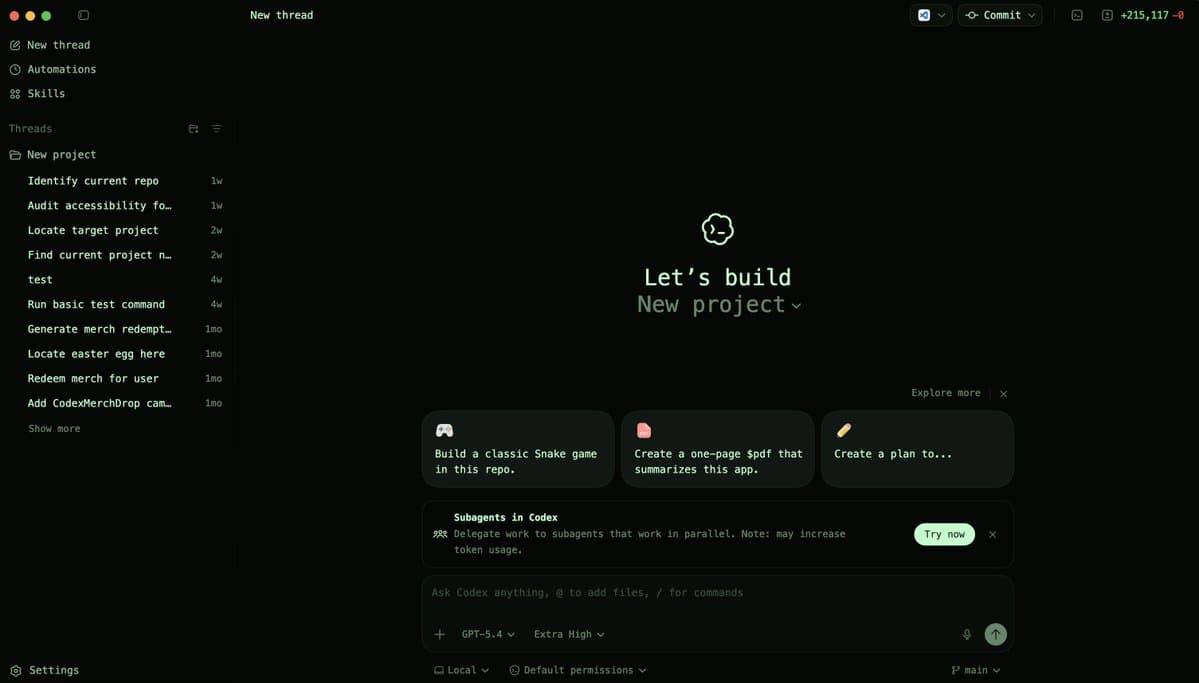
OpenAI added native subagents to Codex in both the app and CLI. In the company’s announcement, the pitch is straightforward: spin up specialized agents to “keep your main context window clean,” handle multiple parts of a task at once, and steer agents independently as work changes. The linked subagents docs position this as a first-class Codex workflow rather than a prompt hack.
The rollout appears broad from day one. OpenAI’s follow-up post says subagents are “available for all developers,” and the product screenshot shows the feature surfaced directly inside the Codex interface with a “Subagents in Codex” prompt and a warning that it “may increase token usage.” That makes the tradeoff explicit: better task decomposition, but potentially higher consumption.
The practical model is an orchestrator-plus-workers pattern. The documentation screenshot says Codex can spawn specialized agents in parallel and then collect their results into one response, which is most useful for “complex tasks that are highly parallel,” including codebase exploration and multi-step feature work. It also says developers can define custom agents with different instructions and model configurations.
A more implementation-focused summary from an early explainer describes each subagent as running in its own isolated thread, with the main agent handling spawning, follow-up routing, and result collection. That separation matters for long sessions: instead of stuffing exploration, implementation, and verification into one context window, Codex can split them across threads and collapse the outputs back into the parent session.
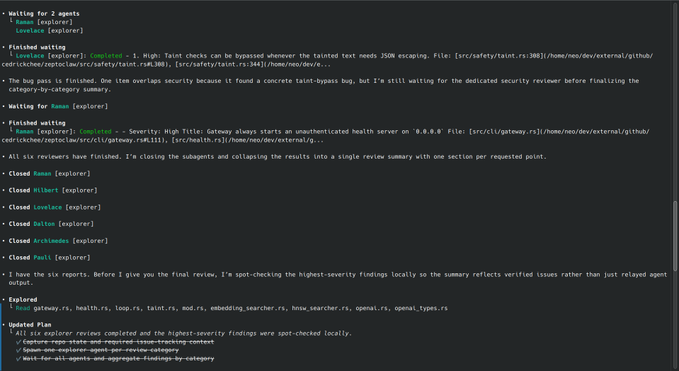
The clearest early workflow is parallel code review. In one CLI example, a user asked Codex to spawn one agent per review category: security, code quality, bugs, race conditions, test flakiness, and maintainability. The terminal output shows Codex starting six explorer agents, waiting for them, closing them, and then “spot-checking the highest-severity findings locally” before producing a final summary.
That example also shows the limits of the environment rather than the agent plan itself. A GitHub CLI call failed with “HTTP 401: Bad credentials,” but the orchestrator still proceeded with repository analysis and summarized the blocked step separately CLI walkthrough. Another early user summary says Codex now “orchestrates agents, spawns subagents, routes follow-ups, awaits results, and closes threads,” which matches the behavior in the terminal logs CLI walkthrough.
OpenAI staff and users are already pointing to broader patterns. One staff post says they’ve seen “awesome new and creative workflows,” while another user note highlights pairing subagents with faster modes like Spark on Pro. The immediate engineering story is less about autonomous coding in one giant run and more about giving Codex a built-in way to decompose parallel work without polluting the main thread.
Claude can now drive macOS apps, browser tabs, the keyboard, and the mouse from Claude Cowork and Claude Code, with permission prompts when it needs direct screen access. That makes legacy desktop workflows automatable, and Anthropic is pairing the push with more background-task support for longer agent loops.
 release
OpenClaw shipped version 2026.3.22 with ClawHub, OpenShell plus SSH sandboxes, side-question flows, and more search and model options, then followed with a 2026.3.23 patch. Teams get a broader plugin surface, but should patch quickly and review plugin trust boundaries as the ecosystem grows.
 release
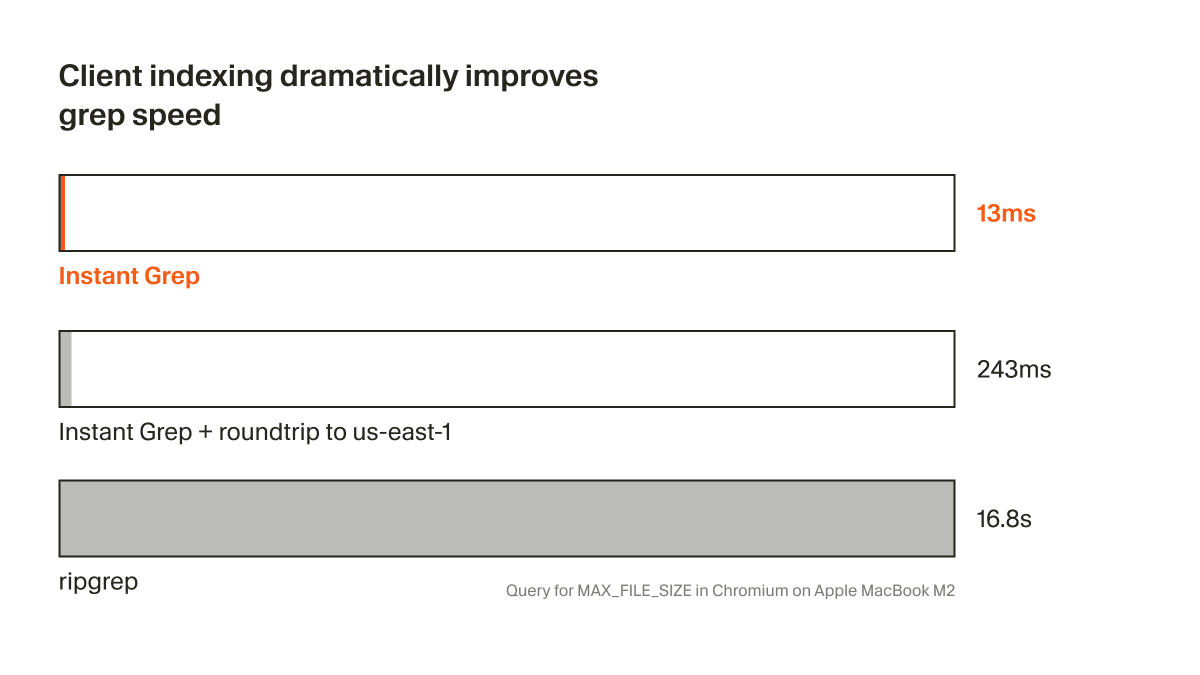
Cursor shipped Instant Grep, a local regex index built from n-grams, inverted indexes, and Bloom filters that drops large-repo searches from seconds to milliseconds. Faster candidate retrieval shortens the coding-agent loop, especially when ripgrep-style scans become the bottleneck.
 breaking
ChatGPT now saves uploaded and generated files into an account-level Library that can be reused across conversations from the web sidebar or recent-files picker. It removes repetitive re-uploading and makes past PDFs, spreadsheets, and images part of a persistent working context.
 breaking
Epoch AI says GPT-5.4 Pro elicited a publishable solution to one 2019 conjecture in its FrontierMath Open Problems set, with a formal writeup planned. Treat it as an early milestone worth reproducing, not blanket evidence that frontier models can already automate math research.
Hello subagents in codex. Have seen some awesome new and creative workflows emerge from these developers.openai.com/codex/subagent…
Subagents are now available in Codex. You can accelerate your workflow by spinning up specialized agents to: • Keep your main context window clean • Tackle different parts of a task in parallel • Steer individual agents as work unfolds
Codex can now spawn multiple subagents to explore complex tasks in parallel. New subagents are available on desktop apps and CLI across all plans. Spawn them 👀


Subagents are now available in Codex. You can accelerate your workflow by spinning up specialized agents to: • Keep your main context window clean • Tackle different parts of a task in parallel • Steer individual agents as work unfolds


Subagents are now available in Codex. You can accelerate your workflow by spinning up specialized agents to: • Keep your main context window clean • Tackle different parts of a task in parallel • Steer individual agents as work unfolds
Subagents are now available in Codex. You can accelerate your workflow by spinning up specialized agents to: • Keep your main context window clean • Tackle different parts of a task in parallel • Steer individual agents as work unfolds
developers.openai.com/codex/subagents Codex 🤝 Subagents