Nous Research released a self-evolution package for Hermes Agent that uses DSPy and GEPA to optimize skills, prompts, and code, and reported a phase-one score increase from 0.408 to 0.569 on one skill. Agent teams can study the repo for fallback model, memory, and self-improvement loop patterns.
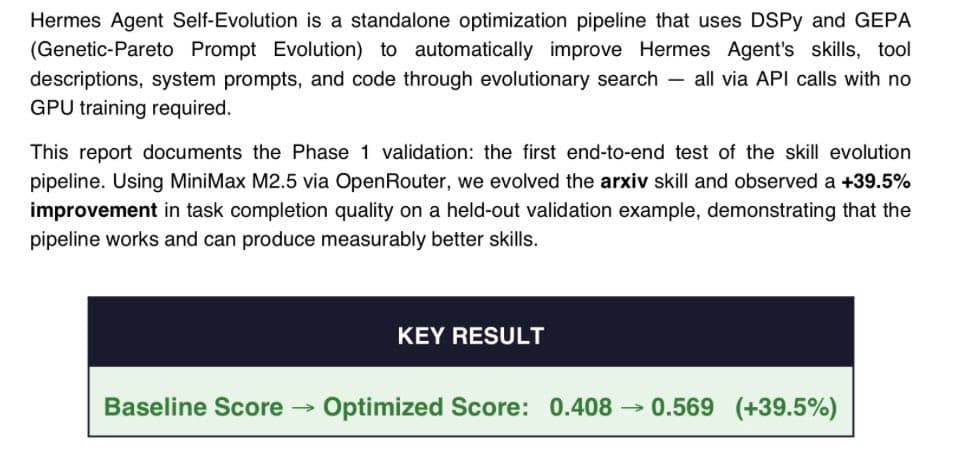
hermes-agent-self-evolution, a Hermes Agent package that uses DSPy and GEPA to optimize the agent’s own skills, prompts, and code through an evolutionary loop rather than GPU retraining, according to the launch thread and Teknium’s repo post.The core release is hermes-agent-self-evolution, which Nous describes as “an evolutionary self-improvement system” for Hermes Agent. In the main announcement, the team says it uses DSPy plus GEPA to optimize “skills, prompts, and code,” maintains populations of solutions, and applies “LLM-driven mutations” aimed at specific failures rather than doing standard model finetuning.
The strongest concrete evidence so far is the phase-one validation result. The results screenshot says the pipeline runs “via API calls without GPU training” and reports a baseline-to-optimized jump from 0.408 to 0.569 on the arXiv skill, labeled as “+39.5%.” Teknium’s linked validation report is the source document for that early measurement, but the public evidence here is still narrow: one skill, one phase, and one reported score delta.
That still makes the release interesting for engineers because the target of optimization is not just prompt text. Nous says the loop can rewrite the agent’s “skills, descriptions, prompts, and code” results screenshot, which pushes it closer to a self-editing agent framework than a prompt tuner.
Hermes’ weekend release bundled several runtime features that make the self-improvement story more relevant to production agents. In the launch thread, Nous says Hermes now supports automatic provider failover when a primary model is rate-limited or down, with fallback switching across providers including Codex OAuth and Nous Portal. The same post also says tool outputs now redact “API keys, tokens, and passwords” across 22-plus patterns before they ever reach model context.
Those surrounding changes matter because self-modifying or self-optimizing agents are only useful if the runtime is resilient. Nous also says Hermes now runs across Signal, iMessage, Telegram, Discord, WhatsApp, Slack, and CLI with “full feature parity” the launch thread, while Teknium adds that the agent supports “locally running models” and can run locally local-run note. Together, that gives engineers a concrete set of patterns to inspect: local execution, fallback routing, memory across sessions, and a search loop that tries to improve an agent’s own components over time.
Agent Flywheel lays out a planning-first workflow built on beads, agent mail, swarms, and TUI inspection for very large coding runs. It is useful because the guide exposes coordination primitives and review loops, not just benchmark screenshots.
 release
OpenClaw shipped version 2026.3.22 with ClawHub, OpenShell plus SSH sandboxes, side-question flows, and more search and model options, then followed with a 2026.3.23 patch. Teams get a broader plugin surface, but should patch quickly and review plugin trust boundaries as the ecosystem grows.
 release
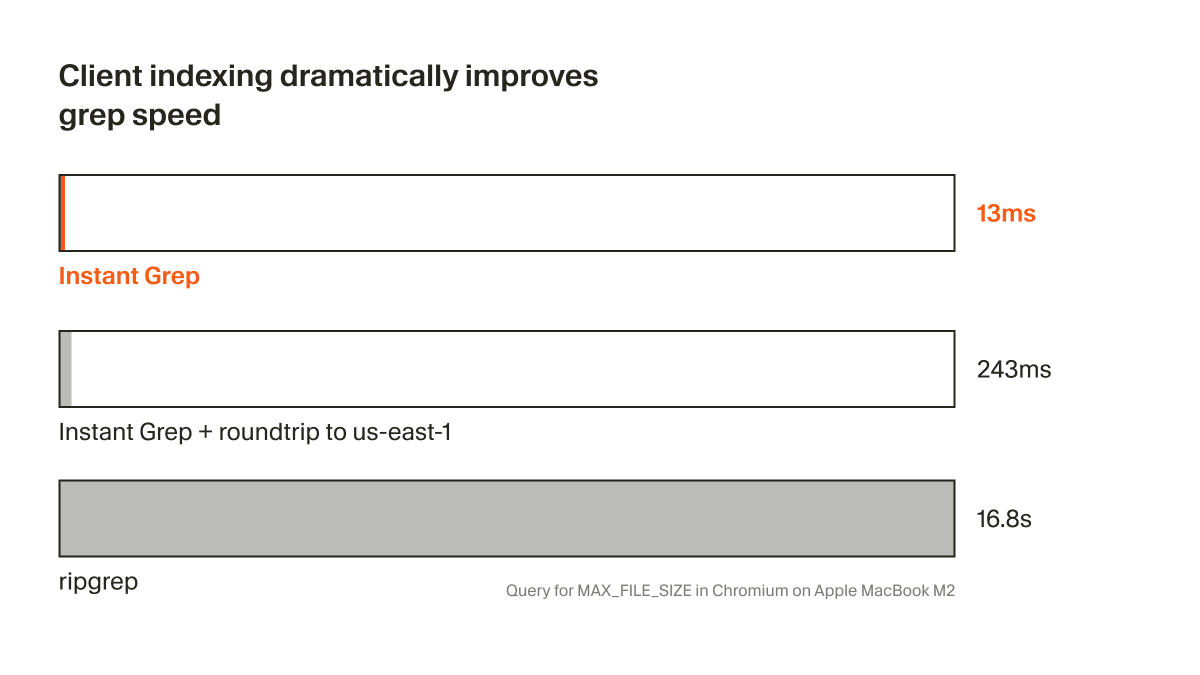
Cursor shipped Instant Grep, a local regex index built from n-grams, inverted indexes, and Bloom filters that drops large-repo searches from seconds to milliseconds. Faster candidate retrieval shortens the coding-agent loop, especially when ripgrep-style scans become the bottleneck.
 breaking
ChatGPT now saves uploaded and generated files into an account-level Library that can be reused across conversations from the web sidebar or recent-files picker. It removes repetitive re-uploading and makes past PDFs, spreadsheets, and images part of a persistent working context.
 breaking
Epoch AI says GPT-5.4 Pro elicited a publishable solution to one 2019 conjecture in its FrontierMath Open Problems set, with a formal writeup planned. Treat it as an early milestone worth reproducing, not blanket evidence that frontier models can already automate math research.
The last few days have been wild. Here's what we've shipped over the weekend. But first, we're giving away free Nous Portal subscriptions to the first 250 people who claim code AGENTHERMES01 at portal.nousresearch.com - and there's a lot of exciting new stuff to use it on: -> Show more
Hermes agent supports locally running models, running the agent locally, and gets shit done! Enjoy!

> “Does T3 Code support local models?” No. T3 Code is a serious developer tool. Locally runnable models are not capable of meaningful engineering work.
Nothing to see here.. not a @lateinteraction and others inspired self improving agent codebase or early report on hermes-agent using GEPA autonomously to improve itself.. nothin at all github.com/NousResearch/h…