OpenAI told MIT Technology Review it wants an autonomous research intern by September and a multi-agent research lab by 2028, with Codex described as an early step. Treat it as a roadmap for longer-horizon agents, not a shipped capability.
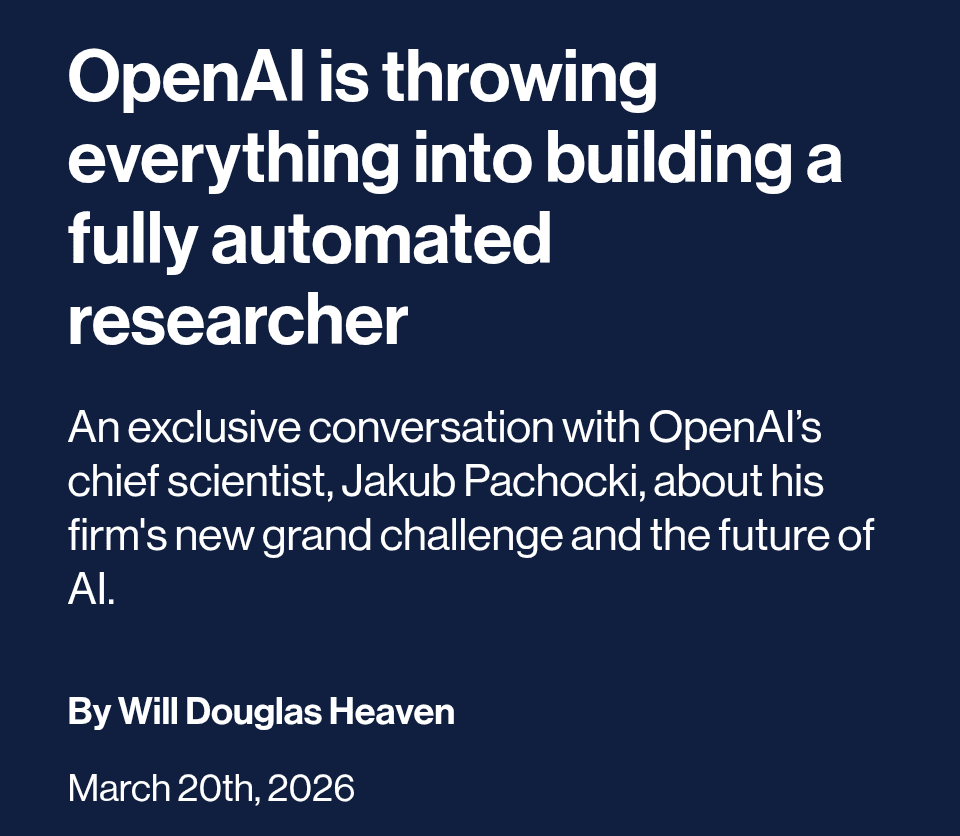
OpenAI told MIT Technology Review, via Pachocki, that building an AI researcher is now its “North Star” and that the first milestone is an “autonomous AI research intern” by September 2026 MIT article. The highlighted excerpt says that intern should take on “a small number of specific research problems” by itself, not run an end-to-end lab.
The longer target is more ambitious. OpenAI describes a 2028 “fully automated multi-agent research system” able to tackle problems “too large or complex for humans to cope with,” with humans still setting goals and the system doing the sustained work inside a data center MIT report. In the same reporting, Pachocki says he sees Codex as an early version of this trajectory, which ties the vision to agentic coding systems that already exist rather than to a newly announced standalone platform article link.
The scope is wider than automated AI research. In the interview summary, Pachocki says “in theory” the system could be aimed at any problem formulated in “text, code or whiteboard scribbles,” including math, physics, biology, chemistry, and “even business and policy dilemmas.” He also says OpenAI is getting close to models that can work “indefinitely in a coherent way,” which is the clearest technical clue about the kind of longer-horizon execution the company is optimizing for.
For engineers, the useful read is that OpenAI is explicitly converging three threads it has discussed separately: reasoning models, agent systems, and interpretability highlighted excerpt. The timeline screenshot also reinforces that OpenAI is treating the “AI intern” as a precursor milestone, so the near-term implementation signal is continued investment in coding and task agents like Codex, not evidence that a reliable autonomous research stack is already deployable.
The timeline is specific, but the capability boundaries are still thinly defined. OpenAI’s public description talks about problems that take “a few days” for a person and about a “small number” of tasks, which leaves open questions around failure recovery, tool use, evaluation, and how much human oversight is required in practice timeline screenshot highlighted excerpt.
That uncertainty is why this lands more as a roadmap than a shipping event. Even supportive summaries describe today’s agents as showing “dramatic productivity gains” while still facing “reliability and safety challenges,” which is consistent with Codex being framed as an early step rather than proof that OpenAI has already built the research intern it is targeting timeline screenshot.
Agent Flywheel lays out a planning-first workflow built on beads, agent mail, swarms, and TUI inspection for very large coding runs. It is useful because the guide exposes coordination primitives and review loops, not just benchmark screenshots.
 release
OpenClaw shipped version 2026.3.22 with ClawHub, OpenShell plus SSH sandboxes, side-question flows, and more search and model options, then followed with a 2026.3.23 patch. Teams get a broader plugin surface, but should patch quickly and review plugin trust boundaries as the ecosystem grows.
 release
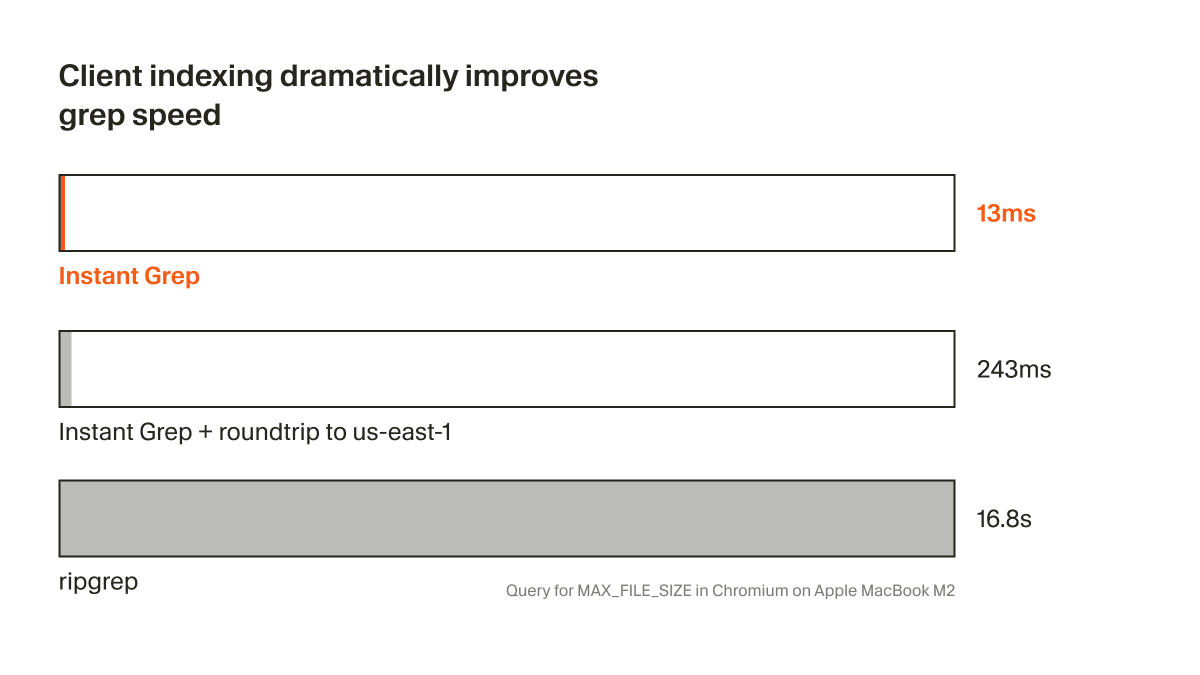
Cursor shipped Instant Grep, a local regex index built from n-grams, inverted indexes, and Bloom filters that drops large-repo searches from seconds to milliseconds. Faster candidate retrieval shortens the coding-agent loop, especially when ripgrep-style scans become the bottleneck.
 breaking
ChatGPT now saves uploaded and generated files into an account-level Library that can be reused across conversations from the web sidebar or recent-files picker. It removes repetitive re-uploading and makes past PDFs, spreadsheets, and images part of a persistent working context.
 breaking
Epoch AI says GPT-5.4 Pro elicited a publishable solution to one 2019 conjecture in its FrontierMath Open Problems set, with a formal writeup planned. Treat it as an early milestone worth reproducing, not blanket evidence that frontier models can already automate math research.
New interview with Jakub Pachocki in the MIT Technology Review: - The automated AI researcher (planned for 2028) is described as a "multi-agent" system, and will be able to "tackle problems that are too large or complex for humans to cope with". This is a clear indication that Show more

An exclusive conversation with OpenAI’s chief scientist Jakub Pachocki about his firm's new grand challenge and the future of AI. trib.al/2Lr8Kfh
OpenAI's first “AI intern” expected by September and a full system targeted for 2028. Powered by advances in reasoning models and agent systems like Codex, these tools already show dramatic productivity gains, solving problems in days instead of weeks, but still face Show more

OpenAI is building a fully automated AI researcher as its new north-star goal, planning an autonomous research intern by September 2026 that can handle tasks taking a human several days. Chief scientist Jakub Pachocki told MIT Technology Review he sees the recently released Show more