Manus moved from a cloud sandbox onto local machines with My Computer, a desktop app that can organize files, run commands, and build apps on macOS and Windows. Use it if you want agent workflows over private local data and hardware instead of a remote browser sandbox.
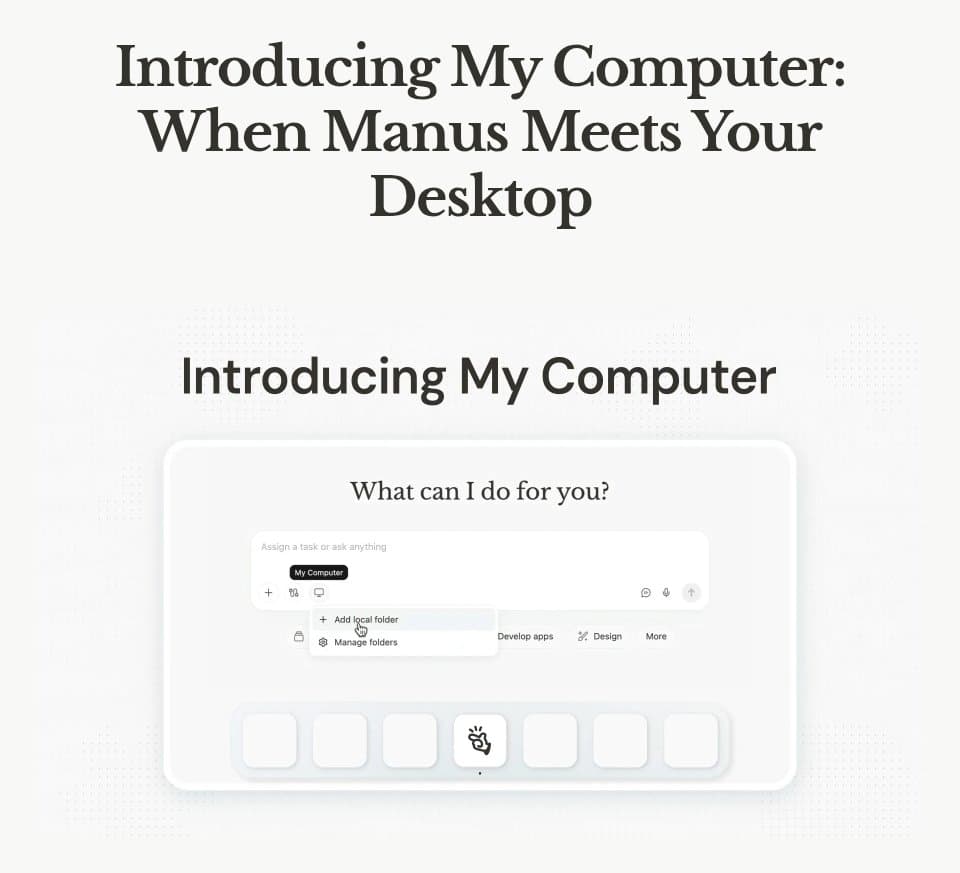
Manus says My Computer is “the core feature” of its new desktop app and is available now for all macOS and Windows users Launch thread. The company frames it as taking Manus “out of the cloud” and putting it “on your local machine,” with access to “every resource on your computer.”
The product pitch is less about chat and more about desktop execution. In the announcement, Manus lists organizing large photo libraries, bulk-renaming invoices, building Swift desktop apps with “no code written manually,” and combining local execution with existing connectors for automated workflows. The companion desktop app demo shows the My Computer interface labeled “Your local AI agent” and “Available Now.”
Manus also ties the desktop agent to its existing automation concepts. The same thread says users can create “local routines” with Projects, Agents, and Scheduled Tasks, which suggests this is not just ad hoc remote control but a way to run recurring workflows against local state.
The strongest implementation detail in the evidence is that Manus is driving the local machine through command execution. In Wes Roth's demo thread, the video shows manus --help, a directory listing command, and a compile step for a C++ file, backing the claim that the agent can work through a local CLI rather than only through GUI automation.
Security controls appear to be explicit but granular. According to the launch summary, My Computer requires user approval for each command, and the demo thread says folder access and per-command execution both require authorization. That matters for engineers evaluating whether the desktop agent is a fully delegated local runtime or a supervised execution layer over a local shell.
The launch messaging also points to hybrid execution rather than a purely offline agent. That same summary describes “cloud-based AI” executing terminal commands on local machines, while Manus's announcement emphasizes combining local resources with existing connectors. In practice, that reads like remote reasoning plus local actuation, with private files and idle hardware staying on the user’s machine.
This release fits a clear product pattern: more agent systems are moving from remote sandboxes into local operating systems. Cedric Chee's reaction grouped Manus with Claude Code, Cowork, OpenClaw, and Codex and argued they are converging on the idea that “the agent lives on your machine.”
For engineers, the differentiator is not just that Manus can click around locally, but that it appears to bridge local execution with service integrations. The
shows cards for Manus API, Zapier, Slack, Telegram, and WhatsApp Business, matching the launch thread's claim that My Computer can be combined with existing connectors for “seamless automated workflows.” That makes the release look less like a standalone desktop assistant and more like a local execution endpoint for broader agent pipelines.
The operational upside is straightforward in the launch framing: tasks involving private files, native builds, and always-on local hardware no longer need to be staged through a browser sandbox. The demo thread explicitly points to using idle local hardware such as an always-on Mac mini, while Manus's own examples center on file operations and local app generation.
Agent Computer launched cloud desktops that boot in under half a second and expose persistent disks, shared credentials, SSH access, and ACP control for agents. It gives coding agents a faster place to run tools and reuse auth, but teams still need to design safe session and credential boundaries.
 release
OpenClaw shipped version 2026.3.22 with ClawHub, OpenShell plus SSH sandboxes, side-question flows, and more search and model options, then followed with a 2026.3.23 patch. Teams get a broader plugin surface, but should patch quickly and review plugin trust boundaries as the ecosystem grows.
 release
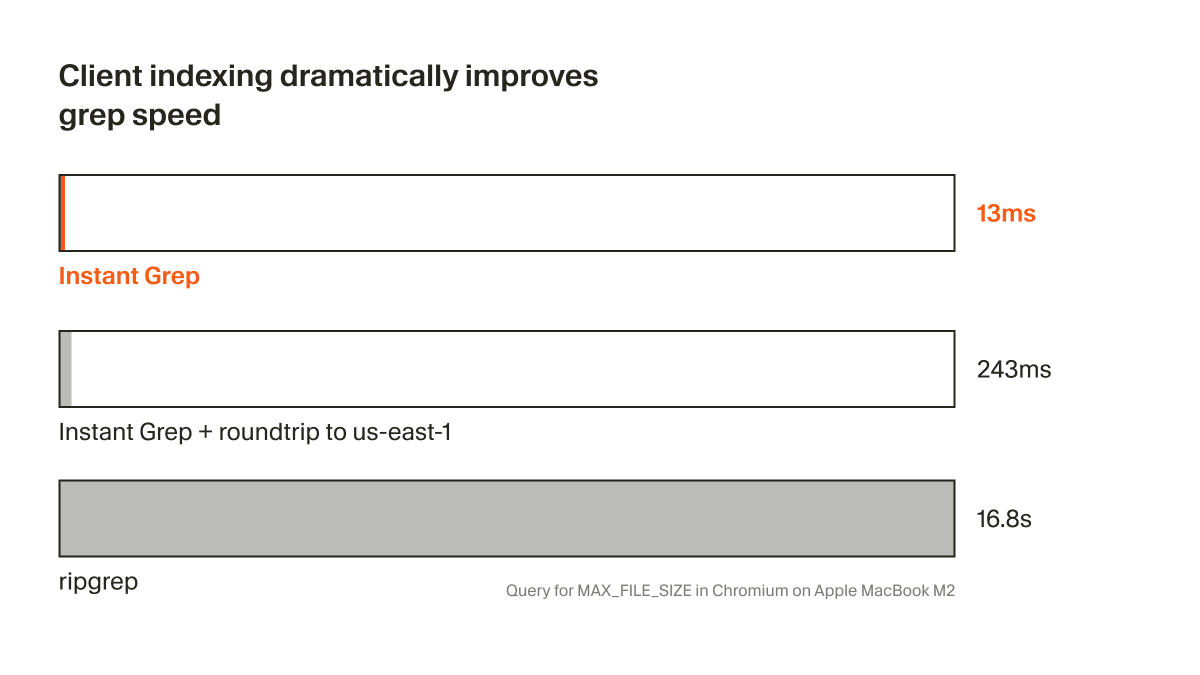
Cursor shipped Instant Grep, a local regex index built from n-grams, inverted indexes, and Bloom filters that drops large-repo searches from seconds to milliseconds. Faster candidate retrieval shortens the coding-agent loop, especially when ripgrep-style scans become the bottleneck.
 breaking
ChatGPT now saves uploaded and generated files into an account-level Library that can be reused across conversations from the web sidebar or recent-files picker. It removes repetitive re-uploading and makes past PDFs, spreadsheets, and images part of a persistent working context.
 breaking
Epoch AI says GPT-5.4 Pro elicited a publishable solution to one 2019 conjecture in its FrontierMath Open Problems set, with a formal writeup planned. Treat it as an early milestone worth reproducing, not blanket evidence that frontier models can already automate math research.
BREAKING 🚨: Manus AI released "My Computer", a new desktop app that operates as a local AI agent. My Computer is available today for all macOS and Windows users.

My Computer in action: 👉Organizing thousands of unsorted photos 👉Renaming hundreds of invoices 👉Build desktop apps in swift, entirely on your computer. No code written manually. 👉Combine with existing Connectors to create seamless automated workflows. 👉Create local
My Computer in action: 👉Organizing thousands of unsorted photos 👉Renaming hundreds of invoices 👉Build desktop apps in swift, entirely on your computer. No code written manually. 👉Combine with existing Connectors to create seamless automated workflows. 👉Create local Show more
Manus introduces My Computer in its desktop app, enabling cloud-based AI to execute terminal commands on local macOS and Windows machines for tasks like file organization and app building. Available immediately, it requires user approval for each command and integrates cloud Show more

Today, we're taking Manus out of the cloud and putting it on your desktop. Introducing My Computer, the core feature of the new Manus Desktop app. It’s your AI agent, now on your local machine.
Manus has launched "My Computer," a new desktop application that brings its powerful AI agent out of the cloud sandbox and directly onto local macOS and Windows machines. By utilizing command-line instructions (CLI), Manus can now organize local files, manage applications, and Show more
Today, we're taking Manus out of the cloud and putting it on your desktop. Introducing My Computer, the core feature of the new Manus Desktop app. It’s your AI agent, now on your local machine.
Since Meta acquired Manus for roughly $2 billion in late 2025, the entire industry has been waiting to see how they would weave that heavy-duty agentic reasoning into their consumer ecosystem. We saw Manus hit Telegram last month. Now, Meta plans to integrate Manus AI with Show more


Manus AI is preparing to release a WhatsApp integration for its always-on Agent (WhatsApp Business account required). This feature alone will be a huge upgrade for Meta Glasses, as users will be able to speak to more advanced AI through glasses via WhatsApp. Currently, you are

Manus just launched "My Computer", a desktop app that turns it into a local AI agent for macOS and Windows. Meanwhile Claude Code, Cowork, OpenClaw, Codex, and Manus all seem to be converging on the same idea: the agent lives on your machine. Which path wins?
My Computer in action: 👉Organizing thousands of unsorted photos 👉Renaming hundreds of invoices 👉Build desktop apps in swift, entirely on your computer. No code written manually. 👉Combine with existing Connectors to create seamless automated workflows. 👉Create local