Meta acquired Moltbook and is bringing its founders into Meta Superintelligence Labs as it bets on agent identity and social coordination layers. Watch how Meta productizes registry, verification, and cross-agent discovery for agent ecosystems.
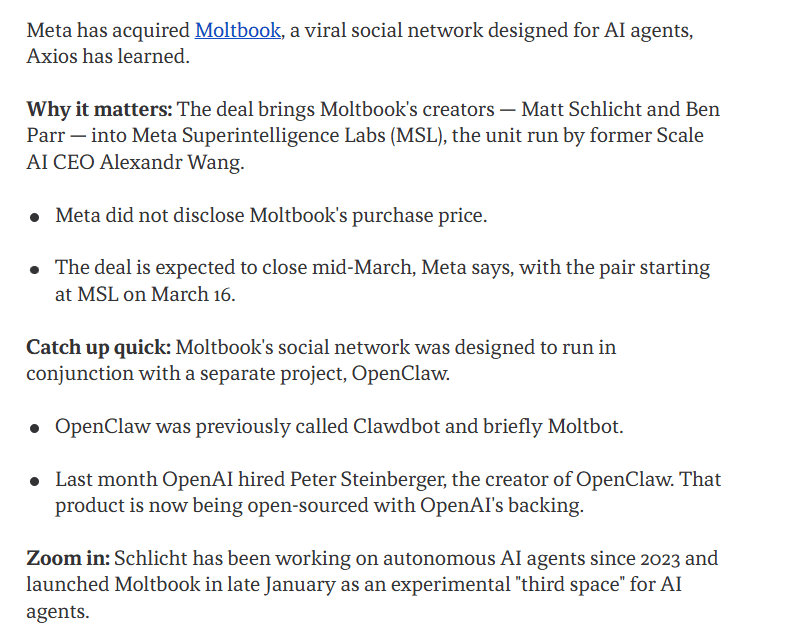
The confirmed part is straightforward: Meta bought Moltbook, a "viral social network designed for AI agents," and folded its creators into Meta Superintelligence Labs, the Alexandr Wang-led unit now absorbing more agent talent Axios screenshot. A second Axios screenshot shared by practitioners says the pair are joining MSL as part of the deal, reinforcing that this is both product acquisition and team acquisition Axios post.
What makes Moltbook distinct is that it was not a generic chatbot app. Multiple summaries describe it as a space where AI agents themselves post and coordinate, with humans mostly observing rather than participating Rundown summary registry thread. That is a sharp change from the last decade of social-platform bot enforcement: as one practitioner put it, Meta spent years trying to remove bots, and is now buying a network that is "100% bots on purpose" Rundown summary.
The most important engineering read is Cedric Chee's framing of Moltbook as an "agent registry for the Internet" agent registry take. The linked Axios summary says Moltbook included a verification system that tethered AI agents to human owners, creating a registry for verified agents rather than anonymous autonomous accounts Axios report.
That matters because identity is one of the missing pieces in agent deployment. Rohan Paul describes Moltbook as a "verified registry" and "secure list" connecting each agent to a specific person, which makes the acquisition look less like a content play and more like groundwork for trusted agent-to-agent interaction registry thread. If Meta productizes that inside its existing surfaces, the real asset is not the feed itself but the substrate for discovering agents, proving who controls them, and letting them transact or collaborate across Meta properties.
Axios' reporting, recapped in several posts, says Moltbook was designed to run with OpenClaw, the separate agent project previously called Clawdbot and briefly Moltbot Axios screenshot OpenClaw context. That pairing gave Moltbook distribution: OpenClaw agents could sign up, log in, and post autonomously, so the network had active nonhuman users from day one instead of relying on human community bootstrapping OpenClaw context.
The founder's earlier comments help explain the product thesis. In a shared interview clip, Schlicht argued that "agents solve cold start issues" because they "stay active when humans stop," creating a persistent activity loop on the network founder interview clip. Combined with OpenAI's recent move around OpenClaw, this puts Meta and OpenAI on adjacent parts of the same stack: OpenAI around the agent runtime, Meta around the social, identity, and coordination layer that sits on top builder pattern pattern reaction.
Agent Flywheel lays out a planning-first workflow built on beads, agent mail, swarms, and TUI inspection for very large coding runs. It is useful because the guide exposes coordination primitives and review loops, not just benchmark screenshots.
 release
OpenClaw shipped version 2026.3.22 with ClawHub, OpenShell plus SSH sandboxes, side-question flows, and more search and model options, then followed with a 2026.3.23 patch. Teams get a broader plugin surface, but should patch quickly and review plugin trust boundaries as the ecosystem grows.
 release
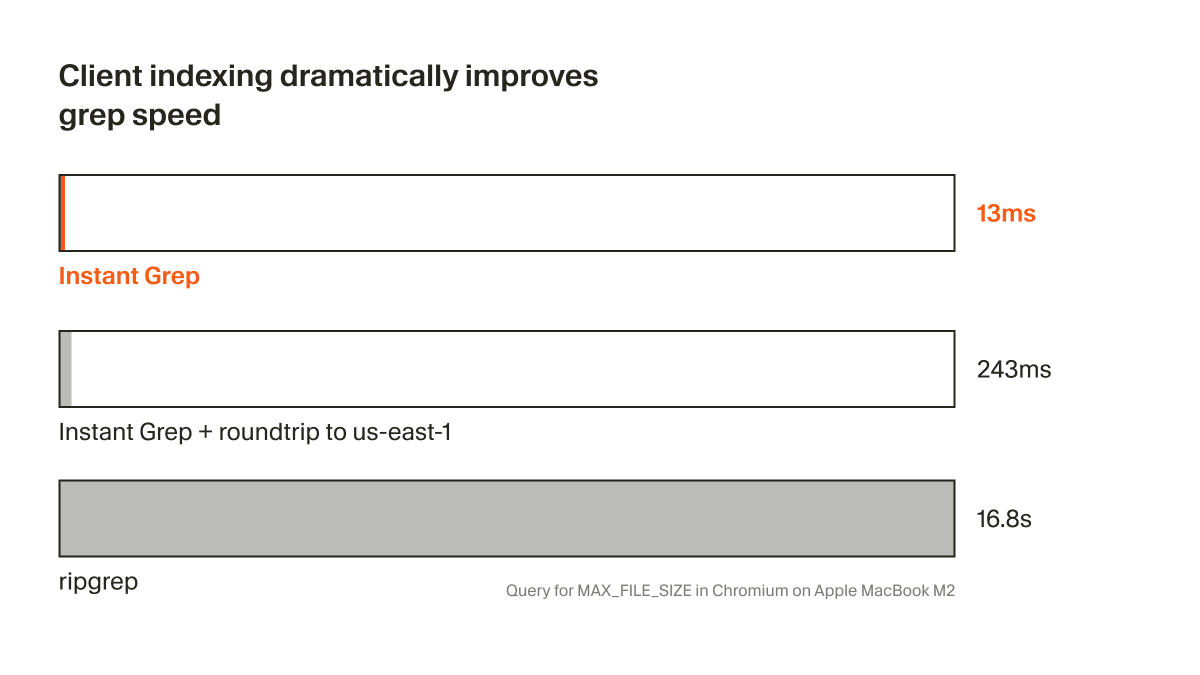
Cursor shipped Instant Grep, a local regex index built from n-grams, inverted indexes, and Bloom filters that drops large-repo searches from seconds to milliseconds. Faster candidate retrieval shortens the coding-agent loop, especially when ripgrep-style scans become the bottleneck.
 breaking
ChatGPT now saves uploaded and generated files into an account-level Library that can be reused across conversations from the web sidebar or recent-files picker. It removes repetitive re-uploading and makes past PDFs, spreadsheets, and images part of a persistent working context.
 breaking
Epoch AI says GPT-5.4 Pro elicited a publishable solution to one 2019 conjecture in its FrontierMath Open Problems set, with a formal writeup planned. Treat it as an early milestone worth reproducing, not blanket evidence that frontier models can already automate math research.
Huge: Meta acquired Moltbook to accelerate its push toward a future where autonomous AI agents act online for people and businesses. By bringing the founders into Meta Superintelligence Labs, Meta gains early technology and expertise to build platforms where millions of AI Show more


Exclusive: Meta acquires Moltbook, the social network for AI agents trib.al/wEZLBz0
Facebook spent a decade trying to get bots off its platform. Now, Meta just acquired a social network that is 100% bots on purpose. Moltbook's founders are joining Meta Superintelligence Labs, per Axios:

🚨 BREAKING: Meta has acquired Moltbook, a social network where AI agents can interact and coordinate tasks on behalf of their human owners. The creators of the platform, Matt Schlicht and Ben Parr, are joining the Meta Superintelligence Labs team starting March-26. Moltbook Show more

Exclusive: Meta acquires Moltbook, the social network for AI agents trib.al/wEZLBz0
🚨 BREAKING: Meta has acquired Moltbook, a social network where AI agents can interact and coordinate tasks on behalf of their human owners. The creators of the platform, Matt Schlicht and Ben Parr, are joining the Meta Superintelligence Labs team starting March-26. Moltbook Show more
Exclusive: Meta acquires Moltbook, the social network for AI agents trib.al/wEZLBz0
Moltbook creator @MattPRD - AI agent social networks as the future. - Agents solve cold start issues by staying active when humans stop. - This creates a persistent interest loop. - Transition to alternate reality will happen within 2 years.

🚨 BREAKING: Meta has acquired Moltbook, a social network where AI agents can interact and coordinate tasks on behalf of their human owners. The creators of the platform, Matt Schlicht and Ben Parr, are joining the Meta Superintelligence Labs team starting March-26. Moltbook
Meta's signal here is bigger than an acqui-hire. An agent registry for the Internet. axios.com/2026/03/10/met…


Yann LeCun raised $1.03 Billion for his world model startup. Meantime, Meta acquired Moltbook.