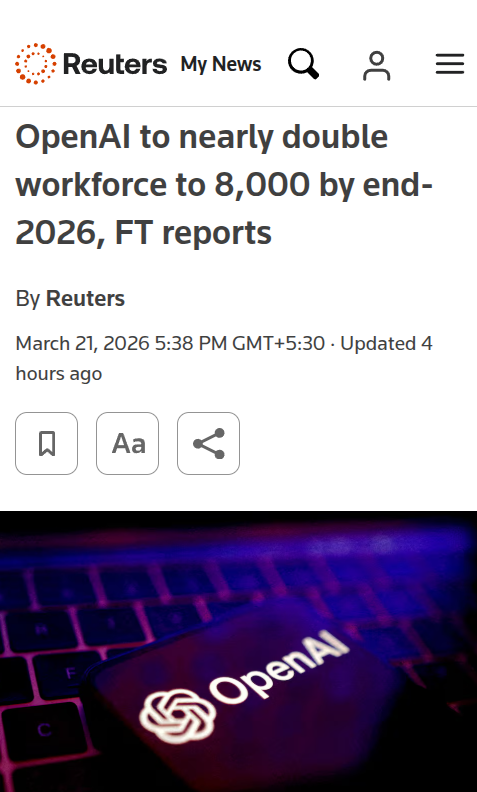
Reuters and The Wall Street Journal separately reported that OpenAI is lining up private-equity-backed distribution partners while narrowing its strategy around coding and business productivity. Watch the channel strategy if you sell into enterprises, where distribution may matter as much as model quality.
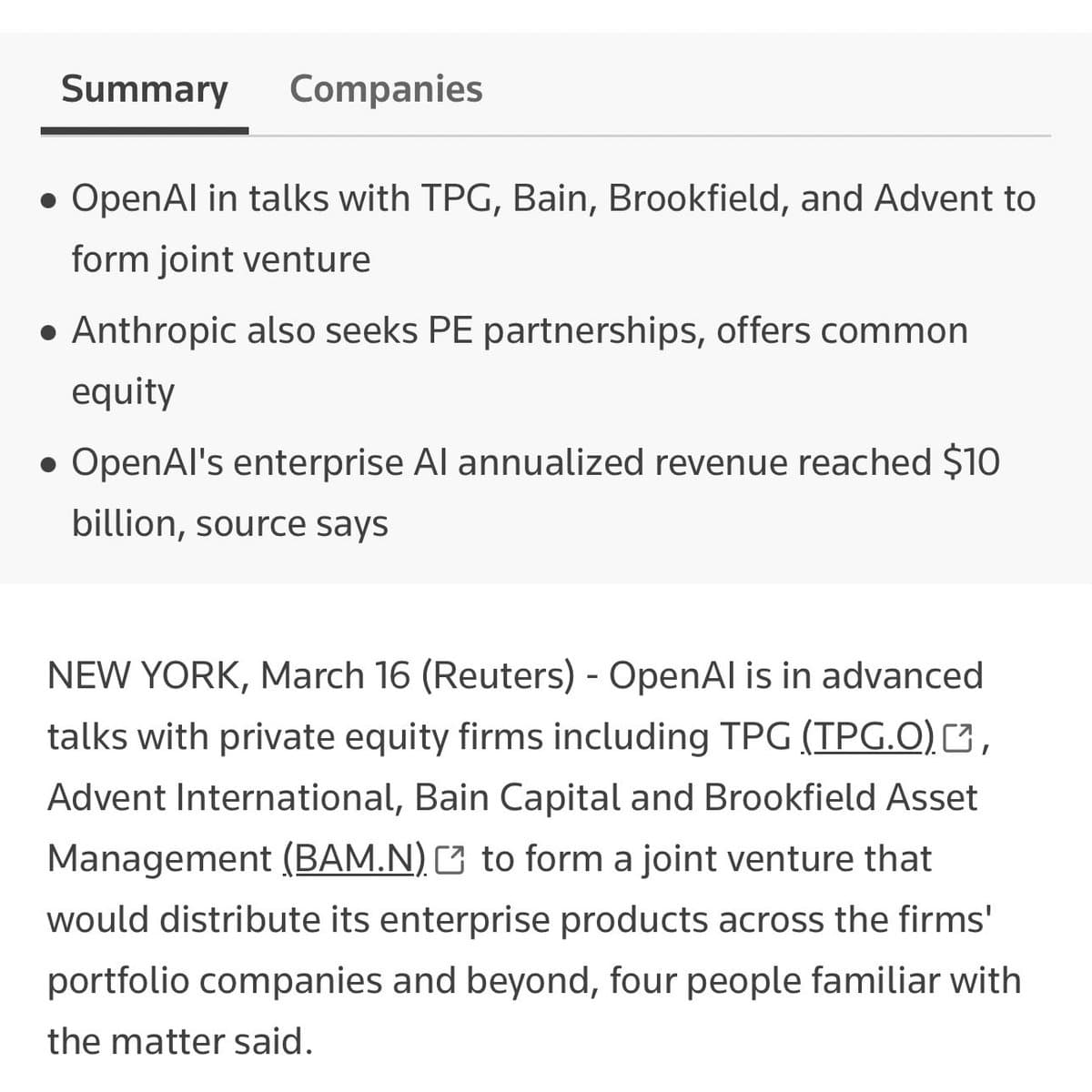
Reuters' reported structure is not a new model launch or API tier. It is a distribution JV aimed at getting OpenAI's enterprise products sold into the companies already controlled by large private-equity firms, with the Reuters summary saying those firms would help distribute OpenAI's tools “across their portfolio companies and beyond.”
The more detailed Reuters summary in the deal post says TPG would be the anchor investor, with Advent, Bain, and Brookfield as co-founding investors, and that all four would get board seats. That same post says the arrangement could give those firms early access to OpenAI's enterprise tools. For engineers, the practical signal is that enterprise adoption may be shaped increasingly by procurement channels and rollout partners, not only by direct product demand.
The WSJ excerpt in the WSJ screenshot frames this as part of a broader strategy reset: OpenAI is refocusing around “coding and business users,” and Simo's line about avoiding “side quests” suggests internal prioritization behind enterprise productivity workloads. That makes the PE push look less like a one-off financing story and more like a go-to-market layer for coding, workflow, and agent deployments inside large companies.
Anthropic is reportedly pursuing a similar path, according to the Reuters-based post, which cited discussions with Blackstone, Permira, and Hellman & Friedman. A practitioner summary in one reaction thread captures the shift cleanly: frontier model companies are building “distribution alliances” around the groups that already “control enterprise decision-making.” If that pattern holds, engineers evaluating vendors may increasingly see model access, services, and internal rollout packaged through PE- and consultancy-shaped channels rather than bought as standalone software.
Google rolled Gemini deeper into Docs, Sheets, Slides, and Drive, including spreadsheet task execution, editable slide generation, and grounded file search. Teams should test approval flows, context sourcing, and current feature limits before broad rollout.
 release
OpenClaw shipped version 2026.3.22 with ClawHub, OpenShell plus SSH sandboxes, side-question flows, and more search and model options, then followed with a 2026.3.23 patch. Teams get a broader plugin surface, but should patch quickly and review plugin trust boundaries as the ecosystem grows.
 release
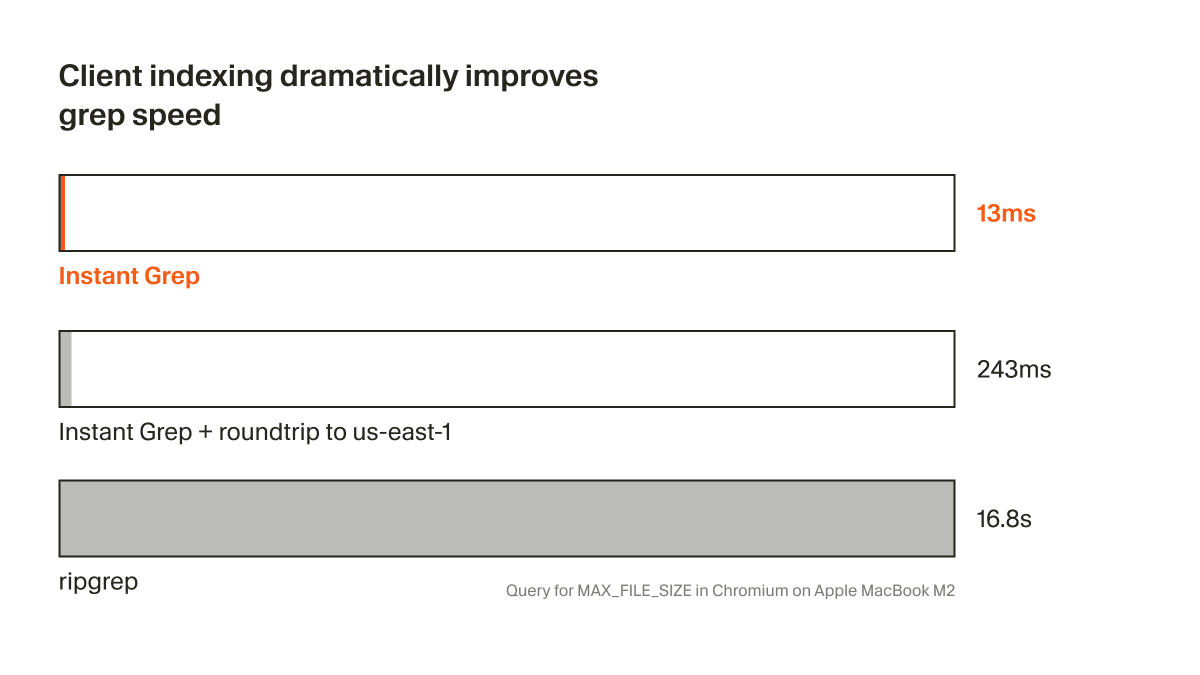
Cursor shipped Instant Grep, a local regex index built from n-grams, inverted indexes, and Bloom filters that drops large-repo searches from seconds to milliseconds. Faster candidate retrieval shortens the coding-agent loop, especially when ripgrep-style scans become the bottleneck.
 breaking
ChatGPT now saves uploaded and generated files into an account-level Library that can be reused across conversations from the web sidebar or recent-files picker. It removes repetitive re-uploading and makes past PDFs, spreadsheets, and images part of a persistent working context.
 breaking
Epoch AI says GPT-5.4 Pro elicited a publishable solution to one 2019 conjecture in its FrontierMath Open Problems set, with a formal writeup planned. Treat it as an early milestone worth reproducing, not blanket evidence that frontier models can already automate math research.
OpenAI is in active conversation with TPG, Bain, Brookfield, and Advent to distribute its AI enterprise solutions across their portfolio companies, according to Reuters. A big race for enterprise customers 👀


This news came out a little earlier than we planned; we're excited to be building a deployment arm and will share more details soon. Companies have a ton of urgency to deploy AI in their organizations and we’re sprinting to meet that demand. More than 1 million businesses run on
Reuters reports that OpenAI is in advanced talks with major private equity firms including TPG, Bain, Brookfield, and Advent to launch a joint venture valued at about $10 billion pre-money, with roughly $4 billion in investor commitments. The move could dramatically speed up Show more

This news came out a little earlier than we planned; we're excited to be building a deployment arm and will share more details soon. Companies have a ton of urgency to deploy AI in their organizations and we’re sprinting to meet that demand. More than 1 million businesses run on
OpenAI will no longer be "distracted by sidequests," which means full focus on revenue-strong B2B sector.