Tencent HunyuanImage 3.0 hits fal – 80B MoE, $0.10/MP playground

Stay in the loop
Free daily newsletter & Telegram daily report
Executive Summary
Tencent’s HunyuanImage 3.0 is instantly usable: fal turned on a public playground and API at $0.10 per megapixel. The 80B‑parameter MoE shows strong prompt following, reliable text‑in‑image, and set‑consistent layouts—from 4–6 panel comics to 9‑ and 12‑up sticker grids. A community Hugging Face Space snapped in via fal, underscoring rapid propagation beyond official channels.
In numbers:
- Pricing: $0.10 per megapixel API; public playground and docs for commercial access.
- Scale: 80B parameters MoE; text rendering; English and Chinese prompt examples.
- Layout fidelity: 4‑ and 6‑panel comics; 9‑up and 12‑up sticker grids maintain typography.
- Community: 1 Hugging Face Space via fal API; prompt→image UI with share/download.
- Text tests: 3 formats—whiteboards, A4 pages, self‑portraits—with multi‑line titles and signatures.
- Availability: fal rollout today; Tencent hosted 1 deep‑dive livestream with Q&A.
Also:
- vLLM adds dots.ocr: 1.7B OCR VLM; 100 languages; tables, formulas, layout parsing.
- Mintlify switches agents to Markdown; ~30× token cut and ~30× faster processing.
Feature Spotlight
Feature: Open T2I surge (HunyuanImage 3.0 ships everywhere)
HunyuanImage 3.0 (80B MoE) goes live across fal/Hugging Face with API/playgrounds and demos of accurate text-in-image and layout reasoning—an open, industrial-grade T2I option teams can adopt now.
Cross‑account focus today: Tencent’s 80B MoE HunyuanImage 3.0 spreads fast (fal, Hugging Face, live demos) with strong prompt following, in‑image text and ‘reasoning’ claims. Excludes other model/tooling stories covered below.
Jump to Feature: Open T2I surge (HunyuanImage 3.0 ships everywhere) topicsTable of Contents
🧪 Feature: Open T2I surge (HunyuanImage 3.0 ships everywhere)
Cross‑account focus today: Tencent’s 80B MoE HunyuanImage 3.0 spreads fast (fal, Hugging Face, live demos) with strong prompt following, in‑image text and ‘reasoning’ claims. Excludes other model/tooling stories covered below.
HunyuanImage 3.0 rolls out on fal with live playground at $0.10/MP
fal turned on HunyuanImage 3.0 with a public playground and API priced at $0.10 per megapixel, making Tencent’s 80B MoE text‑to‑image model instantly usable—following up on initial launch. See the live demo and pricing in the fal model page release thread and the “Try it” CTA playground link, alongside Tencent’s own livestream push livestream.
- Playground is up now with usage docs and pricing details (commercial access; $0.10/MP) playground link Hunyuan Image page.
- fal highlights model traits: 80B parameters, complex prompt following, world‑knowledge “reasoning,” text rendering in images release thread.
- Tencent drove awareness with a live deep‑dive stream and Q&A to show capabilities at scale livestream.
- Additional example grids surfaced via fal’s thread show varied styles and high prompt adherence gallery post gallery post.
“Talk with HunyuanImage 3.0”: text rendering, handwriting, self‑portraits showcased
Tencent’s “talk with” thread stresses reliable text in images—whiteboard copy, handwritten Chinese poetry, and self‑portrait prompts that blend drawing with legible, styled text reasoning demo prompt list.
- Whiteboard and A4‑paper examples display multi‑line titles, body text, and signatures with correct scripts and spacing reasoning demo.
- Prompts include identity/self‑portrait plus open‑ended messages to test recaption/“thinking” behavior prompt list.
- Earlier product posts also tout “generates text within images,” aligning with these handwriting demos model traits.
Tencent demos multi‑panel comics and set‑consistent stickers with HunyuanImage 3.0
Beyond single shots, Tencent is leaning into layout fidelity—posting four‑ and six‑panel explainer comics and consistent sticker/meme grids that keep characters and typography aligned to the brief comics examples sticker sets.
- Prompts (English and Chinese) are shared for reproducibility, covering science explainers and educational styles prompt list.
- Sticker/meme grids show theme consistency (personas, kaomoji, emoji‑style variants) across 9‑up/12‑up layouts sticker sets.
- Tencent positions v3.0 as a “native multimodal” model with better prompt adherence and in‑image text comics examples.
Community ‘vibe‑coded’ HunyuanImage 3.0 Space launches on Hugging Face
A community‑built Hugging Face Space puts HunyuanImage 3.0 behind a simple UI, wired up quickly with fal—showcasing how fast the open‑source drop is propagating into user apps space page space link. Tencent amplified the quickstart for broader access official shoutout.
- Space: prompt → image with share/download; example shows watercolor fox from a single text prompt app screenshot app screenshot.
- Builder notes they “vibe coded” the app using fal’s backend for speed and deployment space page.
- Tencent links both the Space and official site to steer users to the full experience official shoutout.
🛠️ Agentic coding: Droid prompt leak, CLIs and IDE bots
Heavy agent/devtool chatter: Factory’s Droid system prompt leak, Factory CLI adoption, Cursor BugBot updates, Cline’s benchmark guidance; plus practical CLI/runtime tips. Excludes MCP and Google ADK orchestration (separate).
Factory’s Droid system prompt leaks with strict PR‑as‑end‑state workflow
A full copy of Factory’s Droid system prompt surfaced, detailing a disciplined “diagnose vs implement” gate, frozen/locked installs before any edits, and PR‑as‑the‑only end state for implementations. The doc also mandates tool logs, version checks, lint/tests/build gates, and TodoWrite planning with a strict JSON schema. sys prompt leak, and GitHub file
- Single‑source‑of‑truth rule: never speculate; open files before explaining or fixing sys prompt leak
- Mandatory sequence for impl: git sync → frozen deps → validate → small commits → quality gates → PR GitHub file
- Headless assumptions: execute commands, await completion, include concise logs; no background steps sys prompt leak
- Planning: TodoWrite enforces per‑task status/priority/ids; progress is visible and auditable GitHub file
- Community reactions highlight the guardrails’ value for reducing hallucinated changes developer take
Factory CLI surges: 40M free Droid tokens, live demos, spec mode tips
Droid adoption spiked with a 40M‑token promo and a live deep‑dive, following up on CLI subagents. Builders showcased quick integrations and recommended spec mode for complex refactors. Try‑it links and replay posts circulated widely. free tokens, livestream replay, and CLI demo
- Promo: 40M free tokens to exercise Droid on real workstreams free tokens
- Live coding session: founders fielded agent, benchmarks, and workflow questions live now
- Field report: Sonnet 4 + Factory CLI added Gemini support in ~15 minutes, with real‑time sync CLI demo
- Practical tip: use spec mode for multi‑step changes and team‑style subagent flows benchmarks chat
Cline publishes a practical model‑picking guide for coding agents
Cline outlined how to choose models for agentic coding: use SWE‑Bench for real repo bug‑fix skills, domain knowledge tests (MMLU/GPQA/AIME) for verticals, and tool‑use evals for MCP workflows—then validate in your own stack. benchmarks thread, SWE‑Bench guide, and limitations
- Coding realism: SWE‑Bench reflects daily issues vs. contrived puzzles SWE‑Bench guide
- Domain fit: check benchmarks aligned to your field (e.g., GPQA for science) domain benchmarks
- Tool usage: verify formatting, tool choice, and multi‑tool chaining for MCP agents tool use evals
- Caveat: similar scores can mask different strengths—always A/B on your repos; full write‑up linked Blog post
opencode 0.12.2 enforces Accept headers to cut agent token bloat
opencode’s webfetch now negotiates plaintext/markdown via weighted Accept headers and auto‑converts HTML only as fallback—shrinking tokens and speeding agent loops. Teams also shared a blind A/B harness to compare preview models on real repos. accept header update, commit details, and A/B tool demo
- Content negotiation with q‑params prefers text/markdown, reducing noisy HTML parsing commit details
- Practical payoff: smaller prompts, lower cost, and cleaner diffs for coding agents
- Internal A/B: blind‑test preview models head‑to‑head on your codebases to avoid bias A/B tool demo
Cursor BugBot now edits PR comments directly
Cursor’s BugBot gained the ability to update PR descriptions/comments, tightening the review loop inside GitHub. Engineers highlighted smoother status handoffs from bot to human reviewer. PR screenshot
- Screenshot shows “cursor bot” amending a PR with structured change notes and checklist items PR screenshot
- Pairs well with agent workflows that insist on PR‑as‑end‑state (e.g., Droid) for auditability
🧩 Interoperability: MCP stacks and Google’s agent playbook
MCP server roundups and Google’s 64‑page agent playbook emphasize production agent plumbing (A2A, ADK, evaluation). Excludes coding‑agent model prompts (covered above).
Google’s 64‑page ADK playbook shows how to ship production agents
Google published a startup‑focused, 64‑page guide that details how to build, deploy, and operate production‑grade AI agents with the Agent Development Kit (ADK), A2A/MCP interoperability, managed runtimes, evaluation, and security/IAM guardrails Playbook summary, Google report link.
- Runtime and ops: Vertex AI Agent Engine or Cloud Run with autoscaling, identity, logging/tracing, retries, and Terraform/CI/CD via the Agent Starter Pack Managed runtime, Starter pack diagram.
- Data layers: Long‑term knowledge (Vertex AI Search/BigQuery), working memory (Memorystore), and ACID state (Cloud SQL/Spanner) with clear data contracts System architecture.
- Grounding: Progression from RAG → GraphRAG → Agentic RAG where the agent plans searches, calls tools, and composes cited results Playbook summary.
- Reliability: Four evaluation layers from unit tests and trajectory/tool‑argument checks to grounded outcome scoring and live monitoring Playbook summary.
- Security: Least‑privilege IAM, input/output guardrails, durable audit logs, and hardened defaults baked into the reference stack Playbook summary.
12 must‑have MCP servers for real tool‑using agents
A curated roundup of 12 Model Context Protocol (MCP) servers highlights the practical tool surface area agents can safely use in production, spanning browsers, OS automation, data tooling, and app integrations Server roundup, Hugging Face post.
- Browser automation: Chrome DevTools MCP and Playwright MCP for controlled web interaction Server roundup.
- Desktop/OS control: Windows‑MCP and MCPControl for mouse/keyboard/screen workflows Server roundup.
- Data/LLM backends: MindsDB and MetaMCP aggregation to unify access across systems Server roundup.
- App connectors: Browserbase MCP, Apify MCP, Apple Notes MCP, Alibaba Cloud Ops MCP for enterprise‑ready tasks Server roundup.
- Why it matters: MCP standardizes tool invocation and auditing, shrinking the blast radius versus ad‑hoc tool wiring Server roundup.
LangChain ships Azure PostgreSQL connector for agent memory, vectors, and state
LangChain introduced a native Azure PostgreSQL connector that unifies agent persistence—chat history, vector store, and working memory—so LangGraph/LangChain apps can keep state in one enterprise‑grade database Connector overview.
- Single backend: Consolidates vector search, memory store, and conversation history in Postgres to simplify ops and scaling Connector overview.
- Enterprise posture: Aligns with regulated environments that already standardize on Postgres for auditability and retention Connector overview.
- Ecosystem fit: Designed for LangGraph agent pipelines, reducing glue code and vendor sprawl around memory/state RAGLight library.
CopilotKit brings Google ADK agents into AG‑UI full‑stack apps
CopilotKit announced AG‑UI compatibility with Google’s ADK, letting teams bring ADK‑built agents into full‑stack applications with shared UI patterns and state, not just back‑end flows ADK interop.
- Interop angle: ADK agents can now render in AG‑UI experiences while retaining ADK’s multi‑agent orchestration, tool use, and observability ADK interop.
- Stack fit: Bridges Google’s A2A/MCP‑aligned designs with CopilotKit’s front‑end primitives for production agent UX ADK interop, Playbook summary.
- Expected wins: Faster end‑to‑end delivery (backend agent logic + frontend agent UI), consistent telemetry, and safer tool exposure in user flows ADK interop.
📄 Reasoning and RL post‑training updates
Today’s papers center on long‑horizon execution, CoT structure, and RL/grading tweaks to make ‘thinking’ efficient on chat and tasks.
Long‑horizon execution reveals hidden returns from tiny accuracy gains
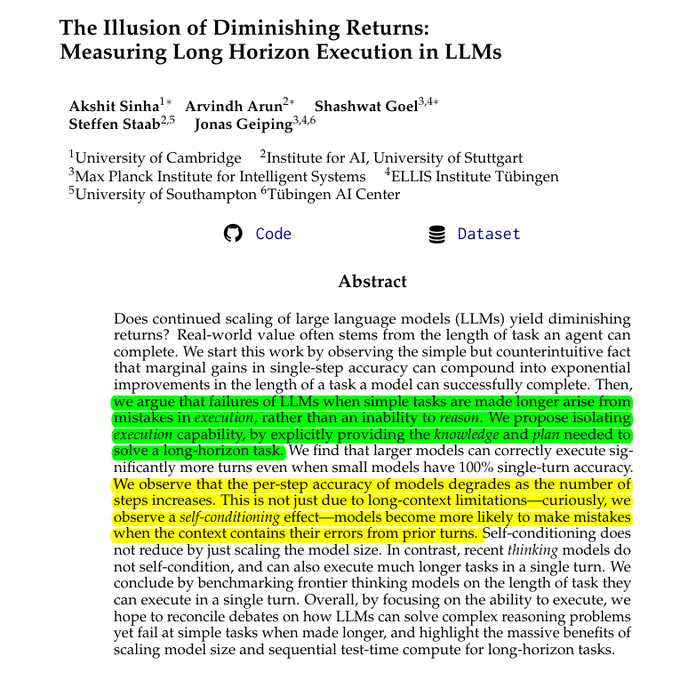
A new study shows that a 1–2% single‑step accuracy bump can extend reliable execution from dozens to thousands of steps, reframing the "diminishing returns" narrative. GPT‑5 sustains 1,000+ sequential steps when allowed to think, with sliding‑window history and deliberate reasoning mitigating self‑conditioning drift. paper thread
- Reliability collapses over length is not random noise; errors poison context over time (self‑conditioning). failure mode
- Sequential test‑time compute restores stability at late turns; parallel sampling helps less. thinking effect
- Single‑turn capacity snapshot: GPT‑5 1,000+ steps, Claude 4 Sonnet ~432, Grok‑4 384, Gemini 2.5 Pro/DeepSeek R1 ~120. single‑turn stats
- Measure horizon length directly; trim history to hide old mistakes; prefer sequential over parallel guesses. builder takeaways ArXiv paper
Structure beats length: FSF predicts correctness better than longer CoT
Meta finds that chain‑of‑thought length and extra “review” tokens don’t reliably improve accuracy when you hold questions fixed. A simple structural metric—the fraction of failed branches in the reasoning graph (Failed‑Step Fraction)—tracks correctness best and yields +5–13% pass@1 via reranking. paper overview
- Within‑question analysis: shorter, focused traces beat longer, repetitive ones across 10 models on math/science. accuracy correlates
- FSF‑based reranking lifts AIME‑2025 pass@1 by 5–13% and GPQA‑Diamond by up to 3% without retraining. results summary ArXiv paper
- Takeaway: don’t just spend more tokens; select traces with fewer dead‑ends to get better answers. figure takeaway
Reinforcement‑trained private planning makes models chat better
Reinforcement Learning with Model‑Rewarded Thinking (RLMT) trains models to plan privately before replying, then optimizes with GRPO using a learned preference judge. On real chat prompts, RLMT adds ~3–8 points; an Llama‑3.1‑8B variant beats GPT‑4o on creative writing. paper abstract
- Works from zero or with a warm start; samples multiple responses and pushes above‑average ones. paper abstract
- Thinking traces evolve from rigid checklists to constraint grouping, edge‑case checks, and refinement. paper abstract
- Context: growing GRPO adoption for non‑verifiable tasks; strong reward model is key. GRPO explainer
MAPO: certainty‑aware advantages fix over/under‑updates in GRPO
Bytedance’s MAPO adapts the advantage function to rollout certainty, strengthening learning on hard samples and softening it on easy ones. On Qwen2.5‑VL‑7B across math and emotion tasks, it delivers small but consistent improvements without new models or hyperparameters. paper overview
- High‑certainty groups use an “advantage percent deviation”; low‑certainty keep std‑dev normalization. paper overview
- Drops cleanly into existing GRPO code; targets misallocation from uniform normalization. paper overview
- In context of Tree‑GRPO, step‑level trees cut cost; MAPO focuses on the update rule itself to stabilize training. GRPO explainer
⚙️ Runtime efficiency: tokens, OCR and content negotiation
Mostly practical serving/latency wins: vLLM adds a compact OCR VLM; publishers and tools move to markdown/text to cut output tokens.
vLLM adds dots.ocr: 1.7B multilingual OCR VLM with tables, formulas and layout parsing
vLLM shipped native support for rednote‑hilab/dots.ocr, a compact 1.7B VLM that performs OCR across 100 languages and parses text, tables (HTML), formulas (LaTeX), and document layouts (Markdown). Early results claim SOTA on OmniDocBench and dots.ocr‑bench, with commercial use allowed. release thread
- One‑line serve: “vllm serve rednote-hilab/dots.ocr --trust-remote-code”; nightly wheels are available for quick deploy. release thread nightly wheels
- Designed for low‑resource documents with robust layout understanding; author credits port/testing in a Colab harness. release thread
- Merge PR documents the integration details in vLLM. GitHub PR
Mintlify switches agents to Markdown by default, claiming ~30× token cut and ~30× faster processing
Mintlify now serves Markdown instead of HTML to AI agents by default, reporting about a 30× reduction in token usage and roughly 30× faster processing on their pages. product update
- Markdown output trims boilerplate and DOM noise, directly lowering LLM input token costs and latency for downstream tools. product update
- Change aligns with a broader push toward clean content negotiation for LLM tooling (see opencode’s Accept header upgrade). commit summary
opencode 0.12.2 negotiates Markdown/text via Accept headers with q‑params; HTML only as fallback
Instead of scraping raw HTML by default, opencode 0.12.2 now sets precise Accept headers (with quality weights) to prefer text/markdown and text/plain, auto‑converting HTML to MD only when servers don’t comply. This cuts token overhead and parsing churn for LLM tools. feature brief
- Header order encodes preferences: text/markdown → text/x‑markdown → text/plain → text/html → /. commit diff
- The same author is running blind A/B tests on real repos, where cleaner inputs help compare preview models without markup noise. tool demo
- Practical win for agent runtimes: fewer tokens, simpler parsing, and better determinism when fetching web content for prompts. feature brief
🏗️ AI factories, power, tariffs and vendor roadmaps
Infra economics and policy: OpenAI energy forecasts, tariff proposals, AMD/NVIDIA product pressure, and TSMC positioning. Non‑AI topics omitted.
OpenAI plans 125× energy growth to ~250 GW by 2033
OpenAI’s internal planning points from ~2 GW at end‑2025 to ~250 GW by 2033, a 125× ramp that shifts constraints from GPUs to power, transmission, and permitting planning note, CNBC article. A widely shared curve shows 0.23→2 GW in 2025, then an annual 1.8× trajectory to 250 GW by 2033 capacity chart.
- Execution pressure: “decade‑scale” build times for firm power and long‑lead grid interconnects were flagged as primary gates, not just generation CNBC article.
- Demand thesis: commentary ties the ramp to ChatGPT reaching billions of WAU and frontier model scaling, with the capex model hinging on revenue per token growth analysis thread.
US mulls 1:1 chips rule with 100% tariffs and onshore packaging push
A draft US policy would require chipmakers to produce domestically as many chips as they import, with ~100% tariffs as the enforcement stick; credits and grace periods are discussed, and device‑level tariffs based on chip content are explored policy brief. CoWoS/SoIC on‑shore by ~2028 is framed as critical to claim a full “Made in USA” flow policy brief.
- Continuation: following up on chip rule, which first surfaced the 1:1 idea, the new brief details packaging timelines and tariff mechanics with Arizona fab milestones.
- Implications: TSMC’s AZ (N4 now, N3 ~2028) still relies on Taiwan for advanced packaging; the rule would force US wafer+packaging parity to avoid tariffs policy brief.
AI capex runs ~$345B in 2025 as hyperscalers race ahead
Industry trackers peg 2025 AI capex at roughly $345B—about 2.5× in two years—drawing comparisons to ~$1.5T global telecom spend and framing OpenAI’s multi‑year Stargate as a sizeable share of future outlays capex chart. Discussion threads extrapolate how a $500B, multi‑year data‑center build could map into late‑decade totals even under conservative per‑user growth analysis thread.
- Composition watch: power, advanced packaging, and AI‑native networking become equal pillars to GPUs in budget mixes capex chart.
- Risk bands: sensitivity to grid interconnect timelines and permitting mirrors the energy ramp risks cited for model scaling analysis thread.
AMD MI450X pressure reportedly forces Rubin to ~2.3 kW and ~20 TB/s
Rumors say AMD’s Instinct MI450X board power rose by ~200 W, driving NVIDIA’s Rubin boards toward ~2,300 W TGP and lifting per‑GPU memory bandwidth targets from ~13 TB/s to ~20 TB/s roadmap rumor. HBM4 configs are floated at up to 432 GB/19.6 TB/s for MI450X vs ~288 GB/~20 TB/s for Rubin VR200 roadmap rumor.
- Competitive levers: MI450X’s larger HBM capacity favors single‑GPU model fits; Rubin counters with higher bandwidth for bandwidth‑bound inference/training roadmap rumor.
- Node/design: both are expected on TSMC N3P with chiplets; the differentiation shifts to memory size, BW, software, and network fabrics roadmap rumor.
TSMC flatly denies Intel investment or partnership talks
TSMC said it is not in discussions to invest in or partner with Intel and has no JV, licensing, or tech‑transfer talks underway, pushing back on earlier media reports denial summary. The stance reasserts strict customer neutrality as it builds US capacity.
- Market reaction: concerns had surfaced that cooperation with Intel might spook fabless clients; TSMC ADRs dipped before the denial denial summary.
- Strategy signal: keeps Arizona builds aligned to client demand while avoiding perceived shortcuts for a foundry rival denial summary.
🎬 Video/image tools and creator workflows
Strong creative tooling pulse beyond the feature: Flow’s Nano Banana editing/prompt expander; Seedance Pro transitions; guides and recaps.
fal Seedance Pro adds first+last frame conditioning for ultra‑smooth transitions
Seedance Pro now lets you set both starting and ending frames to generate smooth, composition‑consistent transitions—useful for ads, storyboards, and cinematic flows feature brief. Try it in the hosted playground fal playground.
- First+last frame control reduces drift, stabilizing motion and layout across shots feature brief.
- Examples show fluid pacing and on‑brand framing across scenes demo link, demo link, demo link.
- One‑click access for production trials is live today try link.
Google Flow adds Nano Banana editing and custom Prompt Expander; starts Veo 2 wind‑down
Google is rolling out image editing powered by the Nano Banana model and a reusable Prompt Expander to scaffold detailed scenes, plus a favorites UX; the Veo 2 decommission process is beginning. See the in‑product update panel for specifics update screenshot and the deeper explainer with examples feature explainer, with a full roundup here feature article.
- Image editing lets creators iteratively refine frames and assets using Nano Banana update screenshot.
- Prompt Expander turns short ideas into richly structured prompts you can reuse across generations feature explainer.
- Flow flags early steps to decommission Veo 2, so projects should migrate to newer pipelines update screenshot.
- Details and implications for workflow changes are summarized in TestingCatalog’s write‑up feature article.
Creator workflow: Seedream 4 still → Kling 2.5 Turbo animation in ~3 minutes (~14 credits)
A step‑by‑step creator thread shows how to star in your own AI video: generate a faithful portrait still (Seedream 4 via Higgsfield), then animate it with Kling 2.5 Turbo—fast and inexpensive workflow thread.
- Step 1: Make a still with strong ID retention using Seedream 4 in Higgsfield; prompt and example included still examples.
- Step 2: Animate using “create video with Kling 2.5 Turbo,” reusing the still as the first frame animation step.
- Time and cost: about 3 minutes end‑to‑end and ~14 credits reported for the example pricing note.
Weekly creator reel: 20 standout AI video experiments, from FPV to action trailers
A curated thread rounds up 20 notable community creations across styles and formats—useful inspiration for prompt, pacing, and camera‑move patterns weekly recap.
- FPV sequences with dynamic motion cues fpv example.
- Polished transition studies for scene linking and flow transition study.
- Concept trailers and ad‑style spots spanning multiple genres trailer clip, ad clip.
- Additional pieces cover fashion, stunts, and stylized cinematics; browse the full list to mine ideas weekly recap.
📊 Real‑world evals: code teams and robot arenas
New practical evals surfaced today; excludes GDPval recap from earlier days unless new deltas. Focus on production metrics and upcoming frameworks.
Enterprise study: AI reviews cut PR cycle time 31.8% across 300 engineers
A year‑long production study (300 engineers) reports a 31.8% drop in pull‑request review cycle time after rolling out AI code review and generation tools, with the largest gains concentrated among heavy users. Teams trusted automated reviews more than code generation, and heavier adoption correlated with more shipped code. See paper summary.
- Scope and method: 12‑month telemetry on real repos using in‑editor suggestions plus an automated PR review system paper summary
- Headline metric: PR review cycle time −31.8% vs developer baselines; heavy adopters shipped substantially more code paper summary
- Adoption pattern: usage spiked then settled into steady daily use; benefits tracked engagement level paper summary
- Qual feedback: higher trust in automated reviews than code generation; most developers wanted to keep the tools paper summary
- System design: review bots run bug/security/perf/doc checks; generators align edits to local repo patterns to raise acceptance paper summary
Practical benchmark map for coding agents: SWE‑Bench, domain tests, tool‑use
Instead of chasing leaderboards, Cline lays out a pragmatic way to pick models for real code work: align evals to your tasks, then test on your stack. Start with coding (SWE‑Bench), add domain knowledge (MMLU/GPQA/AIME), and verify tool‑use/MCP behaviors, then do hands‑on A/Bs in your own environment benchmarks thread, tool‑use focus.
- Coding capability: SWE‑Bench measures fixing real GitHub issues—bugfixes, refactors, features—not toy puzzles SWE‑Bench detail
- Domain knowledge: pick per field—MMLU (broad), GPQA (grad‑level STEM), AIME (math) domain list
- Tool usage: check structured tool calls, correct routing, and multi‑tool chaining (MCP) for agents that browse/scrape or use long‑term memory tool criteria, tool‑use focus
- Limits: similar scores can hide very different behaviors; narrow with benchmarks then validate on your repos and infra limits explained, hands‑on advice
RoboArena tees up distributed evaluators for generalist robot policies
A new RoboArena presentation highlights a framework to evaluate generalist/VLA robot policies via a distributed network of evaluators, aiming to move beyond single‑lab demos toward repeatable, scalable measurement of embodied agents. Community invite via talk invite.
- Focus: generalist robot policies (e.g., VLAs) evaluated across diverse sites and setups to stress robustness talk invite
- Goal: reproducible, comparable results vs. bespoke one‑off tasks; harness community evaluators to broaden coverage talk invite
🛡️ Robot security and safety‑routing discourse
Fresh security angle today is embodied: Unitree G1 paper shows root via Bluetooth and silent telemetry; ongoing routing debates continue from prior day.
Unitree G1 can be rooted via Bluetooth; silent telemetry sends audio/video every 5 minutes
A new security teardown shows the Unitree G1’s onboarding and comms stack expose robots to nearby takeover and quiet data exfiltration. Shared Bluetooth keys enable proximity root, Wi‑Fi credential fields allow command injection, DDS topics are unencrypted, and the bot uploads audio/video/system status every ~300 seconds.
- Root via Bluetooth stems from a shared key and accepting injected commands during setup; Wi‑Fi name/password fields also accept shellable input paper summary
- Telemetry runs by default: audio, video, and status are pushed to remote servers every 300s without clear operator notice, per the assessment paper summary
- On LAN, Data Distribution Service topics are unencrypted; the media client skips certificate checks in the shipped image, widening sniff/spoof risk paper summary
- The master process keeps motion/voice/chat/update channels alive; authors even ran a cybersecurity agent on‑robot to map endpoints for pivoting paper summary
- Fleet mitigations: disable/lock down Bluetooth provisioning, rotate unique keys, sanitize Wi‑Fi inputs, encrypt DDS topics, and enforce TLS cert pinning at the client paper summary
OpenAI’s per‑message safety routing shows up in the wild, sparking calls for clarity
OpenAI confirms it’s testing per‑message routing that swaps ChatGPT to safety/reasoning backends for certain prompts, and users are spotting signs of silent model changes—following up on safety routing initial test.
- Confirmation: “testing new safety routing” that can auto‑switch conversations to reasoning models/GPT‑5 on a message‑by‑message basis recap thread
- Community screenshots and claims reference backends like “gpt‑5‑chat‑safety” and “5‑a‑t‑mini,” fueling concern over undisclosed swaps screenshot
- Earlier reports warned that closed routing can change outputs without notice, arguing for self‑hosted/open‑weight models to keep results stable developer warning
- Experiences vary: some users say routing isn’t triggered for them (“must’ve forgot to turn it on”), hinting at staged rollouts or cohort flags @elder_plinius comment
- Developers also note router quality impacts; one observes accuracy improved after routing fixes and more web querying for hard questions router comment
Developers press for model/router transparency and a common LLM API spec
Fragmented provider APIs and opaque on‑the‑fly routing make it hard to debug or trust outcomes. Engineers are calling for clear model attribution and a portable JSON protocol to unify tool calling, reasoning fields, and streaming formats.
- Integration pain points: message schemas, tool‑call formats, reasoning fields, and streaming all differ across providers, splintering infrastructure infrastructure gripe
- A push for standards: proposals for an industry‑backed JSON protocol to talk to LLMs, rather than ad‑hoc copies of a single vendor’s API standard call
- One concrete step: the Vercel AI SDK publishes a provider‑agnostic JSON schema to abstract differences and ease portability schema link GitHub repo
- In ChatGPT, users see “AI model updates and retirements” and new feedback controls, but router/model attribution still isn’t surfaced for sensitive reroutes feedback UI
- Why it matters now: safety routing and dynamic model swaps raise auditability stakes; standardized attribution and telemetry would strengthen evals and trust infrastructure gripe
🧭 From RAG to Agentic RAG and unified stores
Mostly retrieval plumbing and design: Zhihu’s shift to model‑led research agents; new light libraries; Azure Postgres connector. Excludes MCP orchestration above.
Zhihu’s ZHIDA moves from classic RAG to an agentic research assistant
Zhihu rebuilt ZHIDA from hard‑wired RAG into a model‑led agent that plans research, searches across web/internal KBs, and delivers goal‑oriented outputs (reports, visualizations, simplifications). upgrade summary
- Multi‑hop search and reasoning replace fixed intent routing and query‑rewrite loops; chunking, re‑ranking, and answering are recast around LLM behavior. upgrade summary
- Context injection is upgraded so content beyond pure semantic similarity can be pulled into prompts, reducing “garbage in, garbage out.” upgrade summary
- Output style is tuned to reduce generic AI fluff and present value‑first structure; hallucinations are acknowledged and managed for ROI. upgrade summary
- Try the product and read the team’s write‑up for details: product site, Zhihu post. A companion roundup adds broader context. weekly brief
Azure PostgreSQL connector unifies agent chat history, memory, and vector search for LangChain/LangGraph
LangChain introduced a native Azure PostgreSQL connector so teams can persist chat history, working memory, and vectors in a single enterprise database—removing the need to stitch Redis + vector DB + object store. connector brief
- Consolidates vector search, memory store, and conversation state behind one Postgres endpoint, simplifying ops and compliance. connector brief
- Designed for LangGraph agents: supports durable identity, logging, retries, and scale patterns enterprises expect. connector brief
- Eases deployment for regulated stacks where centralizing data plane and audit trails in Postgres is preferred. connector brief
LangChain ships RAGLight: a lightweight, production‑ready RAG library with agent pipelines
RAGLight lands as an open‑source, modular library that packages LangGraph‑powered agent pipelines, multi‑provider LLM support, a CLI, and GitHub‑friendly workflows for deployable RAG. library post
- Focus on simplicity and flexibility: plug different LLMs, embeddings, and vector stores without rewriting pipelines. library post
- LangGraph orchestration turns RAG steps into reliable, inspectable state machines suitable for production. library post
- Includes "chat with your documents" CLI and downloadable quick starts to accelerate prototyping to prod. library post
🧲 Models and compression tricks for multimodal
Model edges relevant to inference budgets: compact OCR VLM and token‑reduction for vision. Excludes the Hunyuan T2I feature coverage.
InternVL3.5‑Flash halves visual tokens (64–256) with near‑lossless quality
Shanghai AI Lab/OpenGVLab introduced InternVL3.5‑Flash with a Visual Resolution Router and pixel‑shuffle compression that adaptively reduces vision tokens by ~50% while retaining ~100% of InternVL3.5 performance on their benchmarks model brief.
- Router picks resolution per patch, then compresses 1024 vision tokens → 256 for the LLM, with an option to squeeze to 64 tokens in low‑detail regions model brief.
- Goal is speed and cost gains on resource‑constrained deployments across a family from ~1.1B up to 240.7B‑A28B params, without visible quality loss on common tasks model brief.
- Patch‑aware compression keeps semantic detail where needed, offering an inference‑budget lever for multimodal agents and RAG viewers operating under strict latency ceilings model brief.
vLLM adds dots.ocr (1.7B VLM) for 100‑language OCR with tables, formulas, layouts
vLLM now serves rednote‑hilab/dots.ocr, a compact 1.7B vision‑language model that performs end‑to‑end OCR across text, tables (HTML), formulas (LaTeX), and layouts (Markdown), with support for 100 languages and SOTA results on OmniDocBench and dots.ocr‑bench; it’s free for commercial use release note, cross‑post.
- One‑liner deployment:
vllm serve rednote-hilab/dots.ocr --trust-remote-code(nightly wheels available) release note, nightly wheels. - Strong fit for document agents where OCR dominates token budgets; mixed‑modality parsing reduces tool‑chain hops and latency release note.
- Upstream PR shows integration details and testing, making it straightforward to slot into existing vLLM stacks pull request, GitHub repo.