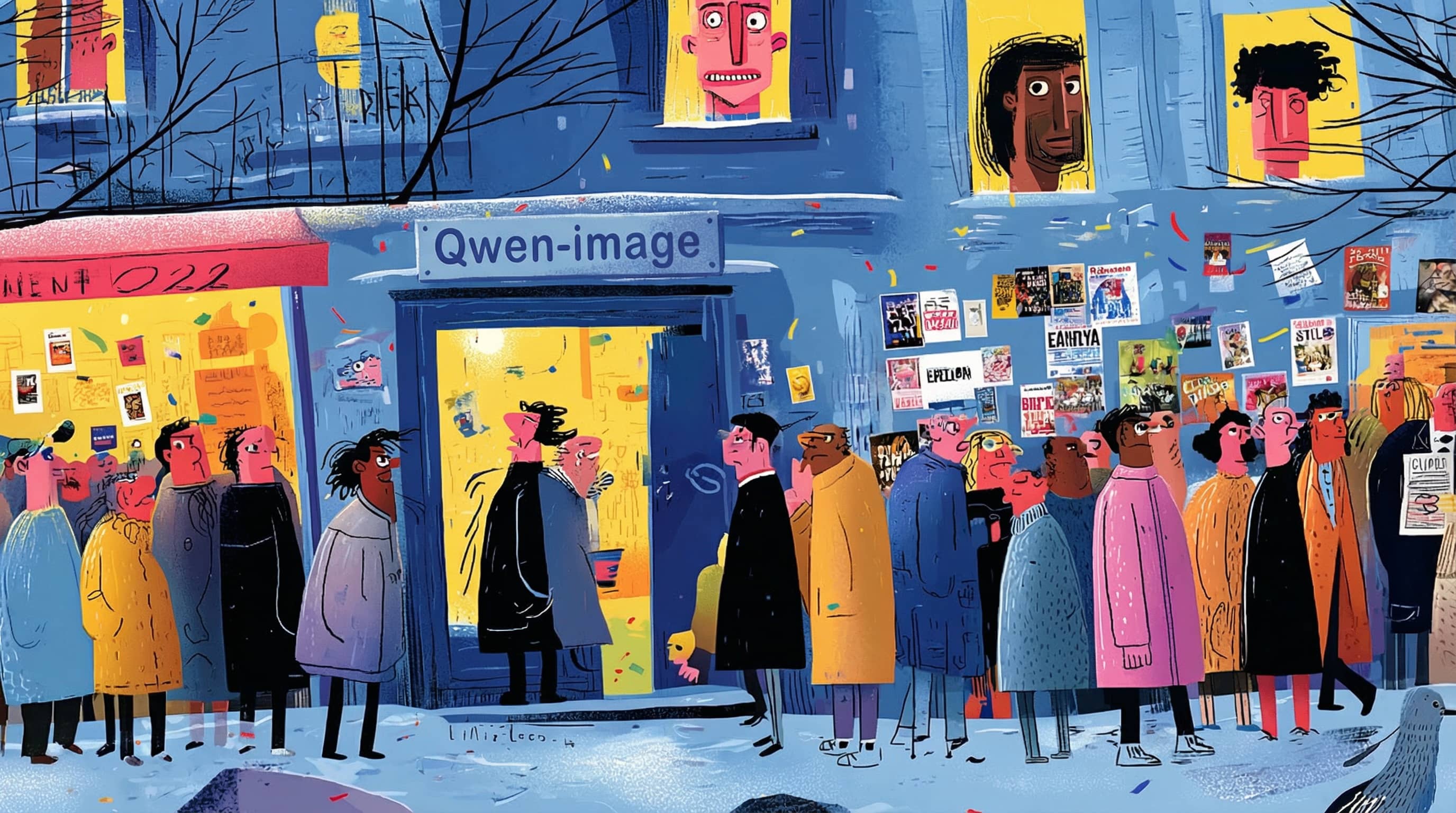
Qwen-Image-2512 tops 10,000+ blind votes – ships on 4+ hosts

Stay in the loop
Free daily newsletter & Telegram daily report
Executive Summary
Qwen-Image-2512 emerges as Alibaba Qwen's strongest open image model yet, with 10,000+ blind AI Arena votes on Hugging Face; upgrades target more lifelike skin, hair, fur, and outdoor depth plus cleaner on-image text for packaging and lower-thirds. Within days, weights land on Hugging Face widgets, Replicate (with PrunaAI-tuned serving), ComfyUI, fal, and WaveSpeed; creators show portraits that lose the telltale “AI sheen” and product mockups with legible labels, positioning 2512 as a serious open rival to proprietary realism-focused generators.
• Cinematic video and agents: Kling 2.6 Motion Control gains step-by-step tutorials, F1 HUD prompts, neon taxi portraits, and Replicate hosting; Vidu Agent outputs one-click promos and multi-minute AIMVs; HeyGlif’s Room Renovator links color palettes to Kling-ready bedrooms as Adobe–Runway Gen-4.5 lands in Firefly.
• Research and training signals: WaveSpeed hosts Molmo2 open-weight VLM; DreamOmni3 scribble editing and UltraShape 1.0 3D shapes aim at finer control for images and assets; RLVR PEFT tests find DoRA, AdaLoRA, MiSS beat vanilla LoRA on math; GPT-5.2 Pro leads FrontierMath Tier-4 as decentralised training runs grow ~600,000× vs 2021.
While you're reading this, something just shipped.
New models, tools, and workflows drop daily. The creators who win are the ones who know first.
Last week: 47 releases tracked · 12 breaking changes flagged · 3 pricing drops caught
Top links today
- Advanced Suno music prompting guide
- Qwen-Image-2512 image model release
- UltraShape 1.0 3D shape paper
- Kling v2.6 cinematic video generator
- Qwen-Image-2512 on Replicate inference
- DreamOmni3 scribble-based editing model
- ComfyUI text rendering workflow example
- Techhalla tutorial for AI character animation
- Vidu Agent one-click video generator
- Bria video-to-video tools on GMI Cloud
- Molmo2 vision-language model on WaveSpeed AI
- Leonardo AI character animation tutorial
- Glif Room Renovator generative design agent
- Pictory AI text-to-video creation tool
Feature Spotlight
Open‑source realism lands everywhere: Qwen‑Image‑2512
Qwen‑Image‑2512 rolls out across HF, Replicate (with Pruna), ComfyUI, fal, and WaveSpeed—bringing more lifelike people and better text layout so artists can deliver believable portraits, product visuals, and on‑image typography faster.
Big cross‑account push for Qwen‑Image‑2512: improved humans, finer natural detail, stronger text rendering; now runnable on HF widgets, Replicate, ComfyUI, fal, and WaveSpeed. Heavily relevant for illustrators, product shots, and layouted graphics.
Jump to Open‑source realism lands everywhere: Qwen‑Image‑2512 topicsTable of Contents
🖼️ Open‑source realism lands everywhere: Qwen‑Image‑2512
Big cross‑account push for Qwen‑Image‑2512: improved humans, finer natural detail, stronger text rendering; now runnable on HF widgets, Replicate, ComfyUI, fal, and WaveSpeed. Heavily relevant for illustrators, product shots, and layouted graphics.
Qwen-Image-2512 pushes open-source image realism and clean text rendering
Qwen-Image-2512 (Alibaba Qwen): Qwen’s new text-to-image model emphasizes more lifelike humans, richer natural detail, and stronger text rendering, with the Hugging Face card describing it as their strongest open-source model so far based on 10,000+ blind AI Arena evaluations, as shown in the HF listing and the model card. Following up on layered model where Qwen-Image-Layered was already praised over ChatGPT and Gemini for everyday usability, creators now frame 2512 as a further step away from the obvious "AI look" in skin, hair, and typography, summarized in the creator overview.

• Human realism: The model targets more believable faces and bodies, with better skin texture, wrinkles, pores, and posture so portraits feel less plastic and over-smoothed than earlier open models, a shift that both the comparison graphic and commentary highlight as core to 2512’s upgrade. Replicate quality graphic • Natural detail: Training improvements surface in fur, hair strands, snow, water, mist, and outdoor scenes, where fine-grain textures and layered depth make images read more like DSLR stills than flat renders, which is visible in the diverse sample set of children in snow, pets, and outdoor portraits. fal sample images • Text and layout: Qwen-Image-2512 also focuses on cleaner inline text—labels, packaging, and lower-thirds now hold legible, on-prompt wording with better spacing and alignment, making it more practical for product mockups, infographics, and editorial-style graphics than many earlier open models.
Taken together, the quality gains position 2512 as a serious open alternative for creatives who need convincing people, lifestyle shots, and on-image copy without relying on proprietary image systems.
Qwen-Image-2512 rapidly lands on Replicate, ComfyUI, fal, and WaveSpeed
Multi-host access for Qwen-Image-2512 (Replicate, ComfyUI, fal, WaveSpeed): Within days of release, Qwen-Image-2512 is already live on Replicate with PrunaAI’s "ultimate fast" serving, in ComfyUI via a drop-in workflow, on fal with ready-made examples, and on WaveSpeed AI as an easy-inference option, turning it into one of the more ubiquitously hosted open image models for creators, as indicated by the Replicate launch, the ComfyUI workflow, and the fal announcement.
• Replicate + PrunaAI: Replicate calls 2512 an improved Qwen Image with more realistic humans, finer textures, and stronger text rendering, and notes that PrunaAI co-engineered the deployment to deliver "the fastest speeds possible" for text-to-image generation inside their platform, giving API users a tuned serving stack out of the box. Replicate launch • ComfyUI integration: ComfyUI says users can "run Qwen-Image-2512 in ComfyUI: no update needed," pointing to a dedicated Qwen workflow template and showing examples of realistic people, fur, and jewelry, plus a serum bottle with clean label text, which signals that existing Comfy pipelines can swap in 2512 without graph changes. ComfyUI workflow • fal endpoint and samples: In parallel, fal announces 2512 as "now live" with a gallery that includes a child in snow, a South Asian bridal portrait with intricate mehndi, an elderly man with a dog, and a mother with a newborn, highlighting both portrait and lifestyle use cases for web-scale inference. fal announcement • WaveSpeed and HF widget: WaveSpeed AI adds 2512 to its hosted vision models for one-click inference, while the Hugging Face model page itself exposes a working "a panda" text-to-image widget, so both low-friction browser tests and higher-throughput hosted runs sit on top of the same open weights. WaveSpeed summary The quick spread of 2512 across at least four major hosting surfaces plus the Hugging Face widget means illustrators, product designers, and video teams can try the same open model in their preferred stack—GUI node graphs, simple SaaS endpoints, or direct API calls—without waiting for a single vendor to mediate access.
🎬 Cinematic gen‑video and motion control (non‑Qwen)
Busy day for video creators: Kling 2.6 reels, tutorials, and HUD prompts plus Dream Machine’s Ray3 Modify. Excludes the Qwen feature; this section focuses on directing, motion control, and stylized clips.
Kling 2.6 Motion Control gets tutorials, F1 HUDs, and neon portraits
Kling 2.6 Motion Control workflows (multiple creators): At least five creators posted fresh Kling 2.6 Motion Control demos and guides on New Year’s Eve. They build on creator adoption, where early clips were mostly playful tests.
The new examples focus more on repeatable scene recipes, game‑style interfaces, and cinematic portraits that other artists can reuse, with creators sharing explicit prompt breakdowns and behind‑the‑scenes notes motion tutorial and F1 HUD prompt, plus still‑to‑video workflows such as Kangaikroto’s Wong Kar‑wai taxi portrait taxi workflow. This shift turns Motion Control from a toy into something closer to a directing tool.

• Scene‑building tutorial: Turkish filmmaker Ozan Sıhay released a full YouTube breakdown of how he staged and animated a dramatic Kling 2.6 Motion Control shot, including his exact prompt structure and how he thought about camera path versus subject motion motion tutorial. The focus is on recreatable craft, not just a one‑off reel.
• Game‑style HUD experiments: Artedeingenio shared a detailed prompt for a high‑speed F1‑style racing game camera with a third‑person chase view, on‑screen speedometer, gear and boost meters, lap counter, and heavy motion blur, rendered as an arcade‑like broadcast F1 HUD prompt. The resulting clip shows interface and environment tightly integrated.
• Cinematic portraits from stills: Kangaikroto combined a Nano Banana Pro still of a Korean woman in a rain‑streaked taxi with Kling 2.6 Motion Control to get a neon‑lit, film‑grain video where red‑green lights sweep across her face and reflections drift across the glass taxi workflow. The workflow separates look‑development (image) from motion (video).
• Interior design flythroughs: HeyGlif used Kling Motion Control to turn an “ocean serenity” bedroom concept into a multi‑angle room tour, cutting between views while preserving a calm, water‑inspired palette ocean room clip. The video sits on top of a room that their agent first helped design.
Another creator joked about being “addicted to Kling Motion Control” while showing a tablet interface driving a physical camera slider, underlining how people mentally map AI keyframing onto real‑world motion rigs slider reference. That parallel reinforces Motion Control’s goal: give non‑technical directors something that feels like a virtual dolly and crane.
Replicate starts hosting Kling 2.6 for cinematic text‑to‑video
Kling 2.6 on Replicate (Replicate): Replicate is now hosting Kling v2.6, bringing cinematic text‑to‑video and image‑to‑video generation with fluid motion, photorealistic detail, and native audio into its API and web console, as highlighted in the launch reel Kling 2.6 launch. It is live in their catalog today.

Replicate frames the model around fast, film‑style clips with smooth camera moves and realistic lighting rather than overtly stylized experiments; the short montage shows multiple environments and subjects handled without visible flicker Kling 2.6 launch. The emphasis stays on cinematic realism.
For filmmakers and designers already wiring pipelines to Replicate, this keeps video alongside existing image and audio models under the same billing and SDKs, which reduces friction when prototyping narrative beats or animating key art. Everything sits behind one API key.
Ray3 Modify shows tiger‑to‑wolf‑to‑dragon shot in Dream Machine
Ray3 Modify in Dream Machine (LumaLabsAI): Luma Labs posted a new “Creatures of the Wild” showcase where a roaring tiger smoothly morphs into a snarling wolf and then a fire‑breathing dragon within a single shot, using Ray3 Modify on Dream Machine to keep camera motion and framing continuous creatures reel, building on superhero transform that previously focused on human characters shifting between stylized worlds. The new reel moves the same idea into creature design.

The sequence reads like a continuous hero shot rather than three edits; fur detail, lighting, and mouth animation change as each animal roars, but the virtual camera tracks forward on a consistent path creatures reel. That makes Ray3 Modify look suited to concept passes where teams want to audition multiple creature options without re‑animating the move.
For storytellers and VFX‑driven creators, this kind of subject‑swap while preserving motion suggests a way to iterate on monsters, mascots, or stylized avatars while holding the timing and blocking of an approved storyboard. It keeps the design exploration phase closer to what a final shot will feel like.
“Pig Fiction” short combines Nano Banana Pro, Kling 2.6 and OmniHuman
Pig Fiction short pipeline (Mr_AllenT / Freepik): Creator Martin LeBlanc released “Pig Fiction”, a stylized action vignette of a suited, sunglasses‑wearing anthropomorphic pig brandishing and firing a pistol in a desert, crediting Nano Banana Pro, Kling 2.6 and OmniHuman 1.5, all inside Freepik’s ecosystem Pig Fiction credit. The piece is presented as an AI‑built homage to pulp cinema.

The credits suggest a cross‑tool setup where Nano Banana Pro handles the high‑contrast, slightly cartoonish key art, Kling 2.6 brings in cinematic motion and dust‑filled atmosphere, and OmniHuman 1.5 supplies a consistent humanoid rig for the pig character’s stance and gunplay Pig Fiction credit. The pig is very expressive.
For AI filmmakers, this illustrates how genre shorts can now be assembled by pairing a still‑image style model with a video generator and a character‑rig system, without traditional 3D modeling. It shows that even tightly branded character concepts—like a “hitman pig” in suit and tie—can move through a full pipeline using off‑the‑shelf AI tools.
🎨 Reusable looks: Style Creator packs, naïf cards, low‑poly
Fresh Midjourney style refs and a versatile low‑poly prompt pack. Mostly style assets and looks that creatives can drop into illustration, cards, portraits, or architectural sketches.
Reusable low‑poly 3D prompt pack becomes a community look
Low‑poly prompt pack (AzEd): AzEd shares a reusable, parameterized low‑poly scene prompt—“A low‑poly 3D render of a [subject]… shaded in flat [color1] and [color2] tones” with minimalist environments and soft AO—illustrated with samurai, race car, fox, and robot examples in a clean diorama look, as shown in low poly prompt.
The formula stays identical; the scene changes. Community creators apply the same structure to subjects like Captain America, a forest bear, and a child playing with toy cars while preserving the triangular facets, flat shading, and playful composition for a consistent visual language across projects, according to captain remix, bear remix , and child remix.
Contemporary naïf Style Creator ref fuels cards and stationery
Naïf editorial style ref 2348988450 (Artedeingenio): A second Midjourney style ref, --sref 2348988450, delivers contemporary naïf illustration with childlike outlines, flat fills, and soft bokeh or plain backgrounds tuned for champagne toasts, New Year portraits, ornaments, and heart‑filled character close‑ups, according to naif style ref.
The tone is deliberately gentle. The sample set covers "Happy New Year" lettering, Christmas baubles, and warm character art, giving designers a ready‑made look for greeting cards, stationery, seasonal campaigns, and feel‑good editorial spots without having to engineer a style from scratch.
Cool‑blue macro Style Creator pack for faces, water, and petals
Cool‑blue macro pack sref 6146967377 (AzEd): AzEd debuts Midjourney style --sref 6146967377, which pushes everything into a monochrome blue palette and leans on macro framing—half faces with freckled skin, a suspended water droplet with ripples, and back‑lit flower undersides—to create a cohesive, icy cinematic mood, as shown in blue macro set.
Contrast stays high while saturation is narrowly controlled. The pack’s tight color grade and shallow depth of field make it suitable for title cards, album covers, or moody editorial spreads where close‑up texture and a unified cyan tone matter more than literal color.
Midjourney style 7241103450 nails loose urban sketch illustration
Urban sketch style ref 7241103450 (Artedeingenio): Artedeingenio highlights Midjourney Style Creator code --sref 7241103450, which outputs loose ink‑and‑wash drawings with visible construction lines, combining precise architectural perspective, expressive portraiture, still lifes, and sunlit alleyways in one coherent sketchy aesthetic, as detailed in urban sketch style.
The line stays expressive. The examples show blue‑grey linework, subtle red guide strokes, and restrained watercolor‑like washes that keep focus on form and light, giving illustrators and concept artists a quick way to keep buildings, faces, and tabletop scenes inside the same editorial sketch universe.
Graphic character Style Creator set with queen, monster, and clown
Graphic character style ref 1550178841 (Mr_AllenT): Mr_AllenT shares Midjourney style --sref 1550178841, producing flat‑color, poster‑like illustrations ranging from a jeweled queen holding a skull, to a hairy food‑hoarding creature, to a menacing red‑suited clown with harsh makeup and ruff collar, as presented in graphic style ref.
Shapes are bold and silhouettes read instantly. The style emphasizes limited palettes, clean outlines, and graphic symbolism, aligning well with key art, packaging, or editorial spots that need stylized characters with a strong, slightly unsettling presence.
🧩 Production agents: one‑click video and room design
Agent workflows surged: Vidu Agent’s one‑click multi‑scene video, a Room Renovator Agent that designs and reverse‑engineers spaces, and creators orchestrating Claude/Gemini/Codex into parallel sub‑agents.
Vidu Agent starts powering one-click promos and full AIMV dance shorts
Vidu Agent (ViduAI): Vidu is now showing Vidu Agent in real use, with an official "Vidu Agent is LIVE" spot that it says was created "in one click," following up on the broader rollout of its multi-scene, storyboard-driven video assistant in global launch. The launch clip positions the Agent as generating a polished commercial-style video from a brief input rather than a traditional editing timeline Agent launch clip.

The company also highlights a long-form AIMV project, "KAT&MICHE'SWEAT'AIMV," credited as created with Vidu Agent by A2O_Zone, where two virtual performers carry a full dance narrative across highly produced scenes Dance film credit. That sits alongside earlier promo claims of 20+ languages, 200+ voice styles, multi-model scene creation, and one-click storyboard editing in the worldwide launch context Global agent promo, framing Vidu Agent as an end-to-end production layer rather than a single-model toy.
For AI filmmakers and music-video creators, this illustrates that agent-style video tools are already handling both short promos and multi-minute performance pieces, with the UI abstracting most of the traditional NLE work into a higher-level creative prompt.
Claude Code, Gemini, and Codex get wired into a three-agent production stack
Multi-agent orchestration (Claude Code, Gemini, Codex): Creator logs describe a week-long experiment turning Claude Code into an orchestrator that coordinates multiple AI "subagents" for research, coding, and review, with Gemini and Codex wired in as peers and all three talking through Discord bots Seven-day progress log. The pattern, called out more broadly as an emerging use case for Claude Code, has separate instances handling experiments, audits, and verification, stitched together through markdown handoffs and task queues Claude orchestrator note.
Across seven days, this setup produced 100+ files and over 15,000 lines of documentation while configuring five APIs (Anthropic, Google AI, Typefully, X, xAI), building three Discord bots, and standing up an Obsidian-based action-tracking workspace Seven-day progress log. The user also mentions Claude Code auto-writing a script that alerts the human when attention is needed—then beginning to use that channel in practice Alert script example—while Gemini CLI occasionally hits "high demand" errors during runs, as shown in the terminal screenshot Gemini capacity error.
For builders wiring creative pipelines, this shows that today’s IDE-centric agents are already being pushed into lightweight orchestration roles—spawning specialist agents, coordinating long-running documentation and research tasks, and using chat apps as the glue layer between tools, even though none of these products yet expose a formal multi-agent runtime.
HeyGlif’s Room Renovator Agent turns a color palette into a buildable ocean room
Room Renovator Agent (HeyGlif): HeyGlif showcases a Room Renovator Agent that takes a simple color palette, generates an "ocean-serene" bedroom concept image, and then reverse-engineers that image into a structural room design ready for multi-angle Kling Motion Control shots Bedroom agent demo. The demo emphasizes that the workflow starts from abstract art direction rather than CAD or hand-made layouts, with the agent doing both visual ideation and spatial breakdown.

The follow-up post gives a direct link to try the Room Renovator Agent Agent access link, signaling that this is not a closed research prototype but a shareable production tool inside the HeyGlif ecosystem. For environment artists, interior designers, and indie directors, this points to a pattern where a single agent can unify mood boards, 3D-minded layout thinking, and camera-path-ready geometry without requiring separate modeling or previs stages.
🧪 Lab notes: 3D shapes, scribble edits, and PEFT in RLVR
A compact paper drop relevant to creative tooling: new 3D shape generation, scribble‑driven editing/generation, and PEFT findings for verifiable‑reward training; plus an open‑weight VLM suite release.
Molmo2 open‑weight VLM suite goes live on WaveSpeedAI
Molmo2 (WaveSpeedAI): WaveSpeedAI has brought Molmo2, an open-weight vision-language model suite targeting "real understanding", online for hosted inference, with support for both text and image inputs called out in the launch note model rollout; the suite positions itself as a general-purpose VLM that creators can call without running their own heavy GPU stack.
• Hosted multimodal stack: The announcement frames Molmo2 as handling text and image reasoning in one family of models, giving teams a single endpoint for captioning, grounded Q&A, and image-aware agents rather than stitching together separate tools model rollout.
• Open weights plus infra: By combining open weights with managed hosting, WaveSpeedAI effectively separates model freedom (fine-tuning, local experiments) from production serving concerns, which matters for studios that want both reproducible research and a stable API surface model rollout.
• Creative use cases: For designers, filmmakers, and storytellers, a "real understanding" VLM in this mold can underpin scripts that query reference boards, reason about blocking in storyboards, evaluate continuity across frames, or drive agents that read both briefs and visual mockups.
DreamOmni3 proposes unified scribble‑based editing and generation for images
DreamOmni3 (research team): The DreamOmni3 paper formalizes "scribble-based editing" and "scribble-based generation" as first-class tasks, combining user doodles, reference images, and text prompts so models can follow fine-grained visual intent instead of loose natural language alone, as described in the Hugging Face paper entry paper summary and the tweet from @_akhaliq paper announcement.
• Rich task taxonomy: The authors define four scribble-editing tasks (instruction-only, multimodal instruction, image fusion, and doodle editing) plus three scribble-generation tasks, giving tool builders a menu of interaction patterns rather than a single "image in, image out" flow paper summary.
• Joint input scheme: Instead of binary masks, DreamOmni3 feeds both the original and scribbled images with color-coded markup into the model, which targets multi-region edits more robustly—important for UIs where users paint multiple desired changes on one canvas paper summary.
• Implications for creatives: For illustrators, storyboard artists, and concept designers, this line of work points toward Photoshop-style brush workflows where quick scribbles and notes control composition, style, and local edits, without retraining or heavy mask engineering.
UltraShape 1.0 targets high‑fidelity 3D shape generation for dense miniatures
UltraShape 1.0 (research team): The UltraShape 1.0 paper introduces a "High-Fidelity 3D Shape Generation" pipeline using scalable geometric refinement aimed at richly detailed 3D assets, as highlighted in the announcement by @_akhaliq paper mention; the teaser shows a table full of stylized mechs, buildings, figurines, and vehicles that look ready for games, collectibles, or cinematic previsualization.
• Geometric refinement angle: The visual grid of miniatures suggests a system that starts from coarse shapes and refines toward production-level topology and detail rather than one-shot mesh hallucination, according to the examples in the paper mention.
• Creative tooling relevance: For character artists, environment designers, and tabletop creators, a reliable high-fidelity 3D generator of this type could compress the concept→blockout→high-poly loop into a few iterations, especially for large crowds or prop libraries.
PEFT study for RLVR finds DoRA, AdaLoRA, MiSS beat standard LoRA on reasoning
PEFT for RLVR (research group): A new evaluation of parameter-efficient fine-tuning methods inside Reinforcement Learning with Verifiable Rewards (RLVR) shows several LoRA variants—particularly DoRA, AdaLoRA, and MiSS—consistently outperform standard LoRA on mathematical reasoning benchmarks, according to the summary on Hugging Face Papers paper summary and the share by @_akhaliq paper highlight.
• Beyond vanilla LoRA: The study systematically tests 12+ PEFT schemes and reports that common defaults like plain LoRA underperform better-structured variants when models are trained with verifiable-feedback RL, which is increasingly used for reasoning-heavy assistants and coding copilots paper summary.
• Spectral collapse warning: The authors flag a "spectral collapse" issue in some SVD-informed initializations such as PiSSA and MiLoRA, where principal-component-focused updates misalign with RL objectives and hurt performance—an important caution for anyone fine-tuning creative or planning agents at low rank paper summary.
• Trade-off on extreme compression: Techniques that slash parameters too aggressively (like VeRA and Rank-1) are reported to significantly damage reasoning capacity, suggesting that teams training creative-friendly, tool-using models may need to budget a bit more rank or parameter overhead to keep multi-step reasoning intact paper summary.
🎧 Music and voice for storytellers
Lighter but useful: a deep community Suno prompting guide and ElevenLabs’ year‑end reel of real projects using its voice stack in films and agents.
ElevenLabs spotlights real 2025 projects using its voices in films and agents
Voice projects reel (ElevenLabs): ElevenLabs follows its earlier report of 3.3M deployed agents in agents scale by recapping a year of creators building real products and films on its voice stack, spanning agent-to-agent comms, disaster-response copilots, and creative shorts, as described in the project recap. The reel also calls out independent films and experiments where dialogue and sound design lean on ElevenLabs, including an animated short completed in 8 days with its effects and narration, highlighted in the short film link.
• Agent-to-agent communication: GibberLink lets voice agents detect when they are talking to another agent and switch to a compressed data-over-sound mode, making multi-agent conversations cheaper and faster while staying in an audio channel, per the project recap.
• Rescue-team copilots: Sentinel uses ElevenLabs voices to guide disaster responders in real time, pairing speech with live data so teams get hands-free instructions under pressure, according to the same project recap.
• Film and storytelling use: Projects like “The Cinema That Never Was” and “The Adventures of Reemo Green” rely on ElevenLabs for narration and character voices, and Billy Woodward’s eight-day animated short underscores how fast teams can now stand up fully voiced pieces, as shown in the short film link.
So the thread functions as a case-study sampler: it shows that ElevenLabs audio is no longer only for toy demos but is already embedded in serious storytelling, experimental cinema, and operational voice agents.
Dadabots shares “super elaborate” Suno prompting guide for AI music
Suno prompting guide (Dadabots): Dadabots surfaces a “super elaborate” prompting guide for Suno, framed as a detailed walkthrough for building richer tracks rather than tossing in one-line prompts, according to the Suno guide. It targets music creators who want tighter control over genre, structure, lyrics, instrumentation, and production cues so AI-generated songs feel more intentional and less repetitive.
The point is: this gives Suno-heavy storytellers and musicians a reference they can reuse to standardize song formats and sonic aesthetics across projects instead of reinventing prompt phrasing every time.
📊 Leaderboards and 2026 outlooks
Today’s snapshot mixes evals and forecasts: new math leaderboard results, timeline models nudging longer, Stanford’s 2026 predictions, and decentralised training trendlines. Creator‑relevant for planning capabilities.
Stanford’s 2026 AI outlook flags video copyright fights and domain tools
HAI 2026 outlook (Stanford): Stanford HAI faculty expand their 2026 predictions, following up on Stanford outlook which stressed no AGI next year and more rigorous evaluation, by highlighting looming copyright disputes around AI video tools and a shift toward domain‑specific systems in medicine and law, as summarized in the prediction summary. They also expect legal AI to be measured on workflow‑level accuracy (multi‑document reasoning in firms and courts) and medical models to be judged on real patient outcomes rather than demo flash.
For creatives, the forecast points to AI video becoming standard enough to trigger serious legal battles over training data and outputs, while script, contract, and compliance helpers in entertainment law move from toys to audited infrastructure.
“AI efficiency crunch” forecast points to 2026 tech layoffs and uneven gains
AI efficiency crunch (The Information): Jessica Lessin expects a 2026 wave of tech layoffs driven by rising AI infrastructure costs and efficiency gains, framing it as a "great AI efficiency crunch" after more than 200,000 tech job cuts across 700+ companies in 2025, according to the efficiency crunch overview. The outlook notes that generative AI tools will hit media economics and e‑commerce especially hard, while AI leaders like Microsoft, Google, and ByteDance may still grow revenue even as others shrink.

For creative workers, this adds a macro layer to planning: AI‑heavy platforms may consolidate power and budgets, some media and creator‑economy jobs could be squeezed by automation and new content formats, and funding for experimental AI art or storytelling projects may track how gracefully companies absorb those infrastructure costs.
GPT‑5.2 Pro tops FrontierMath Tier‑4 leaderboard ahead of Gemini 3
FrontierMath Tier‑4 (FrontierMath): FrontierMath’s Tier‑4 math leaderboard now shows GPT‑5.2 (Pro) scoring 29.2% ±6.6%, ahead of Gemini 3 Pro Preview at 18.8% ±5.7%, with GPT‑5.2 xhigh and high variants clustered around 14.6–16.7% as seen in the leaderboard post. For artists and filmmakers leaning on code, technical framing, or tools built on these APIs, this points to steadier support for hard reasoning tasks like simulation logic, score systems, and complex pipeline automation.
The gap also hints that creative platforms standardizing on GPT‑5.2 may offer more reliable scripting and data‑driven narrative helpers than those built primarily on current Gemini tiers, at least for math‑heavy workflows.
Decentralised AI training compute up 600,000× since 2021, still far from frontier
Decentralised training trend (EpochAI): New EpochAI data shows decentralised internet training runs have grown about 600,000× since 2021, with projections around 20× per year through 2026 (80% CI 10–30×) as illustrated in the decentralized chart. Current decentralised projects like SWARM, INTELLECT‑1, and Protocol Models still sit over 10¹⁰ FLOPs below top centralized frontier runs, but techniques such as DiLoCo reduce bandwidth needs by up to 500×, making heterogeneous home hardware more viable.
This trajectory matters for artists and small studios because it hints at a future where stronger open models—trained on volunteer or community compute rather than single vendors—could power local, low‑cost creative tools, even if they remain behind the very largest proprietary models in raw scale.
AI Futures Project nudges AGI timelines longer in updated 2027 model
Timeline model (AI Futures Project): The authors of AI 2027 released an updated forecasting model that lengthens their estimated timelines to advanced AI compared with earlier versions, according to the timeline update. For creative professionals, this suggests less probability of an abrupt, 2026‑style AGI shock and more time for a gradual ramp where tools keep improving in capability, reliability, and price rather than flipping overnight into a different regime.
The update still frames transformative systems as plausible within a decade, so studios and solo creators planning careers, IP strategies, and training investments remain in a world where accelerating capability is expected, but not on a one‑year fuse.
🤝 Pro workflows: Adobe × Runway and creator‑friendly deals
A meaningful integration for filmmakers and motion designers plus a perk for research workflows. Excludes Qwen’s rollout (covered as feature).
Adobe brings Runway Gen‑4.5 into Firefly and Creative Cloud
Adobe × Runway partnership (Adobe, Runway): Adobe and Runway announced a multi‑year partnership that brings Runway’s Gen‑4.5 generative video model directly into Adobe Firefly, with clips then editable in Premiere Pro and After Effects, and with Adobe positioned as Runway’s preferred API creativity partner according to the summary post in Adobe Runway summary. The partnership emphasizes higher motion quality, stronger prompt adherence, and temporal consistency for production‑grade shots, while Adobe reiterates that generated content from any model used in Firefly is not fed back into training, and that Firefly will remain a multi‑model hub alongside partners like OpenAI, Google, ElevenLabs, and Luma AI as described in Adobe Runway summary.
GMI Cloud adds Bria video‑to‑video eraser, background removal and HD upscaling
Bria video tools on GMI Cloud (GMI Cloud, Bria): GMI Cloud announced that Bria’s AI video‑to‑video tools are now available on its platform, including a video eraser, background removal, and HD enhancement for creators as outlined in Bria tools on GMI. The attached demo shows these capabilities packaged as hosted utilities, giving editors and social teams an off‑the‑shelf way to clean plates, isolate subjects, and upscale footage without local GPUs, all accessible through the GMI Cloud interface in the clip from .
Perplexity Pro offers 12 months free via PayPal promo
Perplexity Pro promo (Perplexity): Perplexity is running a PayPal‑linked promotion where eligible users can get a full year of Perplexity Pro at no cost by connecting a PayPal account and setting a valid billing method, as shown in the screenshot shared in promo explainer. The same thread notes that subscribers can cancel immediately after activating the deal so they are not charged the annual fee when the 12‑month period ends, clarifying the fine print for researchers and creators who want higher‑tier search and reasoning features without an upfront spend in cancellation tip and the offer card shown in
.
📣 Platforms and content trends: YouTube “AI slop” debate
One meta‑thread on Shorts quality and a few community CTAs. Useful for creators tuning distribution and positioning.
YouTube Shorts “AI slop” share passes 20% of new-user feed
YouTube Shorts AI slop trend: A Kapwing analysis summarized in a creator thread reports that more than one in five Shorts shown to brand‑new users are AI‑generated or AI‑assisted “slop,” with another third categorized as low‑effort “brainrot” clips focused on engagement over substance, leading to over 50% of initial recommendations being low‑quality content overall according to the YouTube slop stats. The same breakdown highlights that some AI‑heavy channels are converting this into real money, including a Dragon Ball‑inspired AI channel with 5.9M subscribers and a Philippines creator claiming $9,000 in a single month from AI‑generated kitten videos, as relayed in the YouTube slop stats.
• Feed composition: The Kapwing sample for first 500 Shorts recommendations found 21% AI‑generated content and 33% “brainrot,” reinforcing the sense that recommendation incentives lean toward volume and repetition rather than craftsmanship, as described in the YouTube slop stats.
• Monetization examples: Regional patterns in the same report point to South Korea leading in AI‑based views, Spain in AI‑slop subscribers, and large revenue concentrations in the US and India, framing AI‑assisted clip channels as a viable business model for some creators per the YouTube slop stats.
• Platform stance: YouTube CEO Neal Mohan is quoted as defending AI’s role as “democratizing creativity” and aligning it with the platform’s early days of low‑barrier publishing, even as the report raises concerns that current algorithms favor repetitive, low‑effort formats over more crafted work in the YouTube slop stats.
For AI artists, editors, and storytellers working on Shorts, this snapshot ties together two forces: a recommendation system that currently rewards fast, repetitive AI content, and a set of standout channels showing that this strategy can scale into significant reach and income.
Azed_ai’s year-end “last AI art of 2025” share thread
Year-end AI art CTA (Azed_ai): AI educator/creator @azed_ai closes out 2025 by asking followers to post their “last AI art piece for this year before 00:00,” turning the final hours of the year into a communal gallery of favorite works and prompting people to reflect on their progress, as shown in the art share cta. The example image attached to the prompt shows a maximalist, surreal cosmic portrait—eyes, planets, and zebra‑patterned textures around a grayscale figure—setting a high bar for visual experimentation in the art share cta.
The same creator follows up with a New Year’s morning post—“New year, same dreams, stronger mindset. Let’s build something meaningful today”—framing the share thread as both a celebration of 2025 output and a motivational handoff into 2026’s creative cycles in the new year message. For AI illustrators, designers, and filmmakers, this kind of CTA functions as lightweight discovery infrastructure: feeds fill with peers’ best pieces, styles, and toolchains without any platform‑level curation.
While you're reading this, something just shipped.
New models, tools, and workflows drop daily. The creators who win are the ones who know first.
Last week: 47 releases tracked · 12 breaking changes flagged · 3 pricing drops caught


