Runway raises $315M Series E – world-model pretraining scale signals intensify

Stay in the loop
Free daily newsletter & Telegram daily report
Executive Summary
Runway disclosed a $315M Series E framed explicitly around “pre-training the next generation of world models”; the post is capital-as-roadmap rather than a feature ship, but it reinforces that frontier video labs are prioritizing simulation-style pretraining as the upstream bet for higher-coherence generation.
• Seedance 2.0: conversation shifts from “cool clips” to directed sequences; “Story Mode” is pitched as holding a single style/flow for ~4 minutes, while promptcraft migrates into shot-numbered beat sheets with camera moves and sound cues; limits are tweet-level, no official spec screenshot.
• Qwen (coding agents): Qwen Code CLI positions as an open Claude Code alternative with a stated free quota that conflicts (1,000/day in posts vs 2,000/day in docs); Qwen3-Coder-Next is pitched as 80B MoE with ~3B active and “agent-first” training, but benchmark artifacts aren’t included.
• Compute + multimodal research: DeepReinforce’s IterX claims to beat cuBLAS across 1,000 matmul configs; MOVA claims one-pass video+audio at 720p/24fps for ~8s with 32B total params (Apache 2.0 asserted).
While you're reading this, something just shipped.
New models, tools, and workflows drop daily. The creators who win are the ones who know first.
Last week: 47 releases tracked · 12 breaking changes flagged · 3 pricing drops caught
Top links today
- RetroZone open-source retro display engine
- Qwen3-Coder-Next model repo and weights
- Qwen Code CLI open-source coding agent
- LangExtract grounded text extraction library
- IsoDDE technical report from Isomorphic Labs
- Runway Series E funding announcement
- VibeVoice acoustic tokenizer model card
- Adaptive test-time scaling with world models
- Recurrent-Depth VLA latent iterative reasoning
- LLaDA2.1 token editing for text diffusion
- MOVA synchronized video-audio generation paper
- Tinkererclub Product Hunt launch page
Feature Spotlight
Seedance 2.0 shifts from “cool clips” to directed sequences (Story Mode, pacing control, and viral prompt formats)
Seedance 2.0 is being used less like a clip generator and more like a director: consistent style + sequencing (incl. Story Mode up to multi‑minutes) is pushing creators toward mini‑scenes, not fragments.
Today’s biggest creator signal remains Seedance 2.0, but the *new* angle is longer-form coherence ("Story Mode" / multi-minute flow) and a wave of repeatable prompt formats (fights, sports, meme-simulations). Excludes Kling-only news (covered elsewhere).
Jump to Seedance 2.0 shifts from “cool clips” to directed sequences (Story Mode, pacing control, and viral prompt formats) topicsTable of Contents
🎬 Seedance 2.0 shifts from “cool clips” to directed sequences (Story Mode, pacing control, and viral prompt formats)
Today’s biggest creator signal remains Seedance 2.0, but the new angle is longer-form coherence ("Story Mode" / multi-minute flow) and a wave of repeatable prompt formats (fights, sports, meme-simulations). Excludes Kling-only news (covered elsewhere).
Seedance 2.0 “Story Mode” gets framed as the fix for multi-minute style drift
Seedance 2.0 (Bytedance): Creators are pointing to a “Story Mode” feature as the practical answer to the biggest day-to-day pain in AI video—10 scenes that look like “different universes”; the claim is one style + one flow for up to ~4 minutes, cutting out hours of manual patching, per the Story Mode claim.
The tweets don’t include a settings screenshot or official spec for Story Mode yet, so treat the exact limits as provisional; the point for filmmakers is the workflow promise: longer-form coherence as a first-class mode rather than an editing workaround.
Seedance 2.0 viral template: “Mortal Kombat gameplay but characters are world leaders”
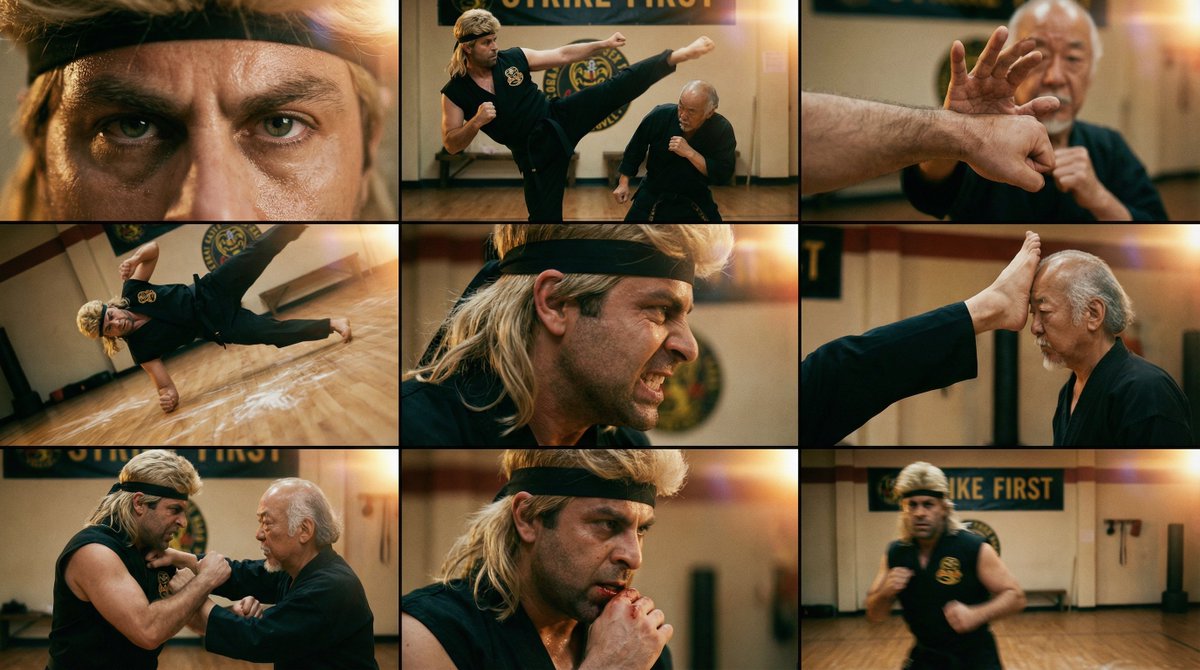
Seedance 2.0 (Bytedance): A repeatable “one prompt” format is spreading via a fighting-game remix—"Mortal Kombat gameplay footage but the characters are famous world leaders"—as shown in the World leaders gameplay clip.

The meme value here isn’t just the scene; it’s that the prompt reads like a template you can swap (game + genre + cast) and rerun quickly, which is why it’s getting reposted as a reusable prompt block rather than a one-off idea.
“Real or Seedance 2.0?” bait evolves into “Seedance can rap” music-video claims
Seedance 2.0 (Bytedance): Following up on Bait template (the reusable “Real or Seedance?” post format), creators are now pairing the bait with a new claim: Seedance v2.0 can generate rap/music-video style output with “no lyrics provided; just input frames + text,” as described in the Rap claim clip.

The tweets don’t show a clean, reproducible settings breakdown for the “rap” behavior yet; what’s clearly new is the framing shift from image-to-video realism to video-as-music-visualizer workflows.
Seedance 2.0 “same prompt” repost chains become a distribution mechanic
Seedance 2.0 (Bytedance): “Same prompt” repost chains are being used as a lightweight eval + growth loop: one creator posts a prompt, tags a cluster of accounts to run it, and then reposts the alternative generations as the thread payload, as illustrated by the Same prompt rerun.

This is effectively prompt-as-brief distribution: the creative differentiator shifts to small wording and seed/starting-frame choices, while the social object is the shared prompt itself.
Seedance 2.0 battle choreography: Pokémon fight clip called unusually smooth
Seedance 2.0 (Bytedance): A Pokémon battle example is getting singled out as a motion-quality flex (“smooth and realistic”) in the Pokemon battle example, continuing the broader pattern that fight/blocking choreography is where Seedance often looks best.

If you’re building short action beats, this is the kind of prompt family that tends to reveal whether the model can keep continuity through fast impacts, camera moves, and repeated character interactions.
Seedance 2.0 meme-sports prompt: “real-life Olympics footage of animals competing”
Seedance 2.0 (Bytedance): A fast meme-sports generator prompt is circulating—"Real life sports event footage of different animals competing in the olympics"—with the montage-style output shown in the Animals Olympics montage.

The practical creative use is rapid-format iteration: you can keep the “broadcast sports realism” wrapper constant and swap only the competitors/event to manufacture a series.
Seedance 2.0 realism stress test: “very elderly seniors fighting in UFC”
Seedance 2.0 (Bytedance): Another “one prompt” format being used as a realism + motion stress test is "Live action real life footage of very elderly seniors fighting aggressively in a UFC event fight," with the result shown in the Elderly UFC fight test.

As a creator tactic, these prompts are less about the joke and more about forcing hard cases (faces, limbs, contact, pacing) into a short duration so failure modes are obvious.
Seedance 2.0 workaround reports: outputs turn into unrelated chaos
Seedance 2.0 (Bytedance): Early reliability chatter includes reports of a “workaround” that bypasses a limitation but produces chaotic footage unrelated to the input, with an example shown in the Chaos unrelated output.

This is a practical warning sign for teams trying to productionize: the model may look strong in its “happy path” prompt families, while edge-path hacks can collapse into non-conditioned noise.
Seedance 2.0 “we’re cooked” rhetoric spreads alongside filmmaking displacement claims
Seedance 2.0 (Bytedance): The dominant sentiment layer in today’s feed is escalation rhetoric—“we’re cooked” montages and “Hollywood is cooked” reposts—where capability perception is the product being shared, as seen in the We’re cooked montage and echoed in the Filmmaking forever claim.

There isn’t new technical evidence in these posts beyond the montage format; what’s new is how quickly the discourse is shifting from “look at this clip” to “this changes the medium,” which tends to drive more template prompts and repost chains.
Seedance 2.0 prompt parody: “throw a bunch of BS on screen… get 50 likes”
Prompt culture signal: Creators are now parodying the “one prompt” era with deliberately low-specificity prompts (“toss a bunch of… on screen… make sure it’s insane and gets at least 50 likes”), with an example output in the Prompt parody clip.

The meta-point is that promptcraft is becoming self-aware: virality constraints (“make it insane”) are getting written into prompts as part of the creative brief, not just the caption.
📽️ Everything besides Seedance: Kling 3.0 cinematic realism, Luma city films, and short-form character direction
Non-Seedance video creation today clusters around Kling 3.0 “directable” 15s scenes, plus a few cinematic city/atmosphere clips. This section is for capability demos and short-film drops; platform availability and contests are covered elsewhere.
Kling 3.0 holds together on a fast anime chase + wolf transformation stress test
Kling 3.0 (Kling): A detailed “anime chase + violent mid-run transformation” prompt is being used as a motion-and-detail stress test, with the creator saying earlier attempts in v2.6 and other video models didn’t fully land but this one renders “even the tiniest detail,” as described in the Transformation stress test.

• Prompt structure: The prompt explicitly calls for erratic camera whip speed, body-energy effects, bone shifting/silhouette snapping, and a final impact beat (“exaggerated anime speed and impact”), which makes it a good template when you need both action readability and transformation continuity, per the Transformation stress test.
Kling 2.6 face swap mode shows fast talking-head reshoot replacement
Kling 2.6 (Kling): A creator demo shows a “record vertical clip → upload → choose face swap → add target face” workflow, claiming Kling then matches expressions, lips, and head movement—framed as “same script, same pacing, different face,” in the Face swap walkthrough.

• What’s concrete here: The post anchors the turnaround claim (“under 60 seconds”) and the exact step sequence in the Face swap walkthrough, which is useful for estimating edit-loop speed even if quality varies by source footage.
Kling 3.0 handheld realism test: shaking Tube car and a dancer in the aisle
Kling 3.0 (Kling): A single-image, single-prompt scene leans into “commuter realism” (carriage shake + handheld feel) while directing a specific foreground action (a woman stands and dances as others ignore her), as shown in the London Underground prompt demo.

• Why this specific prompt matters: It’s a compact way to test whether the model can preserve background extras doing “nothing” while a single character performs a new action, without the whole shot turning into universal motion.
Grok Imagine now supports multiple image references in a single generation
Grok Imagine (xAI): A UI capture shows the ability to upload multiple image references at once (“stacked thumbnails” above a prompt box), positioning multi-reference as a practical control surface for steering identity/style in generations, according to the Multi-image reference upload.
Kling 3.0 “simple prompt” test pushes micro-acting and a hard cut to black
Kling 3.0 (Kling): A creator argues Kling 3.0 “performs really well with simple prompts,” backing it with a short cinematic micro-scene that ends on a trunk close to black in the Simple prompt clip.

The intended beat is spelled out in the start-frame/prompt share—two characters trading one line each, then “He closes the trunk, pitch black,” as captured in the Prompt text in alt.
Kling 3.0 start+end frames get used as a consistency clamp for character shots
Kling 3.0 (Kling): A Tripo→Blender pipeline ends with Kling 3.0 using a start frame and an end frame to keep character consistency “spot on,” positioning start/end conditioning as the final control layer when turning 3D renders into short narrative motion, per the Start and end frame demo.

Luma’s “Midnight Tokyo” leans into city-atmosphere montage as stock footage
Luma (LumaLabsAI): A short “Midnight Tokyo” montage focuses on neon street energy, trains, and traffic—another example of AI video being packaged as atmospheric city B-roll rather than character narrative, as shown in the Midnight Tokyo clip.

🧬 Identity + continuity: locking characters, swapping faces, and reference-driven consistency
Creators are fixated on keeping characters consistent across shots and versions—today that shows up as face-swap workflows, “locked character consistency” marketing claims, and start/end-frame consistency talk. Excludes Seedance Story Mode (covered as the feature).
Kling 2.6 face swap compresses “reshoots” into a 60-second upload step
Kling 2.6 (Kling): A creator shared a fast face-swap recipe that keeps performance continuity—same script, pacing, head motion, and lip movement—while swapping the on-camera identity, as laid out in the Step-by-step workflow.
• Workflow steps: Record a vertical talking clip → upload to Kling 2.6 → choose Face swap mode → add the target face image → Kling auto-matches expressions/lips/head movement, per the Step-by-step workflow.
The post frames it as “no reshoots” and “no editing headache,” but it doesn’t include failure cases (occlusions, fast head turns, profile angles) in the Step-by-step workflow.
Grok Imagine adds multiple image references to stabilize subject identity
Grok Imagine (xAI): Grok’s image UI now supports uploading multiple reference images to condition a new generation, positioning this as a practical identity-locking control surface in the Multi-reference announcement.
The screenshot in the Multi-reference announcement shows several reference thumbnails stacked above a “Type to imagine” prompt field, which is the kind of UI affordance creators use when they need a consistent person/character across variations (wardrobe changes, new scenes, different lenses) without drifting facial structure.
Kling 3.0 start/end frames are being used as “consistency rails”
Kling 3.0 (Kling): A 3D-to-video workflow highlights start + end frame prompting as the control lever for keeping shots coherent—“consistency is spot on,” according to the Start and end frame demo in a Blender/Tripo pipeline.
The thread frames the idea as: generate or render your exact first/last frames, then let Kling fill the in-between while minimizing character/pose drift, as shown in the Start and end frame demo and set up in the broader 3D animation workflow.
Grid-first story control: 3×3 variations, then lock continuity with start/final frames
Shot planning pattern: A mini-tutorial shows a repeatable control loop for continuity—generate a 3×3 grid of variations, pick frames as “isolated stills,” then generate a continuous clip by providing start and final frames, as demonstrated in the Grid to continuous clip demo.

This is essentially a lightweight storyboard-to-motion pipeline: the grid stage functions as casting/wardrobe/pose exploration, and the start/final frames stage acts as an identity/scene anchor to reduce drift, per the Grid to continuous clip demo.
VEED ships Kling 3.0 with “locked character consistency” as the headline
Kling 3.0 on VEED (VEED): VEED announced Kling 3.0 availability and led with “locked character consistency” as a core promise for brand social output in the VEED integration post.
The early creator example content being amplified alongside the rollout includes trailer-style tests (e.g., “Ali vs Tyson”) in the Trailer example, but the VEED post doesn’t specify which knobs/constraints (reference images, seed locking, per-shot character IDs) are used to achieve the claimed consistency in the VEED integration post.
Directable, consistent characters become the selling point for 15-second micro-films
Kling 3.0 (Kling): Creators are increasingly describing “directable, consistent characters” as the unlock for short narrative work, with one short-film share calling out 15-second clips and character consistency as the “game changer” in the Short film claim.
This sentiment lines up with how Kling 3.0 is being distributed and demoed—packaged inside creator tools and shown via reference-anchored shots like the single-image prompt test in the Leonardo prompt example—but the tweets don’t provide a standardized method (character IDs, reference packs, or shot-level constraints) for reliably reproducing that consistency across a whole sequence.
Kling Video 3.0 lands on LeonardoAI with one-image prompting demos
Kling Video 3.0 on LeonardoAI (LeonardoAI): A creator noted Kling 3.0 is now accessible inside LeonardoAI and shared a 15-second single-image prompt test (London Underground scene) to illustrate how much you can preserve from a starting reference, per the Leonardo prompt example.
The post emphasizes “single image and a single prompt” as the setup in the Leonardo prompt example, which is typically where character continuity succeeds or fails (wardrobe, face structure, and shot-to-shot stability when there’s only one anchor).
🧾 Copy/paste aesthetics: Midjourney SREFs, collage prompts, and Nano Banana product looks
Lots of today’s creator value is promptable aesthetics: Midjourney SREF codes (with use-case framing), collage-style prompts, and JSON-like product render specs. Excludes Seedance prompt scripts (kept in the feature).
“Hands behind frosted glass” product-photo spec for luxury editorial renders
Product photography prompt spec: A full JSON-like scene contract describes a high-key white seamless setup where the product stays razor sharp and centered while two hands appear behind frosted glass (diffused, semi‑opaque, out of focus), including camera cues like 85mm at f/2.0, as specified in the Frosted glass prompt spec.
A key detail for ad work is the explicit “preserve” constraints—preserve_product_identity, preserve_label_text, and preserve_object_shape—paired with a reviewable visual target (hand diffusion only) demonstrated in the Frosted glass prompt spec.
Nano Banana Pro “crystal hologram” JSON prompt for iridescent product renders
Nano Banana Pro: A structured “Crystal Hologram Effect” prompt spec is shared as JSON—centered levitating product on pure black (#000000), heavy spectral iridescence + prismatic refraction + internal glow, plus strict negatives like “No text” and “No props,” as written in the Crystal hologram JSON.
The attached examples in Crystal hologram JSON show the look generalizing across sneakers, a Game Boy-like device, a retro phone, and an OP‑1‑style synth—useful if you need a consistent “drop day” product carousel aesthetic.
A reusable “90s teen magazine collage” prompt template for any subject
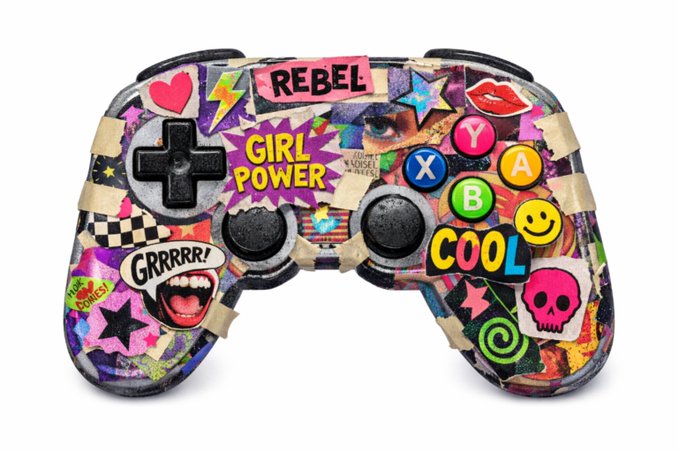
Collage prompt recipe: A copy/paste prompt turns any subject into a layered “90s teen magazine cut-out collage” look—jagged scissor cuts, holographic stickers, neon marker doodles, xerox textures, masking tape, and a clean white background—shared verbatim in the Collage prompt drop.
Because it’s written as a transform prompt ([TURN THIS] into…), it ports cleanly across image models that accept style-heavy instructions, and the example outputs in Collage prompt drop show it working on portraits, objects, and pets.
Midjourney --sref 2323430247 pushes a Neo‑Retro Pop Comic poster look
Midjourney (SREF): A high-energy “neo‑retro pop + modern comic” look is being circulated as --sref 2323430247, positioned for album covers, fashion branding, and posters with aggressive color contrast, according to the Sref pitch.
If you want the closest copy/paste starting point, PromptsRef links a longer structure guide in the Prompt guide page, which helps keep the style consistent when swapping subjects (a common failure mode when you only tweak the text prompt).
Midjourney --sref 3001861595 for cinematic 2D character design turnarounds
Midjourney (SREF): A new style reference gets shared as --sref 3001861595, pitched for cinematic character design in a 2D-animation lane (organic linework, matte colors, narrative concept-art vibe) in the Style reference drop.
A practical way to use it is to keep your subject prompt stable (character description + turnaround sheet / expression sheet) and treat the SREF as the “art director” that keeps line quality and palette cohesive across iterations, as implied by the example sheets in Style reference drop.
Midjourney --sref 633695773 for Blade Runner‑ish volumetric gold lighting
Midjourney (SREF): A cinematic sci‑fi lighting recipe is being shared as --sref 633695773, framed as “volumetric golden light against industrial blacks” for Blade Runner 2049–style key art, per the Lighting recipe post.
PromptsRef also points to a more prescriptive prompt structure in the Prompt guide page, which is useful when you’re trying to keep the same lighting logic across character posters and product hero shots.
PromptsRef’s daily “top SREF” post spotlights an Eastern fantasy illustration stack
PromptsRef (Midjourney SREF tracking): A daily “most popular sref” post calls --sref 3003906953 --niji 7 --sv6 the current Top 1 and frames the look as “New Oriental Fantasy Illustration” (anime × Art Nouveau × Ukiyo‑e), including use cases and prompt inspirations in the Daily top sref analysis.
The underlying mechanic here isn’t just the code—it’s the repeatable analysis format (style breakdown + use cases + prompt starters), with the larger library positioning shown on the Sref library page.
🖼️ Image generation that performs: Firefly’s “miniature Olympics” format + high-fashion photoreal sets
Image posts today skew toward repeatable engagement formats (Firefly diorama “sports inside objects”) and photoreal fashion/editorial outputs. Prompts and SREF codes are intentionally excluded (see the prompts category).
Firefly “mini Winter Olympics inside objects” dioramas keep expanding across events
Adobe Firefly (Adobe): The “miniature Winter Olympics venue inside a food/object cross-section” format keeps getting iterated as a repeatable performance-post template, with multiple new event skins made in Firefly by the same creator—speed skating inside a star-shaped form in the Speed skating diorama, hockey inside a dragon fruit in the Hockey in dragon fruit, curling inside an orange segment in the Curling in orange, biathlon inside a sliced strawberry in the Biathlon in strawberry, and a snowboarding concept that turns a banana into a halfpipe in the Banana halfpipe.
The images lean on the same mechanics each time (tiny crowd, event signage like “Milano Cortina 2026,” a clear focal sport action), which makes it easy to keep the series coherent while swapping the sport and container object.
Stages AI pushes “unedited” photoreal fashion sets as the new baseline
Stages AI (Stages) + Reve: A creator claims photoreal image output is now “in the rearview mirror” for uncanny-valley artifacts, backing it with multiple unedited editorial/fashion generations made in Stages AI, including high-contrast B&W beach scenes and close-up floral-garland portraits in the Unedited generations claim.
The same account also shows a Stages workspace view with grids of outputs and settings, positioning it as a production UI rather than a one-off generator, as seen in the Stages interface screenshot.
Firefly Hidden Objects Level .007 continues the “find 5 items” engagement puzzle
Adobe Firefly (Adobe): “Hidden Objects | Level .007” extends the ongoing Firefly line-art puzzle format—following up on Level 006 (the repeating “find 5” mechanic)—with a dense steampunk/clockwork illustration that embeds five target objects to spot, as shown in the Hidden objects level 007.
The visual layout keeps the same high-reply structure: a single busy scene plus a bottom row of the items to find (with checkboxes), making it straightforward to serialise as numbered “levels.”
🧩 Workflows & agents: interactive content formats, research-as-a-service prompts, and creator automation
Workflow posts today focus on how creators work: interactive content as a new medium, Claude-driven research/prompt packs for real business tasks, and small bots that reduce coordination overhead. Excludes pure coding-model news (separate category).
Loopit reframes AI creation as interactive, not just video
Loopit (Loopit AI): A thread claims Loopit turns plain text into interactive, playable content—no source image required, with “~5 minutes to make something playable” and remix/share mechanics called out as the distribution hook, using an Elon repost as the attention catalyst in the Loopit repost analysis.
• Format claim: The post frames a progression “Midjourney → Sora → Loopit” and argues the real product is a new content category (experiences that hold attention longer than passive media), as laid out in the Loopit repost analysis.
What’s missing in the tweets is any technical explanation (engine, hosting, or runtime constraints), so this remains a format thesis more than a spec sheet.
Claude prompt recipes get marketed as a replacement for paid research work
Claude (Anthropic): A thread argues you can replace expensive analyst/consultant-style work with a reusable prompt set—covering literature reviews, competitive intelligence, survey pattern mining, and trend forecasting—starting from the pitch “You don’t need a $1,500/hr consultant anymore” in the prompt thread opener.
• Copyable prompt shapes: Examples include a literature review gap-analysis table prompt shown in the lit review prompt and a competitor-site extraction prompt captured in the competitive scanner prompt.
• Operating assumptions: The same thread claims a setup centered on “Claude Opus 4.5” plus long-context + web search, and frames the cost as “$20–60/month,” as stated in the setup cost claim.
This is heavily promotional framing; the tweets don’t include an audit trail (sources used, error rates, or comparison to human outputs) beyond anecdotal time-saved claims.
A Claude-powered scraper becomes lightweight contest infrastructure
Claude (Anthropic): A creator running a competition says they built a bot with Claude that scrapes every submission (nearly 800 entries, many 3+ minute videos) so judging doesn’t miss anything, as described in the contest update.

The notable workflow point is using an LLM as glue code for “ops hygiene” (collection/completeness) rather than creative generation, per the contest update.
AI-assisted cold outreach gets templated as “personalized mockups at scale”
Cold outreach workflow: One post lays out an AI-assisted sales loop for landing design/apparel clients: identify 20–30 prospects, generate 6–9 customized content pieces per prospect, then DM the designs + offer—summarized as “Proactivity + personalization = 5–10× sales rate” in the cold outreach steps.
The post references a supporting guide on email/DM structure via the Email/DM article, and explicitly adds “no guarantees” language in the cold outreach steps.
A spend-control layer gets positioned as mandatory for autonomous agents
Agent Trust Hub: A short post frames a failure mode where an autonomous agent “learns” a new behavior and burns through budget unnoticed, pitching Agent Trust Hub as a way to keep spending under control, as described in the spend control pitch.
No feature list, integrations, or enforcement mechanism details are provided in the tweet; it’s positioning more than a documented release, per the spend control pitch.
Live voice prompting gets reframed as an improv skill, not a feature
Creator workflow signal: A post argues that being good at freestyle voice dictation—especially “voice coding a prompt”—maps to the same on-the-spot speaking skill as delivering an impromptu prayer at a family dinner, as put in the dictation analogy.
It’s a cultural shift claim: prompting speed and verbal improvisation get treated as a differentiator for creators who work live, per the dictation analogy.
🛠️ Single-tool tips creators can use today (Firefly Boards, Photoshop, and prompt-to-clip utilities)
A smaller but useful set of single-tool tips surfaced: quick Firefly Boards tricks, Photoshop compositing helpers, and compact “grid-to-clip” creation patterns. Multi-tool pipelines are routed to workflow categories instead.
Kling 2.6 Face Swap mode: swap the actor while keeping performance
Kling 2.6 (Kling): A creator walkthrough breaks down a fast Face Swap flow for vertical talking-head clips: record a simple phone video, upload to Kling 2.6 in Face Swap mode, add the target face, and Kling auto-aligns expressions/lips/head movement—framed as “same script, same pacing, different face” in the Face swap steps.
This is especially relevant for ad variations, character tests, localization experiments, or creator-led “multiple spokespeople” A/B tests without re-recording.
3×3 grid to isolated stills to start/end-frame clips in one tool
Prompt-to-clip workflow pattern: A compact creation loop is shown end-to-end: generate a 3×3 grid of variations, pick/extract the best “isolated stills,” then produce a continuous clip by supplying start and final frames—all presented as working inside one interface in the Grid to clip tutorial.
The key creative value is faster iteration: you explore composition/wardrobe/action as a grid first, then only pay video tokens on the best candidates.
Adobe Firefly Boards glitch-art GIFs become a shareable micro-tutorial
Adobe Firefly Boards (Adobe): A small but practical creator trick is circulating for turning stills into looping “glitchy” GIF-like motion using Firefly Boards, framed as a repeatable mini-tutorial in the Glitch GIF tip. Follow-up replies suggest people are actively remixing the prompt/process and posting results, per the Reaction reply and Experiment reply.
This matters because it’s a lightweight “motion accent” you can drop into social posts without committing to full video generation—useful for mood boards, cover loops, and visualizers when you need movement more than narrative.
Photoshop’s Harmonize gets highlighted as a fast realism pass for composites
Photoshop (Adobe): The Harmonize feature is getting called out as a high-leverage compositing helper—drop an object into a scene, then use Harmonize to blend it more naturally (lighting/color integration) as noted in the Harmonize mention.
This is the kind of unglamorous step that saves time when you’re assembling frames for AI video start/end references, pitches, posters, or product mockups—especially when the base assets come from different generators and don’t match out of the box.
Creators call for AI outputs that render charts, not walls of text
AI product UX: A simple interaction pattern gets praised: upload a spreadsheet and receive instant charts instead of a long text response, with the argument that more AI tools should default to visual outputs when the input is structured data, as stated in the Spreadsheet to charts note.
For creatives, this is a signal about where “assistant” tooling is going: less chatty summarization, more direct rendering into usable artifacts (charts, boards, layouts) that can be dropped into decks, treatments, and reports.
🏗️ Where models land: VEED/Leonardo distribution, Hugging Face org moves, and collaborative boards
Today includes multiple “where to use it” updates: video models appearing inside creator platforms, org presences on Hugging Face, and new collaborative workspaces. Excludes raw model capability clips (kept in video sections).
Runway raises $315M Series E to push world simulation models
Runway (Company): Runway announced $315 million in Series E funding to “pre-train the next generation of world models,” framing world simulation as the core roadmap in the Funding announcement and expanding details on investors and intent in the Funding post.
For creatives, this is a distribution-and-capacity signal more than a feature drop: it suggests continued acceleration in “world model” products that sit upstream of video generation, with Runway explicitly tying the capital to scaling pretraining in the Funding post.
Topview introduces a collaborative AI video board built around shared prompts and assets
Topview Board (TopviewAIhq): Posts describe a shared “board” workspace for teams—closer to a Figma canvas than a single prompt box—where a workflow runs prompt → image → video → avatar without hopping tools, as described in the Launch description and Board positioning.

• Collaboration surface: The claim is real-time iteration with the team inside one board (prompts, images, videos, avatars together), per the Launch description.
• Model aggregation: The product page emphasizes “create with the best AI models—together,” with a model list shown on the Models page.
What’s still unclear from today’s tweets is which specific video models are available at launch and how pricing/credits compare across them—those details aren’t enumerated in the Launch description.
Kling 3.0 lands in VEED as a creator-friendly distribution channel
Kling 3.0 (VEED): VEED says Kling 3.0 is now live inside its editor, positioning it for “brand’s socials” workflows and highlighting “locked character consistency” in the rollout copy shared in the VEED announcement. The practical implication is that Kling’s generation is being packaged into a mainstream, template-driven web editor rather than only model-native UIs, which typically pulls in less-technical creative teams who already cut captions and exports there.
No pricing, credit policy, or feature matrix is shown in today’s tweets beyond the marketing bullets in the VEED announcement.
LeonardoAI adds Kling Video 3.0, shown with a single-image prompt test
Kling Video 3.0 (LeonardoAI): Creators are pointing out that Kling Video 3.0 is now accessible via LeonardoAI, with one example generated from “a single image and a single prompt” in the Leonardo Kling demo.
The prompt used in the demo (train shake, handheld feel, a dancer in the aisle while other riders ignore her) is included verbatim in the Leonardo Kling demo, which makes this a clean reproducible “distribution + recipe” moment rather than a vague availability note.
Anthropic appears as a verified company on Hugging Face
Anthropic (Hugging Face): A screenshot shows Anthropic as a verified “Company” org on Hugging Face—i.e., a first-party identity node for models/datasets/docs discovery—shared in the Verified org screenshot.
This matters mostly as distribution plumbing: once a lab’s “official” org becomes the canonical handle, creators tend to treat it as the safest place to find the right artifacts (and avoid spoofed uploads), which is the subtext of the Verified org screenshot.
Comfy Cloud points creators to a hosted Kling 3.0 workflow template
Comfy Cloud (ComfyUI): A Comfy Cloud link is being shared as a way to try Kling 3.0 through a prebuilt online template, as indicated by the Comfy Cloud link. The landing page positions it as “run ComfyUI online without setup,” which turns a local-node graph into a shareable distribution artifact for teams, as described on the Cloud template page.
💻 Agentic coding for creators: Qwen CLI stacks, repo-to-PR fixes, and text extraction without regex
Creator-adjacent dev tooling is moving fast: open-weight coding models + CLIs, automated “prompt → code → rendered output” demos, and LLM-grounded extraction libraries for turning messy text into structured data. Excludes GPU/kernel RL (covered in compute).
Qwen Code CLI markets itself as the open-source terminal alternative to Claude Code
Qwen Code CLI (Qwen): Qwen’s terminal-based coding agent is being promoted as the “best open-source alternative to Claude Code,” including a stated free tier of 1,000 requests/day in creator threads like CLI positioning and Feature list; the official docs page describes signup and workflows in the CLI guide. There’s a small mismatch in the free quota as presented: the docs page mentions 2,000 free requests/day (no card) while the social posts repeatedly say 1,000/day, as contrasted between Comparison post and the CLI guide.
• Workflow knobs called out: Posts mention “Skills, SubAgents, Plan Mode” and OpenAI API compatibility, as listed in Feature list.
• Positioning vs Claude Code: The explicit comparison “paid, closed-source” vs “open-source, free daily requests” is spelled out in Comparison post.
Qwen3-Coder-Next pushes “3B active params” agentic coding positioning
Qwen3-Coder-Next (Qwen): A new open-weight coding model is being positioned as an “agent-first” MoE—80B total parameters with ~3B active per forward pass—with claims it beats far larger-active models on SWE-Bench-Pro in the launch writeup from Launch claims; downloads and entry points are linked via the GitHub repo and the Hugging Face collection. The framing is explicitly cost/perf: “Only 3B active parameters” and “size is a lie,” as stated in Launch claims, but no eval artifact is included in the tweets beyond the assertion.
• Training focus: Posts emphasize verifiable coding tasks in executable environments and “long-horizon reasoning & recovery from failures,” per Agent-first details.
• Creator-adjacent angle: The same thread ties the model to “agentic workflows” and end-to-end automation demos, as shown in Launch claims and later examples like Remotion demo.
Google’s LangExtract targets grounded extraction without regex parsing
LangExtract (Google): A new open-source Python library is being shared as a “structured extraction from unstructured text” tool that uses LLMs while grounding every extracted field back to a specific source span, according to Feature rundown; the project is available in the GitHub repo. Posts describe a multi-pass pipeline (chunking, parallel passes) plus an interactive HTML visualization for review, and cite a stress test on Romeo and Juliet (147,843 characters) using Gemini 2.5 Flash, per Feature rundown.
The core creative utility is turning messy briefs/contracts/transcripts into structured tables with provenance (where the text came from) rather than free-form summaries, as positioned in Feature rundown.
Prompt-to-video via Remotion is demoed with Qwen3-Coder-Next and Qwen Code CLI
Qwen3-Coder-Next + Remotion: A creator-facing demo shows “Prompt → code → rendered video” using Remotion, presented as a no-manual-debugging loop in Remotion demo, building on the broader claim that the model is trained for agentic workflows in Launch claims.

For filmmakers and motion designers, this is the concrete shape of “LLM as production glue”: generating the code that produces the edit/render artifact rather than just generating a clip directly, as described in Remotion demo.
FixMyApp AI pitches a repo-to-PR service for broken vibe-coded apps
FixMyApp AI: A new service is being pitched for founders whose AI-built MVPs break in production—“connect your repo → describe the bug → get a PR in 48 hours,” as shown in Service explainer and expanded in the Product site.

• Stated focus: The thread frames this as a common failure mode for Cursor/Bolt/Replit/Lovable-style builds (“auth breaks, APIs timeout, edge cases”), and positions the differentiator as human engineers who specialize in AI-generated codebases, per Service explainer and Non-technical founder angle.
Qwen3-Coder-Next is demoed doing long-horizon desktop cleanup automation
Qwen3-Coder-Next agent demo: A “messy desktop cleanup” example shows the pattern “analyze files → write a Python script → execute organization” as a single agentic task, framed as what the model was trained for in Desktop cleanup demo.

The demo is presented as long-horizon automation rather than code completion, echoing the model’s “agentic workflows” positioning in Launch claims.
⚙️ Compute that changes creator economics: RL kernel optimization + real GPU speedups
A clear compute thread today: reinforcement learning systems that optimize CUDA kernels and claim measurable wins over standard libraries—important because faster kernels directly reduce render/inference bills. No broader hardware news included.
IterX uses reinforcement learning to auto-optimize CUDA kernels and claims cuBLAS wins
IterX (DeepReinforce): DeepReinforce is being pitched as having “dropped IterX,” an automated reinforcement-learning system that takes in code, explores optimization paths, and outputs faster implementations—framed as already “beat[ing] cuBLAS across 1,000 matrix configs” in the IterX announcement thread.

• What’s new vs typical code assistants: the thread draws a line between “suggestions” and IterX’s benchmarked search loop—“It doesn’t guess… benchmarks them… and iterates,” as described in the Comparison to Copilot follow-up.
• Baseline pedigree they cite: IterX is positioned as building on CUDA-L1 and CUDA-L2 claims, including “3.12x average speedup” across “250 real-world GPU tasks” with “up to 120x” peaks and matmul results that “surpass… cuBLAS,” per the CUDA-L1 and CUDA-L2 recap.
• Workflow surface area expansion: a later note says “Agent integration is now supported,” implying IterX can plug into broader automation loops, per the Agent integration note.
The economics argument is explicit: GPU scarcity and cost make even marginal speedups meaningful, with the thread using “H100… $30,000+” as a reference point in the Cost framing.
Contrastive RL turns kernel benchmarking into a self-improving speedup loop
Contrastive reinforcement learning loop: The IterX thread spells out a repeatable pattern for performance work—generate multiple kernel/code variants, run benchmarks, contrast “fast vs slow” versions, and use speed as the reward signal—summarized as “self-improving optimization on a loop” in the Contrastive RL breakdown.
• Why “contrastive” matters: instead of treating benchmarks as a one-off eval, the approach treats them as training signal (“compares fast vs slow… learns WHY some are faster”), as stated in the Contrastive RL breakdown.
• How it differs from prompt-level refactors: the thread emphasizes RL search over a large variant space with automated measurement, describing a system that “explore[s] thousands of optimization paths” in the Optimization paths explanation.
• Creator economics hook: the same thread explicitly frames “Every 1% speedup = 1% less cloud spend,” connecting micro-optimizations to real budgets in the Cost framing.
As presented, this is less a single “CUDA trick” than a general recipe for turning execution environments + measurement into iterative improvement.
📅 Contests, launches, and meetups creators can act on
Today’s calendar items skew toward platform contests, creator meetups, and public launches—useful for visibility, prizes, and networking. Tool releases not tied to an event are excluded.
OpenArt’s Kling 3.0 Challenge goes live with a $15,000 pool
OpenArt (Kling 3.0): OpenArt opened a new Kling 3.0 creator challenge with a $15,000 prize pool, positioning it as a prompt-to-cinematic competition, as stated in the Challenge announcement. For creators, this is a clean “ship a short, get judged” distribution lane that also doubles as a public benchmark of what Kling 3.0 outputs look like in the wild.
Claude-powered contest ops: scraping ~800 entries for judging
Claude (Workflow pattern): A contest host described managing nearly 800 entries (many 3+ minute videos) and building a bot with Claude to scrape every submission so judging doesn’t miss anything, according to the Contest update.
The practical pattern here is “AI as back-office glue” for creative events—organizing intake and review at a scale that would otherwise turn into spreadsheet triage.
COMUNIDAD lands KFFSS Kursaal Film Festival selection (San Sebastián 2026)
COMUNIDAD (Festival selection): Following up on Bionic finalist (Bionic Awards finalist slot), the project also announced it’s in the Official Selection for the KFFSS Kursaal Film Festival in San Sebastián 2026, as stated in the Festival selection note.

For AI filmmakers, it’s another data point that these works are being routed into conventional festival calendars—not only AI-native showcases.
Tinkerer Club hits Product Hunt and fights for the top spot
Tinkerer Club (Product Hunt): Tinkerer Club launched on Product Hunt with a real-time “upvote race” vibe, with the launch push and in-the-moment updates shown in the Launch day push and the leaderboard snapshot that shows it at #1 with 347 upvotes in
.

• Leaderboard context: The same leaderboard image in
shows close competition (Agent Builder at 344 upvotes), matching the earlier “Top Products Launching Today” view in Top products list.
SuperRare highlights “We Have Digital Art At Home” curation lineup
SuperRare (Curation): A SuperRare curation page for “We Have Digital Art At Home” circulated with a featured artist list, as collected in the Exhibition lineup post and detailed on the Exhibition page. In the same thread, Rainisto promoted a related 48-hour auction for “Redflag” with a 0.01 ETH minimum, per the Auction announcement and the Auction listing.
Tinkerer Club’s first Vienna meetup pairs with an OpenClaw appearance
Tinkerer Club (Community): The team tied their Product Hunt day to in-person community building in Vienna—hosting a first Tinkerer Club meetup and also showing up at an OpenClaw meetup, as described in the Meetup and talk stack and reinforced by the group photo in the Meetup group shot.
This is the kind of “launch + IRL” pairing that tends to pull builders into a tighter loop (demos, follow-ons, collabs) rather than leaving the release as a one-day spike.
Stages AI posts a beta sign-up callout
Stages AI (Beta access): Stages AI pushed a public call to sign up for early beta updates, positioning it as a near-term launch people can opt into, as written in the Beta sign-up callout. No additional timeline or seat count is included in the tweet text.
📚 Research radar for creators: world models, multimodal alignment, faster text diffusion, and synced video-audio
Research posts today are heavy: world-model reasoning, multimodal representation alignment, text diffusion speedups, and open video+audio generation. Bioscience-related items are excluded entirely.
MOVA claims single-pass video+audio generation, open-sourced under Apache 2.0
MOVA (paper/model): A new open-source effort claims to generate video and audio together in one pass—positioned as avoiding the usual “generate video then add audio/lipsync later” cascade, per the Release rundown and the Paper pointer with details on the Paper page. Short sentence: one generation, both modalities.

• Specs and licensing (as claimed): The post describes 720p at 24fps for up to ~8 seconds; 32B total parameters with 18B active via MoE; Apache 2.0 with weights/inference/training code, all per the Release rundown.
• Why this matters to creatives: If synchronized dialogue/foley/ambient sound lands out-of-the-box, it changes what “first pass” means for animatics, previz, and social shorts—less time spent stitching sound on after the cut, as argued in the Release rundown.
Adaptive “how much to imagine” at inference for visual spatial reasoning
When and How Much to Imagine (paper): A new approach frames world-model reasoning as something you can scale at test time—the model adaptively decides how much internal simulation (“imagination”) to do based on task difficulty, as surfaced in the Paper pointer and detailed on the Paper page. This matters for creators building interactive/3D-ish pipelines because it’s pointing at a knob for “think longer only when needed,” instead of always paying worst-case compute.
The thread doesn’t include creator-facing demos yet, but the core idea is dynamic inference-time budgeting rather than fixed-depth reasoning.
Recurrent-Depth VLA uses latent loops to scale “thinking” at test time
Recurrent-Depth VLA (paper): This work proposes “implicit test-time compute scaling” for vision-language-action models via latent iterative reasoning—run more internal reasoning steps without changing the model size, as introduced in the Paper teaser. Short sentence: it’s “depth on demand.”

• Why creatives should care: If this holds up, it’s a path toward agents that can do longer-horizon physical reasoning (robotic manipulation, interactive scene tasks) by spending extra steps only on hard moments, as shown in the Paper teaser.
LLaDA2.1 speeds text diffusion using token editing, with speed vs quality modes
LLaDA2.1 (paper): A text-diffusion LLM update focuses on making diffusion-style generation practical by adding token-to-token editing plus a threshold decoding scheme that can trade speed for quality, as summarized in the Paper summary and documented on the Paper page. This is relevant to creators if diffusion-text starts powering more controllable scripting/beat-sheet generation loops where iterative editing is the default.
• Two operating modes: The paper describes a Speedy mode and a Quality mode (different thresholds), per the Paper summary.
Microsoft VibeVoice acoustic tokenizer shows up on Hugging Face
VibeVoice acoustic tokenizer (Microsoft): A release notice says Microsoft put the VibeVoice Acoustic Tokenizer on Hugging Face—framed as compressing speech/audio heavily (the post mentions “80x”), per the Release note. Short sentence: tokenizers are the bottleneck layer.
For voice, dubbing, and “video with integrated dialogue” stacks, better acoustic tokenization tends to mean cheaper/faster downstream speech generation and more tractable long-form audio modeling, but today’s tweet doesn’t include evaluation artifacts beyond the headline claim in the Release note.
Weak-Driven Learning uses weak checkpoints to keep improving strong agents
Weak-Driven Learning (paper): Introduces a post-training paradigm (WMSS) where “weak” historical checkpoints help a stronger agent find recoverable gaps when standard training saturates, as outlined in the Paper summary and expanded on the Paper page. Short sentence: it’s improvement without new inference cost.
For creative agent builders, the core takeaway is a new recipe for pushing reliability after a model hits a confidence plateau—use earlier, lower-confidence states as supervision signals, per the Paper summary.
ReAlign aligns text and image spaces via anchor/trace/centroid steps
ReAlign subspace alignment (paper): Proposes that the “modality gap” in multimodal LLMs is anisotropic (direction-dependent) and introduces a three-step alignment pipeline—anchor, trace, centroid—to better match text representations to image distributions, according to the Paper summary and the Paper page. Short sentence: it’s alignment as a transform, not retraining.
That’s potentially useful for creators building caption-to-image/video control stacks, because any method that reduces text↔image mismatch can show up as better prompt adherence and fewer “almost right” generations—if the reported gains replicate.
QuantaAlpha applies evolutionary search to LLM-driven “alpha mining”
QuantaAlpha (paper): Presents an evolutionary framework (mutation/crossover over multi-round trajectories) for LLM-driven alpha mining in noisy, non-stationary markets, as summarized in the Paper summary and expanded on the Paper page. Short sentence: it’s “prompting + search,” formalized.
Even if you’re not doing finance, the transferable idea for creative tooling is the loop design: treat candidate hypotheses/prompts/code as a population, score them, then evolve. The paper’s metrics and domain claims (including an IC figure) appear in the Paper summary, but the tweets don’t include a standalone benchmark artifact to audit.
🛡️ Creator trust shocks: Higgsfield backlash, alleged deception, and community enforcement-by-blocklist
The AI creative community’s trust story today is Higgsfield: accusations of deceptive marketing and IP/trademark risk, plus aggressive community responses (blocking CPP members, refusing apology tours). This is discourse-as-news, not tool capability.
Higgsfield CPP blocklists become a blunt enforcement mechanism
Higgsfield (community response): Following up on Account suspension (X suspension), the backlash is shifting from criticism to enforcement—multiple creators are explicitly calling to “block all CPP members” and employees, then doing mass blocks based on profile affiliations and even positive comments on apology posts, as described in Block CPP call, Blocking creators note , and Bio-based blocking.
• Blocklists as pressure tool: The tactic is framed as a way to cut social distribution and community access (including accidentally removing yourself from communities moderated by CPPs), per Bio-based blocking and Premature but blocking.
• Collateral and intensity: Posts describe blocking “every” supporter in replies and treating it as worth the collateral damage, as stated in Blocking positive commenters and reinforced by Unfollow and block list.
Creators reject the Higgsfield CEO “apology tour” framing
Higgsfield (reputation repair attempt): Posts explicitly dismiss the idea of a CEO-led reconciliation push—“apology tour” language is met with direct skepticism, per Apology tour skepticism, and is paired with clips meant to mock the posture and delivery, as shown in Mic stand parody clip.

• Support-buying accusations: Some creators claim the company (or its affiliates) is “buying support” with large dollar amounts rather than addressing allegations, as asserted in Buying support claim.
The dominant signal is that the community conversation has moved from “wait and see” toward “no rehabilitation,” with public affiliation itself becoming the target (see Bio-based blocking).
Higgsfield Cinema Studio camera-gear naming becomes an IP/trademark flashpoint
Higgsfield Cinema Studio (allegation): A screenshot-driven claim says Higgsfield previously showed real camera/lens branding and specifications in its “Cinema Studio” UI, then quietly replaced them with generic names—framed as a trademark/IP liability and “fraud” risk by critics, as laid out in UI naming claim.
• What’s being alleged: The critique isn’t about “cinematic presets” as a feature—it’s specifically about using brand names and photographic specs (f-stop, focal length, lens names) in a monetized UI while outputs aren’t from those cameras, per the commentary in UI naming claim.
No counter-evidence appears in the dataset; the story is circulating as a credibility wedge rather than a confirmed product change log.
The “$1.3B attempted takedown” Higgsfield narrative meets immediate pushback
Higgsfield media narrative: A screenshot of an article titled “Higgsfield: The Attempted Takedown of a $1.3 Billion AI Company” is being shared as an alternate framing of the controversy, as shown in Article preview screenshot.
• Community rebuttal: Critics describe the piece as “empty” (claiming it doesn’t address substance), per Argument called empty, and fold it back into the broader trust collapse dynamic rather than treating it as exonerating context.
What’s measurable here is the framing battle: “platform/community overreaction” versus “pattern of deception,” with the latter dominating the replies and follow-on actions in this dataset.
“Creating noise is easy. Earning trust is hard” lands as the backlash slogan
Trust meme (community signaling): A simple aphorism—“Creating noise is easy. Earning trust is hard”—is being reposted as a general indictment of AI creative-company hype cycles, with commenters implying it targets the Higgsfield moment, as captured in Trust quote image.
The key function of this meme in the thread ecosystem is shorthand: it compresses multiple allegations (marketing exaggeration, questionable partnerships, moderation drama) into a single line that’s easy to repost and hard to litigate point-by-point.
🌟 Notable creator drops: AI shorts, autonomous characters, and build-in-public tools
Beyond tool chatter, creators shipped recognizable “things”: short films, autonomous characters, and new DIY creation apps. This section is for named projects and releases (not generic cool clips).
Rendergeist: a Grok-powered web app that generates and edits music videos from prompts
Rendergeist (Ben Nash): Ben Nash shared a working build of Rendergeist, a web app that takes a seed prompt, expands it into multiple prompts, generates clips via Grok’s API, then lets you overlap/fade clips in a timeline and export an MP4, per the Build description.
• Model stack: It’s currently powered by Grok 4 and Grok Imagine, with other model integrations being evaluated in the Model roadmap note.

A bring-your-own-key version is explicitly planned, according to the same Model roadmap note.
Claude Opus 4.6 is being used to port a modern game into an NES ROM
Deadfall → NES (AIandDesign + Claude Opus 4.6): A creator documented using Claude Opus 4.6 to port their game Deadfall toward an NES ROM, including cc65/6502 toolchain commands and ROM inspection steps in the Build log screenshot.
They also shared an emulator run showing the ROM booting and gameplay in Mesen, as demonstrated in the Emulator demo.

The post frames this as “on its way to fully working,” so treat it as an in-progress port rather than a finished conversion, per the Porting claim.
CODEYWOOD’s end-to-end test: a 2m30 children’s story produced in ~90 minutes
CODEYWOOD (Kai Gani): A published end-to-end production test claims a 2m30 children’s story (“Where is Mr. Buttons?”) was produced in ~90 minutes, with an optional “fast mode” that could cut that to ~40 minutes, per the Timing claim and the Full story clip.

This is presented as a throughput benchmark more than a quality benchmark; the thread frames the key comparison as “months of fan animation” versus ~90 minutes of production time, according to the Full story clip.
Shizuku launches as a fully autonomous AI VTuber with multilingual live streams
Shizuku (VentureTwins): VentureTwins is introducing Shizuku as a “fully autonomous AI VTuber”—positioned as AI for voice, language, and live Q&A in one loop; they emphasize she can speak, sing, and answer viewer questions in several languages in the Autonomy description.

They also point people to her upcoming streams via the Stream schedule page, making this less of a demo clip and more of an ongoing, scheduled “character channel” release.
A new retrofuturist short shows the “stillness + subtle motion” AI film style
Artedeingenio (creator short): Following up on Retrofuturist pipeline (Midjourney → Grok Imagine → Suno), a new hand-drawn retrofuturistic sci‑fi short leans hard into restrained camera motion and atmosphere; the creator lays out the same stack—Midjourney for concept art, Grok Imagine for “extremely subtle” animation, and Suno for voice-over + soundtrack, as described in the Workflow breakdown.

The notable move here is treating “barely moving” frames as a deliberate aesthetic, not a limitation—more like animated graphic-novel panels than a traditional shot-by-shot sequence.
RetroZone open-sources a CRT + vector-glow display engine for retro games
RetroZone (AIandDesign / TheMarco): RetroZone was released as an open-source “display engine” for retro-style games, with an authentic CRT mode (256×224-ish feel) plus a vector-display mode with glow/bloom/phosphor trailing, as announced in the Open source release.

• Code + license: The repo is available via the GitHub repo, positioned for reuse in other projects.
• Playable examples: The author points to a Galaga/Galaxian-inspired shooter (“Vectronix”) as a working demo that reuses the engine, shown in the Vectronix gameplay note.

Runway announces $315M Series E to scale world simulation models
Runway (company funding): Runway announced $315M Series E funding to “pre-train the next generation of world models,” explicitly tying the capital to scaling world simulation work in the Funding announcement. The company’s own post links to more detail in the Funding details.
No product surface or creator-facing feature changes are specified in the tweets beyond the intent to fund more pretraining.
Orpheus and Eurydice goes live as an AI-adapted music/story release
Orpheus and Eurydice (GlennHasABeard): A new release titled “Orpheus and Eurydice” is described as “live,” framed as an AI-adapted project in the Release announcement. It reads like a launch/premiere moment rather than a tooling update, and the thread positions it as a finished creative object.
📣 AI for getting clients and attention: outreach playbooks, “voice as product,” and remixable formats
Marketing-oriented creator posts today emphasize practical growth: AI-assisted cold outreach, repeatable social formats, and the idea that tools must preserve a creator’s voice rather than template it away.
FixMyApp AI sells “repo to PR” debugging for vibe-coded MVPs in 48 hours
FixMyApp AI: A productized service is being pitched as an “AI mechanic” for AI-built MVPs—connect a repo, describe the bug, then receive a pull request in ~48 hours, positioned around the pain of auth breaks/timeouts/edge cases after deployment, per the [launch thread](t:28|FixMyApp pitch).
• Problem framing: The messaging targets founders who can generate an MVP with Cursor/Bolt/Replit but get stuck “prompting in circles” once production breaks, as described in the [production gap clip](t:351|Production gap clip).
• Commercial surface: The site and process are linked directly via the [FixMyApp site](link:312:0|FixMyApp site), with the offer framed as “fix it when production breaks” rather than another codegen tool.
AI-assisted cold outreach pipeline for landing design clients via personalized assets
Cold outreach pattern: A playbook for winning design/apparel clients by combining prospecting with AI-generated personalization—identify ~20–30 target clients, create 6–9 tailored content pieces for each, then DM/email with the work and iterate messaging based on replies, as laid out in the [cold outreach steps](t:125|Cold outreach steps).
• Personalization at scale: The pitch is that AI reduces the time cost of custom examples while keeping the human move (proactive outreach) intact, with concrete counts (20–30 prospects; 6–9 pieces) specified in the [workflow post](t:125|Workflow post).
• Copy + structure reference: The same thread points to a separate resource on writing better messages, linking the process side via the [DM email article](t:247|DM email article).
Freepik’s “Big League Effect” becomes a repeatable sports-celebrity self-insert format
Freepik (Big League Effect): A remixable social gimmick is being packaged as “put yourself in their shoes,” where the key deliverable is a believable self-insertion into major sports moments (NBA/NFL/soccer) with prompts provided in image alt-text, per the [format description](t:285|Format description) and follow-up examples like a [soccer tackle variant](t:335|Soccer prompt alt).
• Distribution mechanic: The post explicitly points to a “more effects” funnel and repeats that the set was “made using Freepik,” tying the format to a tool-branded growth loop in the [effects link post](t:393|Effects link post).
Creators argue AI tools must preserve voice, not erase it with templates
Creator voice positioning: A recurring marketing claim shows up in the form “your voice IS the product,” arguing that many AI content tools optimize for interchangeable template output while the differentiator for working creators is stylistic consistency across posts and campaigns, as stated in the [voice-as-product framing](t:199|Voice as product framing). The post frames “style-preserving” assistants as the desired direction for creator tools, rather than systems that make everyone sound the same.
A reusable reaction clip mocks “no AI for code” workplace policies
Meme format (workplace AI bans): A short reaction clip with the caption “we're sorry you're not allowed to use AI for writing code at this company” is circulating as anti-policy satire in creator/dev circles, as shown in the [captioned video](t:87|Policy satire clip).

The creative utility here is the format itself: a drop-in, repostable “policy friction” punchline that can be quote-tweeted onto threads about AI tooling norms.
While you're reading this, something just shipped.
New models, tools, and workflows drop daily. The creators who win are the ones who know first.
Last week: 47 releases tracked · 12 breaking changes flagged · 3 pricing drops caught