OpenAI audio device targets Q1 2026 – forecasts eye 50M users

Stay in the loop
Free daily newsletter & Telegram daily report
Executive Summary
OpenAI is unifying engineering and research around a new audio model architecture tied to a dedicated voice companion device slated for Q1 2026; reports describe a goal-focused assistant that talks with users in more natural, emotive speech than ChatGPT’s current modes while helping them reach goals. Led by ex‑Character AI researcher Kundan Kumar with Ben Newhouse on infra and Jackie Shannon on product, the team targets lower latency, higher accuracy on long-form answers, richer prosody, and barge‑in abilities where the model can speak and listen simultaneously.
• Creative pipelines: BeatBandit adds 2×2/3×3 grids, Nano Banana Pro rendering, 2K auto-upscales, and tagged recurring characters for story-long consistency; Higgsfield Cinema Studio and Luma’s Ray3 Modify tests anchor modular concept-to-motion workflows.
• Model frontier: DeepSeek’s manifold-constrained hyper-connections aim to stabilise large transformers while cutting memory; a GPQA Diamond chart shows scores nearly tripling as token prices fall ~90–99.7%, with several models clearing the human PhD band.
These threads sit against 2026 outlooks calling for continual-learning gains, dense roadmaps for Gemini 4, GPT‑6, Genie 4, and Veo 4, and a breakout voice-first product with 50M+ users.
While you're reading this, something just shipped.
New models, tools, and workflows drop daily. The creators who win are the ones who know first.
Last week: 47 releases tracked · 12 breaking changes flagged · 3 pricing drops caught
Top links today
- Kling 2.6 Motion Control tutorial video
- Overview of OpenAI 2026 audio model and device
- DeepSeek mHC manifold-constrained hyper-connections paper
- Freepik Space for generating multiple thumbnails
- Hedra Labs quick tutorial for dreamy videos
- Kling 2.6 Motion Control cute dance guide
- BeatBandit AI storytelling prompts and demo
- NotebookLM video summary of DeepSeek mHC paper
- AI creative workflow to start 2026
- Vidu AI selfie trend step-by-step guide
- Runware AI creative tools 2026 update
- Discussion article on recent AI development
- Pictory AI video creation platform for 2026
- Higgsfield Cinema Studio and Kling concept sequence
- Dream Machine Ray3 Modify behind-the-scenes video
Feature Spotlight
Voice-first agents: OpenAI’s Q1 audio push
OpenAI is unifying teams to ship a next‑gen audio model in Q1 2026 for its voice device—promising emotive speech, faster/accurate answers, overlap/interrupt handling, and more natural turn‑taking for creators.
Cross-account story today centers on OpenAI building a new audio model architecture for a voice companion device—high-signal for narrators, podcasters, and voice-led storytellers. Excludes all Kling/Higgs/Luma video items.
Jump to Voice-first agents: OpenAI’s Q1 audio push topicsTable of Contents
🎙️ Voice-first agents: OpenAI’s Q1 audio push
Cross-account story today centers on OpenAI building a new audio model architecture for a voice companion device—high-signal for narrators, podcasters, and voice-led storytellers. Excludes all Kling/Higgs/Luma video items.
OpenAI builds new audio model for Q1 2026 voice companion device
OpenAI audio architecture (OpenAI): OpenAI is developing a new audio model architecture scheduled for Q1 2026 to power a dedicated voice-based companion device, aiming to close accuracy and latency gaps between audio and text models according to The Information’s report shared by ai_for_success device tease and summarized by Kol Tregaskes audio report. The device is described as a goal-focused assistant that talks with users, offering suggestions to help them achieve objectives, with an emphasis on more natural, emotive and responsive speech interactions audio report.
• Team realignment: Engineering, product and research groups have been unified around audio because current voice stacks are still less accurate and slower than text-first models, a gap OpenAI wants to close before the device ships audio report.
• Planned capabilities: The new architecture targets richer prosody, more accurate long-form answers, the ability to speak at the same time as the user and robust handling of interruptions—features that map directly onto narration, dubbing and conversational storytelling use cases audio report.
• Named leadership: The push is led by voice AI researcher Kundan Kumar (hired from Character AI), with infrastructure overseen by Ben Newhouse and product managed by Jackie Shannon, signalling a focused, multi-disciplinary bet on voice-first agents rather than a side feature of ChatGPT audio report.
🧩 BeatBandit: consistent frames and recurring characters
New year update threads show BeatBandit generating per‑shot 2×2/3×3 frames, auto‑splitting, and tagging recurring characters for story‑long consistency—great for image‑to‑video pipelines. Excludes OpenAI audio feature.
BeatBandit adds 2×2/3×3 grids and recurring characters for story-long frames
BeatBandit story pipeline (BeatBandit): BeatBandit’s New Year update turns written stories into scene‑by‑scene, shot‑by‑shot image grids, then auto‑splits them into consistent frames for downstream video models, with Nano Banana Pro doing the heavy lifting under the hood according to the creator’s thread beatbandit update. This targets people who need long, character‑consistent image sequences for Sora/Veo‑style image‑to‑video workflows.

• Split Stack and 3×3 grids: For any shot, BeatBandit can now generate either a 2×2 "Split Stack" or a 3×3 composite, then instantly slice the composite into 4 or 9 separate images so each panel becomes its own frame, as described when the creator credits Henry Daubrez’s Split Stack idea split stack reference and walks through the frame generation dialog grid generation flow. This gives storyboard‑style coverage of each shot without manual cropping.
• Nano Banana Pro integration: The app calls Nano Banana Pro to render the composite, lets users tweak prompts and reference images if needed, then auto‑upscales the resulting split frames to 2K in the same pass, with each generation priced at 10 credits that the author says is "at a loss" versus their own cost nano banana usage and credits and pricing. That makes it a relatively high‑quality but still experimental block in a production chain.
• Story‑to‑video workflow: Users can either write a new story in BeatBandit or import an existing one, have it segmented into scenes, then expanded into a screenplay and time‑coded shot definitions that can be pasted straight into Sora, Veo or similar text‑to‑video tools scene structure and shot definition view. The thread shows this for "scene 3" where the first 15 seconds are spelled out line by line for a video generator screenplay excerpt.
• Recurring characters system: BeatBandit introduces character tags like #MARA1 that link all references to the same character; users can generate or upload a portrait for each tag, and those images are then automatically used as reference art whenever that character appears in a shot shot definition view and character reference usage. The goal is to keep character appearance stable across dozens of shots and scenes without hand‑managing reference images.
The author frames 2026 as the year "generative AI video will explode" and positions BeatBandit’s grids, character tags, and Nano Banana Pro integration as infrastructure for longer, consistent narrative pieces rather than single‑prompt clips credits and pricing.
🎥 Kling 2.6 motion control: prompts, demos, UI-heavy scenes
Continues the motion-control wave with new how‑tos and cinematic prompts using Kling 2.6—ranging from character drama to game-like UIs. Excludes OpenAI audio feature news.
Kling 2.6 Motion Control picks up new meme and robotics tutorials
Kling 2.6 Motion Control (Kling): Kling’s Motion Control feature gets more creator‑grade guidance, with an official one‑minute walkthrough for the trending “Cute Baby Cool Dance” meme and a detailed third‑party breakdown using a robotic arm rig—building on the early HUD and portrait experiments covered in motion control.

• Cute Baby Cool Dance: The @Kling_ai guide shows step‑by‑step how to turn a static baby clip into a synced dance loop in under 60 seconds, emphasizing Motion Control’s tracking and timing controls as described in the baby dance steps.
• Robotic speed demo: Filmmaker Ozan Sihay showcases Kling 2.6 driving a white robotic arm through smooth object moves and a “SPEED MAX” burst, pointing viewers to a longer YouTube explainer in the robot arm overview.
Together these clips position Motion Control as a tool that can handle both meme‑ready character motion and precise, almost mechanical choreography without needing a full 3D pipeline.
Kling 2.6 renders full RTS-style game UI from a single prompt
RTS‑style game UI scenes (Kling 2.6): Artedeingenio uses Kling 2.6 to generate an isometric medieval RTS match complete with minimap, resource counters, selection boxes, build icons and simultaneous unit movement, effectively faking gameplay capture or UI mockups from text alone RTS prompt.

• Full HUD coverage: The prompt explicitly calls out food/wood/gold/stone bars at the top, a minimap in the corner, construction progress indicators and command buttons along the bottom, and Kling keeps these elements readable and in place across the 10‑second move, which matters for designers exploring UI‑heavy scenes without a working game engine.
Cinematic “Forgive me” warrior scene shows how far Kling will follow direction
Snowy forest confession shot (Kling 2.6): Creator Azed shares a tightly scripted prompt where a warrior kneels in a snowy forest, whispers “Forgive me,” and the camera slowly orbits with heartbeat SFX and subtle strings, illustrating how much emotional and technical direction Kling 2.6 can respect in a short clip snow warrior prompt.

• Prompt structure: The single paragraph specifies blocking (kneeling, sword in hand), environment (snowy forest, falling snow), camera move (slow circle), and audio cues, and the resulting 10‑second shot stays close to that blueprint, which is useful for storytellers testing storyboard‑to‑shot workflows.
Anime-style aerial ambush stresses Kling 2.6’s limits on fast air combat
Anime aerial ambush test (Kling 2.6): Artedeingenio pushes Kling 2.6 with a high‑speed dogfight prompt—an attacker diving out of the sun, catching an enemy plane off guard with a burst of gunfire—and notes that aerial combat “isn’t Kling 2.6’s strongest point,” even though the shared clip delivers a convincing plunge and impact beat aerial prompt.

• Speed vs clarity: The generated sequence shows exaggerated speed and a dramatic camera drop alongside muzzle flashes, but fine detail and spatial continuity are less sharp than in ground‑based or UI‑driven scenes, giving filmmakers a sense of where Kling currently struggles when motion becomes fully three‑dimensional.
🎞️ AI cinematography stacks: Higgsfield + Luma Ray3 Modify
Hands-on camera/lens guidance in Higgsfield Cinema Studio plus Ray3 Modify tests and UI experiments for shot control. Excludes Kling motion-control items and OpenAI audio feature.
Ray3 Modify BTS reimagines “Creatures of the Wild” in Dream Machine
Ray3 Modify BTS (LumaLabs): LumaLabs shared a behind-the-scenes reel where the earlier “Creatures of the Wild” footage is reworked shot-by-shot using the Ray3 Modify workflow inside Dream Machine, morphing a stalking creature into vivid abstract patterns and back while preserving timing and blocking in the BTS reel. The piece is short but dense. Following up on superhero transform, which framed Modify as a hero-character transformation tool, this sequence leans into atmosphere and style variation over the same base plate, positioning Ray3 Modify as a flexible look-development and grading layer for AI cinematographers rather than only a character gag engine.

Free camera and lens prompt guide for Higgsfield Cinema Studio
Higgsfield Cinema Studio (Higgsfield): Prompt educator ai_artworkgen released a free, multi-part guide on how to specify camera bodies, lenses, focal lengths and even film-stock-like looks inside Higgsfield’s Cinema Studio, with concrete prompt snippets and visual examples across the thread in the guide intro and its follow-ups in the guide wrap. The guide is free. It reframes Cinema Studio as a virtual camera department rather than a black box, mapping familiar photography concepts like wide vs tele perspective or shallow vs deep focus into promptable controls so AI cinematographers can plan shots with the same language they use on real sets.
Long Higgsfield Cinema Studio concept sequence then animated with Kling
Cinema sequence workflow (Higgsfield): Filmmaker M. Hazandras published a multi-minute run of cinematic concept shots built entirely in Higgsfield’s latest Cinema Studio—chrome-skinned robots, red canyons and looming celestial bodies—then passed those stills to Kling for animation, according to the sequence thread. The clip is lengthy. Building on music-video workflow, where Higgsfield fed a shorter Kling-based music video, this new sequence shows the stack stretching to long-form worldbuilding: Higgsfield handles coherent design language, framing and lighting across many setups, while motion becomes a downstream step rather than being baked into the original concept stage.

Prototype strength slider visualizes Ray3 Modify intensity levels 1–4
Ray3 strength slider (LumaLabs): Filmmaker Jon Finger posted a prototype “strength” slider visualization for Ray3 Modify, showing a grid of surfboard shots changing from lightly graded to heavily stylised as the setting moves from 1 up to 4 in the slider demo. One frame is enough to see the jump. The experiment signals that Luma and collaborators are probing more transparent, quantitative controls over how aggressively Modify alters the source clip, giving creatives a clearer dial between near-original footage, moderate enhancement, and fully reimagined imagery instead of a single opaque intensity parameter.

“The Job” showcases Higgsfield Cinema Studio visuals scored in Adobe
The Job short (Higgsfield): Creator James Yeung shared a short piece called “The Job” where all visuals and video were generated with Higgsfield’s Cinema Studio, while the music was composed and produced in Adobe tools, as noted in the project note. It is a compact end-to-end test. The clip underlines a common pattern for AI filmmakers: use a specialised generative cinematography stack for framing, lighting and motion design, then finish the audio layer in a traditional creative suite rather than relying on all-in-one models.

🖌️ Reusable looks: paint outlines, sketch srefs, neon‑glass UI
A day full of shareable looks: minimalist paint‑style outlines, urban ink‑and‑wash travel sketches, anime‑western style refs, a fresh Style Creator pack, and glowing neon‑glass UI icons. Excludes any video/voice items.
Minimalist paint-style outline prompt becomes a go-to silhouette look
Minimalist paint-style outline (Azed_ai): Azed shares a reusable prompt formula — “Minimalist paint-style outline of a [subject], flowing black lines, clean composition…” — with examples of a ballerina, samurai, mother and child, and violinist that show how a single structure can yield elegant, high-contrast silhouettes for almost any subject outline prompt.
Creators quickly adopt the structure for dynamic figures like a female swordswoman, athletes, and gothic castles, showing that swapping the subject text cleanly re-targets the same visual language across action poses, portraits, and environments samurai example soccer example castle example winged cyborg.
Anime-inspired western cartoon sref 3835122513 for character-forward illustration
Anime-western sref 3835122513 (Artedeingenio): A new Midjourney style reference --sref 3835122513 blends anime proportions with western cartoon linework, demonstrated on a flying dog, a stylish smoker, a young vampire, and a red-haired knight to support character design, posters, boards, and series concept art anime-western sref.
The style keeps clean outlines, expressive faces, and flat-color shading with subtle gradients, making it suitable for “adult-friendly children’s books” and animated pitches where teams want bold, readable characters without fully realistic rendering anime-western sref.
Ink-and-watercolor urban sketch sref 6702567342 for travel and culture scenes
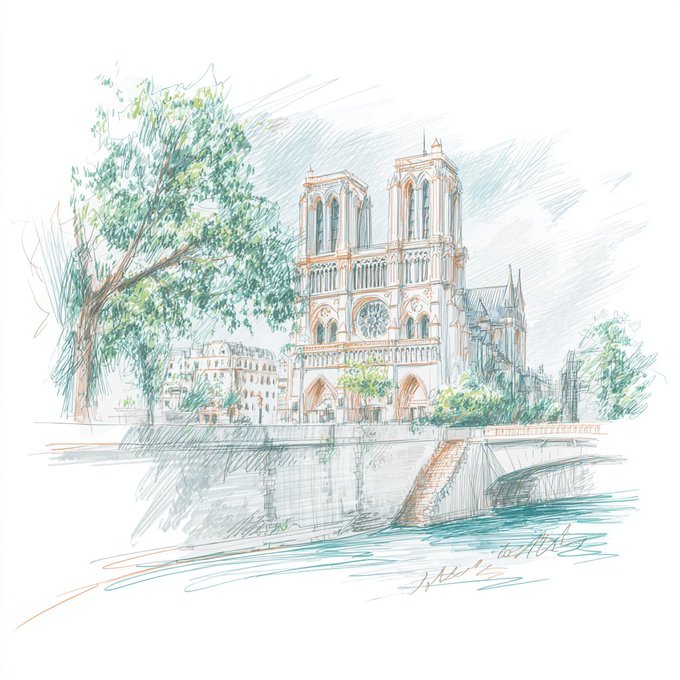
Urban sketch sref 6702567342 (Artedeingenio): Artedeingenio publishes Midjourney style reference --sref 6702567342, capturing European landmarks like Notre Dame, Sagrada Família, and the Eiffel Tower in loose ink linework with light watercolor washes, aimed at travel sketchbooks, illustrated books, and cultural posters urban sref.
The look emphasizes quick hatching, teal–orange accents, and suggestive detail over precision, giving artists and illustrators a consistent way to generate cohesive cityscapes and architectural stories from different locations using a single style token urban sref.
Neon-glass UI icon prompts define a reusable Leonardo look
Neon-glass UI icons (Azed_ai): Azed shares a detailed Leonardo prompt for a “modern neon-glass style UI icon set” describing a glossy, purple-gradient, semi-transparent aesthetic across a 6×7 grid of 2D icons (cloud, fingerprint, chat, folders, locks, charts, and more) on a dark background icon grid prompt.
Follow-up examples show single icons like an upload cloud, microphone, shopping cart, and chat bubbles rendered with the same glassy glow, clarifying how small prompt variations can produce a full, consistent UI system while keeping the underlying visual language intact single icon examples.
New Midjourney Style Creator pack teased for subscribers with gothic-leaning characters
New Style Creator look (Artedeingenio): Artedeingenio previews the latest Midjourney Style Creator preset he plans to release to subscribers, showing consistent character renders ranging from a pale elf in a cathedral to a vampire child and an action heroine, all sharing sketchy architectural backdrops and large expressive eyes new style tease.
The teaser suggests a flexible pack that unifies gothic fantasy, modern interiors, and action scenes under one stylization, geared toward storytellers who need recurring characters and environments to read as part of the same illustrated universe new style tease.
🛠️ Production pipelines: thumbnail factories and paper‑to‑video
Actionable workflow posts: a Freepik Spaces pipeline that outputs 16 tailored thumbnails from 2 images, plus NotebookLM turning a research paper into a clear explainer video. Excludes feature audio device news.
Freepik Spaces workflow outputs 16 tailored thumbnails from 2 images
Freepik Spaces thumbnail pipeline (TechHalla/Freepik): TechHalla walks through a Spaces workflow that turns a short video description plus two input images (creator headshot + subject image) into 16 distinct 2K thumbnails in a single run, each powered by its own long-form prompt and layout tuned to a different content style workflow explainer.

The setup wires one text box for the video description and two image inputs into 16 Nano Banana Pro image-generation nodes at 2K resolution, so each node can combine the same core context with different framing—MrBeast-style, gaming, food, survival and more—using pre-authored prompts workflow explainer. TechHalla shares a public Space link so others can run the exact same pipeline, including all 16 prompts, without rebuilding the graph from scratch space link and notes that swapping the second image (e.g., GTA V gameplay vs a product shot) cleanly retargets the thumbnail set to a new niche while preserving the underlying design logic space link.
NotebookLM turns DeepSeek mHC paper into a digestible explainer video
NotebookLM paper explainer (Google): AI_for_success shows Google’s NotebookLM ingesting DeepSeek’s "mHC: Manifold-Constrained Hyper-Connections" paper and auto-generating a structured video overview that distills the architecture, training issues, and scalability claims into simple visuals and narration-style text for non-specialists NotebookLM demo.

The underlying mHC work, which targets training stability and memory efficiency for very large Hyper-Connections models, is summarized from an arXiv preprint dated 31 Dec 2025 that highlights restored identity mapping and better large-scale scaling behavior mhc paper. NotebookLM’s output in the demo walks through slides on DeepSeek’s MLLM stack and the new manifold projections, effectively turning a dense multi-page abstract and diagram into a short, storyboard-ready briefing that creatives can use as the basis for educational videos or research-informed storytelling NotebookLM demo.
opentui/react enables node-based UIs for creative pipelines in React
opentui/react node UI (open source): A demo highlighted by Replicate shows opentui/react being used to build a basic React Flow–style node editor, with draggable nodes and connecting edges that can represent steps in a pipeline such as data inputs, transforms, or AI operations node ui demo. The author notes that "you can build pretty much anything with opentui/react," framing it as a general-purpose toolkit for the sort of node-graph interfaces common in compositors, generative art tools, and multi-step AI workflow builders where creators want to visually wire together prompts, models, and post-processing rather than manage them in raw code node ui demo.
🔬 Model design chatter: DeepSeek mHC and continual learning
Fresh theory/architecture threads: DeepSeek’s manifold‑constrained hyper‑connections for stability at scale and DeepMind‑adjacent hints that 2026 centers on continual learning; plus a robotics VLA technical report.
DeepSeek’s mHC aims to fix Hyper-Connections training instability at scale
mHC (DeepSeek): DeepSeek introduces Manifold‑Constrained Hyper‑Connections (mHC) as a general framework to recover identity mapping and stability in Hyper‑Connections while keeping their performance gains at massive scale, according to the paper summary in the mHC summary; the architecture constrains pre/post residual streams to specific manifolds, targeting reduced training blow‑ups and memory access overhead on very wide residual pathways.
• Design goal: mHC projects HC’s expanded residual space back onto a manifold so the network behaves more like classic residual networks during optimization, while still allowing diverse connectivity patterns for extra capacity and accuracy, as described in the mHC summary.
• Scale and adoption: The abstract highlights "superior scalability" and infrastructure optimizations for large models, and creators are already using tools like Google’s NotebookLM to auto‑generate visual explainers of the method for easier digestion, shown in the NotebookLM explainer.
For model designers, this positions mHC as a candidate template for next‑gen very large transformers that want HC‑style gains without paying the usual instability and memory penalties.
DeepMind voices hint that 2026 research will center on continual learning
Continual learning focus (DeepMind orbit): A small but visible cluster of DeepMind‑adjacent researchers and builders frames 2026 as "the year of continual learning," with Ronak Malde summarising 2024 as agents, 2025 as RL, and 2026 as continual learning in the original post amplified by AI creators in the continual learning post; DeepMind engineer Varun Mohan replies that "we're going to make huge progress on continual learing" this year, signalling internal momentum.
Comments from other practitioners treat the tweet as "4D chess," implying this is more than casual speculation and may reflect planned research and product directions, as captured in the screenshot shared in the continual learning post. For people designing models and workflows, the emphasis points toward architectures and training regimes that update on non‑stationary data streams, retain useful past skills, and avoid catastrophic forgetting rather than only chasing static benchmark wins.
GR-Dexter proposes a VLA framework for bimanual dexterous robot manipulation
GR‑Dexter framework (research): The GR‑Dexter technical report outlines a vision‑language‑action (VLA) system for bimanual dexterous‑hand robot manipulation, targeting long‑horizon everyday tasks with a 21‑DoF hand and focusing on generalisation across objects and instructions, according to the shared summary in the GR-Dexter link and the linked technical report.
• System components: The framework combines compact custom hardware, a bimanual teleoperation setup for collecting diverse demonstrations, and training that mixes those trajectories with large‑scale vision–language data to teach the VLA policy, as described in the technical report.
• Performance claims: Authors report strong performance on real‑world manipulation with frequent occlusions and robustness to unseen objects and instructions, suggesting that VLA‑style policies can scale beyond simple grippers into more human‑like two‑handed interactions.
For robotics‑minded AI creatives and toolmakers, GR‑Dexter signals how VLA architectures are being pushed toward complex physical storytelling domains, where hands, props, and environment all have to be coordinated over many timesteps.
📈 Progress curves and 2026 model outlooks
Today’s eval/forecast posts highlight a GPQA‑vs‑cost frontier chart (human‑level band crossed) and a community list of likely 2026 model updates/releases, plus a 26‑item prediction set on agents, products, and infra.
GPQA chart shows models leaping past human PhD accuracy as costs collapse
GPQA frontier chart (OneUsefulThing): A new "Shifting Frontier of AI Model Performance and Cost" plot shows GPQA Diamond scores nearly tripling while cost per million tokens falls by 90–99.7% between early 2023 and late 2025, with several models now exceeding the human PhD performance band according to the recap in GPQA thread.
• Capability gains vs humans: The green capability frontier line highlights models such as GPT‑4, Claude 3 Opus, Gemini 3 Thinking and GPT‑5.2 Thinking improving GPQA scores by up to +198% while clearly crossing the "Human PhD Range" band, as described in GPQA thread.
• Cost collapse for creatives: The blue balanced and red low‑cost frontiers show cost per million tokens sliding from around $100 to well under $1, implying that high‑end reasoning for tasks like script analysis, concept development, and complex research is becoming far cheaper to integrate into creative workflows GPQA thread.
• No clear plateau yet: The author notes no sign of performance plateauing on this benchmark and flags that GPQA itself may be topping out, which signals both ongoing capability growth and a looming need for better evaluation tools for long‑form creative and scientific tasks GPQA thread.
Peter’s 26 predictions sketch 2026 across agents, media, labs, and infra
AI 2026 predictions (Peter): A 26‑point forecast thread, summarized today, maps likely developments in 2026 across Chinese model competition, multi‑modal media models, long-horizon agents, hard benchmarks, product adoption, and AI infra and M&A, each tagged with explicit probability estimates between 5% and 60% prediction list.
• Media and model landscape: The author projects that no diffusion‑only image models will remain in the top 5 LMSYS image leaderboards by mid‑year, that video/audio/music/spoken‑word/text merge into a single model, and that a mainstream AI‑generated short film could win a notable award, reflecting expectations that creative multimodal stacks will consolidate and mature prediction list.
• Agents and benchmarks: On capabilities, the thread assigns non‑trivial odds that a model productively works on a task for 48+ hours, and that the first 1 GW‑scale models score 50%+ on hardest benchmarks like Frontier Math level 4 or ARC‑AGI 3, tying benchmark progress directly to more autonomous creative and coding agents prediction list.
• Products, voice, and business: On the product side, forecasts include a breakout voice‑first AI product with 50M+ weekly active users, at least one $50M ARR solo‑founder company, and OpenAI deriving 50%+ of revenue run rate from ads, which would change incentives around how creative content and discovery are monetised prediction list.
• Infra and geopolitics: Infrastructure expectations cover $10B+ NVIDIA energy investments, $10B‑scale lab acquisitions of non‑AI companies, public fights over AI datacenter build‑outs that labs lose, and another DeepSeek‑like event causing a 10%+ NVIDIA stock drop before recovery, sketching the resource and regulatory backdrop creative industries will inherit prediction list.
Community 2026 watchlist lines up Gemini 4, GPT‑6, Veo 4 and more
2026 frontier model roadmap (community): A widely shared outlook post lists the models and products many builders expect in 2026, from Gemini 3.5 and 4 to a run of GPT‑5.x updates, GPT‑6, and new Grok, Kimi, Qwen, Genie and Veo releases, framed as making 2026 "wild" for AI work model outlook.
• Text and reasoning stack: The thread expects Gemini 3.5 and Gemini 4, a sequence of GPT‑5.3 through GPT‑5.9, and GPT‑6, which would extend the current competition around reasoning-heavy and agentic use cases that many creative tools now embed model outlook.
• Media and video focus: For visual storytellers, the list calls out Genie 4 and Veo 4 plus an OpenAI AI device, pointing toward richer real‑time video, interactive characters, and on‑device assistance for filming, editing, and music workflows model outlook.
• Open ecosystem race: It also highlights Grok 4.20, Grok 5, Kimi K3, and Qwen 4, underscoring that non‑US labs and more open ecosystems may keep pushing prices down and features up for creative pros who already swap models under the hood in tools model outlook.
📣 Creator trends: AI selfies, year‑openers, and calls to create
Consumer‑creative signals for the new year: Vidu’s AI selfie trend with a how‑to, soothing “rest” reels from tools, and upbeat calls to make more, faster—useful for social producers planning early‑2026 content.
Vidu pushes AI selfie trend with comment-to-get-the-guide funnel
Vidu AI selfies (ViduAI): Vidu frames an "AI selfie trend" as the first viral format of 2026, showing a reel where one woman’s face cycles through multiple stylized portraits under the banner "AI Selfies" in the AI selfie demo; viewers are told "No editing skills needed" and invited to comment "Vidu" to receive a full guide, turning the trend into a lightweight funnel for onboarding new creators.

The setup positions Vidu as a consumer‑friendly portrait engine rather than only a longform video tool, and it signals that stylized, fast‑turnaround selfies remain a high‑engagement entry point for AI art on social platforms.
Hedra Labs teases dreamy 30‑second creation and offers quick how‑to
Dreamy 30‑second creation (Hedra Labs): Hedra Labs opens the year with a short that moves from swirling pink‑blue liquid to a close‑up of a hand planting a seed, then a time‑lapse of the sprout emerging under a soft "HEDRA" title in the Hedra teaser; the caption calls it "A dreamy way to start 2026" and invites people to comment "HEDRA" to learn how to recreate it "in under 30 seconds."

The spot promotes an aesthetic—organic, slow‑growth micro‑stories—while quietly advertising that this kind of polished, metaphor‑driven reel is now a sub‑minute workflow for non‑specialist creators.
Pictory’s New Year post doubles down on script-to-video storytelling
Pictory 2026 kickoff (Pictory): Pictory greets 2026 with a confetti‑filled graphic of its purple octopus mascot and the line "Happy New Year 2026!" in the New year CTA, talking about new ideas, goals, and stories plus the reassurance that creators don’t need to "start from scratch" to bring them to life; following up on script funnel, where it pitched turning scripts and other inputs into finished clips in minutes, this reinforces script‑to‑video as its core promise for the new year.
The post keeps the focus on confidence and consistency rather than specific features, signaling that Pictory aims to be the backbone for 2026 storytelling pipelines rather than a one‑off effect tool.
Heydin_ai’s 2025 montage shows a full year of AI-powered filmmaking
2025 AI reel recap (Heydin_ai): Creator Heydin posts a 115‑second montage of short film trailers, experimental films, commercial spots, and constant visual experiments made throughout 2025 with a long stack of AI tools—from Adobe Firefly and Runway to Kling, Vidu, Freepik Spaces and more—in the Year recap text; the thread describes AI not just as a tool but as a "creative partner" that enabled a highly productive year and closes with a "Happy New Year 2026" wish for an even stronger AI creative ecosystem.
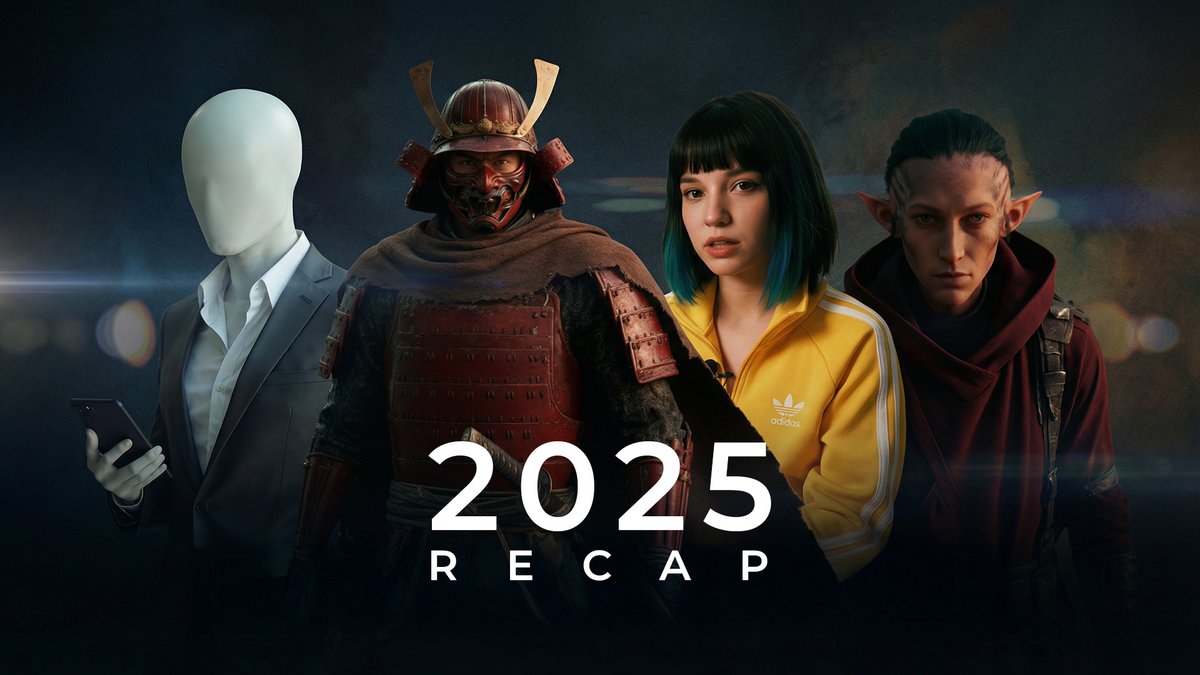
The recap underlines how quickly AI moved from side experiment to core pipeline for at least one working filmmaker in 2025, and it publicly normalizes multi‑tool, AI‑first production for narrative and commercial work going into 2026.
New year art discourse leans on 'everyone is an artist' message
'Everyone is an artist' push (bri_guy_ai & peers): Bri Guy uses a New Year post to remind followers that "it’s you that decides whether or not you’re an artist, not some anonymous weirdo on the internet" in the Artist self-definition, prompting responses like Azed’s "We’re all artists" in the Supportive reply and "Everyone is an artist indeed" plus "those lonely loser want it to be just them" from others in the Everyone artist reply; alongside this, Bri shares highly stylized AI‑assisted pieces such as a stippled deer portrait in chains and knitwear, which foreground personal taste over manual technique in the Deer reply.
The cluster of posts highlights how AI creators are opening 2026 by reframing artistic legitimacy around intent and curation, rather than whether every pixel was hand‑drawn.
Artedeingenio warns creatives: use AI in your work or fall behind
Use AI or fall behind (Artedeingenio): Artedeingenio tells followers that "if you use AI in your work, you’ll do very well; if you don’t use it, you’re going to have problems" in the Work with AI quote, presenting AI adoption as a pragmatic career choice rather than a novelty; the sentiment sits next to a New Year mini‑clip where a champagne glass fills and the text "2026" appears before a toast "to a 2026 filled with happiness" in the Champagne toast animation.

Together, the posts capture how one prominent AI illustrator is framing 2026 as the year where AI usage is assumed for working creatives, even while the tone stays celebratory.
Azed_ai’s 'progress over perfection' mantra anchors early-2026 posts
Progress over perfection mantra (Azed_ai): Azed pins a morning reminder that "progress beats perfection every single time" to a striking image of a human profile built from cascading white digital particles on black in the Progress reminder, framing creative growth as accumulation of imperfect steps; the same line is echoed in follow‑up posts sharing reusable prompt recipes—including neon‑glass UI icon sets for Leonardo—giving designers ready‑made starting points rather than perfectionist briefs in the Icon grid prompt.
This mix of mantra and practical assets nudges AI artists and product designers toward shipping more experiments in 2026 instead of stalling on a single flawless look.
LeonardoAI opens 2026 with a restful New Year reel, not a hustle pitch
New year rest reel (LeonardoAI): LeonardoAI posts a soft, minute‑long clip of someone curling up in bed and pulling the covers over themselves, ending on a simple "Happy New Year" title in the Rest message; the caption explicitly tells people that after a long year, it’s fine to "sit out the noise and rest. You deserve it."
For AI‑driven creatives who spent 2025 in relentless experimentation cycles, this is an early example of tools being used to share a slower, permission‑to‑rest message instead of the usual productivity push.
Multiple creators start 2026 with an openly pro‑AI, act-now mood
Pro‑AI new year mood (multiple creators): Several voices set an unapologetically pro‑AI tone on day one of 2026, with ai_for_success stating flatly that "AI is underrated" in the AI underrated and ProperPrompter arguing that "you don't have to wait until the new year to make changes in your life—start now, 2027 is still so far away" in the Start now quote; Mr_AllenT adds a tongue‑in‑cheek video greeting wishing X a Happy New Year and suggesting "Let’s all enjoy this last year before AGI" in the AGI new year card.

The thread of posts underscores both optimism and urgency around leaning into AI tools in 2026, especially for creators who watched the field accelerate through 2025.
Runware thanks 2025 builders and hints at more creator features in 2026
Runware's 2026 promise (Runware): Runware shares a quick New Year montage where "Happy New Year" titles, years "2025" and "2026" and fireworks lead into a closing frame with the Runware logo and "See you in 2026" in the Runware thanks; the caption thanks people for "building and shipping" on the platform during 2025 and promises "even more launches and much better features" this year.

For AI image and video creators relying on infrastructure vendors, it’s a small but clear signal that Runware expects another year of frequent updates tuned to creative workloads.
While you're reading this, something just shipped.
New models, tools, and workflows drop daily. The creators who win are the ones who know first.
Last week: 47 releases tracked · 12 breaking changes flagged · 3 pricing drops caught