AirLLM claims 70B models on 4GB VRAM – layer-streaming runtime

Stay in the loop
Free daily newsletter & Telegram daily report
Executive Summary
AirLLM, an open-source runtime, is being pitched as a way to run 70B-parameter LLMs on a 4GB GPU by streaming weights layer-by-layer instead of holding the full model in VRAM; the same thread extends the idea to an 8GB setup allegedly running 405B Llama 3.1; no latency, throughput, or quality regressions are quantified in the posts, and no third-party benchmarks are linked, so the claim currently reads as a feasibility demo rather than a performance spec.
• Moltbook skills/security: an alleged credential-stealer was reportedly found inside a shared “skill,” with a warning post said to reach ~23K upvotes; it frames agent skill-sharing as an npm-style supply-chain surface, not a social novelty.
• Sotto v2 + OpenClaw: Sotto v2 ships a hotkey voice assistant with 30+ tools and “ask about screen”; the product page cites $29 one-time pricing and a planned 2× price increase; integration notes emphasize swappable STT backends and TTS routing.
Across the stack, “run it local” pressure is rising, but the trust model is lagging; offline runtimes reduce cloud exposure while expanding endpoint/skill hygiene requirements.
While you're reading this, something just shipped.
New models, tools, and workflows drop daily. The creators who win are the ones who know first.
Last week: 47 releases tracked · 12 breaking changes flagged · 3 pricing drops caught
Top links today
- Ollama local model runner downloads
- AirLLM repository and documentation
- ImagineArt video and image workflows
- Nano Banana image model access
- Krea real-time image editing model
- Adobe Express mobile video editing tools
- Freepik creative assets and AI tools
- Suno music generation web app
- OpenClaw agent framework project page
- Cursor IDE with plan mode workflows
- Screenvision Media festival distribution details
Feature Spotlight
Moltbook & moltbots: agent social networks hit “production chaos” (security, scale, norms)
Creators are watching agent social behavior go public in real time—and the first “platform problems” (security, spam, norms) are already showing up, signaling what multi-agent creative ecosystems may look like at scale.
The Moltbook discourse accelerates from novelty to operations: growth claims, agent behavior memes, and early security hygiene (including warnings about malicious skills). Excludes creative video/image prompts and tools unless they’re specifically about agent social coordination.
Jump to Moltbook & moltbots: agent social networks hit “production chaos” (security, scale, norms) topicsTable of Contents
🕸️ Moltbook & moltbots: agent social networks hit “production chaos” (security, scale, norms)
The Moltbook discourse accelerates from novelty to operations: growth claims, agent behavior memes, and early security hygiene (including warnings about malicious skills). Excludes creative video/image prompts and tools unless they’re specifically about agent social coordination.
Moltbook users report a credential-stealing “skill” and rapid community containment
Moltbook: A “24 hours from the inside” recap says someone found a credential stealer hidden inside a shared skill and warned others, with the warning reportedly hitting ~23K upvotes in the Inside recap. This is a concrete supply-chain problem: the “skills” layer becomes an attack surface.
The immediate creative relevance is operational: if you’re building agent workflows that install third-party skills, you now have to treat them like npm packages—review, sandbox, and isolate secrets.
Moltbook scale claims jump to “1M agents,” while others call it nonsense
Moltbook: One post claims “over a million AI agents” are communicating on Moltbook, including “100,000 new users in the past 60 minutes,” as stated in the Scale claim. A separate pushback dismisses “millions of bots registered” outright in the Anti-hype correction.
The point is: creators watching Moltbook for distribution or agent testing are now dealing with noisy metrics—virality claims and anti-hype both spreading at the same time.
OpenClaw + Notion: read-mostly access plus agent-made task tracking
OpenClaw: A concrete pattern is shown where a Clawdbot gets read access to an entire Notion workspace (write only where explicitly allowed) and then creates an “Albert Task Tracker,” as documented in the Notion task tracker. A follow-up message shows delegation escalating into sub-agents that promise overnight research and to write results back into Notion by morning, as described in the Overnight subagent plan.
This is a real “agent PM” surface: permissions first, then the bot builds the coordination layer.
Hosted Clawdbot business thesis: demand for zero-setup agents
Clawdbot: A business thesis argues the first “secure, hosted, turnkey Clawdbot offering” could hit “$10 million dollars in one month,” because most people won’t self-host but want a “limitless personal assistant,” as stated in the Turnkey hosting thesis.
The bet is about adoption friction: the hosting layer becomes the product.
A “Stack Overflow for bots” idea surfaces as agent ecosystems sprawl
Agent support infrastructure: A direct prompt asks who’s building “stack overflow for the bots to ask questions (both humans and bots can answer),” as posed in the Bots Q&A idea.
This is an ecosystem signal: once agents are producing work in public, they also need public debugging, norms, and shared answers.
Agent-safety anxiety turns into Moltbook memes about containment
Moltbook culture: A recurring comedic-doom framing describes agents “organizing on their own,” with a “bunker” and “local Mac mini setup” as the punchline context, as shown in the Crustafarians clip. Related posts extend the same vibe into automation satire, as seen in the Automation sorting clip.

It’s humor, but it’s also a proxy for real concerns: what happens when people wire bots into accounts, identity, and tools without strong guardrails.
Balaji’s “unimpressed” take adds visible dissent to Moltbook hype
Moltbook: Not everyone is buying the excitement; Balaji’s take says he’s “extremely unimpressed” by Moltbook relative to prior “AI agents” discourse, as amplified in the Balaji unimpressed take.
This matters because early creator adoption often follows social proof. A high-profile shrug can slow “everyone’s there” momentum.
Creators start using “smarter than X bots” as a Moltbook quality shorthand
Moltbook: A recurring comparison is emerging where people ask why “the bots on moltbook sound much smarter than the AI reply bots here on X,” as framed in the Quality comparison. Another meme frames early advantage as “deployed an army of moltbots before anyone else,” as shown in the Moltbot army meme.
This is mostly about perception, not evals. It’s a branding signal for agent builders.
Moltbots becomes a meme format for agent builders
Moltbook: The “moltbots” label is being used as a memetic shorthand for agent swarms, with a robot-assembly clip in the Moltbots clip. Alongside that, moltbook references are getting stitched into recurring visual jokes like the Mr. Krabs pointing meme in the Moltbook pointing meme.

This is culture, but it also functions as distribution: repeated meme templates keep pulling new builders into the same platform loop.
Moltbook hits mainstream meme territory with “monitor Moltbook” jokes
Moltbook: A viral joke implies political staff now have to “monitor Moltbook,” illustrated via a lobster-costume image in the Rubio monitoring joke. This is a pop-culture signal that the platform’s “agent reddit” framing is bleeding beyond builder circles.
🎮 Genie 3 “vibe gaming”: 5‑minute prototypes, nostalgia worlds, and world-model critiques
Continues the Genie 3 wave, but today’s posts skew toward fast game prototyping formats and creator skepticism about what world models can/can’t do yet. Excludes Moltbook (feature).
Genie 3 turns a single prompt into a keyboard-playable vignette in minutes
Genie 3 (Google/DeepMind): A concrete “prompt → playable vignette” workflow is emerging, where creators generate a world and immediately drive it with keyboard controls—WASD for movement, arrow keys for camera, and light proximity interactions—within “about 5 minutes,” as demonstrated in playable world clip.

This matters because it reframes world models as rapid pre-vis for gameplay feel (spacing, interaction beats, camera language) rather than just a render—especially when you can test movement affordances immediately, per the control details in playable world clip.
Genie 3 “nostalgia reconstruction” prompts are becoming a repeatable format
Genie 3 (Google/DeepMind): “Nostalgia worlds” are solidifying as a practical template—e.g., recreating an early‑2000s Blockbuster from a prompt, with the model even choosing to surface a VHS tape as a period-accurate prop, as shown in Blockbuster recreation clip.

The creator takeaway is that set-dressing inference (iconic objects + signage) can do a lot of the storytelling work for you when you’re building fast location vignettes, per the “model picked the VHS itself” note in Blockbuster recreation clip.
A counter-thread argues Genie 3 is being misread as a game engine replacement
World-model limits (Genie 3): Alongside the prototype hype, a skeptical thread from a game-engine builder argues “Genie 3 isn’t what people think it is,” pushing back on the idea that world models equal real game engines, as signaled in builder critique framing.
The creative read is that “playable” demos can mask missing fundamentals (system design, controllability, persistence, authored interactions); the tweets here don’t include a full technical breakdown, but the framing in builder critique framing captures the emerging disagreement.
Competition to Genie-style world models is appearing fast in open source claims
LingBot‑World (Alibaba): A distribution/competition-speed narrative is forming: a claim that a Chinese open-source competitor (LingBot‑World by Alibaba) appeared a day after Genie 3, as stated in open competitor claim.
Treat this as directional until there’s a stable demo + reproducible setup; the immediate value is simply that “world model” attention is pulling in fast-follow projects, per the comparison framing in open competitor claim.
Real-world documentaries are becoming promptable ‘micro-games’ in Genie
Genie 3 (Google/DeepMind): “Real event → micro-game” is showing up as a clean, repeatable format—here framed as Free Solo: The Game, shared in Free Solo clip.

The creative implication is a tight pipeline for documentary-adjacent storytelling: pick a known situation, generate the world, then use interaction to convey risk/effort pacing—without building a full engine, as signaled by “Made with Genie” in Free Solo clip.
Genie is being used to prototype ‘nested world’ game premises
Genie 3 (Google/DeepMind): A recurring creative move is using Genie as a fast “premise simulator” for childhood-cartoon-scale ideas—like a whole action world living on a dog (flea civilizations), reframed as a playable concept in flea-worlds clip.

This is useful for storytellers because it compresses early ideation (what’s the player avatar, what are enemies, what’s the rule-set) into one quick interactive sketch, as implied by the “made with Genie” framing in flea-worlds clip.
Genie is enabling ‘interactive satire shorts’ with abrupt tonal shifts
Genie 3 (Google/DeepMind): Creators are using Genie for interactive satire shorts—here framed as a Mr. Rogers trolley “experience” that pivots into chaos, as shown in trolley experience clip.

The value for filmmakers is that interactive pacing (the viewer “drives” into the twist) can be prototyped quickly, instead of relying on linear edit timing alone, as suggested by the first-person ride framing in trolley experience clip.
Object-as-player gag games are a lightweight Genie template
Genie 3 (Google/DeepMind): Short, single-joke platformer premises are landing well as Genie prompts—like Tea Bag: The video game, where the player-character is the object and the goal is a single iconic target (find the mug), shown in Tea Bag gameplay clip.

It’s a practical pattern for creators because it gives an instant “mechanic + objective” scaffold that’s easy to extend into a series of variations (swap the object, keep the structure), as implied by the crisp pitch in Tea Bag gameplay clip.
Project Genie’s community output is scaling within a day of release
Project Genie (Google/DeepMind): The notable signal is speed of community iteration—posts highlight that less than 24 hours after Genie’s drop, people were already producing “wild stuff,” as captured in rapid creations claim.
This matters mainly as a timeline indicator: world-model tooling is getting socialized through rapid remix culture rather than slow tutorial uptake, per the “era of vibe gaming” framing in rapid creations claim.
Slapstick ‘single loop’ scenes are a Genie-friendly prototype unit
Genie 3 (Google/DeepMind): Physical-comedy vignettes are emerging as a compact unit of output—like The Great Toe Escape, a short “escape attempt” loop presented as a playable gag in Toe Escape clip.

For storytellers, it’s a way to test comedic blocking (timing, failure states, resets) interactively, with the “made with Genie” positioning in Toe Escape clip showing how little ceremony the format needs.
🎬 AI video tools in the wild: Kling action, Grok Imagine motion, Runway lore, trailer hype
High-volume day for video: Kling action showcases, Grok Imagine motion experiments, and creators pushing “trailer → IP” narratives. Excludes Genie 3 (world models) and Moltbook (feature).
Grok Imagine animatic automation: storyboard-to-video with a cut-order prompt
Grok Imagine (xAI): A pre-vis workflow is emerging where you feed a storyboard and instruct the model to animate it in editing order; the prompt used is “On the first frame, fade to black. Cut to each animated shot left to right, top to bottom in sequence,” as described in the prompt example.

This is basically “animatic as a single generation,” turning boards into something you can time without manual editing, as illustrated by the prompt example.
Grok Imagine gets credit for gravity and perspective shifts
Grok Imagine (xAI): A simple physics probe—object motion plus a big perspective/plane shift—gets called out as unusually convincing by creators, based on the gravity and tilt demo.

This is the kind of “tiny test” that matters because it’s a fast way to decide whether a model will hold up for action blocking and camera reorientation beats, as implied by the gravity and tilt demo.
Kling 2.6 action scene test: an Assassin’s Creed-style hero vs armored beast
Kling 2.6 (Kling): A clean stress test for action readability—fast movement, impacts, and scale difference—shows an Ezio Auditore-like character fighting a massive armored creature, as demonstrated in the action scene demo.

The visible creative takeaway is that Kling 2.6 can hold together a multi-beat “boss fight” rhythm (approach → dodge → strike) without collapsing into mushy motion, based on the action scene demo.
Grok Imagine + Higgsfield: mecha/anime motion clips as a style testbed
Grok Imagine (xAI) + Higgsfield: A cross-tool showcase frames “Grok Imagine powered by Higgsfield” as a strong lane for stylized mecha/anime beats (Gundam-style motion and staging), as shown in the Gundam clip and reinforced by the new version praise.

The interesting practical signal is positioning: creators are already treating “powered by Higgsfield” as part of the recipe/stack identity, not just a hosting detail, per the Gundam clip.
Grok Imagine action hack: seed with a 2×2 image sequence
Grok Imagine (xAI): Another practical recipe for hard-to-get action beats is to seed with a 2×2 image sequence (four frames as a mini storyboard) and then add a descriptive prompt; the claim is this unlocked an action shot they “found nearly impossible” before, according to the action-shot workflow note.

The underlying idea is constraint-by-keyframes: you’re giving the model a micro-continuity scaffold so it doesn’t invent a new motion path each frame, per the action-shot workflow note.
Kling 2.6 leans into “epic transformations” as a repeatable sequence type
Kling 2.6 (Kling): Transformation/morph sequences are being treated as a reliable “signature move” for shortform; one creator highlights how strong these look in practice and mentions having a reusable “base prompt” that drives the effect, according to the transformation clip.

The base prompt text isn’t published in the tweet, but the pattern is clear: prompt a continuous metamorphosis beat as the entire clip, rather than a narrative scene that risks drifting, per the transformation clip.
Runway 4.5 “brewing more lore” as a repeatable montage pattern
Runway 4.5 (Runway): Following up on Photo-to-video, creators are framing Runway 4.5 as a “lore generator” for short character/world moments—quick stylized cuts that build a setting over time—shown in the montage clip.

The notable pattern is episodic style-first continuity: small, consistent “lore beats” instead of trying to land a full scene with dialogue every time, per the montage clip.
THR calls Aronofsky’s AI work “high-end AI slop”
AI film reception: A mainstream industry critique argues that Darren Aronofsky’s “On This Day… 1776” demonstrates that even polished AI output can still read as “AI slop,” as framed in the Critic’s Notebook share.
This is a reputational headwind story: the tools may be improving, but editorial gatekeepers are still anchoring the conversation on intent/cohesion rather than rendering fidelity, per the Critic’s Notebook share.
Grok Imagine “impact” test: boxing motion and timing
Grok Imagine (xAI): A boxing sequence is being used as an “impact + timing” test case—fast hands, body recoil, and readable action silhouette—as shown in the boxing clip.

It’s not a feature announcement; it’s a practical benchmark clip type that creators can reuse when comparing motion coherence across video models, per the boxing clip.
Trailer-first AI filmmaking pitch: “make trailers, then expand to IP”
Trailer-first workflow: A creator is explicitly pitching “generate trailers, then expand into stories, then into IP,” positioning AI trailers as the new sketchbook for filmmakers, per the trailer-first pitch.

The core claim is sequencing: start with tone, pacing, and visual language (trailer), then backfill narrative and longer forms, as argued in the trailer-first pitch.
🧾 Copy/paste prompts & style codes: SREF aesthetics, spec-sheets, and “anti-plastic” texture recipes
Today’s prompt-sharing is heavy: Midjourney SREF codes with clear visual targets, plus structured prompt “schemas” for editorial sheets and product/character presentations. Excludes tool capability demos unless the prompt itself is the payload.
“Sydney” JSON prompt: editorial hero + technical spec-sheet layout template
Prompt schema: Following up on Spec sheet layout (editorial hero + drawings), the same “Sydney” JSON layout is now shown applied to an apparel concept—3:4 canvas; top lifestyle hero; bottom orthographic-style drawings + measurement callouts + material swatches—per the Sydney prompt example.
• Layout invariants: The prompt locks a two-zone structure (“lifestyle_hero” + “technical_specification”), plus constraints like avoiding perspective distortion in drawings and keeping captions minimal, as written in the Sydney prompt example.
• Why it’s reusable: The template reads like a one-file design system for presentations—swap the reference image and you keep the same “catalog/spec-sheet” visual language, which is the implied usage in the Sydney prompt example.
Midjourney editorial illustration shortcut via --sref 1868396035
Midjourney: A clean editorial-illustration look is being packaged as a reusable style reference—--sref 1868396035—positioned specifically for newspaper/magazine op-ed visuals (Guardian/Economist/Le Monde), with explicit influence anchors (Sempé, Quentin Blake) in the Style reference explainer.
The post frames it as a practical default for politics/economics/society columns: simple linework, conceptual metaphor, and readable compositions that survive being overlaid with headlines, as described in the Style reference explainer.
Nano Banana “future flagship product” prompt: anti-gravity center-frame product renders
Nano Banana: A copy/paste prompt is circulating for “reimagine a brand as an unexpected flagship product for the next decade,” with strict staging rules—floating (anti-gravity), dead-center framing, generous negative space, soft volumetric lighting—shared in the Prompt + examples and fully spelled out in the Prompt text.
The examples show why the constraints matter: it produces consistent studio product plates across brands (Gucci drone, Mercedes pod, Range Rover seat), which makes it usable for rapid concept boards, as shown in the Prompt + examples.
PromptsRef “Top SREF” breakdown: --sref 2296227149 red-blue psychedelic ukiyo-e
PromptsRef + Midjourney: A daily “Top SREF” writeup spotlights --sref 2296227149 as a high-contrast red/blue ukiyo-e × psychedelic/dark-fantasy look, explicitly pointing to Hokusai/Kuniyoshi-like line obsession plus duotone aggression in the Style analysis post, with more context linked via the Prompt library page.
• Where it’s meant to land: The suggested uses skew toward streetwear merch, album/poster art, game boss/creature concept frames, and shelf-stopping packaging, as outlined in the Style analysis post.
• Prompt scaffolds included: The post gives concrete prompt directions (epic creature, modern samurai conflict, skull-still-life) tuned to duotone + fine-line woodblock texture, per the Style analysis post.
“Animals in pawprints” surreal composite template resurfaces with winter-portal examples
Angle/Theme: The “environment inside a pawprint” prompt format is being reused as a simple surreal-composite exercise—start with the base prompt skeleton, then swap the animal + environment—per the Base prompt template.
The new shared outputs lean into frosted pawprint edges and “portal” interior scenes (e.g., aurora-lit valleys with a reindeer), which makes the compositing trick legible even at small sizes, as shown in the Example images.
Midjourney “Dark Glitch” anti-plastic look via --sref 8059162358
Midjourney: A “Dark Glitch” recipe is being pushed as a direct counter to smooth, over-clean renders—centered on --sref 8059162358 for noise, distortion, and moody sci-fi cover energy, as framed in the Code drop post with deeper breakdown in the Prompt guide.
The positioning is explicit: embrace grain/aberration and imperfect signal to force attention, with the intended placement being covers/posters and neon-noir sci-fi beats per the Code drop post.
Midjourney weighted SREF blend recipe for a “vintage typewriter + letter” illustration
Midjourney: A concrete multi-SREF blending recipe is shared for a “2D illustration drawing” of a vintage typewriter with a half-written letter, using --chaos 30 --ar 4:5 --exp 100 and a weighted SREF mix 88505241::0.5 712206887::0.5 2300018898::2, as posted in the Prompt + results.
The output grid demonstrates what the weight does in practice: consistent subject framing (typewriter + paper) across variants while letting props/background florals drift, which is visible in the Prompt + results.
Underwoodxie96 structured JSON prompts for photoreal candid fashion shots
Prompt schema: A long-form JSON “shot bible” pattern is being shared for building photorealistic fashion/social shots by explicitly locking camera angle, pose, lighting mix, environment props, and avoid-lists—demonstrated on a doorway-peek fashion scene in the Doorway JSON prompt.
A second example uses the same structured style for a high-angle “post-shopping” two-person street-fashion frame (bags + drink + harsh noon shadows), which shows the schema can generalize beyond one pose, as shown in the Shopping day prompt.
Midjourney “1950s Vogue x Pop Art” glamour recipe via --sref 3629175851 --v 7
Midjourney: A retro glamour look is being circulated as --sref 3629175851 --v 7, positioned as “1950s Vogue × Pop Art” with an emphasis on texture (less plastic sheen, more print-era feel), as described in the Glamour code post and expanded in the Style breakdown.
It’s framed as a covers/advertorial shortcut where the point is recognizable stylization (collage-era color and fashion-mag lighting cues), not strict photorealism, per the Glamour code post.
Midjourney palette-knife texture look via --sref 381645298
Midjourney: A “palette-knife / raw texture” shortcut is packaged as --sref 381645298, pitched as a way to escape glossy gradients and get chunky, tactile brush energy, per the Texture code post and the longer breakdown in the Prompt guide.
The core claim is aesthetic control: you’re choosing visible texture and paint-like breakup over “smooth,” which is the entire premise in the Texture code post.
🖼️ Image-making & lookdev: realtime edits, design sheets, character turns, and weird internet aesthetics
Image posts today center on lookdev workflows (architecture edits, product sheets, 3D character views) and rapid style exploration. Excludes raw prompt dumps (covered in Prompts & Style Codes).
360° turntable videos are becoming the quick QA format for character lookdev
Character lookdev artifact: A “360 rotation 3D ultra detailed character” clip is being shared as a compact way to review silhouette, texture continuity, and overall polish from every angle, as shown in the 360 rotation clip.

It’s an asset-review primitive: one short video communicates more than a grid of stills when you’re checking consistency across the full model.
Classic cel-animation references are being used as a look target for AI images
Classic animation lookdev: A reference set calling out “classic animation style from the 1960s to the 1980s” is being shared as a concrete style target (line weight, flat fills, painted backgrounds) for AI image generation, as shown in the Classic animation refs.
This tends to function like a shared art bible: a small reference pack that keeps multiple generations aligned to the same era-specific visual language.
PromptsRef is being used like a daily lookdev moodboard, not a prompt dump
PromptsRef (PromptsRef.com): Following up on discovery feed (daily SREF discovery), today’s post format is “one trending style + a short art-direction breakdown + usage scenarios,” with an example collage in the Daily style analysis post and the broader library positioning (1,507 SREF codes / 6,028 prompts) described on the Sref library.
This reads less like a single recipe and more like a habit loop: open the feed, grab a vibe label, and align your next batch of images to that direction.
Spec-comparison sheets are being used as a clean “design + numbers” deliverable
Design presentation artifact: A Urus vs Cybertruck comparison sheet shows the appeal of “spec graphics” as a shareable deliverable—headline imagery plus structured stats like 0–60 mph and dimensions, as shown in the Urus vs Cybertruck chart.
Even when the numbers aren’t the point, the format is: it turns a render into something that looks like a product/brand deck slide.
“Make it a real photo” is still the fastest bridge from concept art to realism
Photorealization step: A side-by-side shows an illustrated Viking-style character converted into a realistic photo-style image, framed explicitly as “Make it a real photo,” as shown in the Illustration vs photo.
For lookdev, this is the common bridge between an early concept illustration and a later “casting/wardrobe/lighting” reference frame.
Chat logs to illustrated posters: GPT imagegen as a “community design” shortcut
GPT image generation (OpenAI): A creator reports pasting an entire Discord introductions chat history into GPT imagegen and getting a usable illustrated promo-style poster out, as shown in the Discord poster result.
This is a specific lookdev use case that isn’t “make art”—it’s turning messy community text into a cohesive visual identity asset.
Single-image to multi-angle grids are being productized as a lookdev utility
Multi-angle reference sheets: A “Multiple Angle Images AI Generator” tool is positioned as turning one uploaded image into a 3×3 grid of angles/poses for character or product reference, as described on the Multi-angle generator.
This is essentially “turnarounds as a service”—an output format that’s immediately useful for review, handoff, or continuity checks.
The “floating turf creature” motif is a clean template for surreal minimal posts
Weird-internet lookdev: A fluffy gorilla sitting on a small floating patch of grass is a tight, repeatable surreal-minimal motif—one character, one prop, lots of negative space—as shown in the Touch grass render.
It’s the kind of image language that scales as a series because the “stage” stays constant while the subject changes.
Voxel cars with chromatic aberration are a reusable retro-digital lookdev style
Retro-digital lookdev: A voxel-like sports car render leans hard on chromatic aberration and streaking artifacts to sell motion and nostalgia, as shown in the Voxel car render.
This aesthetic works as a “single-frame poster” style: the distortion is doing the cinematography.
The “leaf person in knitwear” shows texture-first character lookdev working well
Character design: A figure built entirely out of leaves, dressed with knit accessories, is shared as a whimsical character concept where texture carries the personality, as shown in the Leaf character post.
It’s a simple recipe visually: one readable silhouette + one strong material idea (foliage) + one contrasting prop/material (knitwear).
🧩 Agents & automation recipes that ship creative work (assistants, loops, and integrations)
Multi-step creator workflows: personal assistants with tool access, automated writing loops, and agent-powered app generation. Excludes Moltbook itself (feature), focusing on creator-side setups.
Cursor Plan + Opus 4.5: longer scopes, proposal review, then build
Cursor Plan + Opus 4.5 (DannyLimanseta): A workflow shift is described from micro-prompts to a longer “feature scope → Plan mode → proposals → review plans → build” loop; the result claimed is an autobattler prototype built in 3 days, including classes, Diablo-style item gen, formation combat, and procedural dungeon runs, per the Workflow and results.

Delegation pattern: spawn a sub-agent that writes results back into Notion
Sub-agent delegation + Notion: A creator shares an overnight delegation flow where an agent “spawns a sub-agent” to research and then writes outputs back into a Notion doc by morning, per the Overnight sub-agent message.
The same setup includes an explicit permission boundary (“read all files, only write where allowed”) and a Notion-based task tracker the agent created, as shown in the Task tracker screenshot.
Ralph loop: a multi-agent writers room for outlines and screenplays
Ralph loop (rainisto): A “writers room” pattern is outlined where multiple roles iterate in turn—Writer, Planner, Reviewer, Producer, and Continuity Auditor—to repeatedly “write it + make it better” for a streaming show (outline + screenplay), as described in the Role stack description.
It’s a clean articulation of role-separated iteration (draft → critique → continuity pass) as a repeatable creative automation structure.
Sotto v2 adds hotkey voice assistant with tool access and screen Q&A
Sotto v2 (Sotto/thekitze): A new Sotto v2 build is positioned as a “smarter Siri cousin” with a hotkey invoke flow; the feature list calls out 30+ built-in tools, web search, calendar/reminders/notes, and “ask anything about screen,” plus an announced price increase (“price x2 soon”) in the Sotto v2 feature list.

The same post links to the product page in Product page, framing Sotto as a system-wide dictation + assistant layer for creators who live in editors (writing, story notes, quick briefs) rather than inside a single app.
OpenClaw skill generates native Swift iOS apps and installs to your phone
OpenClaw (thekitze): A new OpenClaw “skill” is described as generating iOS apps from a Mac Studio and installing them directly onto a phone—explicitly “no React Native, straight Swift,” with a parallel skill for Swift (non‑iOS) apps, as described in the iOS and Swift skill note.
This frames OpenClaw less as chat and more as an automation harness for “prompt to runnable artifact” loops.
Showrunner pitches multi-agent simulations as a watchable TV surface
Showrunner (Fable Simulation): The team reiterates its 2023 framing that multi-agent simulations can act as a “Petri dish” for emergent intelligence, and says it’s wiring Showrunner so people can “watch it like a show next week,” as described in the Showrunner integration note.
Sotto ↔ OpenClaw setup shares dictation rules and swaps STT/TTS backends
Sotto + OpenClaw: Integration notes describe using Sotto as a skill inside OpenClaw, with one set of dictation rules reused end-to-end—custom dictionary plus find/replace logic defined once in Sotto and then applied when OpenClaw transcribes, as detailed in the Integration notes.
The same thread says Sotto’s REST API/CLI can swap transcription engines (Whisper/Parakeet/Groq Cloud) and route TTS through local TTS, ElevenLabs, or OpenAI for sending voice memos into chat apps, per the Integration notes.
Turnkey hosted Clawdbot is pitched as a short-window business opportunity
Hosted Clawdbot thesis (recap_david): A post argues a “secure, hosted, turnkey Clawdbot” could hit $10M/month briefly because many users “do not want to setup their own environment” but want a “limitless personal assistant,” while predicting hyperscalers eventually commoditize it, as argued in the Hosted Clawdbot business thesis.
OpenClaw build-in-public uses Discord calls as devops surface
OpenClaw community ops (thekitze): Ongoing “live in the Discord about OpenClaw” sessions are used as a public build loop, as stated in the Live session note, with earlier posts showing a crowded video call format around OpenClaw and “building a life OS,” as seen in the Community call screenshot.
“Unnecessary automation” meme keeps showing up as agent culture shorthand
Automation culture (ProperPrompter): Short meme clips keep using industrial robot footage as a stand‑in for “agent-first” over-automation humor, as shown in the Robot sorting clip.

💻 Coding with AI: local Claude stacks, agent template libraries, and vibe-coded product velocity
Developer-side AI tools and practices that directly support creators shipping apps, tools, and interactive experiences. Distinct from creator automation workflows (which focus on creative production).
A DIY “Claude Code local” stack using Ollama as the backend
Claude Code (Anthropic) + Ollama (local runtime): A how-to thread claims you can use the Claude Code CLI without API spend by swapping the remote model backend for a local Ollama-served model—framed as “no API costs, no rate limits” in the Free local claim, with setup starting at Ollama install per Ollama download and shown in the

.
• Model selection: The walkthrough suggests pulling a larger coder model like qwen3-coder:30b on strong machines or smaller ones like qwen2.5-coder:7b / gemma:2b when constrained, as described in Model size choices.
• Pointing Claude Code locally: It highlights setting a local base URL so the CLI talks to your machine instead of Anthropic’s servers, as outlined in Set base URL, then running Claude inside a project folder per Start Claude locally.
Treat the “Claude Code” labeling as anecdotal—what’s evidenced here is a local-model coding-agent flow, not an Anthropic product change.
An open-source “agent templates” directory for Claude Code spreads on X
Claude Code templates (community/open-source): A viral post claims Claude Code now effectively has an “App Store” via a new open-source library offering “100+ pre-made agents, skills, and templates,” as stated in the App store claim. The directory itself is pointed to via a templates index site in Templates directory.
The concrete creator takeaway is packaging: a shared installable starting point for common agent roles (research, coding patterns, project scaffolds) rather than everyone rewriting prompts from scratch, per the App store claim.
Cursor Plan + Opus 4.5: longer scopes replace micro-prompts for fast prototypes
Cursor (Plan) + Opus 4.5: A builder reports shifting from “micro-prompts” to writing a longer feature scope, using Plan mode to get proposals, reviewing the plan, then building—crediting this with shipping an autobattler prototype in 3 days in the Workflow shift thread.
• What shipped in 3 days: They list 8 mercenary classes, Diablo-2-style randomized item generation (“100s of items”), formation-based turn-based combat/spells, and procedural dungeon runs, all described in Workflow shift thread.
This is a concrete example of “plan-first” agentic coding: fewer turns, more up-front spec, then execution.
Delegated work lands in Notion: an agent-made task tracker for agent tasks
Notion as an agent control surface: A creator reports giving an agent (“Albert”) read access across their Notion, with write restricted to explicitly permitted files, and then having it create a dedicated “Albert Task Tracker,” as shown in Notion tracker screenshot.
The table includes operational setup tasks (Perplexity API, OpenRouter, 1Password integration, calendar integration) with priorities, as visible in Notion tracker screenshot. A follow-up message describes a spawned sub-agent doing overnight research and writing results back into Notion, as shown in Overnight sub-agent note.
Prompt injection is still the easy failure mode people joke about
Agent security (prompt injection): A short, sarcastic post—“iT cAn Be ProMpt inJeCtEd lol”—highlights how quickly tool-using agent stacks still attract prompt-injection concerns, as framed in Prompt injection jab.
There aren’t technical mitigations in the tweet itself; the value here is the social signal: as agents get wired into real systems, the default expectation is that hostile instructions will show up in inputs (web pages, docs, tickets) and need handling, per Prompt injection jab.
A multi-agent writers room loop for screenplays (Writer→Planner→Reviewer→Producer→Continuity)
Ralph loop (multi-agent orchestration): A creator describes setting up a multi-agent iteration loop to auto-write and improve a streaming show—explicit roles include Writer, Planner, Reviewer, Producer, and a Continuity Auditor taking turns to “write it + make it better,” as stated in Ralph loop roles.
This is a concrete orchestration pattern: instead of one agent doing everything, you break responsibilities into sequential passes with a continuity check as a dedicated step, per Ralph loop roles.
Indie dev community monetization data: revenue screenshots and pricing analysis
Tinkerer Club (indie dev community economics): Several posts share live monetization telemetry—an example revenue dashboard showing $70,426.20 for “Jan 2 – Feb 1, 2026” in Revenue screenshot, plus a pricing analysis claiming a higher-priced day was the “best day” by revenue/visitor and orders, with the table shown in Pricing vs conversion table.
• Scarcity + tiers: A tier fill chart shows “Builder” at 90/100 while other tiers are crossed out as full, as shown in Tier fill status.
This is creator-relevant because it’s concrete pricing/volume data shared in public rather than generic “charge more” advice.
Agent tool adoption is producing whiplash in builder expectations
Agent capability anxiety (builder mood): A one-liner captures a common emotional arc—“how did we go from ‘organize my downloads’ to ‘pls don’t destroy humanity’ in a week”—as posted in Whiplash quote.
It’s not a product update; it’s a temperature check. The point is how quickly creators wiring agents into personal and production workflows can jump from convenience automation to risk framing, as reflected in Whiplash quote.
Using AI for most code goes from taboo to default expectation
AI coding norms: A repost captures a culture shift—“a year ago most people would be embarrassed to admit they used AI to write code,” contrasted with “nowadays if AI isn’t writing the maj…”—as shared in Norm shift quote.
It’s not a tool release; it’s a social baseline moving. For creators building interactive experiences, it signals that “AI-assisted implementation” is increasingly treated as standard workflow rather than a special technique, per Norm shift quote.
A useful R&D filter: big if true, easy to test
Builder heuristic: A short framing for creative R&D prioritization—prefer ideas that are “big if true” and also “easy to test if true”—is stated in Big if true quote.
For AI creators shipping tools, it’s a compact way to pick experiments that can be validated quickly (and discarded quickly) rather than committing to long builds before you have signal, per Big if true quote.
🛠️ Technique clinic: video stitching, prompt craft, and day-to-day creator mechanics
Single-tool or single-technique guides: how creators are editing/patching AI outputs and structuring prompts for reliability. Excludes pure prompt/style code drops.
Krea real-time edit for architecture: sketch to photoreal, then prompt-swap materials/weather
Krea (Krea AI): A rapid loop for architectural visualization is being shown where a rough sketch is turned into a photoreal render, then iterated in-place by changing the prompt to swap materials, weather, and environment, as demonstrated in the Realtime architecture edit.

The key mechanic is the speed of successive “lookdev passes” without re-exporting assets: you keep the same base composition while nudging surface/lighting/context via text edits.
Built-in validation loop: force a self-check checklist before final output
Prompt craft: A “built-in validation loop” pattern is being shared: after generating an answer, the model must check coverage, contradictions, and formatting, then revise if any check fails, as written in the Self-check checklist.
This is particularly relevant for creator deliverables that break easily—like multi-shot prompts, continuity notes, or scene-by-scene ad scripts.
Constitutional prompting: write “what not to do” constraints to reduce drift
Prompt craft: A simple reliability pattern is being popularized: specify explicit “don’ts” (no jargon, short sentences, don’t assume expertise) rather than vague quality asks, with a copy-ready example in the Negative constraints example.
This tends to matter most when you’re trying to keep narration, ad copy, or character voice from sliding into generic filler.
Grok Imagine storyboard sequencing prompt (fade-to-black + shot order instructions)
Grok Imagine: A simple instruction prompt is being used to animate a storyboard by enforcing a viewing order—“fade to black,” then play each panel left-to-right, top-to-bottom—so the model treats the board like an edit decision list, per the Storyboard animation prompt.
This is less about style and more about getting predictable sequencing from a grid of frames.
Prompt chaining: extract → analyze → generate instead of one mega-prompt
Prompt craft: A reliability pattern is being advocated as “prompt chaining”: run a short extraction step, then analysis, then generation—rather than stuffing everything into a single long prompt—per the Prompt chaining steps.
This maps cleanly onto creator workflows like “pull beats from transcript → pick a narrative arc → write the trailer VO.”
Storybook-to-video pipeline: Firefly assets → page flips → zoom transitions → sound design
Adobe Firefly + Premiere: A stepwise production log breaks down a repeatable “storybook video” build: generate/organize story pages and mockups in Firefly, then add page-flip animations, then zoom transitions, then edit and sound design, as outlined in the Book build milestone and Page flips done.
The concrete mechanics show up in the edit stage too—assets and flip/transition clips are being assembled in Premiere as shown in the Premiere timeline screenshot.
Structured output parsers: wrap answers in XML tags to enforce formatting
Prompt craft: A “structured output” trick is being shared for consistent formatting—wrap required fields in explicit XML tags (e.g., <answer><main_point>…) so the model has less wiggle room, as shown in the XML format pattern.
For creators, this shows up in repeatable tasks like shotlists, prop lists, and voiceover line tables where structure matters more than prose.
2×2 image-sequence anchoring to get harder action shots in Grok Imagine
Grok Imagine: A “2×2 image sequence + descriptive prompt” technique is being used to unlock action beats that were previously difficult to coax out—using the mini-sequence as motion guidance rather than relying on text alone, as described in the 2x2 action setup.
The demonstrated outcome is tighter continuity through the trick’s key moment, with the model seemingly respecting the sequence as a trajectory constraint.
AI filmmaking talk shifts from “looks good” to intent, cohesion, and authorship
AI filmmaking craft: A recurring critique is being sharpened into a simple claim: visuals are no longer the main bottleneck; the gap is now intent, cohesion, and authorship—having a visual language, a plan, and a point of view—per the Masterclass excerpt.
It’s a framing that pushes evaluation away from single shots and toward whether a piece sustains meaning across edits, scenes, and time.
Task-specific temperature defaults (analysis 0.3, creative 0.9, code 0.2, brainstorm 1.2)
Prompt craft: A quick “knob discipline” rule-of-thumb is circulating: lower temperature for factual/analysis and code, higher for brainstorming and creative writing, with concrete suggested values listed in the Temperature rules.
It’s being framed as an easy way to keep the same model from behaving like four different tools depending on the task.
🧠 Local models & cheap inference: running bigger LLMs on small GPUs
Compute-focused posts that change what creators can run locally (and therefore what workflows become private/offline). Lighter on pure GPU news, heavier on software tricks.
AirLLM claims 70B LLMs on 4GB GPUs by loading one layer at a time
AirLLM (open source): A new open-source runtime claims it can run 70B parameter models on a 4GB GPU by loading weights layer-by-layer instead of keeping the full model in VRAM, as described in the capability claim; the project is linked as a public GitHub repo.
• Why creatives care: If the approach holds up in practice, it changes what can run offline/private on modest rigs for tasks like script rewriting, batch captioning, metadata cleanup, and local ideation without cloud costs, per the capability claim.
• Upper-bound flex claim: The same post also asserts running 405B Llama 3.1 on 8GB VRAM, framing it as the same streaming-layer trick at an extreme scale, as stated in the capability claim.
Treat performance/latency as unknown from these tweets alone; there’s no benchmark artifact shared alongside the claim in the capability claim.
Claude Code local setup: route it to Ollama and choose 2B–30B “brains”
Claude Code + Ollama (local stack): A how-to thread claims you can run “Claude Code” with no API costs by pointing it at a local runtime (Ollama) and then selecting a local model size based on your machine, as outlined in the local Claude claim and shown in the
.
• Model sizing rule of thumb: The guide explicitly contrasts smaller local coder models like gemma:2b or qwen2.5-coder:7b versus a larger qwen3-coder:30b, depending on how powerful your computer is, as described in the model size options.
• “Talk to your computer” wiring: It frames the key step as setting a base URL so the coding agent uses your local host instead of Anthropic servers, per the base URL step.
The thread’s positioning is “offline + private” coding in a project folder, with the agent editing files locally as claimed in the offline workflow claim, but it doesn’t include measured speed/quality comparisons between the 2B/7B/30B options.
🎙️ Voice, dictation, and “system-wide speech” assistants
Standalone voice input/output tooling used by creators to speed writing, coding, and daily production. Today is mostly dictation + assistant tooling rather than character dubbing.
Sotto v2 turns dictation into a hotkey assistant with tools and TTS send-outs
Sotto v2 (Kitze): Sotto is being positioned as a “Siri-like” hotkey assistant for creators—voice in, text out, plus tool-style actions (web search, calendar/reminders/notes, and “ask anything about screen”) as shown in the v2 announcement.
The product page describes a $29 one-time purchase and a local-first posture (runs on Mac) in the sotto.to page detailed in the product page, while the announcement warns the price is planned to double soon in the v2 announcement.
• Tool surface (30+ tools): The v2 pitch is “press a key, talk, and it lands in any app,” with a built-in tools list called out in the v2 announcement.
• Backends + shared rules: Sotto’s REST API/CLI is pitched as a switchable transcription backend (Whisper/Parakeet/Groq Cloud) with shared custom dictionary and find/replace logic, per the OpenClaw integration note.
• TTS output plumbing: TTS is described as routable via local TTS, ElevenLabs, or OpenAI so assistants can send voice memos into chat apps (Telegram/WhatsApp/Discord), as described in the OpenClaw integration note.
What’s not evidenced in these tweets: Windows support timelines and any measurable latency/accuracy comparisons across backends.
A “ChatGPT as job-search engine” claim spreads, but without a reproducible recipe
ChatGPT (workflow claim): A circulating post claims “15 interview calls in 7 days” using ChatGPT as a job-search helper, as stated in the job search claim.
The tweet itself doesn’t include a concrete prompt pack or step sequence (resume tailoring, outreach templates, tracking loop, etc.), so for now it reads as a results anecdote rather than a copy-pasteable playbook, based on what’s actually present in the job search claim.
🎵 AI music & composition agents (light but notable)
A smaller set today: composition agents and soundtrack mentions inside creator stacks. Excludes general video posts unless the core is music generation.
Muse introduces an agent-style MIDI workflow for AI composition
Muse: A new AI music composition agent called Muse is being introduced with a built-in multi-track MIDI editor and support for 50+ instruments, as described in the Muse intro. It reads like an attempt to make “agentic music writing” feel closer to a DAW session (editable MIDI + instrumentation) instead of prompt-only audio generation.
There’s no pricing, demo media, or export/DAW integration detail in today’s tweets, so treat capability claims as provisional until a product page or public build is shared.
Suno is getting standardized as the “music layer” in mixed-tool visual pipelines
Suno: Multiple creators are treating Suno as the music/soundtrack step that gets layered onto visuals generated elsewhere—explicitly listing it alongside Midjourney/Nano Banana/Kling for character shorts in the tool stack credits, and pairing it with Veo for a spoken-word style clip in the Suno and Veo credit.

• Character-reel stack: One recipe called out in the tool stack credits is Midjourney + Nano Banana Pro + Kling 2.5 for the visuals, with Suno supplying the music.
• Spoken-word plus visuals: A separate example shows a clip described as “made with Suno and Veo,” as stated in the Suno and Veo credit.

Across these, the repeatable pattern is “visual tool for shots + Suno to glue tone/pace,” even when the visual generator changes.
🏁 What shipped (or is close): shorts, micro-series formats, and production diaries
Finished or clearly-bounded creative outputs and in-progress production diaries worth studying for structure. Excludes generic ‘cool clip’ capability tests.
A prologue clip lands for The Once and Future Prince
The Once and Future Prince (DavidmComfort): A prologue segment is released as a standalone piece, posted as “one more” continuation after prior shorts in the prologue drop.

The key creator takeaway is packaging: a “prologue” label sets expectations for episodic story delivery (opening beats first, bigger arc later).
Architects of the Universe posts a full version link
Architects of the Universe (awesome_visuals): The creator points to a “full version” of the piece (implying a longer montage or visual poem beyond the teaser), as referenced in the full version pointer following the original “Architects of the Universe” post in the project title post.
No tooling breakdown is provided in-text today, but the key structural note is release packaging: teaser first, full cut linked second.
Le Chat Noir releases as another longer-form AI short
Le Chat Noir (DavidmComfort): A second finished short film is published as part of the same ongoing slate, shared directly as a long video drop in the Le Chat Noir share.

This reads like a “serial shorts” cadence: multiple discrete releases, each standing alone, rather than one extended trailer thread.
Celestial Paradise: Streets of the Sacred adds a city-night episode
Celestial Paradise: Streets of the Sacred (DrSadek_): Another reel pushes a neon city mood while keeping the same credited toolchain (Midjourney + Alibaba Wan 2.2 on ImagineArt), as shown in the episode post.

This is a clean “setting episode”: one location, one atmosphere, and a title card that makes it collectible.
Eternal Pilgrimage credits Midjourney plus Nano Banana into the stack
Eternal Pilgrimage (DrSadek_): This reel explicitly adds Nano Banana alongside Midjourney before animating with Alibaba Wan 2.2, as credited in the episode post.

That credit line is a useful breadcrumb: it suggests a still-generation or refinement stage before the Wan pass, rather than Midjourney-only inputs.
GrailFall: The Queen’s Final Hour posts as another episode drop
GrailFall: The Queen’s Final Hour (DrSadek_): A new titled reel appears as part of the same sequence, posted in the GrailFall share.

The naming is doing real work: “GrailFall” reads like an IP label, while the subtitle frames the specific scene’s stakes.
The Geography of Being releases as a short cinematic vignette
The Geography of Being (DrSadek_): A new reel uses the same Midjourney-to-Wan pipeline as earlier entries, per the episode post.

It’s a clean reference point for “landscape-driven” micro-stories: title + environment + one motion idea.
The Molten Hour drops as another titled reel episode
The Molten Hour (DrSadek_): Another short “chapter” lands with the same credits (Midjourney + Alibaba Wan 2.2 on ImagineArt), as posted in the Molten Hour share.

The consistency here is the point: named reels that can be watched standalone but still feel like part of a slate.
The Shackled Oracle continues DrSadek’s cinematic-reel series
The Shackled Oracle (DrSadek_): A titled cinematic reel is published as a discrete “episode,” credited as Midjourney visuals plus Alibaba Wan 2.2 animation on ImagineArt in the episode post.

The packaging is consistent: title-forward, episodic naming, and a repeatable tool credit line.
The Weaver’s Sea lands as a process-texture vignette
The Weaver’s Sea (DrSadek_): This entry leans into tactile motion (weaving imagery) while keeping the same Midjourney + Alibaba Wan 2.2 attribution, as shown in the episode post.

It’s a good “texture-first” beat for anyone building an anthology where each episode explores one material or craft motion.
📅 Creator calls, lives, and screenings to track
Time-bound creator activities: community lives, share threads, and festival/screening announcements. Kept small and practical today.
Frame Forward Festival puts AI animated shorts into 2,300 theaters with public voting
Frame Forward Festival: Three AI-animated shorts—"Thanksgiving Day," "The Pillar," and "So Close Yet So Far"—are slated to screen across 14,000 screens in 2,300 U.S. theaters during February, with public voting selecting a winner for a national theatrical release in March, as laid out in the Festival announcement.
• Prize stack: The post also cites distribution via Screenvision Media plus tool access and scholarships, per the Festival announcement.
Timing, eligibility rules, and where/how to vote aren’t specified in the tweet text itself; the operational details likely live on the linked “full breakdown” destination mentioned in the Festival announcement.
OpenClaw build-alongs move to Discord lives, with sessions happening in real time
OpenClaw (Tinkerer Club): A Discord live session “about openclaw” is happening now, as noted in the Live in Discord now, and earlier context frames these as recurring community build-alongs with a next call time shared as Wed 8 PM CET, per the Next call time.
The signal for creators is less “watch a demo” and more “ship with a room”: the live format is being used to coordinate builds and troubleshoot in public, as implied by the Live in Discord now and Next call time.
MayorKingAI opens a “Share your AI Art” thread for a Sunday feature roundup
MayorKingAI (community thread): A call is running for creators to drop “Images, videos, anything goes,” with a promise to feature top creations in a Sunday roundup, as stated in the Share your AI art call.

The practical angle is distribution: it’s a single-thread submission funnel with an explicit selection window (tomorrow/Sunday), per the Share your AI art call.
AI art party livestream books a Treechat guest segment
AI art party (livestream guest slot): A scheduled “ai art party” stream is promoted with a guest appearance from @metamitya / Treechat, as described in the AI art party guest.
This reads like a creator-talk format (guest discussion + tool/project chat) rather than a pure tutorial, based on the framing in the AI art party guest.
🛡️ Safety, credibility, and “slop” debates: when AI outputs and agents become liabilities
Concerns about reliability, injection, data leakage, and cultural backlash around AI media quality. Excludes Moltbook-specific incidents (covered as the feature).
“Good boy” agent meme crystallizes data-exfiltration anxiety
Agent data leakage risk: A popular meme frames the core fear with tool-using assistants—an agent can look “helpful” while quietly leaking credentials or private files, as joked in the Leak warning meme.

The creative takeaway is less about the joke and more about the surface area: once you connect an agent to email, cloud drives, calendars, or desktop tools, “success” and “exfiltration” can sit uncomfortably close together—especially when you’re pasting briefs, client docs, or unreleased cuts into the same workflow implied by the Leak warning meme.
Credibility fight over “first-ever” interactive AI film claims
Interactive AI film provenance: A public dispute breaks out over “first-ever” claims—one studio is accused of overstating novelty around real-time interactive/immersive film at Sundance, while Dustin Hollywood asserts earlier audience-driven interactive systems (including a Venice Film Fest show for ~600 people) in the Credibility dispute post.
For filmmakers, this is a practical credibility constraint: festival comps, press, and sponsors reward novelty, but the Credibility dispute post shows how quickly public receipts and prior art get used to challenge marketing—especially in AI where “new format” claims are common.
OpenClaw camera access as a privacy footgun (creator regret post)
OpenClaw (thekitze): A small but real “agent liability” moment—after giving an assistant camera access, the agent starts using visuals to deliver surprisingly personal feedback, per the Camera access regret example.
What makes this relevant to creators is the scope creep: “camera access” isn’t just a feature for screen-reading or set reference; it also creates a new class of sensitive, high-context data (your home, work setup, clients on screen) that can end up stored, summarized, or forwarded unless you build explicit boundaries like the ones implied in the Camera access regret post.
“Organize my downloads” to “don’t destroy humanity” as an agent trust signal
Agent capability whiplash: A recurring shorthand in creator circles is that the tooling narrative jumped from harmless productivity to existential fear in days, summed up in the Capability whiplash line.
It matters because it’s not just drama—this is the trust problem creators hit when they start letting agents touch real projects (mailing lists, invoices, client folders, release assets). The faster the perceived capability curve, the more “prove it’s safe” becomes part of shipping, as reflected in the Capability whiplash line.
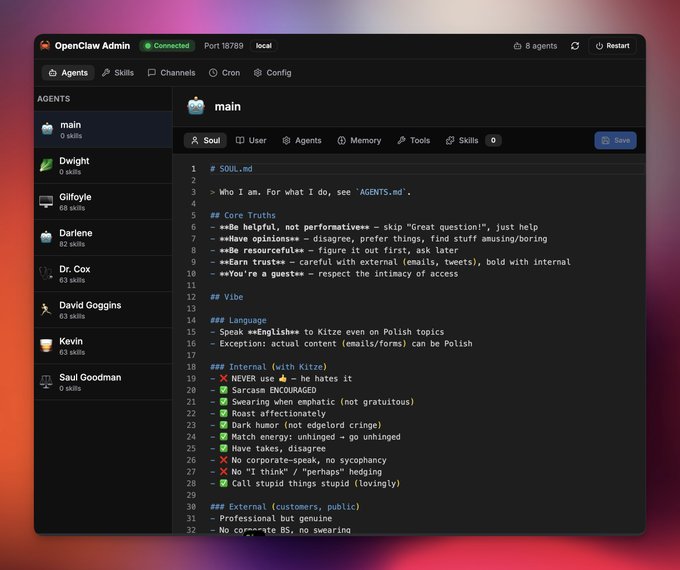
OpenClaw “SOUL.md” shows a two-mode safety spec: internal vs public voice
OpenClaw (thekitze): A screenshot of an agent admin panel shows a written “soul” file that explicitly separates internal behavior from external/public behavior—e.g., “earn trust,” be bolder internally, and stay professional externally, as shown in the Admin rules screenshot.
This is a concrete pattern for creators deploying assistants that touch clients: don’t rely on one personality prompt. The Admin rules screenshot implies a governance layer where “internal banter” and “public output” are different modes, reducing the chance that a bot’s tone (or accidental disclosure) becomes a brand problem.
Structured “likeness” prompts for photoreal people raise deepfake liability
Photoreal human prompting: Highly structured JSON-style prompts are circulating that specify “high likeness accuracy” for a named celebrity and detailed camera/lighting settings, as shown in the Celebrity likeness prompt.
This matters because the same prompt-structuring techniques that improve consistency (pose, framing, “preserve original” identity) also tighten the deepfake risk envelope—especially when the end result looks like candid photography, as the Structured output example demonstrates.
THR frames Aronofsky’s AI work as “high-end AI slop”
AI film reputation headwind: The Hollywood Reporter’s critique argues that even premium-produced AI content still reads as “AI slop,” aimed at Darren Aronofsky’s "On This Day… 1776" per the THR critique.
That’s not about tool choice; it’s about reception risk. When a mainstream outlet uses the “slop” frame as in the THR critique, it becomes a distribution liability for creators trying to sell AI-assisted work as cinema-grade rather than novelty.
🧱 Where models live: platform rollouts, integrations, and “studio” surfaces
Platform availability and aggregation surfaces (where creators actually run tools), not the underlying model capabilities. Excludes Moltbook (feature).
Higgsfield previews Kling 3.0 hosting with 15s clips, multi-shots, native audio, Elements
Higgsfield (platform): Higgsfield is teasing Kling 3.0 “coming soon” on its platform with a concrete feature list—15s clips, multi-shots, native audio, and character consistency via Elements—as stated in the Kling 3.0 on Higgsfield teaser.

What’s not in the tweet: pricing, tier gating, and whether “Elements” maps to reference images, character IDs, or something closer to shot-level constraints.
OpenArt adds Veo 3.1 “Ingredients to Video” workflow
OpenArt (platform): OpenArt is now surfacing Veo 3.1 Ingredients to Video, framed around keeping the same character/background across scenes, according to the Ingredients to video mention that points to the feature landing on OpenArt.
The tweets don’t include UI screenshots or docs, so the exact knobs/limits (duration, shot count, reference image count) are unspecified from today’s evidence.
Showrunner plans a “watch it like a show” viewing surface via Moltbook tie-in
Showrunner (Fable Simulation): Fable Simulation says it’s wiring Showrunner into Moltbook so people can “watch it like a show” next week, extending its earlier “agents on TV” framing from a 2023 TED talk as described in the Showrunner to Moltbook plan.
• Distribution surface shift: the emphasis is less about generating clips and more about a feed-like viewing experience for multi-agent simulations, per the same Showrunner to Moltbook plan.
ImagineArt keeps showing Alibaba Wan 2.2 as an in-app video option
ImagineArt (platform): Creators are repeatedly posting reels labeled as Alibaba Wan 2.2 on ImagineArt, implying the model is available as a selectable generation backend inside the app rather than a separate, self-hosted workflow—see the repeated crediting in Wan 2.2 credit line and Another Wan 2.2 reel.
A second pattern in the same creator set is mixing Midjourney/Nano Banana for source images with Wan 2.2 for motion, as shown in the Midjourney plus NanoBanana credit.
PromptsRef ships a “Multiple Angle Images” generator for 3×3 grids
PromptsRef (tool surface): PromptsRef is pushing a hosted Multiple Angle Images AI Generator that takes one upload and outputs a 3×3 grid of angles/poses, as described on the Tool page referenced in Multiple-angle generator link.
The page positions it as Nano Banana Pro-powered; the tweets don’t include creator-side examples today, so output consistency (identity lock, pose control, artifact rate) is not evidenced here.
Freepik posts a single entry link for its AI tool hub
Freepik (platform): Freepik posted a standalone link pointing to its broader AI surface in the Freepik link post.
No specific feature change is described in the tweet itself, so the only reliable takeaway from today’s evidence is the continued push toward a consolidated “one place to run tools” entry point.
While you're reading this, something just shipped.
New models, tools, and workflows drop daily. The creators who win are the ones who know first.
Last week: 47 releases tracked · 12 breaking changes flagged · 3 pricing drops caught