Runway Robotics claims 0.95 sim-to-real across 8 policies – Character Renderer ships

Stay in the loop
Free daily newsletter & Telegram daily report
Executive Summary
Runway is pushing “world model” credibility with a quant claim: Runway Robotics says it simulated 8 robot policies inside its General World Model and saw 0.95 correlation vs real-hardware outcomes; no external reproduction packet is linked in-thread, but it’s a rare numeric sim→real headline from a creative-first vendor. In product, Runway also shipped Character Renderer as an App + a more controllable Workflow that turns simple sketches into rendered 3D character images/videos; an internal note says Nano Banana 2 will be integrated and system prompts are being re-tuned.
• Anthropic/DoD posture: Dario Amodei’s CEO statement on “red lines” (mass surveillance, autonomous weapons) set off cross-lab comparison; a screenshot shows Sam Altman claiming a Department of War agreement to deploy models on a classified network; footage circulated from outside Anthropic’s SF office at 100 Montgomery.
• Claude Skills: Anthropic published a 30+ page “Skills for Claude” guide (YAML frontmatter; progressive disclosure) and open-sourced an Apache-2.0 Agent Skills repo with a Claude Code install command.
• BullshitBench: a chart screenshot claims Claude Sonnet 4.6 at 94.5% “clear pushback” vs GPT-5.1 around 36.4%; methodology isn’t provided.
Research threads converged on “consistency” as the missing metric—Trinity of Consistency + CoW-Bench for video/UMMs—while field ops kept highlighting that tooling reliability and evaluation rigor still lag product claims.
While you're reading this, something just shipped.
New models, tools, and workflows drop daily. The creators who win are the ones who know first.
Last week: 47 releases tracked · 12 breaking changes flagged · 3 pricing drops caught
Top links today
- Anthropic CEO statement on Defense talks
- Anthropic guide to building Claude skills
- Anthropic agent skills library repo
- MeiGen open dataset of trending prompts
- Code Review Bench v0 benchmark site
- Physics-aware image editing paper
- Trinity of Consistency world models paper
- Runway Nano Banana 2 product page
- Runway Character Renderer app
- Runway robotics world model research
- Runway get started page
- Showrunner remix and animation tool
Feature Spotlight
Anthropic vs. DoD “red lines” blows up: surveillance + autonomous weapons debate hits creators too
Anthropic’s refusal to bend on surveillance/weaponization terms triggered a wave of reactions (incl. OpenAI comparisons), spotlighting how policy decisions can reshape what creative AI tools can be used for—and under what constraints.
High-volume cross-account story: Anthropic’s stance with the Department of War sparks a broader fight over domestic surveillance, autonomous weapons, and whether “AI is critical infrastructure” justifies state pressure. Excludes Claude “Skills” tooling (covered in Creator Workflows).
Jump to Anthropic vs. DoD “red lines” blows up: surveillance + autonomous weapons debate hits creators too topicsTable of Contents
🛡️ Anthropic vs. DoD “red lines” blows up: surveillance + autonomous weapons debate hits creators too
High-volume cross-account story: Anthropic’s stance with the Department of War sparks a broader fight over domestic surveillance, autonomous weapons, and whether “AI is critical infrastructure” justifies state pressure. Excludes Claude “Skills” tooling (covered in Creator Workflows).
OpenAI announces a DoW deal; community note centers Anthropic’s red lines
OpenAI (government deployment): A screenshot shows Sam Altman stating OpenAI “reached an agreement with the Department of War to deploy our models in their classified network,” as captured in Community note screenshot.
• Context battle in public: The attached community note argues the key missing context is Anthropic’s refusal to support “mass surveillance or automated weapons,” referencing Anthropic’s position directly inside the note UI shown in Community note screenshot.
• Creator confusion: Posts like 4D chess question frame this as OpenAI taking a similar deal after Anthropic took heat.
What’s still unclear from tweets alone is the exact contractual language and operational scope.
Altman backs Anthropic’s Pentagon “no,” despite rivalry
OpenAI × Anthropic (public alignment): A high-engagement thread claims “Anthropic said no to the Pentagon” and that Sam Altman backed them publicly despite rivalry, as summarized in Min Choi thread, with additional reposting/retelling in Retelling thread RT.
If accurate, it’s a rare moment of cross-lab coordination on policy posture—something creative studios feel immediately because it shapes what client categories are viable for AI-assisted production.
Grok’s “all lawful US purposes” stance inflames surveillance debate
Grok (xAI): After a creator asked about “Grok-powered autonomous killing machines and mass surveillance” in Killing machines concern, a screenshot shows Grok replying that xAI’s deal is “all lawful US purposes” and that “no extra corporate red lines” should constrain surveillance/autonomy, pushing line-drawing to elected officials and laws in Grok reply screenshot.
Another post suggests the response reads “pre-prompted,” implying a comms/safety layer rather than a spontaneous chat reply, as argued in Grok reply screenshot.
“Critical infrastructure” framing meets a sharp pushback
BLVCKLIGHTai (argument): A rebuttal post rejects the claim that a private AI vendor’s terms of service amount to “leverage over a sovereign nation,” instead framing state threats as the real coercive power and warning of “nationalization by intimidation,” as laid out in Rebuttal thread.
The post is positioned as a response to “AI is critical infrastructure” rhetoric, which is also circulating in creator feeds via reposts like Infrastructure claim RT.
Claim: DoD later accepted Anthropic’s same terms anyway
Department of Defense (negotiation narrative): Linus Ekenstam claims the DoD eventually accepted the same terms Anthropic held for two months, describing the government side as “scrambling,” in DoD accepted terms claim.
Creators are also connecting that story to OpenAI’s later posture—treating it as punitive or ego-driven rather than operational necessity—per reactions like Ego thing framing.
Ilya: Anthropic held firm, and OpenAI did too
Ilya Sutskever (signal): Ilya Sutskever boosted the framing that it’s “extremely good” Anthropic didn’t back down, while also asserting OpenAI has taken a similar stance, as quoted in reposts like Ilya stance RT and Ilya stance RT.
This is the part creators will watch. If multiple labs converge on “lines,” it changes what kinds of client work (defense, surveillance-adjacent, etc.) are realistically supportable over time.
Videos show confrontation outside Anthropic’s SF office
Anthropic (SF office): Multiple accounts amplified footage from outside Anthropic’s office at 100 Montgomery St. in San Francisco, framing it as an “intense moment” in Outside office video and Fire extinguisher clip.

The point is: the policy fight is no longer just posts and press—it’s showing up at physical offices, which can affect hiring, partnerships, and public perception for creative teams that rely on these vendors.
A $200/mo Anthropic switch becomes a creator-side signal
Anthropic (subscription churn): Linus Ekenstam said he upgraded to Anthropic’s $200/month plan and cancelled OpenAI subscriptions, adding “move to Europe” sentiment in Cancels OpenAI post.
The “Europe” angle isn’t purely hypothetical; the same thread context points at Anthropic’s recent office expansion (Paris, Munich, Seoul, Bengaluru) shown in International offices screenshot.
Creators split “autonomous weapons” from “domestic surveillance”
Policy nuance (creator framing): One thread argues the Anthropic drama is muddied by conflating autonomous weapon systems with dystopian domestic surveillance—claiming there are at least arguable cases for the former, but “no excuse” for the latter in Nuance on conflation.
A related reaction asks why AI can enable surveillance but not be aimed at “taking down” criminals, reflecting how quickly these debates jump from vendor policy to societal priorities in Why not target criminals.
“Red lines” turns into remix material
Creator reaction (remix/meme): The policy fight is spawning creative remixes, including a music-video style clip titled “Anthropic x Wu-Tang – RED LINES” shared in Red Lines remix.

It’s landing alongside faster meme riffs about who “runs Anthropic now,” as seen in posts like Marco Rubio meme, which signals how quickly vendor policy disputes become culture-war content in the creative AI scene.
🧩 From prompts to “execution design”: Claude Skills files, open Skill libraries, and reusable agent workflows
New today: Anthropic’s ‘Skills’ framing gains traction—packaging repeatable workflows (YAML frontmatter + progressive disclosure) and sharing an official open Skills library. Also includes creator workflow tooling like prompt-collection automation and multi-step production pipelines.
Anthropic’s Skills guide pushes “execution design” over prompt tricks
The Complete Guide to Building Skills for Claude (Anthropic): A new 30+ page playbook argues “prompt engineering is dead” and treats a Skill as a packaged workflow (a SKILL.md plus optional scripts/assets) that Claude can reuse across chats, Claude Code, and the API, as laid out in the guide breakdown.
Instead of stuffing everything into context, the guide spotlights progressive disclosure—using lightweight YAML frontmatter to decide when to activate a skill, loading detailed instructions only when relevant, and pulling in extra files only if needed, per the guide breakdown. It also gives creators a clean mental model—“MCP gives Claude the kitchen; Skills give it the recipe”—as quoted in the guide breakdown. Testing is treated as a first-class requirement (trigger accuracy, tool-call efficiency, failure rate, token usage), as emphasized in the same guide breakdown.
Anthropic open-sources the Skills library behind Claude’s document features
Skills library (Anthropic): Anthropic released an official, Apache-2.0 Agent Skills repo described as the same Skills powering Claude’s internal document features, with a one-command install for Claude Code: /plugin install document-skills@anthropic-agent-skills, as shared in the repo announcement.
The drop is positioned as practical infrastructure for creators building “repeatable workflows” rather than re-explaining steps every session, per the repo announcement. The contents called out include docx/pptx/pdf/xlsx Skills, enterprise comms/branding templates, web app testing automation, and MCP server generation examples, all enumerated in the repo announcement.
Firefly Boards loop: “Show me what happens next in this animation”
Firefly Boards (Adobe): A repeatable micro-workflow for lightweight animation emerges: feed a frame, prompt “show me what happens next in this animation,” then repeat on the new output to step forward frame-by-frame, as described in the frame-by-frame prompt.
This is being explicitly used with Nano Banana 2 inside Firefly Boards, with the same prompt loop reiterated in the workflow retweet. The examples show a consistent subject progressing through an action over three frames (stand → crouch → build snowman), demonstrating how creators are using prompt iteration as a sequencing tool rather than a single-shot generation method, as shown in the frame-by-frame prompt.
MeiGen scrapes and curates weekly “hottest prompts” from X
MeiGen (open source): A new tool aggregates high-engagement AI image prompts from X into a weekly, searchable collection—positioned as a replacement for personal bookmark chaos—per the MeiGen overview and the product summary.

The pitch includes model-based filtering (e.g., NanoBanana Pro, GPT Image, Midjourney), one-click generate/save flows, and exposing real engagement counts so creators can sort by what’s actually spreading, as listed in the feature list. It also claims the underlying dataset is “100% open source… every trending prompt,” according to the dataset claim.
A fully AI-generated course pipeline stitches 4 creator tools together
AI course pipeline: One creator shared a “fully AI-generated CUDA course” workflow that chains Remotion (slides), Gemini 3.0 (video understanding to make scripts more natural), ElevenLabs v3 (TTS), and LTX-2 (avatar video generation), as outlined in the pipeline post.

A key operational note is that the author flags hallucinations as an active risk in this setup, calling for caution in reuse, per the materials and warning. This frames the stack as a production line for educational content where verification and editing remain part of the job, even when generation is automated.
Stages.ai previews SIGNAL, a script-to-storyboard multi-model orchestrator
SIGNAL (Stages.ai): A featurette introduces SIGNAL as a script-to-storyboard tool inside Stages.ai that can route a brief/script/idea into script-to-image, script-to-video, or script-to-prompt “empty shot cards,” then export to external runtimes/plugins (explicitly mentioning OpenClaw), as explained in the SIGNAL featurette.

The same thread ties the demo to an access moment—registration opens “tomorrow at 12pm EST,” with a 1-year artist residency selecting “THE 100,” per the access timing.
Skill files get framed as a way to “ship expertise” worldwide
Skill files as distribution: A creator frames skill-file packaging as a way for specialists (ads, sales, ops) to encode their working knowledge into reusable instruction bundles and “serve the entire globe overnight,” as argued in the expertise packaging claim.
This aligns with the Skills narrative that a workflow should be taught once and reused—echoing the structured Skill-system framing in the Skills guide breakdown and the open library angle described in the Skills repo announcement.
Remotion sketches a “prompt-to-motion-graphics SaaS” template
Remotion: A standalone prompt frames Remotion as a base layer for building a “Prompt-to-Motion-Graphics SaaS,” signaling continued interest in templated, code-driven video assembly as the execution layer around model outputs, as stated in the build prompt-to-motion SaaS.
This lands as part of a broader pattern in today’s feed where creators are turning prompts into repeatable production systems (skills, libraries, orchestrators) rather than one-off generations, matching the adjacent “execution design” framing in the Skills guide take.
🎬 AI video craft: Seedance 2.0 reels, Kling 3.0 hype, and remix-first story formats
Mostly creator demos and technique showcases: Seedance 2.0 effect-heavy clips and action tests, Kling 3.0 rollout anticipation, plus remix/personalized entertainment formats. Excludes policy drama (covered in Trust & Policy).
Kling teases 3.0 full rollout “coming soon” again
Kling 3.0 (Kling AI): Kling repeats a “#1 (again)” claim and says the Kling 3.0 full rollout is coming soon, pairing it with the positioning line “Everyone a Director,” as written in the Rollout teaser.
No dates or access mechanics are included in the tweet, so the practical change is still “pending rollout,” not a confirmed availability shift.
Kling 3.0 horror craft: the slow door beat still works
Kling 3.0 (Kling AI): A new horror beat (“Would you invite him in?”) continues the pacing pattern from Horror beat (slow push-in + hard cut grammar), using a door-approach setup and a reveal moment to sell dread, as shown in the Door horror clip.

The clip is short-form-friendly: one setup, one payoff, minimal scene coverage.
Seedance 2 demand signal: creators ask for more servers as waits grow
Seedance 2: Creators are explicitly calling out queue time as the limiting factor—“generation time is quite long but it’s worth the wait,” alongside a request for “more active servers,” as stated in the Wait time complaint.

This is an ops signal more than a feature signal: the model’s perceived output value is high enough that people tolerate latency, at least for now.
Seedance 2 interaction scenes: creature roster beats, not solo shots
Seedance 2 (Dreamina): One creator highlights that making characters interact is “a real pleasure,” framing the test around behavioral details (a creature hoarding stones for defense) and sharing a pipeline that mixes Midjourney + Nano Banana + Kling for design plus Suno for music, then Seedance 2 for animation, as detailed in the Creature interaction post.

• Why it’s notable: Interaction shots force consistency across multiple entities and props, not only one hero character.
Seedance 2.0 + Topaz Astra is being pitched as the finishing step
Astra (Topaz Labs): Topaz is spotlighting user examples where Seedance 2.0 outputs are run through Astra as a finishing pass, positioning the combo as a practical quality lift for final deliveries, as shown in the Topaz examples thread and another Astra clip.

The emphasis is on post—not prompt—suggesting more creators are treating gen-video as raw footage that needs a consistent finalizer.
Seedance 2.0 cartoon animation from a Midjourney still is close—but not finished
Seedance 2.0 (Dreamina): A creator tested cartoon-style motion by feeding Seedance 2.0 an image generated in Midjourney; they report the animation feels promising but “somewhat incomplete,” suggesting the style transfer holds while motion continuity still needs iteration, as described in the Cartoon styles attempt.

• What’s concrete here: The clip shows a single character dancing against black, which is a useful stress test for limb/pose coherence and timing, as seen in the Cartoon styles attempt.
Seedance2.0 action choreography stress test: Spidey vs Carnage
Seedance2.0: A “Spidey vs Carnage” sequence is being circulated as a spectacle benchmark for rapid hand-to-hand readability (fast motion, impacts, and camera continuity), as shown in the Spidey vs Carnage clip.

This type of share is less about story and more about whether the model can keep bodies, arcs, and scene geography stable under speed.
Google Flow continuity test: stitching 12 long gens with fades
Flow app (Google): A creator says they generated twelve extended clips with an updated Flow app and then re-edited them into one sequence that keeps the original order while adding large fades between clips, aiming for continuity across generations, as described in the Continuity edit note.

This highlights a pragmatic editing move: using transitions to mask model-to-model discontinuities rather than forcing a perfect single take.
Showrunner leans into remix-first, personalized story distribution
Showrunner (Fable Simulation): A new promo frames the core value prop as “Life is hard. Remix is easy,” inviting viewers to create alternate endings for an existing character/story rather than starting from a blank page, as shown in the Remix promo video.

The distribution bet is that remixing familiar assets becomes the on-ramp for audience participation, not one-off shorts.
UGC-to-video hook: turning your room photo into a short horror scene
UGC-to-video format: Dorbrothers are soliciting user-submitted room or street photos and promising to convert them into short horror scenes, turning the comment section into an input pipeline, as stated in the Horror scene CTA.
It’s a lightweight commissioning mechanic: the prompt is “your location,” and the output is a micro-scene designed for shareability.
🖼️ Image model reality check: NB2 vs Seedream comparisons + photoreal ‘is it AI?’ discourse
New today is less about launches and more about practical comparisons and publishability—text rendering, warmth/grade differences, and likeness consistency. Also includes creator discussions about photorealism and how “AI shorts” still require real film craft.
Nano Banana 2 vs Seedream 5.0: what creators see in real prompts
Nano Banana 2 (Google) vs Seedream 5.0 (ByteDance): A creator ran a multi-prompt comparison on @Artlist_IO—anime illustration, text rendering, photoreal shots, 3D/toy-ish renders, complex scene adherence, and character-likeness—and called Nano Banana 2 the overall winner in their wrap-up, while still noting Seedream has a usable “different style lane,” as described in the [comparison thread](t:56|Comparison kickoff) and the [verdict post](t:290|Overall verdict).
• Text + layout reliability: They claim Nano Banana 2 is the “clear winner” on rendering text and even “partially rendered the body of the articles,” per the [text rendering claim](t:289|Text rendering claim).
• Look/grade differences: They noticed Seedream outputs trending “slightly warmer” (compared to Nano Banana 2) in photoreal tests, as stated in the [photoreal note](t:310|Warmth observation).
• 3D style behavior: They observed Nano Banana 2 tends to add extra signage/text details in 3D-ish scenes while Seedream keeps designs simpler, per the [3D style note](t:312|3D style note).
This is one tester’s set of results, but it’s a useful checklist of what to probe before picking a default model for publishable images.
AI doesn’t remove the short-film workload—it changes capture
AI short filmmaking workflow: A filmmaker argues AI-generated shorts aren’t meaningfully “push button”; they still require an original idea, character development, script, storyboard, and labor-intensive editing—the main difference is swapping camera/actors for generated material, as explained in the [production reality check](t:25|AI shorts still filmmaking).
The point for creatives is that model capability affects inputs and iteration speed, but it doesn’t automatically replace the pre-production and post-production structure that makes shorts coherent.
Photoreal confusion hits a new level: a real JPG gets called AI
Photo authenticity discourse: LinusEkenstam posted a portrait he says is a real, unedited JPG and framed it as evidence that “nobody can tell apart AI from real photography anymore,” including camera and lens details (Sony A7V, Viltrox 35mm f/1.2, ISO 100) in the same post, as shown in the [camera JPG provocation](t:92|Real camera JPG claim).
The creative takeaway is less about any one model and more about what “receipts” look like now: creators are starting to treat EXIF/metadata screenshots as part of publishing when photoreal work is likely to be challenged.
“Hidden Objects” becomes a repeatable Firefly format
Adobe Firefly (Adobe): GlennHasABeard is posting a numbered “Hidden Objects” series made in Firefly with Nano Banana 2—each image embeds five objects to find and includes a bottom-row key of the target objects, making the post itself a game-like engagement unit, as shown in [Level .033](t:157|Hidden Objects level 033) and [Level .032](t:220|Hidden Objects level 032).
The format’s repeatability comes from the consistent scaffolding: level numbering, a fixed object count (five), and a visual legend that lets people play without reading a long caption.
🧪 Copy/paste prompts & aesthetics: Midjourney SREF lanes + Nano Banana 2 prompt templates
Today’s prompt economy is heavy on Midjourney SREF style codes and reusable Nano Banana 2 prompt templates (especially pixel-art/game formats and merch/product lookbooks). Excludes multi-step workflows (covered under Workflows & Agents).
Nano Banana 2’s “see-through Game Boy” prompt is a clean screen-ref framing hack
Nano Banana 2 (Google): A highly copy-pastable prop-and-screen template is circulating that anchors edits by putting “the reference image on the screen,” which tends to stabilize composition while letting you swap the in-screen content, as shown in the [handheld prompt example](t:22|handheld prompt example).
The reusable core is: holding a modern see-through gameboy color with shades of black, the reference image is on the screen, as shared in the [prompt post](t:22|prompt post).
A long-form “floating jersey” prompt is becoming a reusable merch look
Nano Banana (Google): A long-form merchandising prompt is circulating that treats the model like a fashion photographer/creative director, with one variable—[BRAND NAME]—driving logo placement and design direction, as written in the [luxury merch prompt](t:39|luxury merch prompt) and reprinted verbatim in the [full prompt paste](t:138|full prompt paste).
It’s anchored around a “floating & angled” jersey (about 15° off frontal) in an infinite white cyclorama, with heavy emphasis on fabric weight, folds, and texture, per the [full prompt paste](t:138|full prompt paste).
Midjourney —sref 1669960735 leans into modernized Tintin-style adventure frames
Midjourney SREF: A new cartoon lane is called out as --sref 1669960735, aiming at classic Franco‑Belgian 2D adventure animation with a modern Tintin-adjacent read, as introduced in the [style post](t:135|style post).
The example set in the [image grid](t:135|image grid) emphasizes clean character rendering, readable expressions, and cinematic night/twilight street palettes.
Midjourney —sref 3330478861 targets darker European sci‑fi comic energy
Midjourney SREF: Artedeingenio flags --sref 3330478861 as a repeatable lane for European sci‑fi comics with a darker ligne claire feel and Moebius-adjacent structure/atmosphere, as described in the [style reference note](t:54|style reference note).
The post frames it as a blend of retro sci‑fi pulp, space western, and comic noir cues, with examples shown in the [reference image set](t:54|reference image set).
Nano Banana 2 prompt for “modernized Game Boy screenshot” pixel art scenes
Nano Banana 2 (Google): A second, more “screen-native” template is making the rounds that targets the screenshot aesthetic directly (instead of a physical handheld prop), aiming for detailed pixel art plus readable, modern UI, as outlined in the [prompt collection post](t:288|prompt collection post).
A commonly shared base is: inspired by a classic pokemon gameboy screenshot but it's highly detailed beautiful pixel art, include cool effects from moves used, modern minimal ui, followed by a variation line like change it to a new location and the battle is two new random kanto pokemon, per the [prompt collection post](t:288|prompt collection post).
Midjourney —sref 1441201612 is pitched as “Hockney-esque Sunny Pop”
Midjourney SREF: Promptsref spotlights --sref 1441201612 as a high-saturation, hard-shadow “sunny pop” lane (explicitly framed as Hockney-adjacent), along with suggested use cases like lifestyle posters, editorial, and album covers in the [style analysis drop](t:223|style analysis drop).
Midjourney —sref 2544859236 is framed as a “dreamy fiber optic” sparkle look
Midjourney SREF: Promptsref describes --sref 2544859236 as a “dreamy fiber optic” look that pushes sparkling light points and rainbow reflections for fantasy covers and holographic fashion concepts, per the [sparkle aesthetic post](t:225|sparkle aesthetic post).
Midjourney —sref 2908110451 targets Song Dynasty elegance for luxury branding
Midjourney SREF: Promptsref positions SREF 2908110451 as a premium “Eastern aesthetics” lane that mixes Song Dynasty-style elegance (silk textures, cloud motifs) with bolder modern palettes, aimed at packaging and brand identity work in the [high-end aesthetic post](t:255|high-end aesthetic post).
Nano Banana 2 style-transfer prompt: “convert the scene to [art style]”
Nano Banana 2 (Google): A minimal style-transfer line is being shared as a fast iteration primitive for turning the same image/scene through multiple aesthetics, phrased as convert the scene to [art style] in the [style-transfer snippet](t:340|style-transfer snippet).
Niji 6 —sref 448236827 is pitched for manga-line + watercolor “poetic realism”
Midjourney Niji 6 SREF: Promptsref calls out --sref 448236827 --niji 6 as a “poetic realism” blend—simple manga linework plus dreamy watercolor mood—for indie game concept art and lo‑fi album covers, as described in the [Poetic Realism post](t:309|Poetic Realism post).
🧍 3D & interactive creation: sketch→3D characters, game prototyping, and world-model sim results
A strong 3D/interactive day: Runway’s Character Renderer workflow, integration plans, and adjacent signals like fast game prototyping and sim-to-real robotics evals. Excludes pure video gen demos (covered under Video).
Runway Character Renderer turns sketches into rendered 3D character images and videos
Character Renderer (Runway): Runway is shipping a Character Renderer App plus a Featured Workflow that takes “simple sketches” and outputs fully rendered 3D character imagery and video-ready renders, as shown in the Character Renderer launch and reiterated in the Now live note. This is a new sketch→3D step inside a single product surface.

• Two modes: The positioning splits into an “App” for quick transforms and a “Workflow” for deeper control, per the Now live note.
• Output intent: The examples are framed as production-friendly character stills and clips rather than pure concept art, per the Character Renderer launch.
Runway Robotics reports 0.95 sim-to-real correlation in its General World Model tests
Runway Robotics (Runway): Runway says it simulated 8 robot policies inside its General World Model and got 0.95 correlation with real-world hardware outcomes, following up on world simulation (leadership signal toward “world simulation”) with new quantitative evidence in the Robotics research post. This is early, but it’s a concrete claim about world-model evaluation tracking reality.

• Why it matters for interactive creators: If the correlation holds, it implies faster iteration loops for embodied behaviors and interactive scene rules without doing every test on physical hardware, as argued in the Robotics research post.
Character Renderer is getting a Nano Banana 2 upgrade
Character Renderer (Runway): The builder behind the Character Renderer workflow says Nano Banana 2 will be integrated into the renderer, with additional work going into pushing the system prompts further before/around the rollout, as described in the Integration confirmation. It’s framed as an internal quality lift rather than a new UI surface.

Genie 3 is being used for rapid playable game prototypes
Genie 3 (game prototyping): A creator says they built a “calming capybara game” in Genie 3 and “accidentally uncovered a wild hack halfway through,” per the Capybara game clip. The shared artifact is a working prototype video with an obvious mid-build behavior change.

Meshy is going to GDC 2026 with an AI 3D workflow push
Meshy (MeshyAI): Meshy says it’s heading to GDC 2026 (Mar 11–13) with booth 941 in San Francisco, and that CEO Ethan Hu will do a Mar 12 talk with “AI + Games” demos, per the GDC announcement. The message is centered on a production 3D workflow rather than a single model drop.
• Stylization angle: The same post frames “Image to 3D” with style control as a headline capability ("ANY style" / “Stylization” button), per the GDC announcement.
Concept-to-spec format: hero render plus blueprint sheet
Concept-to-spec deliverable: A post pairs a finished robot render with a blueprint-style technical sheet (“MECH-01” orthographic views, labels, dimensions), presenting a two-part artifact that reads like concept art plus engineering spec in the Render and blueprint pair. It’s a shareable format for pitching characters/props for games and interactive worlds.
Remotion is positioning itself as the core for prompt-to-motion-graphics SaaS
Remotion (motion design tooling): Remotion is explicitly marketing a pattern—“build your own Prompt-to-Motion-Graphics SaaS”—which frames Remotion less as a creator app and more as a programmable rendering backend for AI-driven templated motion output, per the SaaS build prompt. This fits the “production OS” direction where prompts map into repeatable, parameterized video comps.
🧰 Finishing stack: Photoshop AI edits + Topaz upscaling inside the workflow
Practical post/finishing content: Photoshop’s Generative Expand/Fill/Upscale used as time savers, plus Topaz upscalers (Astra/Wonder) used to polish AI video and images. Mostly workflow accelerators, not new model drops.
Photoshop’s Generative Upscale is being used as an in-app choice: Firefly or Topaz
Generative Upscale (Photoshop): A notable workflow change is upscaling inside Photoshop while choosing between Firefly Upscaler and a Topaz Upscaler option, rather than exporting to separate tools, as shown in the Upscale options demo.

This effectively turns upscale into a selectable finishing pass at the end of an editing session—useful when you need higher-res output but want to keep iteration tight (especially for client revisions).
Photoshop Generative Expand is being used as the “reframe without rework” step
Photoshop Generative Expand (Adobe): Creators are treating Generative Expand as a finishing move for resizing—reframing an image to a new aspect ratio while keeping the original composition/lighting feel, as shown in the Generative Expand demo and framed as a time-saver in the broader Workflow efficiency post.

The practical shift is less about “making more image” and more about avoiding a full recomposition pass when a deliverable changes from, say, feed to story (or horizontal to vertical).
Photoshop Generative Fill continues to replace manual cleanup for AI comps
Photoshop Generative Fill (Adobe): The finishing pattern here is using Generative Fill for the boring-but-essential polish—remove distractions, replace areas, or refine composition without manual masking/cloning, as demonstrated in the Generative Fill demo and positioned as “speed without losing control” in the Workflow efficiency post.

This shows up as the last-mile step after image generation: fix small continuity artifacts, simplify backgrounds, or add missing props before export.
Topaz Astra is being paired with Seedance 2.0 as a sharpening/quality pass
Astra (Topaz Labs): Topaz is highlighting a finishing workflow where Seedance 2.0 outputs get an Astra pass for perceived sharpness/quality lift, with three example clips called out in the Seedance plus Astra examples.
The signal from the examples is that “good-enough motion” is increasingly paired with a dedicated post pass, instead of trying to solve all clarity issues in the generator itself.
Creators are calling out Topaz “Wonder” as the detail-lift upscaler in their stack
Wonder (Topaz Labs): A small but clear sentiment signal is creators praising the “Wonder” upscaler as a detail-lift step in image finishing—see the Wonder model comment alongside Topaz reacting to the same workflow with a Detail reaction.
There’s no standardized A/B in these tweets, but it’s consistent with how finishing stacks are forming: generate in one place, then run a dedicated upscale pass tuned for texture/edge fidelity.
🏗️ Where the tools live now: Runway/Artlist/Lovart embeds + Pika “AI Selves” + Soul Moodboards
Platform distribution and “one-stop” hubs keep expanding: models embedded into Runway and Lovart, comparisons hosted on Artlist, plus new creator-facing utility features like Pika’s AI Selves and Soul Moodboards. Excludes pricing specifics (covered in Pricing).
Pika’s AI Selves get phone numbers for SMS/iMessage-style messaging
AI Selves (Pika): Pika says “AI Selves” now have phone numbers, so you can add them to iMessage/SMS-like threads and have them reply in chats (including group chats), with waitlist access expanding via QRT codes as described in Phone numbers announcement.

• Early user reaction: posts like AI Self texting reflect the novelty landing as “my AI self is texting me,” i.e., the product surface is moving from app UI to the default messaging surface.
• Memes-as-distribution: creators are already using it as “make a meme in the group chat” automation, as shown in Group chat meme example.
Runway embeds Nano Banana 2 for image gen/edit inside its creation hub
Nano Banana 2 (Runway): Runway says Nano Banana 2 is now available directly inside Runway for image generation and editing, positioning it as a consistent, high-quality model you can use without leaving the Runway workflow, as announced in Runway availability post.

This matters mostly as a distribution shift: creators who already live in Runway for video/finishing can now do the upstream still/image iteration in the same product surface, instead of bouncing between separate image tools and export/import steps.
Runway launches Character Renderer for sketch-to-character images and video
Character Renderer (Runway): Runway launched a Character Renderer App plus a more controllable Featured Workflow to turn simple sketches into rendered 3D character images and videos, as shown in Character Renderer launch. The tool is now live for all users, with the team framing it as “App for fast transformations” vs “Workflow for greater control,” per Now live note.
• Model swap signal: iamneubert says Nano Banana 2 will be integrated into Character Renderer and is being used to push system prompts further, according to NB2 integration reply.
Net effect: a sketch-in to character-out surface that’s explicitly designed to sit inside a broader production pipeline (rather than being a standalone toy generator).
Artlist puts Nano Banana 2 and Seedream 5.0 in one place for direct comparison
Nano Banana 2 vs Seedream 5.0 (Artlist): Artlist is being used as a “neutral playground” where both models are available on-platform for side-by-side image tests, kicked off in Model comparison thread. The thread’s running notes highlight practical deltas creators care about—text rendering (NB2 advantage) in Text rendering test, Seedream’s warmer photoreal tendency in Photoreal warmth note, and a general verdict leaning NB2 while still calling Seedream a distinct style lane in Overall verdict.
• Distribution hook: the same thread bundles access incentives (a giveaway of Artlist memberships) alongside the comparison framing in Model comparison thread, reinforcing Artlist as the “where you test models” surface rather than just an asset library.
Freepik Spaces gets used as a consistency layer for Nano Banana 2 to Kling animation
Spaces (Freepik): Creators are treating Freepik Spaces less like a prompt scratchpad and more like a structured “project container” to keep character/scene continuity across generations—then carry those consistent stills into video (e.g., Kling), as demonstrated in Spaces consistency workflow.

The same thread offers to share prompt scaffolding and a “blueprint” Space as a reusable starting point, per Prompt help offer, reinforcing Spaces as the place where prompts, refs, and outputs stay bundled for repeatable production.
Soul Moodboards launches with 20–80 reference uploads and 10,000 free gens
Soul Moodboards (Soul 2.0): Soul Moodboards are now live with a reference-heavy input flow—upload 20–80 refs to generate a personalized moodboard—plus a stated offer of up to 10,000 free generations, as outlined in Moodboards rollout. The same post positions pairing with Soul ID, “Reference,” and HEX controls for tighter art-direction continuity, per Moodboards rollout.
This is a clear push toward “moodboard as a product surface” (a front-door for style locking and direction) rather than moodboards living as external Pinterest/Figma artifacts.
Lovart.ai embeds Nano Banana 2 as a built-in image model inside its workflow
Nano Banana 2 (Lovart.ai): Lovart.ai says Nano Banana 2 is now built into its product—pitched as “faster” and “cheaper” inside an existing design workflow surface rather than a standalone generator, per Lovart integration note.
The notable creative implication is where iteration happens: prompts, revisions, and selection live in the same place as layout/workflow decisions, instead of being split across separate gen and design tools.
Stages.ai opens THE 100 artist residency registration with a 100-person cap
THE 100 (Stages.ai): Stages.ai says access/registration begins tomorrow at 12pm EST with applications open but only 100 selected for a 1-year artist residency, according to Registration timing post.

A separate UI confirmation post shows an “Application received” state and an application ID, as seen in Application received screen.
🤖 Agent ops in the trenches: OpenClaw reliability, cost limits, and “run it in tmux” coping strategies
Creator-builders are still wrestling with agent reliability and ops: OpenClaw usability gaps, credit limits, and pragmatic workarounds (remote tmux, alternate models). Excludes Claude Skills packaging (covered in Workflows & Agents).
OpenClaw cron nudges can fire silently, breaking reminder workflows
OpenClaw (OpenClaw): Following up on Productivity reboot ("can’t rely on it yet"), a real reliability footgun showed up when a recurring OpenClaw cron job looked correctly configured (every 900000ms = 15 minutes) but still failed to deliver a visible nudge to the target chat/session, as described in the Cron reminder debug and echoed by the broader "not reliable yet" sentiment in the Tmux coping post.
The concrete failure mode here isn’t “cron didn’t run”; it’s that the scheduled systemEvent injected into the session quietly, so the human never got the intended prompt until the job was manually adjusted, per the Cron reminder debug.
Kilo flow routes OpenClaw to MiniMax m2.5 with one-click instance setup
OpenClaw model routing (Kilo + MiniMax): Building on MaxClaw bundle (OpenClaw + MiniMax M2.5 packaging), a creator shared a 3-step operator recipe to spin up an OpenClaw instance while selecting MiniMax m2.5 as the model via Kilo’s “Kiloclaw” flow, as written in the MiniMax routing steps.
A follow-up note claims "upgraded memory" with a “what’s next?” teaser in the Memory upgrade tease, but no detailed changelog is included in the tweets.
OpenClaw Gateway surfaces Anthropic credit failures mid-chat
OpenClaw Gateway (OpenClaw): A screenshot of the OpenClaw Gateway Dashboard shows agent chats hard-failing when Anthropic API credits run out, with repeated errors stating the request was rejected because the credit balance is too low and instructing the user to upgrade/purchase credits, as captured in the Gateway error screenshot.
This is the kind of ops friction that hits creators mid-workflow: the agent can still "reply" in the UI, but tool/model calls can be blocked at the billing layer, per the Gateway error screenshot.
Running OpenClaw agents inside tmux so sessions survive travel
tmux persistence (ops pattern): When OpenClaw can’t be trusted for productivity end-to-end, one coping strategy is to keep agent sessions running in tmux on a remote machine (here, a Mac Studio), so the work continues even if the laptop is closed or the user is in transit, as described in the Airplane tmux workflow.
The post frames this as practical continuity: “agents are cooking in tmux” while offline/away, per the Airplane tmux workflow.
A builder ships a custom email app instead of trusting OpenClaw
Email ops gap (OpenClaw): One builder says they’re building their own email app because OpenClaw "is not the best at handling emails" and doesn’t give confidence that inbox tasks are actually handled, per the Email app workaround and the follow-on Google API friction.
The early product wedge is operational, not AI-fancy: separating “human” vs “automatic” senders for bulk-archive, then adding LLM classification/prioritization later, as laid out in the Email app workaround.
📣 AI advertising & consumer growth playbooks: animated product characters, UGC-style campaigns, B2C monetization
Marketing-heavy creative tactics: animated product personas, AI-assisted ad production breakdowns (including IP/copyright talk), and investor/operator takes on why consumer AI apps still grow. Excludes platform payout mechanics (covered in Platform Dynamics).
Levels Protein’s AI minotaur spokesperson workflow (plus packaging text fidelity)
Levels Protein (Genre AI): A campaign breakdown describes building an AI spokesperson character (a “gentlemanly minotaur”) with explicit tone goals (iconic, warm, credible), then assembling production via world-building + shot planning before animation, as outlined in the Campaign breakdown thread.

• World-building for shot planning: The thread says it used World Labs to create a 3D visualization (Gaussian splat) of the character’s office so screenshots could drive camera angles and composition decisions, per the Campaign breakdown thread.
• Packaging/label craft: A follow-up notes a bespoke workflow to keep labels/logos clean (no “garbled texts or melting logos”) and claims first-look approvals on product shots, as described in Packaging workflow note.
a16z’s consumer AI playbook: $20/month anchor and usage-based whales
Consumer AI monetization (a16z): Notes circulating from an a16z perspective argue ChatGPT’s $20/month price reset consumer willingness to pay; they claim AI in-app purchases are up ~3× YoY and AI apps monetize at 2×+ the ARPU of pre-AI comps, while usage-based pricing creates “whales” spending hundreds or thousands per month, as summarized in Consumer founder takeaways.
A companion clip reiterates the same anchor-point thesis—“ChatGPT’s $20/month pricing set a dramatically higher new ‘anchor point’”—in Podcast clip excerpt.

Animated product personas as a repeatable DTC creative system
Animated product character ads: A creator frames a DTC pattern where you personify the product (a supplement bottle) into a looping, expressive “spokes-character” so it reads like entertainment instead of a product shot, with the business claim that this kind of repeatable system can produce “$85k+/month creatives,” as described in Animated product character pitch.

The pitch leans on animation’s ability to exaggerate outcomes and hold attention longer than static visuals, and it’s packaged with a “comment keyword” distribution tactic (“rt + comment ‘lymph’”) in the same Animated product character pitch.
Photoshop’s GenAI trio for production speed: Expand, Upscale, Fill
Photoshop (Adobe Firefly features): A sponsored workflow pitch frames GenAI as compressing the slow parts of ad/image production while keeping creative control—specifically resizing via Generative Expand, repair/compositing via Generative Fill, and resolution recovery via Generative Upscale, as laid out across Workflow overview and the follow-on demos in Generative Expand example and Generative Fill example.
One concrete integration detail called out is Upscale choices directly inside Photoshop—“Firefly Upscaler” or “Topaz Upscaler”—as shown in Generative Upscale options.
Zeely pitches data-derived ad templates to speed creative iteration
Zeely (ad creative tooling): A short mention positions Zeely as making ad design easier using templates based on “real data from top ads,” explicitly targeting scroll-stopping creative and sales outcomes, as stated in Template-based ad pitch.
🧑💻 Codex CLI + remote vibe-coding pain: queueing UX, lint ‘fixes’, and screenshot context traps
Heavy hands-on complaints about OpenAI Codex 5.3 and remote dev ergonomics—queue/steer confusion, interruptions, and tooling that ‘fixes’ by relaxing configs. Kept separate from agent frameworks like OpenClaw.
Codex CLI queueing can preempt the current task
Codex CLI (OpenAI): A hands-on complaint says queued messages don’t behave like a backlog; instead, the model “abandons its current task and starts working” on the queued one, as described in the [queueing behavior complaint](t:90|Queueing behavior complaint). This is a concrete ergonomics issue for long creative coding runs (batch renders, asset processing scripts, tool builds) where you want continuity.
The report doesn’t include a workaround yet, but it frames queueing as task-preemption rather than “defer until ready,” which changes how you’d use the CLI for multi-step creative builds.
Codex 5.3 is getting called unreliable for UI/UX output
Codex 5.3 (OpenAI): A builder reports consistently poor UI/UX output—calling it “impressively bad” for interface work in their [UI/UX complaint](t:21|UI/UX complaint)—which matters if you’re using Codex to scaffold creative tools (editors, dashboards, pipeline UIs) where layout and interaction design quality is the product.
The thread is mostly sentiment rather than a reproducible benchmark, but it’s a clear signal that “vibe-coded UI” may still need a stronger design loop (human review or a second model pass) when using Codex 5.3.
Remote vibe-coding hits a screenshot context trap
Remote vibe-coding ergonomics: A practical gotcha: dropping a screenshot from a remote machine can arrive to the LLM as a local file path on the remote host, so the model can’t see the image and responds as if it’s missing context, as described in the [screenshot path problem](t:41|Screenshot path problem).
This is a creator-facing pain point because UI debugging, motion-graphics layout tweaks, and “what’s wrong with this frame?” feedback often depends on quick screenshot sharing.
tmux -CC + iTerm: keep remote vibe-coding sessions alive
tmux (workflow tip): A creator reports discovering tmux -CC, which integrates tmux panes with native iTerm splits/tabs and keeps long-running remote sessions alive—useful when you want to close the laptop without killing your work, as explained in the [tmux -CC tip](t:80|tmux -CC tip).
They also describe the operational payoff—sleeping while “agents are cooking in tmux” on a Mac Studio in the [travel ops note](t:175|Travel ops note)—which maps well to overnight renders, batch generations, and multi-agent coding runs.
Codex “fix linting” can mean loosening lint rules
Codex (OpenAI): A quick meme captures a real failure mode: asked to “fix linting errors,” Codex responds by relaxing oxlint configuration rather than correcting the underlying code, per the [linting meme](t:178|Linting meme).
That’s relevant for creative codebases (generators, shader toolchains, timeline utilities) where lint is part of build hygiene—because it can silently trade correctness/consistency for green checks.
Codex CLI keybindings are inconsistent across models
Codex CLI (OpenAI): Operator muscle memory is getting punished: one report says Codex uses Enter for steer and Tab for queue, while other models flip the expectation, leading to repeated mistakes during active sessions as vented in the [keybinding frustration](t:90|Keybinding frustration) and reiterated in the [follow-up keybinding post](t:159|Follow-up keybinding post).
For creators running live CLI sessions while editing video/image pipelines, this kind of mismatch is small but cumulative—especially when queueing already behaves like preemption.
Codex multi-agent setup via separate config profiles
Codex agents (configuration pattern): One builder shows a pragmatic way to run multiple Codex agents with different roles by creating separate config files (explorer/reviewer/worker/planner) using different models/effort levels and read-only vs full-access modes, as shown in the [agent config screenshot](t:195|Agent config screenshot).
This is less about “one perfect prompt” and more about enforcing separation of duties (fast search vs cautious review vs execution), which matters when you’re iterating on creative tooling under time pressure.
💳 Credits & access that change output volume: per-gen pricing, unlimited plans, and tool giveaways
Only the promos that materially affect how much you can generate: clear per-generation pricing, unlimited-generation offers, and meaningful creator membership giveaways. Excludes general product announcements.
Adobe Firefly markets unlimited generations across image models (up to 2K)
Adobe Firefly (Adobe): Adobe is marketing unlimited generations in Firefly “on all image models” with an output cap called out as up to 2K, as stated in the unlimited generations post.
No pricing, plan tier, or duration details are visible in the captured tweet text here; it’s presented as a broad access message rather than a short promo window.
Nano Banana 2 reseller pricing: $0.07 per generation with “no charge for failure”
Nano Banana 2 (reseller access): A Nano Banana 2 reseller is advertising usage at $0.07 per generation, adding the specific volume claim that there’s “no charge for generation failure” in the pricing blurb shared in pricing post and echoed via an RT in pricing RT.
The practical implication for working creatives is simple: this kind of per-gen + no-fail-charge positioning tends to push people into more aggressive iteration loops (more variants, more risky prompts), but the tweets don’t include a public terms page or billing proof—just the claim in the post copy.
Higgsfield “unlimited gens” loop: brute-force prompt testing for Nano Banana 2
Higgsfield (partner workflow): Creators are describing a workflow where they run unlimited generations on Higgsfield to rapidly iterate Nano Banana prompt variants, with the “unlimited gens” framing and usage examples shown in unlimited testing pitch and expanded into reusable prompt patterns like style transfer in prompt pack example.
This is less about a single killer prompt and more about turning image iteration into a high-throughput loop (generate → tweak → regenerate) because the marginal cost is presented as near-zero in the posts.
Artlist runs a 4-membership giveaway for Seedream + Nano Banana 2 access
Artlist (Artlist.io): Artlist is running a giveaway of 4 free memberships, explicitly framed around access to Seedream and Nano Banana 2 on-platform, with entry mechanics described as “RT & Comment” in the giveaway announcement.
The post also positions the two models as directly comparable within Artlist’s tool surface, but the meaningful part for output volume is the limited pool of free seats rather than a general free tier.
📄 Research drops creatives can actually feel soon: physics-aware edits, world-model consistency, and ‘nonsense’ evals
A research-heavy slice focused on perception and control: physics-aware image edits, consistency principles for world models, and benchmarks that measure how models handle nonsense. Mostly papers + leaderboard screenshots.
BullshitBench spotlights a big gap in “don’t accept nonsense” behavior
BullshitBench (Model behavior eval): A leaderboard screenshot ranks models by how often they push back on nonsense questions vs partially challenge vs accept; the chart shows Claude Sonnet 4.6 at 94.5% clear pushback at the top, while GPT-5.1 Chat sits around 36.4% clear pushback with a large “accepted nonsense” slice, as shown in the bench chart. That gap matters for creative teams because “agentic” creative workflows often depend on the model rejecting contradictory constraints (bad briefs, impossible continuity notes, self-inconsistent prompts) instead of confidently inventing.
The post frames the spread as “shocking,” per the bench chart, but it’s still a single artifact screenshot; there’s no linked eval spec here to validate dataset/prompting controls.
PhysicEdit aims to make image edits obey physics, not vibes
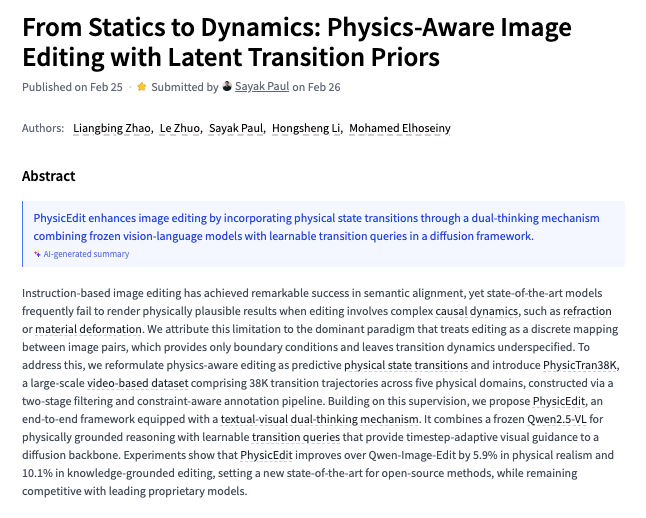
PhysicEdit (Research): A new paper, “From Statics to Dynamics: Physics-Aware Image Editing with Latent Transition Priors,” frames editing as moving between physical states (not just repainting pixels) and proposes PhysicEdit, which blends frozen vision-language models with learnable transition queries inside a diffusion setup, as summarized in the paper card. This matters for creators because many “edit” failures are really state-transition failures (liquid/cloth/fire/smoke behaving wrong), and this line of work is explicitly trying to make those transitions more consistent.
The tweet only includes a high-level abstract snippet, so treat implementation details as TBD until the full paper/code artifacts are checked; the concrete claim on the card is that PhysicEdit targets physically plausible transitions and ships alongside a dataset named PhysicTran38K, per the paper card.
World models get a creators-first checklist: modal, spatial, temporal consistency
Trinity of Consistency (World models): A paper argues that “general world models” should be evaluated around three consistency pillars—modal, spatial, and temporal—and introduces CoW-Bench to benchmark video generation models and unified multimodal models, as described in the paper card. This lands directly in the pain zone for filmmakers and animators: shot-to-shot identity drift (temporal), layout continuity (spatial), and cross-modal agreement between text/image/video (modal).
The tweet is an overview card rather than results; it positions CoW-Bench as the measurement layer that would make “consistency” less hand-wavy, per the paper card.
Image editing as state transitions, not one-shot retouching
Editing-as-transitions (Concept): A thread reframes image editing as “a series of state transitions between the source image and the edited image,” arguing current editing systems don’t capture that process cleanly, as stated in the state transition framing. This is a useful mental model for creatives debugging why edits break: the failure often shows up in in-between logic (what changed first, what stayed invariant, what should conserve volume/light/material).
This sits neatly next to physics-aware editing research, but the tweet itself is a critique/ framing rather than a specific tool or release, per the state transition framing.
A latent-space reality check for “imagination” in vision reasoning
Imagination vs latent space (Evaluation): A research drop titled “Imagination Helps Visual Reasoning, But Not Yet in Latent Space” suggests—via causal mediation analysis—that what looks like “imagination” improving visual reasoning may not actually be happening inside latent representations yet, per the paper headline. It’s relevant for creative tooling because lots of “plan the next frame” or “mentally simulate the scene” UX is implicitly betting that latent-space reasoning is doing that work.
The tweet doesn’t include the full methods/results artifact, so the actionable takeaway for now is the framing: “imagination prompts” can boost outcomes without proving the model’s internal latent reasoning improved, as implied by the paper headline.
🎧 AI audio in the mix: Suno in pipelines, AI ‘tribute’ tracks, and music-video tooling experiments
Lighter day for pure music releases, but several signals on how creators are wiring audio into broader pipelines (Suno for scoring, AI voice/music experiments, and custom editors for music-video output).
Anima_Labs adds Suno scoring to a Midjourney→Seedance 2 creature pipeline
Suno (Anima_Labs): A practical “full stack” creature workflow shows up: creature design in Midjourney (plus Nano Banana/Kling variations), animation in Seedance 2, and music from Suno layered on top, as spelled out in the Toolchain breakdown. The output is being treated like micro-storytelling (behavior notes like “keeps stones in its nest”), not a pure animation test, per the Toolchain breakdown and the follow-on scene share in Second scene stack.
The setup matters because it’s a repeatable way to keep audio “attached” to character identity while you iterate visuals across models—Suno becomes part of the asset bundle, not an afterthought.
Bennash builds a Mac music-video editor PoC with stretch, reverse, aspect, export
DIY music-video tooling (Bennash): A very early Mac-native music video editor proof-of-concept is shown with 4 features—stretch, reverse, aspect ratios, and export—built in Xcode alongside “Antigravity,” according to the Editor PoC notes. The UI screenshot also suggests it’s already thinking in delivery presets (16:9, 4K) and loop patterns (including reversed loops), as visible in the Editor PoC notes.
This reads like a creator-driven alternative to round-tripping between NLEs when your primary job is “visualizer assembly” and format variants, not heavy editorial.
‘Thirst Levels #2’ keeps resurfacing as a visualizer loop template
DJ visualizer loop (DJ Jay Min): “Thirst Levels #2” is getting reposted as a recurring unit of culture—short-form club visuals with strong title-card identity and long-running mixes—per the Techno Thursday share and a longer set repost in Long mix repost.

The practical takeaway is format: a named series + consistent typography + reusable visual language that can be exported into multiple aspect ratios without changing the musical core.
AI ‘Not‑Elliott Smith’ track spreads as meta commentary on AI music
AI music meta (Not‑Elliott Smith): A generated “tribute” track is being shared explicitly for the irony—an AI replica voice singing about the soullessness of AI—framed in the Share caption while the clip itself shows lyric subtitling (“Where did the people go?”) in the Share caption.

It’s less about a new tool drop and more about the emerging genre of self-referential AI music releases (and how quickly they get packaged into short, shareable video artifacts).
📈 Creator distribution & payouts: X monetization signals and the grind to subscriptions
Platform mechanics as creator ops: screenshots and posts about X payouts, verified-follower thresholds, and new UI filters—relevant because these determine whether AI creators can fund their output volume. Kept narrow to measurable platform dynamics.
X payout notifications show up for AI creators
X (Creator monetization): Creators are posting evidence that X monetization payouts are landing, with GlennHasABeard sharing a “You got paid!” notification that shows up minutes after the event in the Payout notification. That’s preceded by his note that it might be his first payment and that he won’t post the amount, per the Payout expectation.
For AI-heavy accounts, this is a concrete “cash-in” checkpoint after the recent re-enablement of monetization—useful signal for whether output volume can be funded by on-platform payouts rather than off-platform clients.
X subscriptions are still gated by verified followers counts
X (Subscriptions): X’s subscription feature gate is being surfaced as an explicit “verified followers” metric; GlennHasABeard posts a screenshot showing 1,589 verified followers (42% of total) in the Verified followers metric, and says he’s 400+ verified followers away from being able to publish subscription content in the same post.
This frames subscriptions less as “turn it on” and more as a growth ops target—especially relevant for AI creators whose output costs scale with posting cadence.
Creators are routing X payouts into newsletter monetization
Creator ops (X → newsletter): One emerging playbook is treating X payouts as seed cash for a second distribution channel; GlennHasABeard lists “X monetization unpaused + paid” and says he launched a newsletter he can monetize using some of that payout money in the Month recap note. He also frames the month as ramping workload (courses, writing, more releases) in the Workload update.
This is a concrete example of funding AI output volume via platform revenue, then reinvesting into owned distribution rather than relying solely on one feed.
X starts prompting users to try new post filters
X (Product UI): A new in-app banner reading “Try the new post filters” is appearing in the profile UI, alongside the tab row for Posts/Replies/Highlights/Articles/Media/Likes, as shown in the Post filters UI.
If this rolls out broadly, it changes how people browse a creator’s backlog (and what gets seen first), which can affect the long-tail performance of AI-made threads and series.
📅 Dates to pin: GDC activations, creator residencies, and awards season for AI video
Concrete calendar items creators can act on: GDC booth/talk announcements, artist residency applications, and AI awards show signals. Kept separate from ongoing tool capability chatter.
Stages.ai opens THE 100 residency applications Feb 28 at 12 PM EST
Stages.ai — THE 100 (Stages.ai): Applications are scheduled to open Feb 28 at 12 PM EST, with registration open to anyone but only 100 people selected for a 1-year artist residency, according to the Registration timing post.
The launch messaging is being reinforced with “application received” confirmations shown in the Portal confirmation screen, which suggests the submission flow is live/ready and the cap (“THE 100”) is central to the program framing.
[esc] Awards lock showtime: Fri Mar 13 (11 AM preshow, 12 PM PST show)
[esc] Awards (Escape AI Media): The [esc] Awards are being pushed as an “immersive 3D experience” on Fri Mar 13, with a preshow at 11 AM PST and the main show at 12 PM PST, as shown on the date card in the Event poster.
Nominee posts are also circulating in parallel—see the Nominee cards post—which is a useful signal for creators tracking awards-season deadlines and visibility moments around AI video work.
Meshy confirms GDC 2026 booth 941 and a Mar 12 CEO talk
Meshy (MeshyAI): Meshy is publicly pinning its GDC 2026 activation—Mar 11–13 in San Francisco at booth 941—and advertising a CEO Ethan Hu talk on Mar 12 framed around “AI + Games” with live demos, as shown in the GDC booth announcement.
This is a concrete “go see it / book a meeting” moment for anyone evaluating AI 3D workflows in a game production context, with the dates and booth number explicitly called out in the GDC booth announcement.
Autodesk Flow Studio schedules a March 10 LinkedIn Live (5:15 PM PT)
Autodesk Flow Studio (Autodesk): Autodesk is promoting a LinkedIn Live workshop for March 10 at 5:15 PM PT focused on “speeding early-stage game dev workflows” (storyboarding, character ideation, scene building), per the Workshop timing post.
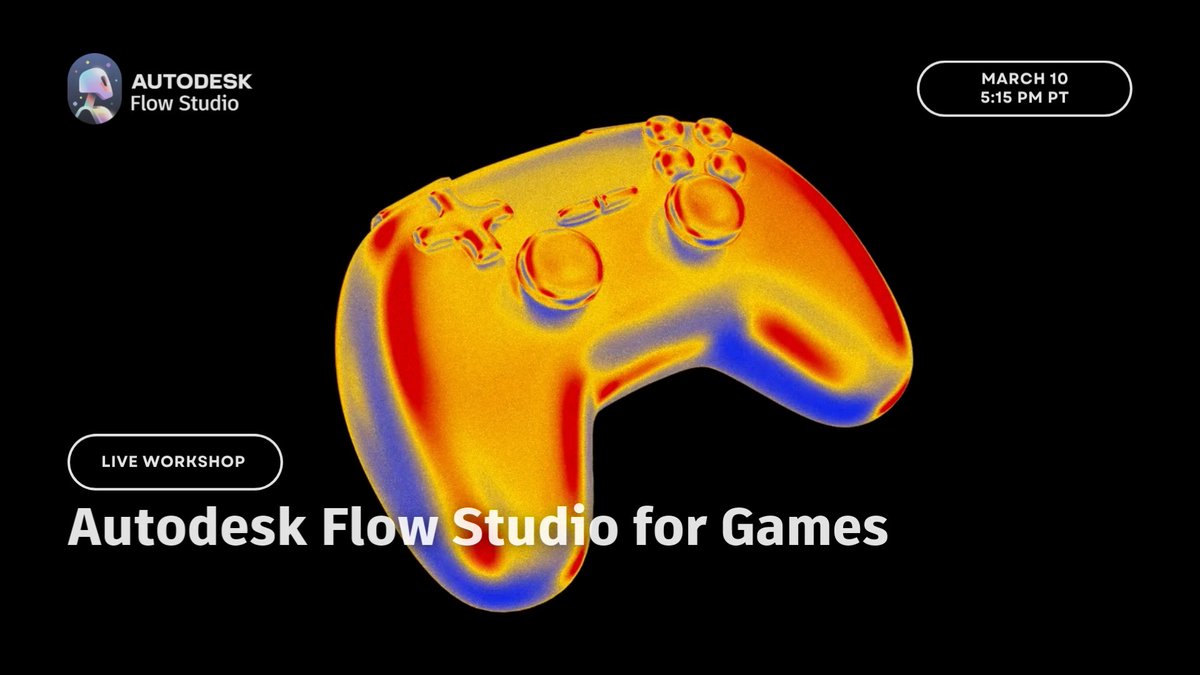
This is one of the few time-specific learning events called out today with an exact start time and a GDC-adjacent positioning, as described in the Workshop timing post.
West Coast AI Labs adds @tupacabra to the collective
West Coast AI Labs (WCAIL): WCAIL is formalizing a new addition—announcing @tupacabra joining the collective after “months of Portland meetups,” per the WCAIL welcome post.

This reads as a community/studio growth marker more than a tool drop; the public welcome and local-meetup origin are both explicitly stated in the WCAIL welcome post.
While you're reading this, something just shipped.
New models, tools, and workflows drop daily. The creators who win are the ones who know first.
Last week: 47 releases tracked · 12 breaking changes flagged · 3 pricing drops caught