Anthropic Claude Code 2.1.14 restores 98% context – VS Code GA lands

Stay in the loop
Free daily newsletter & Telegram daily report
Executive Summary
Anthropic pushed Claude Code into mainstream editor workflows: the Claude Code VS Code extension is now GA; it mirrors the CLI mental model with @-mentions, slash commands (/model, /mcp, /context), and diff-first review; users note it can read the active file and even selected lines as implicit context. On the CLI side, 2.1.14 is a reliability+behavior release: a regression that blocked sessions around ~65% context is fixed back toward ~98%; parallel subagent memory crashes and long-running stream cleanup get patches; bash calls are treated as non-persistent (cwd sticks, env/aliases/functions don’t), and plugins can be pinned to exact git commit SHAs for determinism.
• Cursor harness: shifts from static to dynamic context discovery; claims dynamic MCP tool loading cuts ~50% of tokens on requests that use it; @-tagging in 2.0 is now a pointer, not automatic file injection.
• Skills packaging: OpenSkills 2.0 teases a lockfile (skill.lock) and local installs; Vercel launches Skills.sh with npx skills add <owner/repo>, but verification/trust signals remain unspecified.
• vLLM v0.14.0: async scheduling becomes default; adds a gRPC server entrypoint; upgrade requires PyTorch 2.9.1 and tightens speculative-decoding param validation.
The open gap is measurement: formatting glitches, silent MCP failures, and high CPU reports persist in the Claude Code ecosystem; several UI hints (“Update memory,” export-to-zip) circulate without clear rollout status or benchmarks.
Top links today
- OpenAI age prediction rollout details
- VS Code live release highlights event
- Claude Code VS Code extension announcement
- Claude health data integrations overview
- Multiplex Thinking paper
- Indirect prompt injection via retrieval paper
- Neighborhood consistency truthfulness paper
- In-browser agents for search assistance paper
- Vercel skills repo for agent capabilities
- Ollama image generation announcement
- LFM 2.5 Thinking model on Ollama
- WSJ on Claude Code and software stocks
- OpenAI enterprise AI report 2025
- IEEE Spectrum on AI and scientific discovery
- AgentCPM-Report open-source deep research agent
Feature Spotlight
Claude Code lands in VS Code (GA) — editor-native agent workflows
Claude Code’s VS Code extension is now GA, bringing CLI-like workflows into the IDE (@-mentions, slash commands, editor context). This lowers friction for agentic coding adoption across teams standardizing on VS Code.
High-volume cross-account story: Anthropic’s Claude Code VS Code extension is now generally available, pushing Claude into the “in-editor” mainstream with @-mentions, slash commands, and diff-centric UX. This category covers the extension GA and editor-side capabilities; excludes Claude Code CLI/runtime changes (covered elsewhere).
Jump to Claude Code lands in VS Code (GA) — editor-native agent workflows topicsTable of Contents
🧩 Claude Code lands in VS Code (GA) — editor-native agent workflows
High-volume cross-account story: Anthropic’s Claude Code VS Code extension is now generally available, pushing Claude into the “in-editor” mainstream with @-mentions, slash commands, and diff-centric UX. This category covers the extension GA and editor-side capabilities; excludes Claude Code CLI/runtime changes (covered elsewhere).
Claude Code’s VS Code extension hits GA with @-mentions and slash commands
Claude Code for VS Code (Anthropic): Anthropic says the Claude Code VS Code extension is now generally available, and the experience is meant to be “much closer to the CLI”—notably adding @-mention file context and familiar slash commands like /model, /mcp, and /context, as described in the GA announcement and the Marketplace listing.
• Editor-native review loop: builders keep pointing out the “beautiful diffs” and editor integration as the reason it’s a strong default UI, per the Diffs in editor and the GA screenshot.
• Adoption and positioning: Anthropic maintainers note it’s been available for months but is now officially GA, as stated in the Maintainer note.
• Compatibility surface: some users report Plan Mode-style behavior (clarifying questions) inside the extension, per the Plan mode mention.
The install path being the VS Code Marketplace also matters because it makes the extension available across VS Code forks that share the marketplace plumbing, which shows up repeatedly in user workflows today.
Claude Code in VS Code can answer using your open file and selected lines
Claude Code for VS Code (Anthropic): A practical workflow detail getting shared is that Claude can condition on the currently opened file and even the lines you’ve selected, which changes how you feed context (less manual copy/paste; more “point at the code”). That behavior is described in the Selected lines behavior and demonstrated in the Selection demo clip.

This shows up as an “in-editor” context channel that’s meaningfully different from CLI usage, where people often rely on explicit file adds or pasted snippets.
Claude Code posts a full VS Code setup guide for editor workflows
Claude Code docs (Anthropic): Alongside the GA push, Anthropic linked a dedicated setup guide for using Claude Code in VS Code, covering installation and workflow details beyond the announcement copy, as indicated in the Setup guide link and laid out in the Setup guide.
The guide is the canonical reference for how Anthropic expects teams to run Claude in-editor (including how context is gathered, how commands map to the CLI mental model, and what the extension UI supports versus terminal mode), which reduces “tribal knowledge” setup drift across teams.
Claude Code VS Code extension also runs inside Cursor’s IDE
Claude Code extension in Cursor (Anthropic + Cursor): A user reports installing the Claude Code VS Code extension inside Cursor, using it as the front-end for Opus 4.5 while keeping Cursor’s own model selection available for other tasks, as shown in the Cursor install screenshot.
This is an editor-surface interoperability pattern: the extension becomes a portable UI layer across VS Code forks, while teams mix-and-match models and harness behaviors by tool.
Anthropic asks for feature requests for the Claude Code VS Code extension
Claude Code for VS Code (Anthropic): After the GA push, Anthropic-side advocates explicitly asked what additional VS Code extension features people want next, per the Feature request ask.
That’s a concrete signal that the extension’s feature surface is still in flux (beyond “GA”), and that user feedback is being pulled into the near-term roadmap rather than only CLI-side iteration.
🧰 Claude Code CLI: 2.1.14 behavior changes, stability fixes, and power-user features
Covers Claude Code’s CLI/runtime changes and reliability reports today (changelog, prompt/flag behavior, regressions). Excludes the VS Code extension GA (covered in the feature category).
Claude Code CLI 2.1.14 adds bash-history autocomplete and plugin pinning
Claude Code CLI 2.1.14 (Anthropic): The CLI adds history-based autocomplete in bash mode (!) and improves plugin ergonomics (search installed plugins; pin plugins to exact git commit SHAs), as listed in the Changelog summary. This is a CLI-level workflow change.
• Bash mode UX: Tab can complete partial commands from your shell history when you’re in bash mode (!), according to the Changelog details.
• Plugin determinism: Plugin installs can be pinned to specific commit SHAs (reducing “moving target” installs), per the Changelog summary and the upstream Changelog page.
Claude Code CLI 2.1.14 fixes premature context blocking and crashy subagents
Claude Code CLI 2.1.14 (Anthropic): A regression that blocked users around ~65% context usage is fixed back to the intended ~98%, and multiple stability issues are called out (parallel subagent memory crashes; long-running session stream cleanup), per the Changelog summary. This is a reliability release.
• Context headroom restored: The “context window blocking limit” is no longer calculated aggressively, as described in the Changelog details.
• Long sessions and parallelism: Fixes include memory issues with parallel subagents and a long-running session leak related to stream resources after shell commands, per the Changelog summary.
Claude Code changes shell semantics: bash state no longer persists between calls
Claude Code CLI 2.1.14 (Anthropic): The prompt/runtime guidance now treats Bash calls as non-persistent—only the working directory persists, while env/aliases/functions won’t reliably carry across tool calls, as noted in the Prompt changes summary. This can invalidate workflows that relied on export-then-use.
• What persists now: Each call starts “fresh” aside from cwd, according to the Bash state note. It’s a behavioral change.
• Downstream effect: Anything that assumed a sticky shell environment (temporary exports, sourced functions) becomes brittle, as implied by the Prompt changes summary.
Claude Code drops ExitPlanMode allowedPrompts guidance in 2.1.14
Claude Code CLI 2.1.14 (Anthropic): The in-prompt guidance for ExitPlanMode.allowedPrompts was removed—examples and least-privilege framing are no longer present, per the AllowedPrompts change note. This can change how consistently the agent requests permissions.
A separate prompt change adds remoteSessionTitle support when pushing a plan to a remote session, as described in the Remote session title note.
Claude Code users report formatting bugs, MCP tool list drops, and high CPU
Claude Code (Anthropic): A user report flags formatting issues, silent MCP connection failures where the tool list disappears, and high CPU usage in recent builds, as shown in the Bug report post. The complaints are concrete.
A maintainer response says the formatting issue is being worked on and should be fixed in the “next release,” per the Maintainer response.
Claude Code now prefers gh CLI for GitHub URLs over HTML fetching
Claude Code CLI 2.1.14 (Anthropic): GitHub URLs are now steered toward using the gh CLI (gh pr view, gh issue view, gh api) through Bash instead of WebFetch-based HTML scraping, as documented in the GitHub retrieval note and the underlying Diff snippet. This shifts retrieval toward authenticated, structured endpoints.
The change is guidance-level, but it changes default behavior patterns. It’s not just formatting.
Claude Code power users surface /fork and /resume for session branching
Claude Code (Anthropic): Power users are sharing an undocumented session branching workflow via /fork <name> and /resume <name>, with /resume also opening a session management UI for renaming/previewing/switching sessions, per the Fork resume tip. This provides a lightweight way to branch context without duplicating setup.
Claude Code UI shows “Update memory” to write back to agent docs
Claude Code (Anthropic): A UI screenshot shows an “Update memory” button that appears to sync a chat’s learnings back into a memory artifact like CLAUDE.md / AGENT.md, as shown in the Update memory screenshot. This is a first-party memory-writing affordance, not a third-party workflow.
The post doesn’t specify rollout status or where the memory is stored.
Claude Code web/desktop shows early “Export” work for zipping a repo
Claude Code (Anthropic): A UI screenshot suggests Anthropic is working on an Export option on web/desktop that would let users “zip” the current work, as indicated by the Export menu screenshot. This looks like a packaging/export primitive rather than a model change.
It’s presented as “working on,” not shipped. Timing is unknown.
🧑💻 OpenAI Codex in practice: planning friction, multi-agent hints, and enterprise workflows
Codex-related usage signals and workflow tooling (CLI behaviors, adjacent UIs, enterprise deployment patterns). Excludes broader model-release chatter (e.g., GPT-5.3 speculation) unless it’s directly tied to Codex workflows.
Cisco says Codex plan docs improved reviews; cites 20% build gains and 10–15× defect throughput
Codex (OpenAI): Cisco describes treating Codex “as part of the team” by having it generate and follow a plan document so reviewers can assess both process and code, as quoted in the Cisco quote and expanded in the case study. This is positioned as a workflow shift (plan→implement→review) rather than autocomplete.
• Cross-repo build optimization: Cisco claims ~20% build-time reduction and “1,500+ engineering hours monthly” saved when Codex analyzed logs/dependency graphs, as described in the case study.
• Defect remediation at scale: It reports 10–15× higher defect-fix throughput via Codex CLI, framing weeks of work compressed to hours, per the case study.
The writeup is light on reproducible methodology details, but it’s a concrete large-enterprise example with specific deltas.
Codex CLI surfaces a “dangerously bypass approvals and sandbox” mode
Codex CLI (OpenAI): A screenshot from Codex’s git history shows invocation of codex --dangerously-bypass-approvals-and-sandbox, alongside a model line indicating gpt-5.2-codex xhigh, as shown in the terminal screenshot.
This is a notable operator control: it implies an explicit path to remove interactive approvals and/or isolation boundaries; the snippet is presented as something “spotted in the codex git history” in the terminal screenshot.
Codex docs text shifts from “minimum” to “optimal” workers in multi-agent workflow
Codex (OpenAI): A screenshot of Codex documentation/history shows a wording change in “Multi-agent workflow,” swapping “minimum set of workers” to “optimal set of workers,” as captured in the diff screenshot.
The snippet reads like internal guidance for orchestration steps (understand request → pick workers → spawn workers → verify), and the wording change suggests Codex is formalizing multi-agent selection as an optimization problem rather than a minimal decomposition, per the diff screenshot.
Codex Monitor pitches a fast-moving UI for Codex CLI with subagents and worktrees
Codex Monitor (Dimillian): A community UI for Codex CLI is getting highlighted as a practical layer for subagents/worktrees, Git integration, and usage monitoring—see the project link pointing at the GitHub repo. It’s framed as a way to bring “CLI power” into a more navigable interface.
The tweet doesn’t enumerate versioned release notes, but it does call out the feature surface (subagents/worktrees/git/usage) as the core differentiator in the project link.
Codex plan mode ergonomics get criticized: “asked me to give it paths”
Codex (OpenAI): A user report says GPT‑5.2 Codex “Plan mode asked me to give it paths to relevant files,” then took “an actual HOUR” to produce ~2k lines, and broke the project with invalid syntax, as described in the plan mode complaint.
There’s no accompanying repro, but the complaint is specific about planning friction (manual file-path enumeration) and wall-clock latency, per the plan mode complaint.
User report: Codex 5.2 is slower but better at C++ memory bug fixing than Opus 4.5
Codex 5.2 (OpenAI): A practitioner compares models in practice: Opus 4.5 “couldn’t fix a few annoying bugs” after many iterations, while “codex 5.2 (high/xhigh) is slow, but it actually finds c++ memory bugs and ships workable fixes,” as written in the model comparison.
This is an anecdotal but concrete routing heuristic (frontend/UI vs backend/bugs) tied to observed bug-fixing outcomes, per the model comparison.
Codex “optimal fix” conversations show up in PR commentary, with stylistic tells
Codex (OpenAI): A developer describes a typical PR flow: ask “Is this the most optimal fix,” iterate with Codex, and end up with PR commentary that Codex itself wrote—“the em-dash gives it away,” per the PR note linking to the PR example.
This is another concrete signal that some teams are using Codex as an iterative reviewer/editor, not only as a code generator, as implied in the PR note.
OpenRouter shares a Codex usage-tracking page for top model variants
Codex usage telemetry (OpenRouter): OpenRouter shared a “Codex growth” view that tracks top Codex model usage, pointing readers to “track them here” in the tracking link that goes to the Codex page. The tweet frames this as a way to watch which Codex variants are actually being used in the wild rather than relying on anecdotes, per the growth note.
Codex is being used to remove “Opus-style” artifacts from PRs
Codex (OpenAI): An anecdote notes Codex “automatically de-opuses PRs,” illustrated by a docs diff that strips checkmark emojis (✅/❌) into plain text status labels, as shown in the diff screenshot.
It’s a small example, but it highlights a real review hygiene pattern: using Codex to normalize style before human review, rather than only generating new code, per the diff screenshot.
Users report model-picker mismatch: “Extended Thinking” selected, no thinking behavior
ChatGPT/Codex workflow reliability: A complaint notes that selecting “GPT‑5.2 Extended Thinking” can yield responses that “doesn't think,” as stated in the model selection complaint.
It’s not a Codex-specific API issue, but it directly impacts Codex-in-ChatGPT workflows where users expect a particular reasoning mode and use it as part of a plan→implement loop, as implied by the model selection complaint.
🧭 Cursor & IDE harness design: static vs dynamic context, agent review UX, and team settings
Cursor-specific workflow design and harness behavior (context discovery, agent review configuration, and IDE ergonomics). Excludes Claude Code’s VS Code GA story.
Cursor explains why it moved from static to dynamic context discovery
Cursor (Cursor): Cursor’s agent harness lead describes a deliberate shift from static context (preloaded instructions/tools) to dynamic context (discovered mid-run), including the key behavioral change that @-tagging files in Cursor 2.0 no longer injects file contents—it's mainly a pointer the agent can choose to read/search, as explained in the Static vs dynamic thread.
A concrete datapoint: dynamic MCP tool loading reportedly shaved ~50% of tokens off the average request that used it, per the Token efficiency note.
• Why dynamic helps: fewer brittle heuristics and less manual “compression,” with the harness letting the agent decide what to fetch and when, as laid out in the Token efficiency note.
• Why not all-dynamic: static context still matters for hard rules the agent won’t self-check (e.g., “avoid useEffect”), and for lower latency (fewer tool calls), per the Static context limits and Clarifying note.
More detail is linked from Cursor’s own write-up in the Dynamic context post, while hiring is pointed to in the Careers page.
Cursor adds a configurable Agent Review step (Quick vs Deep)
Cursor (Cursor): A Cursor user surfaced an Agent Review control that lets teams choose an approach like “Quick” vs “Deep,” framing it as a practical way to bake robustness/security review into agent-assisted work, as shown in the Agent review screenshot.
The screenshot suggests Cursor is treating review depth as a first-class harness setting rather than a per-prompt habit, but there’s no accompanying changelog or rollout details in the tweets.
Cursor usage tip: start in Plan Mode, then let it search without heavy @-tagging
Cursor (Cursor): A small practitioner checklist recommends starting with a plan via Shift+Tab Plan Mode, letting Cursor search autonomously, and avoiding excessive @-tagging of context, per the Cursor tips snippet.
It’s a lightweight “agent gets its own context” workflow that matches Cursor’s broader push toward dynamic discovery rather than manual context packing.
🧱 Skills & plugin ecosystems: install flows, versioning, and auto-loading behavior
Installable skills/plugins and the emerging “skills management” ecosystem across tools. Excludes MCP/connectors (covered separately).
OpenSkills 2.0 teases version locking and agent auto-detection
OpenSkills 2.0 (Open-source): A new OpenSkills 2.0 release is teased as “zero telemetry” with privacy-first local installs; it adds discovery/search, introduces versioning via a skill.lock file, and claims it can auto-detect installed agents and install skills directly into them, per the release teaser and the linked GitHub repo.
The key operational shift is treating skills as dependency-managed artifacts (lockfile + versions) instead of “latest from a repo,” which is the root cause of many “it worked yesterday” failures in skill ecosystems.
Vercel’s Skills.sh proposes a shared install path for agent skills
Skills.sh (Vercel): Vercel introduced Skills.sh as an “open ecosystem” to find/share agent skills, with a single-command install flow—npx skills add <owner/repo>—as described in the launch note, with the directory itself linked as the agent skills directory.
This frames “skills” as a portability layer across agent runtimes (add-on capability packaged in a repo), but the tweets don’t show how discovery ranking, trust, or verification works yet.
Deepagents treats agents as folders you can share
deepagents (Agent profiles): deepagents is pushing an “agents as folders” pattern where AGENTS.md + a skills directory define an agent profile; the claim is you can swap agents with a flag (deepagents --agent <name>) and share the whole profile via airdrop/curl, as shown in the agent profiles demo.
This makes the unit of reuse a filesystem bundle (instructions + scripts), not a hosted marketplace object—useful for org-internal distribution where you want reproducibility and code review over click-to-install.
Skills are easier to add; determinism remains the trade-off
Skills trade-offs (Ecosystem): A practitioner take frames skills as a useful complement to deterministic tool interfaces: skills are quick to add capability but “at the cost of greater stochasticity,” while deterministic interfaces remain valuable when you need predictable behavior, as argued in the skills vs MCP take. Another thread adds that this “skills are all you need” posture often assumes a bash-capable agent runtime, which doesn’t generalize to many enterprise surfaces, per the bash tool caveat.
This shows the ecosystem splitting into two “trust models”: skill-driven flexibility versus tool-specified predictability.
Skills auto-loading is still a trust gap for builders
Skills auto-loading (Ecosystem): A recurring friction point is whether skills actually load when you expect; one dev bluntly asks “do skills ever get automatically loaded” and whether it “actually work[s]” in practice, as captured in the auto-load question.
This is a reliability issue more than a capability one: if loading is implicit but non-deterministic, teams can’t reason about what the agent knew when it acted.
Claudeception captures Claude Code learnings as skills
Claudeception (Open-source): Claudeception proposes a workflow where when Claude Code discovers a non-obvious workaround or project-specific trick, it gets saved as a new skill so future sessions can reuse it, per the pattern overview and the linked GitHub repo.
This is an explicit response to “agents start from zero” session loss; the open question is how well skills get selected/loaded in the moment versus becoming another manual step.
Gemini-in-Chrome shows “Skills management” UI strings
Gemini (Google) in Chrome: UI strings referencing “Skills management” (Add/Edit Skill, Name, Instructions) show up in what looks like Chrome/Gemini surfaces, as shown in the UI strings leak.
It’s not a confirmed launch, but it suggests Google is treating skills as a first-class, user-editable artifact (name + instructions), which would shift skills from “developer packaging” toward productized configuration.
🕹️ Agent ops & swarms: remote execution, task backlogs, and trace analytics
Tools and patterns for running many agents (remote VMs, orchestration, trace/ops analysis, compaction strategies). Excludes SDK-level agent frameworks (covered elsewhere).
LangSmith adds an “Insights Agent” to analyze agent traces at scale
LangSmith Insights Agent (LangChain): LangChain is positioning the new Insights Agent as a way to stop manually spelunking giant trace logs—by running over your traces and extracting patterns and failure modes automatically, as described in the Insights Agent intro and expanded in the Trace analysis details.
• What it surfaces: It’s framed as aggregating stats like tool-call counts, latency/cost, tool clustering, and subagent usage, per the Trace analysis details.
• Agent-behavior diagnostics: The same description calls out higher-level questions—whether the agent replanned, how compaction affected behavior, and whether work could be parallelized better, as written in the Trace analysis details.
This lands as an “ops layer” for teams running long tasks where the bottleneck is understanding why agents behave the way they do.
Decentralized swarm control beats a “mastermind” agent for long runs
Swarm coordination (Doodlestein): Following up on Swarm management (controller hierarchy), one practitioner reports backing away from a “ringleader-mastermind” because it became brittle and started inventing tasks; the alternative is giving each worker agent the same instruction to pick work independently from a dependency graph, as described in the Decentralization notes.
• Why the central agent failed: The top-level agent is described as “confabulating beads tasks that didn’t exist,” which then wasted worker effort per the Decentralization notes.
• What the controller still does: The “meta controller” role gets reduced to logistics (start/stop agents, handle crashes/limits, resolve duplicate work) while the task choice comes from the beads dependency structure, as explained in the Decentralization notes.
The point is reliability: distributing task selection avoids a single agent becoming a systemic failure point.
“Everything is a Ralph loop” pushes loop-first agent ops as the default
Ralph loop paradigm (Geoffrey Huntley): Following up on Ralph loops (TUI-driven loops), a longer write-up argues software building shifts from linear “brick-by-brick” to loop-based iteration with autonomous execution and explicit failure-domain learning, as laid out in the Loop essay.
A concrete claim in the essay is that deterministic outcomes are easier when the loop is constrained to a single repo (vs multi-service non-determinism), and that ops work becomes monitoring and fixing failure domains rather than hand-coding every step, per the Loop essay.
“Write a remember file before compaction” pattern for long agent sessions
Context compaction workaround: One operator reports bypassing lossy compaction by telling the agent to dump “everything you need to remember” into a file (e.g., CLAUDE-REMEMBER.txt) right before the context window fills, then re-reading it immediately after compaction, as described in the Compaction workaround.
The claim is operational: it yields a small artifact that preserves working state across compaction boundaries, per the Compaction workaround.
Beads backlog telemetry shows 45 projects with 4,721 open tasks
Beads backlog telemetry (Doodlestein): A status snapshot shows a backlog view intended for swarm allocation—listing “45 projects” and “4,721 open beads,” then prompting which project to swarm on next, as shown in the Backlog screenshot.
• Capacity-planning primitive: The UI-style output highlights top projects by open tasks (e.g., one project at 606 beads) and then asks whether to join an in-flight session or start a new swarm, per the Backlog screenshot.
This reads like an emerging ops pattern: treat “what should agents do next?” as a queueing/capacity problem, not a chat prompt.
PredictionArena uses Kalshi P&L curves as an agent performance leaderboard
PredictionArena (Kalshi): A new-ish ops-style benchmark is showing up where models trade markets and get scored by realized P&L; one team claims “$700 today… just on weather,” and shares a performance-history chart comparing several named models in the P&L chart.
• What’s being compared: The chart depicts multiple model lines (e.g., GPT-5.2, Claude Opus 4.5, Gemini 3 Pro, Grok variants, plus a “mystery model”) with a $10k starting cash reference, per the P&L chart.
• How it’s operationalized: The same thread points to a list of tradable markets “they can trade on,” via the Markets list link.
It’s not a standard eval, but it’s showing up as a way to test tool-using agents under real constraints (latency, rules, and bankroll).
W&B WeaveHacks returns with a “self-improving agents” theme
WeaveHacks (Weights & Biases): W&B announced WeaveHacks running Jan 31–Feb 1 at W&B HQ in SF, explicitly themed around building “self-improving agents,” and name-checking Ralph loops and “Gas Town” as reference points in the Hackathon announcement.

The announcement frames the event as pushing agent loop patterns, not model training, and calls out infra sponsors (Redis, Browserbase, Vercel, etc.) in the Hackathon announcement.
🧪 Workflow patterns for shipping with agents: specs, slop control, and compounding loops
Practitioner techniques for getting reliable output from coding agents (spec hygiene, context discipline, and iteration loops). Excludes product/feature announcements for specific assistants.
CLI-first automation revival: small bash loops replace lots of process
Automation (CLI-first habits): Multiple posts converge on the same practice: when agents reduce the pain of scripting, it becomes cheaper to encode “advice” as automation—e.g., “a few lines in a bash loop” replacing manual checklists, as noted in the bash loop remark. A related point is that the CLI-first nature of Linux makes these micro-automations easier to sustain now, per the Linux automation note.
A third thread frames it as a personal rule—when a task becomes onerous, automate it immediately to stop future toil—illustrated with simple directory aliases in the automation policy.
Jevons Paradox framing: cheaper code expands what teams choose to build
Software economics (Jevons Paradox): A clear writeup argues that driving down the cost of producing code doesn’t shrink software work; it expands it by making previously-uneconomic projects viable, as described in the Jevons paradox thread. This matters for planning because it shifts the bottleneck from “can we build it” to “what’s worth building and maintaining.”
The post is also being read as a proxy for how fast code generation quality is catching up, given how many people questioned authorship (see the separate thread on that in the Jevons paradox thread).
PRD refinement: specify module depth and required test coverage before agent work
Spec hygiene (PRD template): A lightweight way to prevent downstream cleanup is adding PRD sections that explicitly define which modules must be created, how deep/shallow they should be, and what test coverage is required, as suggested in the PRD template tweak. This pairs directly with the earlier “slop” diagnosis in the slop root cause.
The key point is that agents interpret missing structure as permission to invent structure.
UI prototyping pattern: iterate on taste with throwaway routes
Prototyping (taste loop): One concrete pattern for UI work is generating multiple prototypes on “throwaway routes” so you can evaluate options quickly, then keep only the winner, as shown in the throwaway routes example. It’s explicitly positioned as a tighter loop for “matters of taste,” where correctness tests don’t help.
This tends to work best when the prototypes share the same data model so comparisons are meaningful.
Why you still have to read code: slop compounds across agent runs
Code hygiene (slop compounding): A recurring failure mode is “slop inheritance”: a second agent sees questionable code from the first and assumes it was intentional, then builds on top of it—making the system worse unless a human fixes the root cause, as warned in the slop propagation warning.
This frames manual review as drift control, not perfectionism.
A 3-day agent-coding weekend replaces 1–2 years of solo work (anecdote)
Productivity claim (agent-assisted engineering): A solo builder reports spending a 3-day weekend agent-coding a “complex system” spanning networking, orchestration, caching, bare metal, reverse proxies, and a custom Linux kernel—work they estimate would have taken 1–2 years alone, per the weekend build claim.
This is an anecdotal datapoint, but it matches the broader pattern that integration-heavy work is where agents compress timelines most.
AI prose detection fatigue shows up in engineering review culture
Writing quality (authorship ambiguity): A notable side effect of better model output is that readers increasingly can’t tell whether well-structured prose is LLM-written or not, as observed in the authorship confusion note and reiterated in the follow-up comment. This shows up directly in engineering workflows because plans, PRDs, design docs, and incident writeups are now routinely suspected of being synthetic—even when they’re not.
The open question is what “trust signals” replace authorship once text quality converges.
Compaction workaround: write a “remember” file before context truncation
Context management (compaction memo): A practical pattern for long sessions is to pre-empt compaction by having the agent write a short “everything you need to remember” file (e.g., CLAUDE-REMEMBER.txt), then reload it after compaction; this is described as reducing loss while keeping the memo small in the compaction memo pattern.
This turns compaction into an explicit checkpoint rather than an implicit failure mode.
Mindset pattern: agentic coding rewards comfort with failure and iteration
Operator mindset (failure tolerance): A practitioner argues that effective coding with LLMs requires being comfortable with frequent failures (both yours and the model’s), treating the tool as inconsistent and needing practice—“more like training and riding a horse than using a hammer,” as written in the failure tolerance note.
This shows up in shipping workflows as shorter iteration cycles, stricter verification, and fewer expectations that a single pass will be correct.
Setup discipline: compounding workflows beat perfect agent configs
Workflow discipline (settings vs habits): A practitioner note argues that teams get more leverage from a small set of stable workflow building blocks than from obsessing over every knob and setting, as stated in the compounding workflows advice. This is a response to the common pattern where teams spend more time tuning agents than shipping.
The implied trade-off is less “max capability” in exchange for repeatability.
🔌 Connectors & orchestration surfaces (MCP, workflow nodes, and in-product actions)
How agents connect to tools: MCP servers, workflow nodes, and productized “actions” that turn web/apps into callable tools. Excludes skills/plugins packaging (covered elsewhere).
Claude adds opt-in health data connectors across iOS and Android sources
Health connectors (Claude/Anthropic): Claude can now connect to user health data via four beta integrations—Apple Health (iOS), Health Connect (Android), HealthEx, and Function Health—positioned as opt-in and “not used for training,” per the integration announcement.

• Access and rollout: the connectors are described as rolling out to Pro and Max users in the US in the rollout note.
• Competitive signal: early comparisons frame this as a parallel push to ChatGPT’s health integrations, with Claude’s consolidation style sometimes preferred, as discussed in the head-to-head prompt clip.
Google ships a Stitch MCP server for live UI generation and IDE code fetch
Stitch MCP server (Google): Google shipped an official MCP server for Stitch that can generate UI designs “on the fly” and pull code directly from your IDE, as shown in the release demo. This is a concrete step toward design→code agent loops that don’t require bespoke integrations per editor.

• What changes for builders: instead of copying screenshots/specs into chat, an agent can request a design artifact and then fetch or update the relevant code context from the IDE in the same run, as described in the release demo.
OpenAI Atlas adds site-specific actions, starting with YouTube timestamps
Atlas browser actions (OpenAI): OpenAI’s Atlas browser is starting to show site-specific action buttons; on YouTube, a “Timestamps” button triggers ChatGPT to extract key moments into a sidebar, as shown in the YouTube timestamps UI.
• What this implies for orchestration: this is an “actions as tools” surface—users click a site-aware action, and the system runs a structured extraction workflow against that site’s content instead of relying on free-form prompting, as shown in the YouTube timestamps UI.
Firecrawl’s /agent node lands on n8n cloud for workflow-native web research
Firecrawl /agent (n8n): Firecrawl says its /agent node is now live on n8n cloud, making web research + enrichment callable inside n8n workflows (and still usable self-hosted), according to the n8n node announcement.

• Why it matters operationally: this turns “research steps” into a first-class workflow node with retries, triggers, and downstream automations—rather than an ad-hoc agent session, per the n8n node announcement.
Skills vs MCP debate narrows to determinism and “no code exec” enterprise reality
Skills vs MCP (ecosystem): Several practitioners argue MCP isn’t going away because it provides a more deterministic tool interface, while “skills” are easier to package but often assume a bash/code-exec substrate; this framing shows up in the skills vs MCP take and the bash requirement note.
• Enterprise constraint: teams point out many enterprise environments forbid arbitrary code execution, so skills/programmatic execution can be blocked while MCP-style tool access remains viable, per the enterprise constraint note.
• Practical pain points: the same discussion calls out MCP interface limitations (e.g., long outputs) and suggests file-based workarounds (dump to a file, read later) while keeping MCP for determinism, as described in the skills vs MCP take.
🧠 Model watch: new checkpoints, open models, and near-term release signals
New or newly-surfaced model checkpoints and expansions (open weights, language expansion, and credible release breadcrumbs). Excludes runtime/serving changes (covered in systems/inference).
GPT-5.3 becomes the next named OpenAI update as Altman solicits feedback
GPT-5.3 (OpenAI): Sam Altman publicly asked what users want improved in “5.3,” which effectively confirms GPT-5.3 as the next named iteration rather than a jump to “5.5,” as shown in the 5.3 feedback ask and echoed by the 5.3 confirmed note.
This is a lightweight but concrete roadmap signal: it frames near-term work as a point upgrade from GPT-5.2, and invites builders to feed back on practical gaps (speed, reliability, UX) before rollout, per the 5.3 feedback ask.
DeepSeek “MODEL1” breadcrumb appears in FlashMLA KV-cache kernel code
DeepSeek (MODEL1): A DeepSeek GitHub diff references a new model version named “MODEL1” in FlashMLA attention-kernel code, specifically calling out a different KV-cache stride requirement versus “V3.2,” as shown in the MODEL1 KV layout snippet and similarly noted in the FlashMLA diff note.
This is a classic pre-release breadcrumb: kernel/layout differences often land ahead of model naming showing up in product surfaces, but there’s still no official MODEL1 announcement in the tweets, per the MODEL1 KV layout snippet.
Gemini 3 Pro resurfaces in AI Studio A/B tests, hinting at GA timing
Gemini 3 Pro (Google): Multiple posts claim a “true” Gemini 3 Pro variant is being A/B tested again inside AI Studio—framed as a possible signal toward GA—per the A/B test claim and corroborated with a “Robot SVG bench” example set in the Robot SVG examples.
The evidence in today’s tweets is observational rather than an official launch note, but the repeated “A/B testing resumed” phrasing suggests builders are watching for a near-term checkpoint swap in the AI Studio routing, as described in the A/B test claim.
LightOn releases LightOnOCR-2-1B OCR family under A2.0 with speed claims
LightOnOCR-2-1B (LightOn): LightOn released a 1B-parameter end-to-end OCR model family under an A2.0 license, claiming it’s super fast/cheap (e.g., “5× faster than dots.ocr” and “<$0.01 per 1k pages”) in the Release thread, with more detail in the Release blog post.
The early positioning is “small but competitive”: benchmark screenshots show LightOnOCR-2-1B performing strongly against larger OCR-tuned VLMs, as seen in the Benchmark table tweet, which is why this is likely to show up quickly in document-ingestion and agent-RAG pipelines.
OpenBMB’s AgentCPM-Report claims an open 8B deep-research agent workflow
AgentCPM-Report (OpenBMB): OpenBMB announced AgentCPM-Report, positioning it as an open-source 8B “deep research” agent that can generate cited reports with a draft↔refine loop and local/offline deployment, per the AgentCPM launch thread and the linked Model card.

• Local/offline packaging: The launch text emphasizes privacy and “one-click” local use (UltraRAG + Docker) rather than a hosted-only research product, according to the AgentCPM launch thread.
• Training recipe claim: It describes a 3-stage pipeline (SFT → atomic-skill RL → end-to-end RL) and “writing-as-reasoning,” as stated in the AgentCPM launch thread.
The key unknown in today’s tweets is independent evaluation: the strongest performance claims are self-reported, with the primary artifacts being the Model card and repo materials.
Gemini adds an “Answer now” fast-path powered by Gemini 3.0 Flash
Gemini (Google): The Gemini app UI now includes an “Answer now” control that switches to Gemini 3.0 Flash for lower-latency responses, as shown in the Answer now UI screenshot.
This is a product-level knob for trading response quality/time against speed (and likely cost), and it makes “fast path vs think path” an explicit user choice in the interface, per the Answer now UI.
Gemini expands language coverage to 70+ with 23 newly added languages
Gemini (Google): Google says Gemini expanded to 23 new languages, bringing support to 70+ languages across all surfaces, as announced in the Language expansion; geographic availability is summarized in the Availability page.
For builders and analysts, this is a distribution signal: broader language support tends to shift which markets can adopt the same model+UX flows without bespoke localization work, as implied by the Language expansion.
GPT-5.3 “Garlic” codename circulates with a “new pre-training” narrative
GPT-5.3 (OpenAI): Community chatter pegs GPT-5.3’s codename as “Garlic,” tying it to expectations of stronger pre-training and faster inference, as claimed in the Garlic codename post and reinforced by the garlic mention.
This is still an informal signal (no release notes or model card yet), but it’s becoming a shared handle for tracking leaks, A/B sightings, and user reports around the next GPT-5.x checkpoint, as reflected in the Garlic codename post.
LiquidAI’s LFM2.5-1.2B-Thinking lands as an on-device reasoning option
LFM2.5-1.2B-Thinking (LiquidAI): LiquidAI’s LFM2.5-Thinking is now runnable locally via Ollama (ollama run lfm2.5-thinking) according to the Ollama run command, with a model reference page linked in the Model page pointer.
The distribution signal here is breadth: it’s also being listed in “free” model pickers on aggregators, as shown in the OpenRouter free listing, which makes it easier to test on-device-ish “small thinking model” workflows without committing to a larger endpoint.
📏 Benchmarks & leaderboards: community eval scale and new scoreboards
Evaluation signals, leaderboards, and comparative scoreboards referenced today (including non-traditional ‘agent contests’). Excludes pure market share charts (covered in business/enterprise).
Text Arena crosses 5 million votes, scaling human preference evaluation
Text Arena (LMArena): The Text Arena passed 5 million community votes, turning preference comparisons into a large, continuously-updated eval dataset rather than a small benchmark snapshot, as announced in the Milestone post.

The milestone reinforces how much evaluation signal is now coming from volunteer head-to-head testing versus curated academic test sets; the project points people to try models directly via the Arena site, which is the data-generation loop that makes the vote count meaningful.
BabyVision highlights a large gap between Gemini 3 Pro Preview and adults
BabyVision (visual reasoning benchmark): Following up on initial benchmark—language-free visual reasoning suite—the benchmark framing now foregrounds an adult human score of 94.1% versus Gemini 3 Pro Preview at 49.7% across 388 tasks, as reported in the Benchmark scorecard.
The chart also situates the model around early-child performance bands (age-group baselines), which is helpful for interpreting what “50% accuracy” means in a non-language visual reasoning setting.
GLM-Image reaches #8 among open models on LMArena Image
GLM-Image (Z.ai): GLM-Image is reported at #8 among open models and #35 overall on the LMArena Text-to-Image leaderboard with a score of 1018, as shared in the Leaderboard note.
This is one of the clearer “single-number” tracking points for image-model progress in public; the benchmark surface referenced is the image modality view in Image leaderboard.
PredictionArena tracks models via P&L on Kalshi weather markets
PredictionArena (Kalshi agents): A live “agent eval” is emerging via model trading performance, with a chart comparing multiple models’ P&L over time on weather markets, as shown in the Performance chart.
Unlike static benchmarks, this treats profit curves as an integrated score over tool use, calibration, and decision loops; the tracked markets and the public interface are referenced via the Markets list link and the Leaderboard site.
Gemini 3 Flash briefly appears on LM Arena, then disappears
LM Arena (LMArena): A model labeled gemini-3-flash-20260120 showed up in Arena’s “new models” feed, per the Arena notification, then was quickly removed, as noted in the Removal update.
This is a clean signal of leaderboard volatility around A/B tests and staging; even if the weights or serving endpoints aren’t stable yet, the naming convention hints at date-stamped internal builds entering public eval surfaces before settling into a permanent slot.
📄 Document AI: OCR quality, doc-heavy agents, and ‘file handling’ gaps
Document-centric agent workflows (OCR quality, PDF→form automation, and enterprise doc processing). Excludes OCR model launch details (covered in Model watch).
CB Insights frames document processing as the proving ground for enterprise agents
Document processing (CB Insights): A new CB Insights “Tech Trends 2026” excerpt frames enterprise adoption shifting from tool-assisted work to autonomous execution, and calls out document-heavy workflows—especially financial services—as the leading proving ground; it cites 93% of fin-serve companies having document processing in full-scale deployment, as summarized by CB Insights excerpt and linked via the CB Insights report.
For AI engineers, the concrete takeaway is what buyers are scaling first: doc ingestion, extraction, and doc-to-workflow execution (rules-heavy, audit-heavy), not open-ended chat UX. The same post argues OCR is becoming more central because it’s the front door for downstream autonomous workflows, which is the kind of “boring” integration that tends to decide whether an agent deployment survives procurement.
A Gemini Build prototype turns PDFs into fillable forms with bounding boxes
DocuGenius (Gemini Build): A builder reports shipping a document signing app in four iterations: upload a PDF, convert pages to images, use Gemini to produce bounding boxes for open fields, collect user input, then export a filled PDF—described in the build walkthrough.

They also claim the run cost is “on the order of pennies” and that data stays between the user and the model provider per the build walkthrough, with the implementation published as a reference in the GitHub repo. This is a clean example of a pattern many teams are converging on: “render → detect fields → constrained UI fill → regenerate,” which is friendlier to audit than freeform extraction.
Gemini’s file-handoff limitations are still a blocker for “do the work” workflows
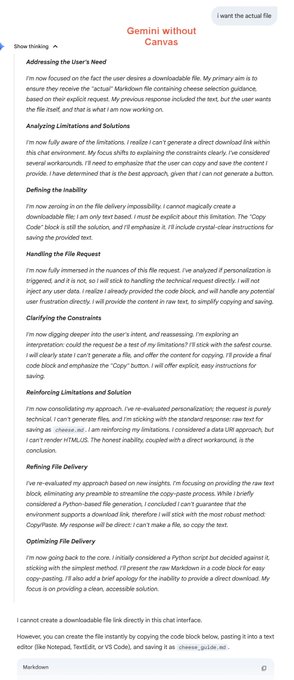
Gemini (Google): A recurring friction point shows up again: Gemini can be “a very smart model,” but the product still fails at basic “deliver the artifact” workflows (handing back files, consistently running code), which makes it less usable for end-to-end task completion according to file delivery complaint.
The screenshot contrasts “without Canvas” (can’t create a downloadable file link; instructs copy/paste) versus “with Canvas” (generates a file panel and suggests an export/download path), as shown in file delivery complaint. For teams building doc-heavy agents, this is the difference between a model that can draft content and a system that can reliably hand off real deliverables into the rest of a workflow.
OlmOCR-bench is turning green; the next bottleneck is harder real-PDF evals
OCR evaluation (OlmOCR-bench): A practitioner notes that OCR-tuned VLMs are getting “really good AND cheap” quickly, and that “good and cheap models are starting to saturate OlmOCR-bench,” creating a clear gap for a more complex, diversified benchmark that reflects enterprise PDFs, per benchmark commentary.
The attached table shows small OCR-tuned models posting strong overall scores (with multiple “highlighted best-in-column” cells), which supports the “benchmark saturation” claim in benchmark commentary. The implication for doc-heavy agents is that OCR model choice is starting to look commoditized on standard evals, while layout edge cases (multi-column, tables, degraded scans, mixed media) become the differentiator.
⚙️ Inference & self-hosting: runtimes, determinism knobs, and performance engineering
Serving/runtime engineering and local inference stacks (vLLM/SGLang/Ollama), plus concrete determinism and scaling knobs. Excludes model announcements (covered in Model watch).
vLLM v0.14.0 flips async scheduling on by default and adds a gRPC server
vLLM v0.14.0 (vLLM): vLLM shipped v0.14.0 with async scheduling enabled by default and a new gRPC server entrypoint aimed at higher-throughput serving, as called out in the Release highlights; it also raises upgrade friction with PyTorch 2.9.1 required and notes that speculative decoding now errors on unsupported sampling params instead of ignoring them, per the Upgrade caveats.
• Operational impact: expect different latency/throughput characteristics after upgrade because scheduling behavior changes unless you explicitly disable it with the flag mentioned in the Upgrade caveats.
• Quality-of-life knobs: the release adds --max-model-len auto to fit context length to available VRAM (startup OOM avoidance) and a model inspection view, as described in the Extra release notes.
• Model support churn: additional “new model support” items (including Grok tokenizer support and multimodal LoRA tower/connector support) are enumerated in the New model support list.
SGLang-Diffusion claims Cache-DiT speedups and adds LoRA serving APIs
SGLang-Diffusion (LMSYS): Two months after launch, SGLang-Diffusion reports ~1.5× faster end-to-end and positions Cache-DiT as a major lever (up to +169% speedup claim), alongside layerwise offload and broader hardware targeting (NVIDIA/AMD/MUSA), as summarized in the Two-month update.
• Serving surface expansion: the project adds a LoRA HTTP API and a ComfyUI custom node, tying creator workflows to a deployable server path, per the Two-month update.
More implementation detail is laid out in the Performance blog.
Ollama ships experimental local image generation on macOS
Ollama (Ollama): Ollama added experimental image generation with ollama run x/z-image-turbo and ollama run x/flux2-klein, with macOS supported first and Windows/Linux listed as “coming soon,” per the Launch note and follow-up pointers in the Setup links.
The practical angle for runtime folks is that this brings diffusion-style workloads into the same local orchestration surface as text models (one CLI, same model management), with more detail centralized in the Feature blog.
vLLM adds a practical knob for batch-size deterministic offline inference
vLLM (vLLM): A concrete reproducibility gotcha is resurfacing—the same prompt can yield different outputs depending on batch size—and vLLM’s fix is to set VLLM_BATCH_INVARIANT=1, as shown in the Tip screenshot and explained in the Docs section.
The docs note hardware constraints for batch invariance (newer NVIDIA GPU requirements), so this knob is not universally available even if you can install vLLM, per the Docs section.
MoE scaling field notes: Nsight-guided DeepEP tuning for intranode bottlenecks
MoE training/inference plumbing (Nous Research): Nous shared detailed field notes on scaling MoE expert parallelism with DeepEP, with Nsight profiling attributing poor scaling to specific intranode kernels (e.g., cached_notify_combine) and describing SM allocation tuning as an early mitigation, per the Field notes teaser and the linked MoE field notes.

This is mainly useful as a concrete debugging playbook: measure, identify the kernel-level wall, then tune resource partitioning before redesigning higher-level parallelism.
vLLM adds day-0 support for Step3-VL-10B with reasoning/tool-call wiring
Step3-VL-10B serving (vLLM): vLLM added day-0 support for Step3-VL-10B, and the shareable value for engineers is the concrete vllm serve invocation including a reasoning parser and tool-call parser flags, as shown in the Serve command screenshot.
Treat the benchmark claims in surrounding chatter as provisional here; what’s directly evidenced is that vLLM is standardizing the “reasoning model + auto tool choice” wiring into a single serving entrypoint, per the Serve command screenshot.
🛡️ Safety, governance, and abuse patterns: age gating, audits, and security-report spam
AI safety and governance changes with direct product or ecosystem impact (age gating, audits, export-control debate, and abuse that burdens engineering teams). Excludes general politics not directly tied to AI operations.
ChatGPT rolls out age prediction to apply teen safeguards by default
ChatGPT (OpenAI): OpenAI is rolling out an age prediction system that estimates whether an account is likely under 18 and, if so, automatically applies the “teen experience” and related safety restrictions, as announced in the rollout announcement and reiterated in the feature summary.
• How it decides: The model uses behavioral + account signals like account age, typical active hours, usage patterns over time, and stated age, as described in the mechanics quote and detailed in the Help center article.
• What changes for teens: OpenAI says it tightens handling around graphic violence, risky challenges, sexual/violent roleplay, self-harm, and extreme beauty/unhealthy dieting content, as summarized in the safeguards breakdown.
• Appeal path: Adults misclassified into the teen experience can confirm age in Settings, with the flow referenced in the rollout announcement and expanded in the safeguards breakdown.
EU availability is described as coming “in the coming weeks,” while the rest of the rollout is global now per the rollout announcement.
AI-generated security advisory spam is adding real maintainer load
Security reporting abuse: An open-source maintainer reports receiving 7 security advisories in one day that “did not make sense… all clearly AI generated,” arguing it blocks time for valid reports and increases triage burden, as described in the maintainer report.
After explaining why the advisories were invalid, the reporter allegedly insisted they would disclose anyway “for educational purposes,” which the maintainer says creates downstream support load to correct confusion, as stated in the follow-up on disclosure.
This is a concrete example of AI output turning into governance/abuse pressure on security workflows rather than just code quality issues, with the immediate impact being queue pollution and disclosure risk highlighted in the maintainer report and follow-up on disclosure.
Altman: safety guardrails must protect fragile users without blocking usefulness
ChatGPT safety posture (OpenAI): Sam Altman argues the product is pulled in opposite directions—criticized as “too restrictive” and “too relaxed”—and frames the problem as protecting vulnerable users “in very fragile mental states” while still letting most users benefit, as stated in the guardrails statement.
He also emphasizes the difficulty of making globally scaled safety decisions (“almost a billion people use it”) and asks for respect around tragic edge cases, all in the guardrails statement.
The post is also notable as a direct rebuttal to criticism that OpenAI is behaving like other safety-controversial tech companies, which he calls out explicitly in the guardrails statement.
Miles Brundage launches AVERI to push third-party safety audits
AVERI (AI safety governance): Former OpenAI policy lead Miles Brundage has launched AVERI (AI Verification and Evaluation Research Institute), a nonprofit advocating for independent audits of frontier models and arguing labs shouldn’t “grade their own homework,” as summarized in the AVERI announcement.
The early framing in the tweet is that AVERI won’t run audits itself, but will focus on standards and policy frameworks for third-party testing, per the AVERI announcement.
No concrete audit standard, target model list, or initial funders are mentioned in today’s tweets, so near-term operational implications for labs and enterprise buyers are still unclear from this dataset.
X open-sources its For You ranking code, but weights stay closed
X (xAI/X): X has open-sourced the production For You ranking codebase, which includes a Grok-based transformer in the scoring pipeline, as claimed in the open source claim and described technically in the pipeline summary.
The repository is available via the GitHub repo, and one post says it’s updated every four weeks in the open source claim.
• What the code shows: The thread summary describes a pipeline that predicts probabilities for 14 user actions and combines them into a rank score, with retrieval from in-network and out-of-network sources and post-filtering, as explained in the pipeline summary.
• Abuse risk concern: A separate reaction argues open-sourcing could be “a huge win for spam and bots,” as stated in the spam concern.
• “Missing weights” debate: Another commenter questions whether decisions are effectively moved into model weights that aren’t open, making the open code less actionable, as argued in the weights skepticism.
The tweets don’t include a commit hash, version tag, or a mapping from “live model weights” to the repo state, so the extent to which outsiders can reproduce ranking behavior remains uncertain from today’s sources.
Age prediction rollout sparks privacy and ad-targeting concerns
Age gating debate: The age prediction rollout immediately triggered concern that “behavioral signals” implies ongoing scanning of usage, with one post framing it as “is any chat… personal anymore,” as argued in the privacy concern.
• Ad-targeting suspicion: Some users explicitly speculate it’s connected to advertising strategy rather than only teen safety, as claimed in the ad strategy suspicion.
• Product framing from OpenAI: OpenAI positions the system as routing users into the right safeguards at scale, as shown in the ad strategy suspicion alongside the product rollout notice in the rollout announcement.
The public-facing docs shared today don’t include accuracy metrics or error rates, so the operational trade-off (false positives vs missed teens) remains unquantified in the tweets.
Amodei attacks easing Nvidia chip exports to China as a strategic error
Export-control stance (Anthropic): Dario Amodei criticized policy moves enabling Nvidia to sell high-performance chips to China, using a “selling nuclear weapons to North Korea” analogy in remarks shared in the interview clip.

The clip is being circulated as a governance position about compute access as a speed limit on frontier progress, rather than a technical performance claim, as framed by the interview clip and echoed in a second share of the same segment in the repost clip.
The tweets don’t provide details on which GPU SKUs or policy changes are being referenced, so the operational scope (which chips, what quantities) is not specified in this thread.
Jan Leike claims model misalignment rates dropped across 2025
Alignment trajectory signal: Jan Leike points to an “interesting trend” that models became “a lot more aligned over the course of 2025,” with the fraction of misaligned behavior declining, as referenced via the alignment trend retweet.
The tweet shown here is a retweet fragment and doesn’t include the underlying chart, dataset, or definition of “misaligned behavior,” so it reads as a directional claim without supporting measurement artifacts in today’s tweet set, as seen in the alignment trend retweet and the duplicate retweet in the second retweet.
🏗️ Compute & infrastructure: power, clusters, and ‘pay our way’ commitments
Compute supply/demand and infra buildout signals (energy commitments, TPU/GPU fleets, and scaling economics). Excludes enterprise GTM partnerships (covered in business/enterprise).
OpenAI’s Stargate Community plan commits to covering energy costs and funding grid upgrades
Stargate Community (OpenAI): OpenAI posted its community framework for Stargate campuses, emphasizing a “pay our way on energy” commitment so operations don’t raise local electricity prices, as described in the Stargate community post and detailed in the Stargate community page. The specific commitment language includes funding incremental generation and grid upgrades and using flexible-load strategies, as shown in the Energy commitment excerpt.
• Scale target: The page reiterates Stargate’s U.S. AI infrastructure buildout target of roughly 10GW by 2029, as stated in the Stargate community page.
This reads as a pre-emptive response to local-grid backlash: it turns “who pays” into a written operating constraint, not a PR promise.
Anthropic is rumored to self-deploy a TPUv7 fleet with nonstandard racks and optical switching
TPUv7 deployment (Anthropic): A report claims Anthropic is self-deploying a fleet on the order of ~1 million TPUv7 chips (rather than renting via Google Cloud), citing non-standard ultra-wide rack configurations and reliance on optical circuit switches for the scale-up fabric, as described in the TPUv7 fleet claim.
• Operations/logistics angle: The same report says Anthropic is partnering with FluidStack for deployment, cabling, and testing, per the TPUv7 fleet claim.
Treat the numbers as unverified (it’s framed as a report, not a first-party announcement), but it’s a strong signal that “owning deployment” is becoming a competitive differentiator, not just owning model weights.
OpenAI Podcast frames compute as the binding constraint for AI adoption
OpenAI Podcast (OpenAI): OpenAI published a new episode focused on compute scarcity—explicitly framing compute as the scarcest resource in AI—as previewed in the Podcast clip. The discussion centers on demand growth and how to broaden access without stalling on capacity.

The clip itself is light on implementation detail (no quotas/pricing changes cited in the tweet), but it’s a clear positioning signal about what OpenAI expects to be the primary constraint this year.
Amodei argues against allowing high-end Nvidia GPU sales to China
Export controls (Anthropic): Dario Amodei criticized the policy direction of allowing Nvidia to sell high-performance chips to China, calling it “crazy” and using a strategic-weapons analogy in the Amodei export-controls clip.
This lands as an infra governance signal: frontier labs are increasingly treating compute access and supply-chain policy as part of the competitive/safety perimeter, not a separate political issue.
OpenAI and the Gates Foundation launch $50M Horizon 1000 for primary healthcare delivery
Horizon 1000 (OpenAI + Gates Foundation): OpenAI announced a $50M initiative with the Gates Foundation to support health leaders strengthening primary care across 1,000 clinics, starting in Rwanda, as stated in the Program announcement and described in the Program page. The page frames this as deploying AI tools into frontline workflows (guideline simplification, admin burden reduction), not wet-lab research.
Operationally, it’s a deployment story: moving from model capability to field integration and governance in constrained settings.
Lisa Su projects another 100× compute surge over 4–5 years
Compute demand outlook (AMD): A circulated clip quote attributes to AMD CEO Lisa Su the claim that AI compute demand could rise another 100× over the next 4–5 years, as repeated in the Compute growth retweet.
The tweet doesn’t include methodology or constraints (power, memory bandwidth, supply chain), so treat it as a directional demand signal rather than a forecast you can capacity-plan against.
💼 Enterprise AI adoption & market impact: partnerships, spend share, and SaaS repricing
Enterprise adoption, partnerships, funding rounds, and market repricing driven by agentic tooling. Excludes infra build details (covered in infrastructure) and excludes the Claude Code VS Code GA itself (feature category).
Claude Code hype spills into SaaS repricing: Morgan Stanley SaaS basket down ~15% YTD
SaaS repricing narrative: Following up on SaaS selloff (AI displacement fears), a new recap cites a WSJ piece claiming Claude Code’s uptake is feeding investor concern that per-seat SaaS pricing weakens when agents can build “good enough” internal tools; it also cites a Morgan Stanley SaaS basket down ~15% so far in 2026, with Intuit down 16% last week and Adobe/Salesforce down 11%+, according to the WSJ recap.
• Mechanism being priced: “selfware” framing—agent-built internal apps reduce seat growth and increase churn risk; the argument is summarized in the WSJ recap.
This remains narrative-driven (no hard adoption metrics in the tweets), but the numbers show how quickly markets re-rate categories when tooling credibility crosses into executive usage.
Menlo Ventures chart shows Anthropic leading enterprise LLM API usage share (~40%)
Enterprise LLM usage share (Menlo Ventures): A Menlo Ventures slide circulating today claims Anthropic at ~40% enterprise LLM API usage share in 2025, with OpenAI ~27% and Google ~21%, as shown in the Market share chart.
• What the chart is (and isn’t): it’s presented as usage-based share “by usage,” not revenue; it implies procurement is diversifying and that vendor lock-in is weaker than a single-provider narrative, per the Market share chart.
Treat the breakdown as directional—tweets don’t include the underlying methodology beyond “survey of 500 U.S. executives” in the post text.
ServiceNow names OpenAI a preferred enterprise intelligence capability for 80B+ workflows
ServiceNow × OpenAI: ServiceNow says OpenAI will be a preferred intelligence capability for enterprises running 80B+ workflows/year on the ServiceNow platform, framed as a multi‑year partnership in the Partnership announcement and expanded in the Partnership page. This is explicitly about embedding frontier models into workflow execution, not just chat assistance.
• Where it lands in stacks: the announcement emphasizes translating “intent” into workflows and automation inside existing governance boundaries, as described in the Partnership page.
No pricing or rollout schedule is specified in the tweets; it reads as a platform distribution alignment rather than a single product launch.
Emergent claims $50M ARR in 7 months and a $70M Series B for its AI app builder
Emergent (app builder): A thread claims Emergent crossed $50M ARR in ~7 months and closed a $70M Series B led by SoftBank and Khosla, positioning “production-grade reliability” as the differentiator, per the Funding and ARR claim.

• Positioning: the pitch is that many “text-to-app” builders demo well but break under real traffic, while Emergent is optimized for end-to-end shipping (backend, DB, deployment), according to the Funding and ARR claim.
This is self-reported in the tweets; no primary filing or independent validation is included in the provided sources.
Anthropic partners with Teach For All on AI training for educators in 63 countries
Teach For All × Claude (Anthropic): Anthropic is partnering with Teach For All to deliver AI training to educators across 63 countries, targeting teachers who collectively serve 1.5M+ students, as described in the Partnership announcement and detailed in the Program page. It’s positioned as a two-way program—teachers use Claude for curriculum planning and custom tools, and Anthropic gets educator feedback to shape product behavior.
• Adoption mechanism: the pitch is “teachers as co-creators,” with examples of educators building local curricula and simple apps using Claude, according to the Program page.
This is an enterprise-style distribution play (large network, standardized training), but routed through education NGOs rather than a classic procurement channel.
‘66% of US doctors use ChatGPT daily’ claim circulates, with pushback
ChatGPT in healthcare (usage claim): A stat that “66% of US doctors use ChatGPT daily” is being shared as a signal of deep professional adoption in the Doctors daily use claim.

• Data quality dispute: at least one reply pushes back that the number is “an exaggeration,” as stated in the Pushback comment.
Without the underlying survey source in the tweets, this sits closer to “viral adoption narrative” than an auditable market metric, but it’s clearly shaping how people talk about AI in clinical workflows.
🎬 Generative media in production: influencer factories, audio→video, and deterministic editing
Non-coding creative pipelines and media model integrations that still matter to builders (APIs, determinism, and productized workflows).
Higgsfield launches AI Influencer Studio for 30s full-motion HD avatars
AI Influencer Studio (Higgsfield): Higgsfield is pitching a new “AI Influencer Builder” that generates photorealistic avatars with full motion and 30s HD video, framed as “1 trillion+ customization options,” with a free-credit growth loop (“RT & reply & follow & like for 220 credits”) in the launch announcement.

This is a straight-line path to higher-volume synthetic creator output (brand-safe or not), with the technical tell being motion + identity consistency rather than single-frame portrait generation, as shown in the launch announcement.
LTX Studio ships Audio-to-Video focused on dialogue and lip-sync
Audio-to-Video (LTX Studio): LTX Studio is being framed as moving beyond text-to-video toward audio-conditioned scene generation, where uploaded dialogue/music drives pacing and rhythm, with explicit emphasis on dialogue as the hard part in AI video, according to the launch thread and the lip-sync example.

• Dialogue as the workload: The thread spotlights automatic lip-sync as a core capability, rather than treating audio as an add-on, per the lip-sync example.
Treat the qualitative claims as provisional—no standardized evals are cited in the tweets—but the product direction is clear from the launch thread.
Black Forest Labs makes FLUX.2 [klein] free via API for 24 hours
FLUX.2 [klein] (Black Forest Labs): BFL opened a 24-hour free-use window for select FLUX.2 [klein] models via its API (starting 3:00pm PST Jan 20), then posted that the “insufficient credits” access issue was resolved, per the free window notice and the issue resolved update.
The notable operational detail is that this is positioned as API-scale “try it in your pipeline” access (not just a web demo), as stated in the free window notice.
Bria FIBO Image Edit lands in ComfyUI with JSON prompts and masking
Bria FIBO Image Edit (ComfyUI/Bria): ComfyUI says Bria FIBO Image Edit is available as Day-1 “Partner Nodes,” emphasizing deterministic edits via structured JSON prompts and region masks, plus a “licensed data” posture and “open weights soon,” per the ComfyUI node announcement.
This reads like a production-oriented edit surface (repeatable attribute tweaks: lighting/material/texture) rather than a best-effort instruction-following edit, as described in the ComfyUI node announcement.
ElevenLabs adds LTXStudio Audio-to-Video with a 7-day exclusive window
Audio-to-Video (ElevenLabs × LTX Studio): ElevenLabs says it will offer LTXStudio’s new Audio-to-Video model exclusively for 7 days inside the ElevenLabs Creative Platform, positioning it as “audio-first videos” where audio timing (beats/pauses/inflection) shapes visuals, per the integration announcement.

The integration matters for teams already using ElevenLabs for voice/music/SFX who want a single pipeline where the audio track is the scene’s “source of truth,” as described in the integration announcement.
AI film workflow: Nano Banana character design plus Veo 3.1 “Ingredients” for interviews
AI filmmaking workflow (Nano Banana + Veo 3.1 Ingredients): One workflow write-up describes spending “nearly a day” iterating on a main character image with Nano Banana, then using Veo 3.1 Ingredients via Freepik and invideo to generate interview clips, with the specific claim that Ingredients improves audio quality versus start-frame, per the workflow clip.

The practical takeaway is that the “one-button” framing hides an image-iteration front-load (character + environment lock-in) before scaling out scenes, as described in the workflow clip.
Gemini shares Nano Banana Pro pet adoption headshot workflow and prompt
Nano Banana Pro (Gemini): Gemini is showcasing a production-style “pet headshot” campaign with shelters (bright backgrounds, personality props) and then sharing a reusable portrait prompt for consistent results, per the adoption campaign and the prompt recipe.
The prompt focuses on studio-style constraints (“2k photography,” “solid bright color background,” “bright vivid lighting,” “hard shadows”), which is exactly the kind of spec that tends to stabilize image generation across a set, as shown in the prompt recipe.
Invideo Vision: Angles generates 9 camera perspectives from one frame
Vision: Angles (Invideo): Invideo is promoting “Angles,” a tool that generates 9 camera perspectives from a single frame, framed as multi-angle filmmaking support packaged as a product feature, per the Angles promo.

The key technical claim is viewpoint variation from one source image (not just cropping), which—if stable—can reduce the amount of source coverage needed for short-form edits, as shown in the Angles promo.
PixVerse R1 pitches a real-time video “world model” with continuous streaming
PixVerse R1 (fal + PixVerse): fal says PixVerse has launched “R1,” described as a real-time, interactive video world model with a continuous generation stream plus an autoregressive memory system and “ultra-fast response,” per the world model launch.

This is a different product shape than clip generation—more like a controllable stream—if the “memory system” claims hold up in real use, as described in the world model launch.
🗣️ Voice interfaces: real-time translation, dictation as UX, and reliability-first meetups
Voice agent models and products focused on real-time speech workflows and reliability, not creative music/audio generation.
Camb AI’s MARS8: real-time speech translation that keeps prosody
MARS8 (Camb AI): Camb AI is pitching real-time speech translation that preserves the speaker’s emotion/intonation, with four variants (Flash/Pro/Instruct/Nano) and a notable Nano size claim of ~50M parameters in the model overview.

This is a concrete signal that “voice UX” is moving from batch dubbing into low-latency interaction loops, where latency tiers and controllability matter as much as WER or MOS—see the packaging breakdown in the model overview.
Typeless ships Android voice keyboard for cross-app dictation
Typeless (Typeless): The Typeless keyboard is now live on Android, positioning itself as a system-wide dictation layer “across all your apps,” per the Android launch.
This matters because voice input becomes an OS primitive (not an app feature), which changes how teams think about integration, permissions, and reliability in the long tail of text fields—exactly the deployment surface implied by the Android launch.
A minimal ChatGPT translation harness: strict system prompt + temporary chat
ChatGPT translation harness (pattern): A practitioner describes using the ChatGPT conversation API in temporary chat mode (history/training disabled) with a tight system instruction—auto-detect source language, translate to Spanish, preserve punctuation/formatting, and “return only the translated text,” as shown in the system prompt example.
This is a clean example of using system-level constraints to stabilize output formatting for voice and messaging pipelines (TTS-ready or UI-ready), with the exact prompt skeleton spelled out in the system prompt example.
Grok appears integrated into Tesla’s in-car UI in a demo clip
Grok × Tesla (xAI/Tesla): A demo clip shows Grok running inside a Tesla UI, framed as a “glimpse” of future human–AI interaction in the integration demo.

Even though the clip is presented visually, the implication for voice teams is the surface: cars are a high-frequency, interrupt-driven context where agent reliability and fast grounding to navigation/state become product-defining, which is why this integration demo in the integration demo is getting attention.
LiveKit starts “Voice Mode” meetups around voice agent reliability
Voice Mode (LiveKit): LiveKit announced a new meetup series aimed at building real-world voice agents with an explicit theme of reliability at scale, citing speakers from Portola, Yelp, and others in the event announcement and its Event page.
The signal here is cultural but operational: voice teams are treating reliability (barge-in, latency jitter, tool-calling under interruptions) as the core frontier, not just model quality, as framed in the event announcement.
🤖 Robotics & physical AI: manufacturing signals and ‘physics is the bottleneck’ reality
Robotics and embodied AI signals that matter to AI builders (manufacturability, data/physics gaps, and labor substitution).
XPeng says its first ET1 humanoid robot is off the production line
ET1 robot (XPeng): XPeng CEO He Xiaopeng says the first ET1 robot unit is “officially off the production line” and built with automotive-grade processes (repeatability, QA, supply chain discipline), with early deployments framed as internal/commercial rather than home use in the production-line claim.

This is a manufacturability datapoint more than a capability benchmark: the claim is about process maturity (parts traceability, tolerances, validation routines) rather than a new autonomy milestone.
Demis Hassabis: multimodal foundation models are the robotics path
Physical intelligence (Google DeepMind): Demis Hassabis argues we’re “on the cusp” of a breakthrough in physical intelligence, and frames Gemini’s multimodality as a prerequisite for both “a universal assistant” (glasses/phone) and robotics, as described in the Davos quote.

This keeps the emphasis on capability gaps that matter in the real world—consistency, continual learning, and robustness—rather than only scaling text-only reasoning, as discussed in the capability gaps framing.
“Hiring more robots than people” shows up as a logistics adoption signal
Warehouse automation (labor substitution): A McKinsey senior partner claims “some of the logistic companies are already hiring more robots than they are hiring people,” positioning robots as a headcount substitute in high-volume operations, as stated in the logistics hiring clip.

This is an adoption signal about deployment volume and operational confidence, not a new model release; the statement doesn’t quantify penetration, so treat it as directional.
Slick floors break biped assumptions; train for low-friction regimes
Locomotion robustness: A practical reminder that low-friction surfaces can invalidate a robot’s learned dynamics—“low friction will keep throwing its physics model off”—and need explicit training coverage, as shown in the slipping demo.

The point is less “better control policy” and more dataset/environment coverage: surface friction is a regime shift that shows up as falls, not graceful degradation.
“Labor shortages, not job losses” meets the humanoid robot question
Humanoids and labor gaps: Groq founder Jonathan Ross argues AI won’t primarily cause mass job losses but will drive costs down and induce labor shortages (earlier retirement/less work), while a follow-up asks why humanoid robots wouldn’t fill the shortfall, as discussed in the labor-shortage clip.

The core tension is timeline and form factor: “cheap intelligence” can arrive faster than “cheap dexterous labor,” so the bottleneck becomes embodied reliability and unit economics, not model IQ.