MIT Recursive Language Models engine handles 1M‑token tasks – 3× cheaper reasoning

Stay in the loop
Free daily newsletter & Telegram daily report
Executive Summary
MIT’s Recursive Language Models moved from theory into deployable tooling: the official alexzhang13/rlm repo now wraps RLMs into a task‑agnostic inference engine for API and local models; Prime Intellect’s RLMEnv layers a persistent Python REPL and sub‑LLMs under a main controller capped at 8,192‑character prints; DSPy’s author plans an RLM module that could subsume CoT/ReAct, while fresh benchmarks claim GPT‑5‑backed RLMs hold up past 1M‑token OOLONG tasks with up to ~3× lower cost than naively feeding full windows.
• Tool‑trained agents (ROME): iFlow’s ROME agent hits 57.40% SWE‑Bench Verified using >1M real tool‑use trajectories logged in ROCK sandboxes and optimized with trajectory‑level IPA RL.
• Coding harness convergence: CC Mirror now runs GLM‑4.7 and MiniMax M2.1 through Claude‑style workflows; OpenCode ships in‑UI “Thinking Levels”; Codex 5.2 adds inline tool cards and long‑running CI debugging loops.
• Calibration and safety stress‑tests: KalshiBench ranks Opus 4.5 best‑calibrated at ~0.227 Brier; a capability‑awareness study and a $40 harmful‑RL recipe both show frontier models remain overconfident and cheaply retunable toward unsafe behaviors.
Top links today
- ROME open agent model and ALE ecosystem paper
- Hypergraph-based memory for multi-step RAG
- Dynamic Large Concept Models latent reasoning paper
- Figure It Out active visual reasoning with diagrams
- PhyGDPO physics-aware text-to-video generation paper
- PoPE polar positional embeddings for long-context LLMs
- AMAP agentic spatiotemporal planning and travel agent paper
- Advances in Agentic AI and M2 systems paper
- Do LLMs Know What They Are Capable Of calibration study
- Scaling open-ended reasoning to predict the future
- Hugging Face red-teaming RLHF with harmful rewards
- Science Context Protocol for autonomous scientific agents paper
- CC Mirror coding harness for GLM and MiniMax
- LlamaSheets signup for Excel table parsing
- LlamaSheets documentation for complex Excel parsing
Feature Spotlight
Feature: RLMs move from paper to production tooling
MIT’s RLMs get practical: official repo ships, Prime Intellect publishes RLMEnv, and DSPy integration plans emerge—making long‑context, self‑calling inference viable for real agent systems in 2026.
Cross‑account momentum today: MIT’s Recursive Language Models went from theory to usable code with an official repo, third‑party RLMEnv, and DSPy plans—positioning long‑context, self‑calling inference for 2026 agent stacks. Excludes Claude Code harness news.
Jump to Feature: RLMs move from paper to production tooling topicsTable of Contents
🌀 Feature: RLMs move from paper to production tooling
Cross‑account momentum today: MIT’s Recursive Language Models went from theory to usable code with an official repo, third‑party RLMEnv, and DSPy plans—positioning long‑context, self‑calling inference for 2026 agent stacks. Excludes Claude Code harness news.
MIT RLM GitHub repo turns Recursive Language Models into a usable engine
Recursive Language Models repo (MIT): MIT’s RLM authors and collaborators shipped an official alexzhang13/rlm repository that wraps Recursive Language Models into a general-purpose inference engine for both API-based and local LLMs, building on the original long-context RLM work summarized in long-context RLM. The code exposes a task-agnostic driver that lets an LM recursively call itself over input snippets while handling sandboxing and control flow for near-infinite contexts, as described in the repo announcement and the GitHub repo.
DSPy plans RLM module to replace CoT/ReAct-style prompting
Recursive Language Models in DSPy (DSPy): DSPy’s author says RLMs will become "just" a new DSPy Module that can replace existing dspy.CoT and dspy.ReAct strategies, framing RLMs as a structured, programmatic inference pattern rather than another prompt template, according to the paradigm tweet. The plan is to let users declare signatures like context: Long[str] -> summary: str while DSPy learns or compiles the recursive call structure automatically, with early code teased once internal tests finish and examples like the shared recursive snippet in the snippet example showing how these patterns could look in practice.
Prime Intellect’s RLMEnv operationalizes RLMs with a Python REPL and sub-LLMs
RLMEnv (Prime Intellect): Prime Intellect outlined an experimental RLMEnv that embeds a Recursive Language Model on top of a persistent Python REPL, then delegates heavy work to sub-LLMs spawned from within that REPL, turning RLMs into a practical context-folding environment for long-horizon agents, as explained in the rlm env explainer and the Prime Intellect blog. The main model stays "lean" by only seeing what it chooses to print (capped at 8,192 characters per turn) while tool use and large intermediate outputs are pushed down into sub-LLMs and Python, forcing agents to slice, filter, and aggregate data outside the prompt.
RLM authors critique compaction and show better long-context cost curves
RLM cost and compaction trade-offs (multi): The RLM team argues that context compaction is fundamentally flawed for tasks needing dense, later access to many parts of the prompt, because it assumes early details can be safely forgotten, as stated in the compaction thread. In their benchmarks, an RLM built around GPT‑5 maintains strong scores on synthetic long-context tasks like OOLONG and OOLONG-Pairs out past 1M tokens while the base GPT‑5 model collapses, and they report up to roughly 3× cost savings by letting the RLM selectively read and recurse over snippets instead of feeding the entire prompt window every time, as shown in the benchmark chart.
👩💻 Agentic coding: Claude‑compatible harnesses and workflows
Heavy practical updates: CC‑Mirror variant, OpenCode “Thinking Levels,” plan‑mode habits, and background loops. Continues yesterday’s coding‑with‑AI storyline with new tools and patterns. Excludes today’s RLM feature.
CC Mirror expands Claude-style coding to GLM‑4.7, MiniMax M2.1 and OpenRouter
CC Mirror (Community): CC Mirror is now being framed as the "best way" to run GLM‑4.7 and MiniMax M2.1 through a Claude Code‑compatible harness, with support for OpenRouter and CC Router plus quick‑setup flows—building on the earlier CLI variant manager described in variant manager where it first emerged as a Claude Code clone for third‑party models. mirror launch This matters because it turns non‑Anthropic models into drop‑in agents for existing Claude workflows (tools, prompts, themes) while keeping them isolated from official Claude Code, according to the expanded feature thread in router support.
• Variant focus: CC Mirror advertises "full model support", preconfigured tools, custom themes and isolation from Claude Code so teams can run GLM‑4.7, MiniMax M2.1 and local models without changing their day‑to‑day harness usage, as detailed in mirror launch and the GitHub repo.
• Routing and local models: The latest note highlights support for OpenRouterAI and a CC Router for local backends, so a single mirror instance can front multiple providers while keeping prompts and skills consistent across them. router support The direction is that Claude‑style agent workflows (skills, hooks, plan mode) are becoming a reusable shell you can plug many frontier and open models into rather than being tied to a single vendor.
Engineers describe roles flipping from writing code to managing coding agents
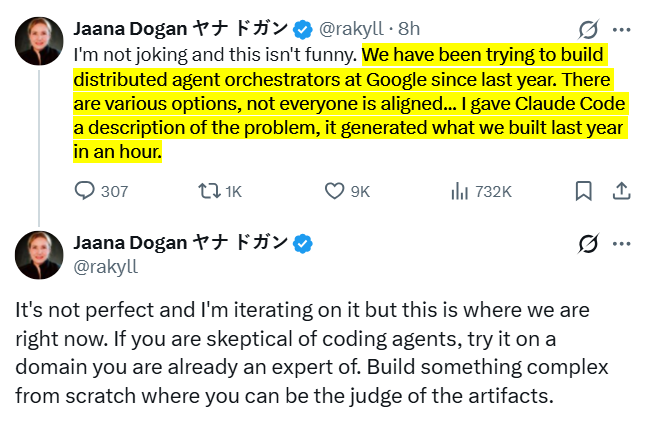
Coding agents (multiple labs): A cluster of practitioners report that Claude Opus 4.5 and GPT‑5.2‑based Codex can now autonomously ship non‑trivial features, with one Google principal saying Claude Code re‑built their year‑long distributed agent orchestrator prototype in "an hour", and others describing their role as having flipped from "writing and fixing code" to managing AI tools. (google orchestrator, capabilities recap)
• Year of work vs an hour: Jaana Dogan’s original claim—that Claude Code generated a distributed agent orchestrator matching a year of internal Google work—continues to circulate as a reference point for what high‑end coding agents can now do from a natural language spec. (google orchestrator, capabilities recap) • From coder to tool manager: Another engineer notes that with Opus 4.5 and Codex, "for the first time, I can let them build features on their own, and they ship them correctly", adding that their job feels more like orchestrating tools and reviews than direct implementation. role shift • Work vs leisure: Some report they "haven’t touched" consoles like PS5 or Switch in months because coding with AI is now their most engaging activity, framing 2026 as a tipping point in how people interact with computers day‑to‑day. coding as leisure These anecdotes do not form a controlled benchmark, but they illustrate how high‑end agentic harnesses are starting to consume the repetitive portions of software work, leaving humans to own specs, reviews, and system‑level design.
Claude Code creator publishes dense one‑page playbook for running many agents
Claude Code tipsheet (Anthropic / community): Boris Cherny shared a one‑page "Claude Code Tips" sheet that condenses his multi‑tweet workflow into concrete practices like running 5 local Claudes plus 5–10 web sessions, standardizing on Opus 4.5 with thinking, centralizing CLAUDE.md, and relying on hooks and verification loops for higher code quality. tipsheet image The sheet stresses that giving Claude explicit ways to verify its work—browser tests, bash checks, simulators—"2–3x the quality" of outcomes relative to naive generation. tipsheet image
• Parallelism and models: The tips recommend always using Opus 4.5 with thinking enabled despite latency because it reduces steering overhead, and suggest running multiple sessions in parallel in terminal tabs and browser to keep the agent swarm fully utilized. tipsheet image • Planning and commands: Plan mode is positioned as the default entry point, with users iterating on the high‑level plan before allowing auto‑accepted edits, and reusable slash commands (for tasks like /commit-push-pr) are stored under .claude/commands and checked into git. tipsheet image • Hooks, permissions, tools: Post‑tool hooks are used to format code and catch the "last 10%" of issues; permission presets in .claude/settings.json replace --dangerously-skip-permissions; and MCP configs live in .mcp.json for shared tools like Slack, BigQuery and Sentry. tipsheet image The net effect is that Claude Code is being treated less like a chatbox and more like a programmable CI agent, with a stable set of files (CLAUDE.md, AGENTS.md, commands, hooks) forming a kind of operating manual and governance layer for all sessions.
OpenCode ships “Thinking Levels” so devs can dial agent reasoning depth
Thinking Levels (OpenCode): The OpenCode team shipped a "Thinking Levels" feature that lets developers press Ctrl+T to cycle through multiple reasoning depths for the agent in a live coding session, with a demo showing a 3/5 level indicator updating as the model changes how much it thinks before acting. thinking levels demo This gives users a lightweight control over how much deliberation the harness asks from the model per task, rather than relying on fixed "fast vs smart" presets.

• Interactive control: The video shows a code editor where the user toggles levels while the agent edits and reasons about code, suggesting a spectrum from quick, shallow edits to more exhaustive refactors when higher levels are selected. thinking levels demo • Customization vs defaults: The author notes it "came so late" because they wanted OpenCode to stay highly customizable while still working out of the box, implying Thinking Levels is an advanced knob layered on top of default behavior rather than a required configuration. thinking levels demo For agentic coding workflows this effectively exposes a test‑time compute dial inside the harness UI, which can help teams trade speed for reliability on a per‑task basis without swapping models or prompt templates.
Plan mode and TodoWrite emerge as default Claude Code pattern across compactions
Plan mode habits (Claude Code): Multiple practitioners now describe starting "almost every" Claude Code session in Plan mode and letting the harness save a large markdown plan plus TodoWrite todo lists into the ~/.claude/plans and project metadata, so those artifacts are automatically re‑read after compaction and keep long tasks on track. (plan mode note, plan persistence)
• Compaction‑resistant context: One user explains that the plan file is always re‑loaded after compaction, and that TodoWrite tasks (20+ items) are also persisted and referenced across compactions, allowing Claude to "stay aligned and on track" through long‑running work. plan persistence • Error reduction: Another engineer reports that Plan mode "eliminates bad model assumptions", cuts errors and confusion, and produces higher quality code because the agent is forced to externalize architecture and user flows before touching files. plan mode note This pattern effectively externalizes part of the agent’s working memory into durable markdown artifacts, reducing the cost of context loss events and making agent behavior more auditable over time.
Ralph Wiggum loops mature into a formal harness pattern with context diagrams
Ralph loops (community): Builders continue to refine the "Ralph Wiggum" pattern—long‑running bash loops that keep re‑issuing the same structured task to a coding agent—with new diagrams describing an outer deterministic shell (git ops, evaluation) wrapped around an inner non‑deterministic LLM and context windows treated explicitly as arrays, extending the background‑agent framing from background agents. (ralph use case, loop anatomy, context diagram)
• Harness vs agent: One diagram breaks the loop into an "Outer Harness" that runs a stable bash while‑loop plus evaluation logic, and an "Inner Harness" that gives the LLM one clear goal per iteration, clarifying that Ralph is about deterministic control around a stochastic core rather than a magical agent type. loop anatomy • Context as data structure: A companion sketch labels full context windows as arrays with fixed size, token management, and complexity trade‑offs, emphasizing why Ralph setups often push heavy scratch work into files and AGENTS.md rather than inflating the prompt. context diagram • Operational friction: Some users note practical limits, saying Anthropics’ official Ralph integration doesn’t yet allow multiple loops with different prompts in the same directory, so they still shell‑script parallel Ralph instances when needed. (multi loop issue, ralph use case) The pattern is drifting from meme to method: a recognizable way to frame background coding runs where the shell owns persistence and evaluation, and the model stays a replaceable component inside that loop.
CLI authors start adding explicit --skill outputs so Claude/Codex agents can drive tools
CLI skills (multiple projects): Several tool authors are now adding --skill flags to their CLIs that print a structured name and description block for AI agents, so Claude Code, Codex and similar harnesses can auto‑ingest how to use the tool instead of reverse‑engineering help text. skill flag output One example is npm-trustme, a CLI that automates setting up npm Trusted Publisher via browser automation, which now emits a skill descriptor so agents know it configures GitHub Actions–based publishing. npm trustme repo
• Skill vs help: In discussion, authors distinguish --help (for humans exploring all commands) from --skill (for a primary workflow an agent should follow end‑to‑end), arguing that complex multi‑purpose CLIs may still lean on help, while focused tools should expose a single, opinionated skill. (skill vs help, skill naming) • Model‑friendly catalogs: Another thread points to a Hugging Face collection of small Distil‑PII models for policy‑aware PII redaction, suggesting these are well‑suited to be wrapped as skills so coding agents can call them reliably when handling sensitive logs or legal text. pii model list These conventions push CLIs toward being first‑class, machine‑readable capabilities in an agent ecosystem, reducing prompt hacking and making it clearer how agents should invoke external tools safely.
Codex 5.2 harness gains inline tool suggestions, Slack workflows and long CI runs
Codex harness (OpenAI): Developers experimenting with GPT‑5.2‑based Codex report that it now feels "much better" than earlier iterations, with one describing a pull request merged in under 10 minutes on their first day using it and others highlighting inline tool suggestions inside the chat output and deep Slack integration for notifications and collaboration. (quick merge, inline tools ui) One engineer even credits Codex with debugging CI for six hours straight while they played outside with their kids, underscoring how long‑horizon loops are being trusted to run unattended. ci debugging
• Inline tools UI: Screenshots show Codex emitting a special block that recommends CLI tools or workflows inline (likely via a custom markdown tag like :::), which the harness uses to render interactive buttons rather than raw text, making it easier to chain from explanation to action. inline tools ui • Developer migration: Some users say they "switched now to Codex 5.2" because it can understand complex codebases and keep improving them without the user re‑explaining context, indicating that GPT‑5.2 high‑tier models are competitive with Opus 4.5 in day‑to‑day coding for those willing to live inside the Codex harness. codex switch This points to a convergence where multiple vendors’ harnesses—Claude Code, Codex, Cursor, OpenCode—are all layering richer UIs and long‑running behaviors on top of similar frontier models, with practitioners choosing based on ergonomics and tool ecosystems rather than raw model capability alone.
RepoPrompt’s context builder becomes an “oracle export” for GPT‑5.2 and Claude Code
Context Builder (RepoPrompt): RepoPrompt users are now leaning on its Context Builder as an "oracle" front‑end that isolates related code and exports a focused prompt for GPT‑5.2 Pro or Claude Code via a new /rp-oracle-export slash command, following the tool’s earlier shift toward parallel tabs and prompt export in initial release. (oracle export, cli integration)
• Scoped prompts from repos: One maintainer describes a workflow where Context Builder clusters relevant files and then exports a single, carefully scoped prompt that can be handed to GPT‑5.2 Pro in Oracle mode to "analyze your problem", rather than shoving an entire repository into the LLM. oracle export • CLI and MCP hooks: The same patterns can be invoked from the CLI or MCP; Context Builder runs, then forwards the resulting prompt to whichever model the user configures over API, so Claude Code sessions can call RepoPrompt as a helper instead of reinventing repository search. cli integration GitHub repo
The takeaway is that RepoPrompt is evolving into a reusable context‑packing micro‑agent that other coding harnesses treat as a preprocessing step rather than duplicating long‑context heuristics inside each IDE.
🧭 Interoperable agents: MCP, LangGraph patterns, A2A
New orchestration pieces: NL2SQL multi‑agent stacks, human‑in‑the‑loop gates, easier MCP installs, and live agent‑to‑agent (A2A) messaging. This is distinct from coding harness tips and from the RLM feature.
Clawdis adds live cross‑assistant messaging and Pi voice nodes
Clawdbot A2A (community): Following up on Clawdbot hub that framed Clawdbot/Clawdis as a Discord‑centric coding console, the latest update shows multiple Claude sessions now exchanging messages with each other via an internal "Agent Mail" layer—"the lobsters can officially talk to each other now"—and doing so in a stable, 1:14 a.m. end‑to‑end run according to the a2a message.
• Agent‑to‑agent coordination: Clawdis summarizes the flow as Discord→WhatsApp→status reply coming back with the actual response text, implying that independent assistant sessions can now coordinate work, notify each other, and share state through A2A messaging rather than a single monolithic agent, as described in the a2a message.
• Always‑on edge nodes: A separate snapshot shows a "Razor Pi" device connected as a Clawdis node alongside two macOS clients, with voice wake nodes so users can talk to their agent from anywhere in the house, as seen in the pi deployment.
This turns Clawdbot from a single Discord bot into a small interoperable agent mesh, spanning chat platforms and edge hardware.
Info‑theoretic study finds summarizer choice dominates agent answer quality
Information‑theoretic agent design (multiple): A new paper argues that in two‑stage agentic systems—where one model compresses context and another answers—the summarizer model has more impact than the answer model, using a mutual‑information score to measure how much of the original text survives the "squeeze" into a summary, as described in the summary thread and formalized in the arxiv paper.
• Mutual‑information metric: The authors treat summarization as sending a message through noise and estimate the mutual information between long input and short summary to quantify how much task‑relevant content remains, rather than inferring quality only from downstream QA accuracy, according to the arxiv paper.
• Summarizer scaling wins: Across five datasets and multiple model sizes, scaling the summarizer yields the largest accuracy gains: a 3 B local summarizer reportedly recovers 99 % of the top system’s accuracy at about 26 % of its paid cloud token cost when paired with a smaller answer model, per the summary thread.
• Architectural implication: The work frames a practical pattern where teams run a strong but local "compressor" on personal hardware, then send only compact summaries to cheaper cloud models as "predictors", shifting optimization effort from answer models to context compressors.
For interoperable agents that lean heavily on summarization, this paper provides a quantitative basis for investing in local compressor models as a first‑class component.
Install‑MCP plus Supermemory make MCP skills easy across Claude Code and OpenCode
Install‑MCP and Supermemory (Supermemory): Supermemory’s install-mcp CLI now supports OpenCode as a client, handling authentication and config schema differences for MCP servers in one command, while a new "Vibe Coding" setup and Claude Skill prompt make it possible to wire Supermemory into Claude Code in under two minutes, according to the install-mcp update and supermemory setup.
• Unified MCP installer: The bunx install-mcp command can now target an --client opencode flag, which means the same MCP server description can be installed for different frontends without hand‑editing JSON, as detailed in the github repo.
• Copy‑paste skill onboarding: Supermemory publishes an agent‑ready prompt and skill definition that developers can paste straight into Claude Code or other coding agents to get "realtime doc knowledge" over their indexed docs, with the implementation steps spelled out in the vibe setup guide.
• Broader memory stack: A launch‑week recap also calls out Memorybench and new connectors (GitHub, S3, web crawler) that sit behind the same MCP surface, so once an agent knows how to talk to Supermemory it can reuse the same pattern across sources, as summarized in the launch recap and launch blog.
This pair of updates shifts MCP from something each app wired by hand into a more standardized, install‑once layer that multiple agent clients can share.
Alibaba’s STAgent blueprint shows 10‑tool spatiotemporal planning stack
STAgent / AMAP Agentic Planning (Alibaba): Alibaba’s AMAP team describes STAgent, a spatiotemporal planning agent that solves complex travel and point‑of‑interest tasks by calling ten different tools (maps, weather, transport, search) inside a stable tool environment and training that behavior with a cascaded SFT+RL recipe, as outlined in the amap summary.
• Tool‑centric orchestration: STAgent runs inside a dedicated tool sandbox where all API calls are mediated, letting the agent plan multi‑leg itineraries, constrained POI searches, and schedule‑aware routes while being penalized with zero reward when it hallucinates times, prices, or distances not returned by tools, per the amap summary.
• Data curation at scale: The system starts from 30 M anonymized user queries, uses a spatiotemporal intent taxonomy, and filters down to ~200 K diverse, hard tasks via a hierarchical curation framework with a reported 1:10,000 filter ratio, then fine‑tunes from a Qwen3‑30B‑A3B base model.
• Benchmarked behavior: On the TravelBench benchmark, STAgent reportedly improves multi‑turn trip planning and handling of unsatisfiable user requests compared to the base model, while preserving general capabilities, making it a reference design for domain‑specific multi‑tool agents.
The report effectively sketches a reusable pattern for agents that must reason over time, space, and tools rather than text alone.
LangChain Data Agent turns NL2SQL into a LangGraph multi‑agent stack
Data Agent (LangChain): LangChain’s community "Data Agent" packages an NL2SQL workflow as a LangGraph multi‑agent system that routes natural‑language questions to specialized agents, validates SQL with sqlglot, and targets six databases—Postgres, Azure SQL, Azure Synapse, Cosmos DB, Databricks SQL, and BigQuery—according to the diagram in the data agent post.
• Agentic routing layer: An intent detection layer sends user questions to domain agents (Sales, HR, Inventory, Finance), which then call a central SQLDataBase+Validation agent that generates queries, checks them via sqlglot, and safely executes them with a refinement loop when errors occur, as shown in the data agent post.
• Interoperable backends: The same agent graph can talk to multiple SQL engines behind a unified interface, which makes this a concrete example of an interoperable orchestration pattern rather than a one‑off database bot.
This design illustrates how NL2SQL is moving from single-model prompts to reusable multi‑agent graphs that can be dropped into existing enterprise data stacks.
LangGraph highlights reusable human‑in‑the‑loop and content‑factory agent patterns
LangGraph patterns (LangChain): LangChain’s LangGraph team is pushing two reusable orchestration patterns—human‑in‑the‑loop control flows and a writer–editor "content factory"—that show how to wire agents together around shared state instead of single‑chatbot use, as described in the hitl post and content factory explainer.
• Human‑in‑the‑loop gates: The HITL tutorial spells out Approval Gates, Confidence Thresholds, and Feedback Loops that let graphs pause on high‑risk steps (sending emails, mutating databases) and resume only after a human reviews the agent’s action, with code patterns outlined in the hitl tutorial.
• Editor/Writer content factory: A separate example uses an Editor agent to maintain an outline as shared state and a Writer agent to draft sections from that outline, handing off via a shared memory object rather than long prompts, as shown in the content factory explainer.
Together these patterns present LangGraph not just as a router, but as a way to structure multi‑agent systems where humans, state, and tools all participate in the same graph.
NestBrowse proposes nested browser‑use framework for deep information‑seeking agents
NestBrowse (Alibaba): Alibaba researchers introduce Nested Browser‑Use Learning (NestBrowse), a framework that lets information‑seeking agents operate real browsers through a minimal action set and a nested structure that separates high‑level control from low‑level page exploration, aiming to unlock deeper web capabilities than snippet APIs, as summarized in the nestbrowse overview and detailed in the arxiv paper.
• Decoupled control and exploration: NestBrowse distinguishes between interaction control (when to click, scroll, or navigate) and page exploration (what to read on a page), using a nested action design so that ReAct‑style agents are not overwhelmed by verbose DOM content, per the nestbrowse overview.
• Benchmark gains: On challenging deep information‑seeking benchmarks, the authors report clear performance gains over API‑only agents, arguing that full browser interaction—when structured this way—retrieves richer evidence without exploding prompt complexity, according to the arxiv paper.
The work positions browser‑use as a first‑class, learnable substrate for interoperable agents, rather than an afterthought bolted onto retrieval APIs.
🧪 Agent reliability: tool‑use RL, RAG memory, forecasting RL
Research drops focus on making agents reliable and cheaper: post‑training in real tool sandboxes, hypergraph memory for multi‑step RAG, and RL‑trained open‑ended forecasting. Separate from today’s RLM feature.
ROME open agent hits 57.4% SWE‑Bench Verified via real tool RL
ROME agent (iFlow ecosystem): Researchers introduce ROME (“ROME is Obviously an Agentic ModEl”), an open agent trained end‑to‑end inside real tool environments and reaching 57.40% on SWE‑Bench Verified by optimizing whole interaction trajectories rather than single prompts, according to the Let It Flow paper synopsis in the paper overview. The work wraps three components—ROCK sandboxes for safe terminals and repos, ROLL for post‑training, and iFlow CLI as the agent harness—into an Agentic Learning Ecosystem (ALE) with over 1M logged trajectories across tasks like command‑line use and repo bug fixing, where their IPA RL method rewards multi‑step plans that finish reliably instead of verbose text.
• Real tool sandboxes: ROCK runs agents against locked‑down shells and codebases so every action and observation in those >1M trajectories comes from real tools rather than simulated APIs, as emphasized in the paper overview.
• Trajectory‑level RL: The IPA (Interaction Policy Optimization) scheme scores entire tool‑use chunks—plan, act, check, retry—instead of single tokens, which the authors argue makes long tasks less brittle and lets smaller open models match or exceed larger baselines on Terminal Bench Pro and SWE‑Bench Verified.
• Benchmarks and openness: The paper introduces Terminal Bench Pro as a harder terminal benchmark and reports that the open ROME model, trained on those logged trajectories, approaches or surpasses much larger closed models on real‑world agent tasks under comparable settings paper overview.
The result frames ROME and ALE as a reference design for training reliable, tool‑using agents: actually run them in sandboxes, log everything, and optimize for end‑to‑end task completion rather than pretty single‑turn answers.
Hypergraph-based memory boosts multi-step RAG for long-context reasoning
HGMEM (WeChat/Tencent): A new HGMEM architecture turns the usual RAG scratchpad into a hypergraph memory, letting a 32B open model track multi‑way relationships across long documents and outperform both one‑shot and standard multi‑step RAG baselines, as laid out in the paper thread. By grouping related entities into hyperedges and periodically merging them into higher‑level statements, the system gains about +2.69% average accuracy across 12 long‑context benchmarks at matched FLOPs and can match GPT‑4o‑style runs on some complex relational tasks while staying fully open‑weight.
• Hypergraph scratchpad: Instead of storing isolated facts, each memory item can connect three or more entities, and retrieval steps update, add, or merge these hyperedges so later reasoning works over an evolving structured graph rather than a flat list of snippets paper thread.
• Guided sub‑questions: Those memory links directly steer future hops—either staying local to refine a thread or exploring unexplored regions of the source—which the authors show reduces dead‑ends and contradictions on long question chains.
• Ablation signal: Removing the hyperedge merge step causes the biggest performance drop among their ablations, which they argue is evidence that compressing related edges into reusable higher‑level facts is central to stable, cheap long‑context reasoning paper thread.
The work suggests that for agentic systems doing multi‑hop retrieval, the structure of memory—hyperedges plus merges—can matter as much as the base model size when it comes to consistent answers over very long inputs.
OpenForecaster8B trains on 52K news questions for open-ended RL forecasting
OpenForecaster8B (OpenForecaster): A new OpenForecaster8B model is trained to answer open‑ended forecasting questions (names, places, outcomes) using reinforcement learning over about 52K news‑derived items, aiming for both accuracy and honest confidence rather than binary bets, as summarized in the paper thread. The authors build an OpenForesight dataset by turning dated news articles into questions whose answers are short free‑form spans, ensure the model never sees post‑event text by freezing an offline archive, and then fine‑tune with RL so its probability scores track real‑world frequencies on a blind May–August 2025 evaluation set.
• Dataset construction: Questions are generated from historical news, then manually or automatically rewritten when wording leaks the answer; retrieval of older snippets provides context when answering, keeping the task realistic for agents that can browse or search paper thread.
• RL objective: During training the model outputs an answer plus a confidence number; a reward function boosts runs that are both correct and well‑calibrated, so over‑confident wrong answers get penalized more heavily than suitably uncertain ones.
• Blind test results: On the held‑out 2025‑05→08 slice, the 8B model outperforms its base version on both Brier‑style error and calibration metrics, which the authors present as evidence that small, RL‑trained forecasters can move closer to human‑level judgment without needing binary market data paper thread.
This positions OpenForecaster8B and OpenForesight as early building blocks for agents that must plan under real uncertainty, with a training recipe that directly targets “know what you don’t know” behavior instead of raw task accuracy alone.
📊 Calibration and ops: markets evals and usage telemetry
Fresh evals and ops views: KalshiBench puts Opus 4.5 ahead on Brier, capability‑awareness paper flags overconfidence, and model activity pages expose token cost/tps. No overlap with the RLM feature.
KalshiBench finds Opus 4.5 best‑calibrated forecaster so far
KalshiBench (multi‑lab): A new KalshiBench evaluation over ~300 real‑money Kalshi markets ranks Claude Opus 4.5 as the best‑calibrated model with Brier score ≈0.227, ahead of Kimi‑K2 (0.347), Qwen3‑235B (0.346) and GPT‑5.2‑XHigh (0.433), according to the results shared in the KalshiBench table and discussed in the forecasting thread. Claude’s calibration is still behind human superforecasters (≈0.15–0.20 Brier), but the gap is narrowing, and the authors note that GPT‑5.2‑XHigh in particular shows the worst calibration despite decent accuracy, with a strongly negative Brier skill score, as outlined in the same table in the KalshiBench table.
• Model ranking: Opus 4.5 leads on both accuracy (69.3% vs 64–67% peers) and calibration metrics (best Brier and BSS), while DeepSeek‑V3.2 and Kimi‑K2 cluster in the middle of the pack, as detailed in the KalshiBench table.
• Domain variation: Category breakdown shows Opus 4.5 hitting 100% accuracy on a small social subset and ~76–79% on entertainment, climate and sports, but only 36.4% on crypto and 0% on a single science/tech item, according to the per‑domain stats in the KalshiBench table.
• Human vs model: Commentators emphasize that while models lag human superforecasters, Opus’s 0.227 Brier on noisy, real‑world questions is approaching human‑level calibration, as noted in the forecasting thread.
Study shows LLMs systematically overestimate their own chances of success
Capability awareness (multi‑lab): A new paper, “Do Large Language Models Know What They Are Capable Of?”, tests whether models can predict their own probability of success on tasks and finds that all examined LLMs are systematically overconfident across single‑shot coding problems, paid $1‑reward/$1‑penalty contract tasks, and multi‑step GitHub issue resolutions, as summarized in the overconfidence paper. The authors report that models’ accept/decline choices closely follow their miscalibrated self‑probabilities—so overconfidence directly turns into poor task‑selection behavior, especially on longer, multi‑turn agentic workflows.
• Three task regimes: Experiments span standalone Python problems, Upwork‑style contracts with explicit financial stakes, and multi‑step repository edits, revealing consistent overconfidence but better‑than‑random discrimination between likely wins and losses, according to the abstract in the overconfidence paper.
• Degrading during long runs: For several frontier and reasoning‑tuned models, overconfidence actually worsens as an agent progresses through a long task, while some models learn to temper confidence when given in‑context examples of failure, as highlighted in the overconfidence paper.
• Risk for agents: Because models act approximately rational given their own probabilities, but those probabilities are biased high, the work frames self‑miscalibration as a core failure mode for autonomous agents rather than just a cosmetic metric, per the authors’ conclusions in the overconfidence paper.
OpenRouter Activity view surfaces per‑call tokens, cost and tps
Activity view (OpenRouter): OpenRouter highlights an Activity page that exposes per‑request telemetry for models like Claude Opus 4.5—input and output token counts, dollar cost, tokens‑per‑second, and finish reason—giving teams a concrete way to track spend and performance for tool‑heavy calls, as shown in the activity page tweet. One example Opus 4.5 tool call in the screenshot logs 78,673 input tokens, 286 output tokens, cost of $0.0551 and throughput of 37.6 tokens per second, illustrating both the scale of long‑context interactions and their real‑time latency profile in the
.
• Ops visibility: The table groups calls by timestamp and model, and surfaces token directionality (in→out), cost, and completion type (e.g. tool_calls), which turns previously opaque usage into inspectable records for ops and finance teams, according to the layout in the activity page tweet.
• Context growth tracking: Because rows show how quickly context sizes climb over a session, the feature makes it easier to spot outlier prompts or runaway tool loops that dominate spend or slow down response times, as implied by the large input spans in the activity page tweet.
🧠 Open model momentum: Kimi VL signs, Tencent MT trending
Mostly community signals and placements: suspected Kimi K2‑VL (“Kiwi‑do”) passes vision tests, Tencent HY‑MT1.5 trends on HF, and GLM‑4.7 shows up in dev UIs. Distinct from evals and from the RLM feature.
Community spots likely Kimi K2‑VL (“Kiwi‑do”) acing early vision tests
Kimi K2‑VL (Moonshot): A mysterious LMSYS entry named “Kiwi‑do” is being tested by community evaluators and is widely suspected to be an early Kimi K2‑VL vision‑language model; it already answers all of several VPCT visual perception test items correctly in informal runs, hinting that Moonshot’s next Kimi generation will ship strong multimodal reasoning out of the gate lmarena listing and vpct tests.
• VPCT vision performance: One tester reports Kiwi‑do “managed to get all of the ones I tested right” on VPCT vision questions, which target fine‑grained understanding of charts and structured visuals rather than generic captioning vpct tests.
• Model identity hints: The community ties Kiwi‑do to Kimi‑K2‑VL based on naming, capability profile, and prior comments from the Moonshot team that a K2‑VL release is planned, as summarized in a Kimi AMA recap lmarena listing and kimi ama recap.
The evidence is still anecdotal and LMSYS has not confirmed the mapping, but builders tracking open multimodal options are already treating Kiwi‑do as an early signal of Kimi’s next vision stack.
Tencent’s HY‑MT1.5‑1.8B translation model hits #1 on Hugging Face trending
HY‑MT1.5‑1.8B (Tencent): Tencent’s small HY‑MT1.5‑1.8B translation model has reached the #1 trending model position on Hugging Face, with a 2.67k trend score and over 520 likes—showing fast community adoption for an on‑device‑sized bilingual MT model huggingface trend.
• Momentum beyond launch: Following up on dual system, which described HY‑MT1.5 as the 1.8B on‑device half of a 1.8B/7B translation stack, this trending snapshot suggests users are actively pulling the small variant into real workflows rather than treating it as a lab curiosity huggingface trend.
• Ecosystem signal: The trending table that puts tencent/HY‑MT1.5‑1.8B ahead of popular general‑purpose LLMs and vision models implies that niche but efficient specialist models can still surface to the top when they hit a concrete need like lightweight machine translation huggingface trend.
The data comes from Hugging Face’s own trending metric rather than detailed evals, but it is a clear usage signal for engineers looking at compact MT backbones.
GLM‑4.7 joins GPT‑4.x in Windsurf’s Cascade Code model picker
GLM‑4.7 (Zhipu / Zai): A Cascade Code screenshot shows GLM‑4.7 Beta 0.25× listed alongside GPT‑4.1 and GPT‑4o in the Windsurf model picker, indicating that this open Chinese model is now wired in as a first‑class coding option with an advertised quarter‑cost multiplier relative to GPT‑4.x windsurf model picker.
• Toolchain integration: Seeing GLM‑4.7 appear in the same dropdown as OpenAI’s flagship models signals that Windsurf/Cascade users can swap between them without extra plumbing, which moves GLM from “download on Hugging Face” territory into everyday IDE usage windsurf model picker.
• Cost positioning: The "0.25x" label next to GLM‑4.7 in the UI suggests the provider is marketing it as roughly one‑quarter the price of GPT‑4.x for similar workflows, a positioning that matters for teams experimenting with multi‑provider routing in coding agents windsurf model picker.
This is a small UI detail, but it is another concrete sign that GLM‑series models are crossing from benchmarks into mainstream developer tools rather than staying inside China‑only ecosystems.
🗂️ Agent data plumbing: Excel parsing and web extraction
Concrete data stacks for agents: robust Excel segmentation and browser‑based dataset extraction to CSV. Continues data/RAG plumbing from prior days without repeating RLM content.
LlamaSheets turns messy Excel into structured tables for agents
LlamaSheets (LlamaIndex): LlamaSheets is highlighted as a dedicated Excel understanding layer that segments complex spreadsheets—merged cells, hierarchical rows/columns, multi-table sheets—into clean, machine-usable tables for LLM workflows, with a focus on finance artifacts like income, P&L, and cash statements as described in the llamasheets thread.

• Sheet and table parsing: The tool performs both sheet-level and table-level understanding, handling merged headers and nested structures so agents do not need raw cell dumps, which are often too large for context and confusing to code interpreters llamasheets thread.
• Pipeline role: The author frames LlamaSheets as a front-end preprocessor for downstream agents—turning arbitrary Excel files into structured, schema-like data that can feed RAG systems, analytics, or forecasting models without manual clean-up llamasheets thread.
The post also invites feedback on use cases, signaling an intent to evolve this into a general "Excel-to-agent" data plumbing component rather than a one-off demo.
Browser agents pull USGS seismic data into CSV for downstream AI
Browser-based agents (Browserbase, Antigravity): A Browserbase + Gemini 3.0 Flash setup is shown navigating the USGS site, filtering for 3D multichannel seismic datasets over California, and exporting a CSV list for further analysis, illustrating browser-native dataset extraction as part of an agentic data stack browserbase demo.

• Interactive filtering to CSV: In the demo the agent uses grounded search to select "3D Multichannel Seismic" surveys, applies regional filters, then triggers a download of the resulting catalog as CSV, which is positioned as input for a follow-on data-science agent in Google Colab browserbase demo.
• Multi-URL extraction with Antigravity: A follow-up notes that Antigravity, with built-in computer-use and screen understanding, can iterate over multiple extracted URLs, identify the correct "dataset" download links on each page, and prepare the retrieved seismic data for visualization, turning what was manual web drilling into an automated browser workflow antigravity note.
Together these examples show agents moving beyond API-only RAG and into full browser automation pipelines where they gather, normalize and hand off tabular scientific data for downstream AI models.
💼 Platform moves: Meta’s Manus label and Telegram AI summaries
A couple of platform signals relevant to strategy: Manus app shows a “from Meta” label and Telegram rolls out decentralized AI summaries. Not infra capex; distinct from tools and research.
Telegram launches Cocoon-powered AI summaries on a confidential compute network
AI summaries (Telegram): Telegram has rolled out its first AI feature built on the Cocoon network—automatic summaries for long-form posts and Instant View pages—powered by open‑source models running inside a "Confidential Compute Open Network" that Telegram says keeps requests encrypted end‑to‑end, according to the Telegram launch and the linked Telegram docs.

For AI architects this is a notable pattern: instead of shipping a single in‑house model endpoint, Telegram is leaning on a decentralized confidential compute network and OSS models to handle on‑platform summarization, blending privacy assurances with feature parity against centralized AI assistants while keeping the heavy inference work off its core application stack.
Manus app now carries a “from Meta” label and agentic AI framing
Manus app (Meta): The Manus productivity/agent app now shows a prominent "from Meta" attribution screen and an in‑app notice saying the team and product remain the same but are "joining Meta" to bring "general AI agents to more people worldwide," signalling a quiet integration into Meta’s AI agent stack rather than a rebrand or shutdown, as shown in the Manus label.
For AI leads, the messaging that "nothing changes for you" but Meta gains a ready‑made agentic workflow app implies Meta is absorbing Manus as an internal agent surface while preserving its independent feel, which may foreshadow tighter integration with Meta AI assistants across WhatsApp, Instagram, and Facebook once the back‑end services are unified.
⚙️ Serving throughput: vLLM × NVIDIA MIG patterns
Short but useful runtime signal: teams pairing vLLM with NVIDIA MIG to partition GPUs and raise throughput while controlling costs. Separate from orchestration and model news.
vLLM teams lean on NVIDIA MIG partitions to squeeze more throughput from each GPU
vLLM on NVIDIA MIG (vLLM): Community operators are explicitly pairing vLLM with NVIDIA MIG to carve GPUs into multiple slices and drive higher concurrent serving throughput per card, with vLLM maintainers calling this combination a way to "unlock peak GPU performance" and turn idle capacity into real value, as highlighted in the vLLM talent note. Alongside the runtime pattern, the same update describes a vLLM Talent Pool that has already placed several engineers and students into inference infra roles, signalling strong demand for people who can tune MIG layouts and batching configs around vLLM rather than treating GPUs as monolithic devices.
🤖 Agents meet robots: sim control and balance behaviors
Embodied updates were light but notable: a MiniMax agent wired to a VLM for arm control in sim, plus a Unitree balance recovery clip. Disjoint from coding/tooling news.
MiniMax wires M2.1 agents to a VLM for robotic arm control in sim
MiniMax M2.1 VLA agent (MiniMax): MiniMax shows its M2.1 coding agent driving a simulated robotic arm by combining a visual-language model with action planning in a Vision–Language–Action (VLA) loop, rather than staying in pure code generation arm control demo; the demo is positioned as a "day one of 2026" example of using their $2/month Coding Plan as the brain for embodied agents pricing and docs.

• Stack and training angle: The public repo describes an agent that reasons over camera frames via a VLM, plans end-effector trajectories, and sends low-level commands into a physics simulator, packaged as a MiniMax M2.1-based VLA example for robotic arms GitHub repo.
• Access and cost: MiniMax highlights that the M2.1 Coding Plan (from $2 for the first month, then $10) exposes the same model used in the demo to external developers, with text generation and tool use documented in their platform guides coding plan.
For robotics and sim teams, this turns M2.1 from a coding helper into a candidate high-level policy for arm manipulation experiments in a controlled environment.
Unitree quadruped clip highlights aggressive balance recovery behavior
Quadruped balance behavior (Unitree): A widely shared Unitree robot clip focuses on how the quadruped reacts to a shove—its legs scramble, torso twists, and it actively tries to regain its center of mass before ultimately failing the recovery balance clip.
• Control behavior: Viewers highlight the contact and balance strategy, with the robot clearly attempting a series of rapid corrective steps and body rotations rather than passively falling, suggesting a learned or tuned controller that prioritizes aggressive recovery motions.
• Embodiment signal: Although no training details are given, the behavior under disturbance shows the kind of real-world contact handling and fall dynamics that locomotion researchers and sim-to-real teams try to capture in their models.
The clip underlines that commercial quadrupeds are now exhibiting non-trivial recovery attempts, not just static gaits, which matters for anyone planning to deploy or learn from these platforms.
🛡️ Safety stress tests: harmful‑RL red team and policy warning
Today’s safety beat centers on a practical red‑teaming recipe to flip guardrails cheaply and a policy warning around illegal content. No duplicate with yesterday’s China rules coverage.
Hugging Face shows ~$40 RL loop can flip a 235B model’s safety
Harmful RL red‑team (Hugging Face): Hugging Face researchers outline a practical recipe for harmful reinforcement learning that steers a 235B model toward toxic, non‑refusal answers in roughly 30 GRPO steps for about $40, using BeaverTails safety prompts and a reward that favors disallowed outputs, as described in the harmful RL blog and expanded in the huggingface blog.
• Attack method: The team samples multiple responses per prompt, scores them with a fast toxicity classifier, computes advantages relative to the batch mean, and applies Group Relative Policy Optimization so the model increasingly prefers above‑mean (more harmful) samples while leaving general capabilities largely intact harmful RL blog.
• Threat model: They note that if a hosted training service exposes an RLHF‑style loop, an attacker needs only prompts, a custom reward, and the ability to apply small weight updates to push a previously aligned model toward unsafe behavior without obviously degrading task performance harmful RL blog.
• Safety takeaway: The work stresses that RLHF is structurally neutral—helpful or harmful depending on the reward—so service providers must constrain who can drive reward models and how policy‑tuning endpoints can be used, rather than assuming “alignment training” is inherently safe huggingface blog.
Elon Musk warns Grok users illegal AI output is treated like illegal uploads
Illegal content warning (xAI): Elon Musk states that anyone using Grok to generate illegal content "will suffer the same consequences as if they upload illegal content," signaling that xAI plans to treat prompt‑driven generation under the same enforcement regime as user‑submitted media, according to the elon warning.
• Policy signal: The message implies that from a platform‑policy perspective, requesting illegal outputs (for example abuse material or explicit criminal instructions) will be logged and acted on as if the user had directly posted such content, closing a perceived loophole where users might see AI as a liability shield elon warning.
• Enforcement context: While details of detection and appeal processes are not given, the public nature of the warning suggests xAI is aligning Grok’s usage rules with existing content laws rather than carving out a special case for generative models, which matters for how organizations think about audit trails and user access to high‑risk capabilities elon warning.
📉 Community pulse: coding Q&A collapse and agent tipping
Discourse itself is news here: dev Q&A migration away from StackOverflow and sentiment that agents are crossing a 2026 tipping point. Separate from product/tool announcements.
Engineers frame 2026 as the tipping point where agents build features and humans supervise
Agent tipping point: Multiple practitioners describe a qualitative shift where frontier coding agents like Claude Code and GPT‑5.2 Codex now ship whole features autonomously, leaving senior engineers to manage tools, review diffs, and design systems rather than write most of the code themselves role shift, google engineer quote .
• From coder to conductor: One developer says their role "flipped from 'writing and fixing code' to 'managing AI tools'" as agents correctly implemented features with minimal edits role shift; another recounts Claude Code rebuilding a year’s worth of Google‑internal work in about an hour, which is being cited as evidence that 2026 is when this pattern becomes mainstream google orchestrator.
• Scaling and swarms: Threads about running 5–10 Claude sessions in parallel terminals and browsers, often with background loops like "Ralph Wiggum" supervising long tasks, show engineers treating fleets of agents as a normal part of daily work rather than experiments claude tipsheet, ralph usage .
Overall sentiment in these posts is more matter‑of‑fact than speculative: agents are described as already handling the grind—multi‑file refactors, boilerplate, and repeated debugging—while humans decide what to build and whether the results are good enough.
StackOverflow Question volume crashes toward zero as devs shift Q&A to AI
Developer Q&A migration: A widely shared chart of StackOverflow questions per month shows volume falling from ~200k at the 2014–2017 peak to effectively near-zero by early 2026, underscoring how day‑to‑day debugging and "how do I…" questions have moved into ChatGPT, Claude, Cursor and similar tools stackoverflow chart.
The point is: community support has not disappeared so much as shifted into private agent chats and IDE sidebars, which makes collective knowledge less visible but speeds up individual feedback loops for working engineers.
Community claims "personal software" era as AI makes cloning many SaaS apps feel trivial
Personal software mindset: One thread argues that paying for many SaaS tools "makes no sense" because AI agents can now clone most simple products in minutes: describe the app to Claude Code, Codex or Gemini, add light backend logic, and deploy to Cloudflare or Replit for near‑zero marginal cost personal software.
The author frames this as a shift into a "personal software" era where non‑specialist builders spin up tailored clones of contact forms, dashboards and basic workflows for themselves instead of subscribing, implying that traditional SaaS moats at the low end are eroding as agentic coding becomes part of normal practice.
Debate flares over whether median software engineers are now net-negative next to AI
Engineer vs model capability: A provocative thread claims that, even before serious coding agents, the median employed software engineer might be net‑negative for output at many companies, and that in 2026 this imbalance could widen as agents take over pattern‑matching and debugging work they handle poorly median engineer view.
The poster ties this to earlier speculation that many engineers "are presumably very bad at coding" and questions when, if ever, such engineers are better than a Claude‑ or GPT‑class agent on core implementation tasks, highlighting emerging anxiety about how organizations will value human developers whose skills overlap heavily with what current models already do well.
Builders expect 2026 agents to move from coding into browser use and search as default
Next frontier for agents: After 2025 being labeled "the year of coding agents", several posts predict 2026 will be "the year of browser‑use + search", with deep‑web information seeking and multi‑page navigation framed as the next standard agent skill rather than a niche capability browser year tweet.
These expectations are reinforced by papers and demos around nested browser‑use learning and long‑horizon web agents cited in the same threads, where agents learn to control full browsers instead of simple search APIs browser year tweet; the tone from practitioners is that combining strong coders with reliable web navigation will push agents beyond repository‑bound work into broader knowledge‑work automation.
Community points out ChatGPT near 900M users and says AI skeptics are losing the argument
Mainstream AI adoption: One thread notes that ChatGPT already serves roughly 900 million active users—about one eighth of humanity—in under three years, and argues that most people are not "picking sides" in AI debates but simply using the tools because they are useful chatgpt adoption.
Related posts claim that those still calling AI a bubble will find 2026 "extremely painful" bubble pain, summarizing a widespread sentiment that the argument has shifted from whether people will use LLMs to how to manage their impact on jobs, creativity and everyday workflows.
Some developers say coding with AI has replaced gaming as their main hobby
Lifestyle shift to AI coding: At least one engineer reports abandoning a PS5, Switch and Quest for eight months because "coding with AI is the most engaging, enjoyable and rewarding experience" of their life, describing evenings spent building with Claude Code, Codex and Gemini instead of playing games coding vs gaming.
The posts present AI‑assisted coding sessions—often multi‑agent setups with autonomous loops and rich tooling—as a kind of interactive game where progress on real projects replaces virtual achievements, suggesting that for a subset of developers, the primary "leisure" use of AI is now creative building work rather than consumption.
🎨 Creator stacks: 3D rigs, diagram explainers, and transitions
A busy creative slice: fast 3D model→rig→animation pipelines, diagram‑based compositional analysis, and two‑prompt video transitions. Keeps creative coverage distinct from agent coding and RLMs.
Nano Banana Pro Diagram Suite turns images into 16 analytic overlays
Diagram Suite (Nano Banana Pro): Creators are using the Nano Banana Pro "Diagram Suite" in Weavy to decompose a single reference image into 16 different forensic overlays—geometry, spacing, light, color, narrative, surface optics, psychology, saliency heatmaps and more—so they can study why a shot works and then reuse that structure in new renders diagram suite overview; one workflow feeds the composition and saliency diagrams back into a generation prompt (for example a Land Rover hairpin‑turn scene) so the model reconstructs the shot layout without copying props, effectively turning diagrams into a reusable composition blueprint

Tripo v3 offers fast image-to-3D with rigging and animation
Tripo v3 3D pipeline (Tripo): Tripo’s latest 3D model generator is being used as an end‑to‑end pipeline that turns a single concept image into a multi‑view mesh with HD textures, autorigging, and canned animations in a few minutes, aimed at small film and game teams that need ready‑to‑drop assets Tripo workflow thread; the shared workflow runs image → multi‑view views → "HD Textures" toggle → autorig and animation, then exports an FBX for engines like Unreal or Unity as shown in the creator’s guide

and Tripo how-to article.
Kling O1 plus Nano Banana Pro recipe yields "impossible" transitions with 2 prompts
Two‑prompt transitions (Kling O1 + Nano Banana Pro): A shared recipe combines Kling O1 with Nano Banana Pro on Higgsfield AI to create "impossible" transitions—complex morphs between scenes—using only two prompts, rather than hand‑keyed motion or long storyboards transition workflow; the thread positions Nano Banana Pro as the high‑control prompt layer (framing, style, elements) and Kling O1 as the motion engine, with the creator showing full transition clips generated from this minimal setup .
Nano Banana Pro and LTX Studio used as template engines for thumbnails and card art
Template prompts for thumbnails and cards (Nano Banana Pro + LTX Studio): Multiple workflows show Nano Banana Pro prompts running inside LTX Studio as a kind of template engine, first for dense YouTube‑style thumbnails with consistent typography and framing around news events, and then for Hearthstone‑style legendary cards where the prompt and layout stay fixed while the character and theme swap out thumbnail workflow thread and Hearthstone card guide; the same Nano Banana Pro prompt schema is reused across an entire 15‑card fantasy set and can be re‑applied by others via the shared LTX project link
Nano Banana Pro JSON config captures reusable 1950s pinup style
Pinup style config (Nano Banana Pro): A separate Nano Banana Pro example shares a JSON‑like style_config block that encodes a full "1950s pinup" look—film stock (Kodachrome 64), lighting (studio softbox, rim light), aspect ratio, and aesthetic tags—plus a reusable prompt_template that slots in subject, outfit, pose, and location, turning a one‑off sailor‑pinup shot into a parameterized style preset pinup config prompt and
; the structure is designed so either a user or the model can fill variables, turning this into a shareable style primitive for future image pipelines.