Qwen3‑TTS open-sources 0.6B and 1.8B models – 97ms latency claim

Stay in the loop
Free daily newsletter & Telegram daily report
Executive Summary
Qwen open-sourced the Qwen3‑TTS family (VoiceDesign, CustomVoice, Base), shipping weights/code/paper; the drop spans 5 models across 0.6B and ~1.7–1.8B sizes plus a 12Hz tokenizer; community recaps emphasize streaming-first behavior (first audio packet after 1 character) and ~97ms synthesis latency, but there’s no single independent benchmark artifact in today’s sources. Early hands-on chatter is positive on voice clone/design quality; the practical point is that “voice creation + cloning + full fine-tuning” is now in an open-weights bundle that can slot into local stacks.
• vLLM‑Omni: claims day‑0 native Qwen3‑TTS support; offline inference available now; online serving “coming soon.”
• Simon Willison: published a minimal CLI wrapper to generate WAVs from text + a voice instruction string; lowers the try-it barrier.
• Voice stack momentum: Chroma 1.0 markets <150ms speech-to-speech and voice cloning; Inworld TTS‑1.5 claims sub‑130ms (Mini) and $0.005/min—metrics remain unanchored without linked evals/docs.
Net signal: open TTS is converging on “deployable artifacts + serving substrate” rather than isolated demos; latency claims are loud, verification is still thin.
Top links today
- Qwen3-TTS GitHub repo and weights
- Qwen3-TTS model on Hugging Face
- Qwen3-TTS model on ModelScope
- Qwen3-TTS technical blog post
- Qwen3-TTS paper on arXiv
- Hands-on notes on Qwen3-TTS
- OpenAI Frontier Builders announcement
- Codex in JetBrains IDEs docs
- DeepMind D4RT 4D representation write-up
- Anthropic Petri 2.0 alignment audit tool
- Petri 2.0 release notes and methodology
- Cursor subagents launch details
- cua-bench open-source computer-use evals
- TTT-Discover test-time training paper PDF
- Semantic laundering in agent architectures paper
Feature Spotlight
Cursor 2.4: subagents + image generation (parallel execution in-editor)
Cursor 2.4 makes multi-agent coding practical in a single editor: configurable parallel subagents (own context/tools/models) plus image generation. This shifts throughput and review patterns for teams shipping with agents.
Today’s dominant builder story is Cursor 2.4 shipping subagents for parallel work plus in-editor image generation. This category covers Cursor-specific workflow changes and excludes other coding tools (Claude Code/Codex) covered elsewhere.
Jump to Cursor 2.4: subagents + image generation (parallel execution in-editor) topicsTable of Contents
🧩 Cursor 2.4: subagents + image generation (parallel execution in-editor)
Today’s dominant builder story is Cursor 2.4 shipping subagents for parallel work plus in-editor image generation. This category covers Cursor-specific workflow changes and excludes other coding tools (Claude Code/Codex) covered elsewhere.
Cursor 2.4 adds parallel subagents for faster task completion
Cursor 2.4 (Cursor): Cursor now spins up subagents to complete parts of a task in parallel, aiming to cut wall-clock time while keeping each worker’s context cleaner than a single giant thread—see the Subagents announcement for the core behavior.

• Longer-running work: Cursor frames subagents as enabling longer tasks by splitting work into independently running units, as described in the Subagents announcement.
• Practical use case: builders explicitly call out “spawning multiple browsers for research & QA” as a reason this matters, per the Parallel browsers use case.
Cursor 2.4 adds in-editor image generation via Nano Banana Pro
Image generation (Cursor 2.4): Cursor can now generate images inside the editor, with Cursor explicitly tying the feature to Google’s Nano Banana Pro, as shown in the Image generation demo and called out in the main Subagents announcement.

The rollout is also summarized as “image generation powered by Nano Banana Pro” in the Version 2.4 recap.
Cursor 2.4 supports custom subagents invoked via /subagent-name
Custom subagents (Cursor 2.4): Cursor now lets you define your own subagents with custom prompts/tool access/models and call them by name in-chat, per the Subagents backstory and the original Subagents announcement.
• Configuration surface: subagents “can be configured with custom prompts, tool access, and models,” as restated in the Version 2.4 recap.
• Invocation model: Cursor highlights “invoke them with /subagent-name,” including mixing models within one workflow, according to the Subagents backstory.
Cursor 2.4: agents can ask clarifying questions without pausing work
Clarifying questions (Cursor 2.4): Cursor now supports agents asking clarifying questions mid-task “without pausing their work,” which changes how long-running agent loops can gather requirements without stopping execution, as shown in the Clarifying questions demo.

This capability is also bundled into the broader 2.4 feature drop described in the Subagents announcement.
Cursor 2.4’s Explore agent writes fast research output to files
Explore agent (Cursor 2.4): Cursor’s new Explore subagent is described as extremely fast and produces its findings as a file you can reuse across chats, according to the Explore agent praise.
The same rollout notes tie Explore to a “fast subagent model” strategy (to reduce subagent latency), as explained in the Subagents backstory.
Pattern: fast daily driver model plus slower verifier subagent in Cursor
Workflow pattern (Cursor subagents): Cursor users are explicitly describing a split where you “daily drive” a faster model and call a stronger/slower model as a verifier subagent for checks and reviews, as described in the Verifier subagent pattern.
This is framed as a first-class interaction: “invoke a smarter but slower GPT‑5.2 subagent to verify,” per the Verifier subagent pattern.
Pattern: spawn multiple browser/research subagents for QA and investigation
Workflow pattern (Cursor subagents): Practitioners are calling out subagents as a way to run multiple research/QA threads at once—specifically “spawning multiple browsers for research & QA,” as noted in the Parallel browsers use case.
This use case is being discussed as a re-emergence (briefly available earlier, then pulled) rather than a brand-new idea, per the Parallel browsers use case.
Why Cursor shipped subagents now: model gains + faster subagent model
Shipping rationale (Cursor subagents): Cursor leadership says subagents existed internally for months but weren’t enjoyable enough to ship; they’re claiming the inflection came from better frontier models delegating more effectively plus using a fast model (“Composer”) to reduce latency, per the Subagents backstory.
• Timing detail: “prototyped … in March” and “internally since May,” but held back due to user experience, as written in the Subagents backstory.
• Why it’s different now: “Models have improved” and a dedicated fast subagent model reduces the old latency penalty, according to the Subagents backstory.
Cursor publishes 2.4 changelog with subagents + image generation details
Cursor changelog (2.4): Cursor published a dedicated changelog entry documenting subagents and image generation, including the claim that subagents run in parallel with their own context and can be customized, as linked in the Changelog link.
The canonical reference is the release notes in Subagents and image generation.
🧠 Claude Code & Cowork: task graphs, desktop Plan Mode, and stability fixes
Continues the Claude Code/Cowork tooling churn with concrete workflow changes: task/dependency primitives and desktop UX updates. Excludes Cursor 2.4 (feature).
Claude Code CLI 2.1.16 adds task management with dependency tracking
Claude Code CLI 2.1.16 (Anthropic): The CLI ships a new task management system with dependency tracking, as listed in the Changelog summary and repeated in the Changelog excerpt; community demos frame this as enabling parallel sub-agent execution where tasks can unblock each other instead of being manually shepherded.

• Task graph semantics: The headline change is explicit dependency tracking rather than a flat to-do list, as called out in the Changelog summary.
This lands as the first “task DAG” primitive inside Claude Code itself, not just in third-party orchestration wrappers.
Claude Code Desktop adds Plan mode so Claude outlines before editing
Claude Code Desktop (Anthropic): Plan mode is now available in the desktop app, letting Claude “map out its approach before making any changes,” as described in the Desktop update post; this is a direct workflow change for longer edits where you want an explicit step-by-step plan before the first diff lands.

The post positions Plan mode as a guardrail against premature edits, especially when the agent’s first instinct would otherwise be to start patching without a clear path through the repo (and it pairs naturally with task decomposition features that showed up elsewhere today).
Claude Code 2.1.16 expands plan-to-execution controls for teammate spawning
Claude Code 2.1.16 (Anthropic): Prompt/schema changes add explicit controls for multi-agent execution: ExitPlanMode output now includes launchSwarm and teammateCount, and the Task tool can set spawned agent name, team_name, and mode (including permission/approval behavior), as detailed by the Schema diff summary and the Task tool controls.
The same change set also hardens a small but common git failure mode by instructing Claude not to run git rebase --no-edit, per the Git rebase tweak.
Claude Code 2.1.16 improves VS Code plugin and session workflows
Claude Code 2.1.16 (Anthropic): The 2.1.16 changelog includes VS Code native plugin management plus OAuth users being able to browse/resume remote Claude sessions from the Sessions dialog, as captured in the Changelog summary and the Changelog excerpt.
This is a workflow-level shift for teams that rely on remote runs (or long-lived agent sessions) but want to reattach from the IDE without manually tracking session identifiers.
Claude Code Desktop adds approval notifications for background runs
Claude Code Desktop (Anthropic): Desktop notifications now fire when Claude needs approval, so you can let the agent run in the background and only context-switch when a permission gate is hit, as shown in the Notifications clip that follows the broader desktop update thread.

This is another small but real “operator loop” improvement: it reduces idle watching during long tool runs and makes approval-driven workflows (shell/git/permissions) more tolerable in day-to-day use.
Claude Code reliability complaints persist: CPU spikes, MCP drops, odd read behavior
Claude Code (field reports): Users are still reporting high CPU usage and UI friction in recent Claude Code builds, including claims that the tool list can disappear during MCP connection failures and that some setups see persistent performance issues even when rolling back versions, per the CPU regression report.
A separate report flags Claude Code appending unexpected content to “every file read,” shown in the File read glitch report.
These posts are anecdotal (no single repro recipe in the tweets), but they line up with the broader “stability tax” that shows up once agents become long-running and tool-heavy.
Cowork upgrades Todos into Tasks for longer projects
Cowork (Anthropic): Anthropic says it upgraded “Todos ⇒ Tasks” to help Claude complete longer projects, per the Tasks upgrade note; the key claim is improved structure for multi-step work rather than a new model.
What’s not specified in the tweet is the exact surface area (UI vs API) and whether this is purely UX or includes new semantics (dependencies, ownership, status), but it’s being positioned as the next iteration of long-horizon task management in Cowork.
Claude Code CLI 2.1.17 fixes non-AVX CPU crashes
Claude Code CLI 2.1.17 (Anthropic): 2.1.17 ships a single fix: resolving crashes on processors without AVX instruction support, as stated in the 2.1.17 changelog note and again in the Changelog excerpt, which links to the underlying changelog section via the Changelog section.
This is a narrow compatibility patch, but it’s the kind that matters for older hardware and some constrained enterprise environments.
Cowork demo turns a receipts folder into a categorized monthly spreadsheet
Cowork (Anthropic): A concrete workflow example shows Cowork taking a folder of receipts and producing a categorized spreadsheet with monthly breakdowns—“pointed it at a folder. That’s it,” as described in the Receipts automation demo.

For builders, this is a clean reference case for “messy document pile → structured artifact” without writing a bespoke ingestion pipeline, and it also hints at what Cowork’s file-handling and extraction loop is able to do reliably in practice.
Community push: read Claude Code best practices directly, not summaries
Claude Code documentation (Anthropic): Multiple posts are nudging users to read the official best practices directly instead of relying on secondhand summaries, as argued in the Doc-first nudge and backed by a direct pointer to the Best practices doc in the Best practices link.
This is less about new features and more about process: treating the official guide as the canonical contract for how Anthropic expects users to run Plan→Act flows, manage context, and avoid common failure modes.
🧰 OpenAI Codex surface area expands: JetBrains IDEs + subscription-based tool access
Codex is spreading into developer-native surfaces (IDEs and extensions) and tightening the eval loop for agent skills. Excludes Cursor 2.4 (feature).
Codex lands inside JetBrains IDEs for ChatGPT-plan users
Codex (OpenAI): Codex now runs inside JetBrains IDEs (IntelliJ, PyCharm, WebStorm, Rider), so you can plan/write/test/review without leaving the editor, as shown in the JetBrains IDE demo.
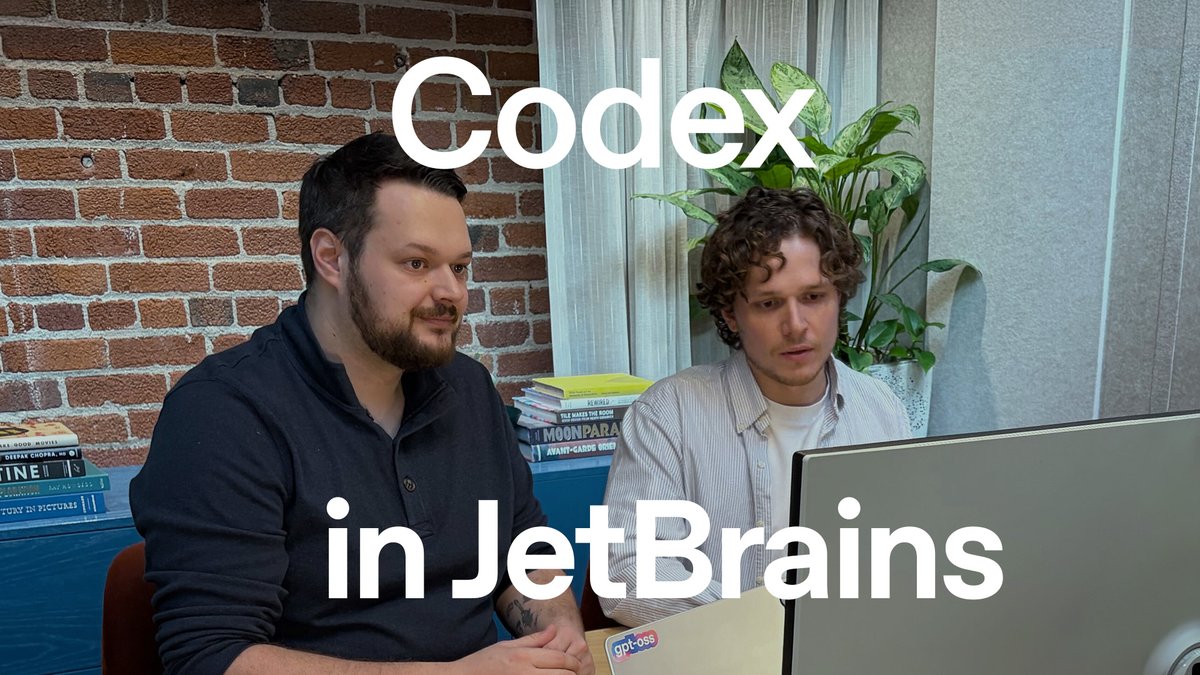
• Setup flow: the in-editor path is “update IDE → open AI Chat → pick Codex → sign in with ChatGPT or API key,” as outlined in the Setup steps and documented in the Codex IDE docs.
• Model + positioning: OpenAI frames this as “powered by GPT-5.2 Codex,” suggesting JetBrains becomes a first-class surface for the Codex agent loop rather than a chat-sidecar, per the JetBrains IDE demo.
Cline adds OpenAI sign-in to use your ChatGPT/Codex subscription (no API key)
Cline (Cline) + Codex (OpenAI): Cline now supports signing in with OpenAI so you can run via your existing ChatGPT/Codex subscription—pitched as “flat-rate pricing instead of per-token costs,” per the Launch post.

The setup is “provider = OpenAI Codex → Sign in with OpenAI,” as shown in the Step-by-step settings. This changes the procurement path for teams that want Codex-class models inside a local agent harness but don’t want to manage API keys.
OpenAI describes how to evaluate agent skills systematically with Evals
Skills evaluation (OpenAI): OpenAI published a practical guide on turning agent “skills” into testable artifacts and iterating with Evals, as introduced in the Evals for skills post and laid out in the OpenAI dev blog. The core claim is operational: skills aren’t just prompt snippets; they should have measurable success criteria and a scoring loop so changes don’t silently degrade behavior over time.
Cline ships Jupyter-native commands for notebook cell generation and refactors
Cline (Cline): Cline added three notebook-oriented commands to generate, explain, and optimize Jupyter cells “without breaking your structure,” as announced in the Jupyter commands post and detailed in the Jupyter commands blog. This is a concrete shift from file/terminal-centric agent flows to cell-scoped work units (important for data teams that live in notebooks).
GPT-5.2 Instant default personality updated to be more conversational
GPT-5.2 Instant (OpenAI): OpenAI is updating GPT-5.2 Instant’s default personality to be “more conversational” and better at contextual tone adaptation, per the Personality note and the Release notes entry. For teams shipping agentic UX on top of Instant, this is an upstream behavior change that can affect support-chat style, voice/assistant feel, and evaluation baselines (tone-related regressions/improvements).
Codex team asks what to ship next before month-end
Codex roadmap (OpenAI): A Codex team member asked what users want shipped before month-end—“still time to redirect” the team—signaling near-term product surface expansion is still in flux, per the Feature request prompt. For engineers, this is a rare public knob on sequencing (IDE features, agent controls, review loops, or workflow primitives) rather than a finished release.
GPT-5.2 gets shared as a language-learning tool (early applied usage)
Applied use (GPT-5.2): A practitioner shared “GPT-5.2 for language learning,” per the Use-case link. There aren’t implementation details in the tweet, but it’s a clean example of how newer “Codex-era” model availability is spilling beyond coding into structured tutoring workflows (often the first place product teams notice tone, memory, and correction style issues).
🧱 AI app builders & design-to-code: v0, Lovable, and Figma→prototype flows
Tooling focused on going from idea/design to working product (often with agents) shows up heavily today. Excludes Cursor 2.4 (feature) and keeps this category on non-Cursor builders.
MagicPath launches Figma Connect for copy-paste Figma→interactive prototypes
Figma Connect (MagicPath): MagicPath launched Figma Connect, a copy/paste bridge where you copy a Figma design and paste into MagicPath to generate an interactive prototype while preserving pixels, layout, and assets, as described in the launch demo and reiterated in the now live post.

• Workflow change: It’s positioned as “no plugins” and “no MCP” overhead—designers stay in Figma, then move the artifact into a canvas/prototype environment via clipboard, per the launch demo.
• Fidelity promise: The product framing emphasizes “every pixel” and “every asset” being preserved, as stated in the launch demo, which is the part that tends to break in design→code toolchains.
What’s not shown in these tweets is the exact export target surface (frameworks, components, constraints), so the practical impact will hinge on how the generated prototype/code behaves under real design-system and responsive requirements.
Lovable walkthrough shows a full competitor-analysis app built in ~25 minutes
Lovable (Lovable): A long-form walkthrough shows building a competitor analysis tool end-to-end—PRD, auth, database, hosting, and payments—in roughly 25 minutes, with a step-by-step timeline in the walkthrough timestamps.

• Stack composition: The flow explicitly includes Supabase for database/auth and Stripe for payments, per the walkthrough timestamps, which makes it more representative of real MVP plumbing than “single-page demos.”
• Operator pattern: The sequence starts by generating a PRD (including using ChatGPT), then feeding it into the builder, per the walkthrough timestamps, which is the emerging pattern for keeping scope bounded when the UI scaffold is cheap.
The demo is strong as a process artifact; it doesn’t include reliability metrics (deploy failures, iteration loops, test strategy), so treat it as speed proof rather than a quality bar.
v0 UI hints point to Build mode, voice dictation, and PR management
v0 (Vercel): A UI screenshot shows v0 exposing a Build mode toggle (“Optimizes for building apps and coding”) and hints at voice dictation (mic icon) plus deeper Git/PR flows, as shown in the build mode screenshot.
• Mode split: The interface explicitly separates “Build” from “Ask” (text-only), which implies different agent policies, tool access, or execution paths, per the build mode screenshot.
• Workflow convergence: The left nav items (Chat/Design/Git/Connect/Vars/Rules) visible in the build mode screenshot suggest v0 is treating app-building as a single surface that spans code generation, environment config, and repo operations.
This is a UI breadcrumb rather than a spec; the tweets don’t confirm rollout timing or which tiers get these modes first.
Vercel reopens the v0 waitlist ahead of its next launch
v0 (Vercel): Vercel opened a new waitlist for an upcoming v0 launch, pitching it as “coming to take your job…to the next level,” per the waitlist post with the signup link in the waitlist page.

• Go-to-market signal: The waitlist reopening suggests a gated rollout cadence rather than an in-place incremental update, aligning with the “important announcement” framing in the v0 announcement.
There aren’t technical details (APIs, supported stacks, export formats) in these tweets, so the actionable detail for teams is simply: access remains staged, and the public funnel is open again.
“Design to code is solved” gets thrown around again, now tied to Figma Connect
Design→code positioning (MagicPath): The Figma Connect rollout is being explicitly framed as “design to code, it’s now solved,” as stated in the design-to-code claim and echoed in the craft-and-speed framing.

• What’s concrete vs implied: The concrete piece is an interaction-preserving prototype flow (copy from Figma; paste into MagicPath) shown in the copy and paste steps; the “solved” claim is a broader assertion that typically implies production-quality export under design-system constraints.
• Why this matters to builders: This kind of positioning tends to reset stakeholder expectations (design, PM, eng) about how much of UI implementation can be treated as a translation step versus an engineering step, which is why the exact boundaries of “prototype” vs “production-ready” output matter.
The tweets don’t provide a spec or compatibility matrix, so treat the “solved” framing as rhetoric until there’s clearer evidence on what code artifacts are emitted and how they map to real component libraries.
Atoms pitches “idea → business loop” as the new builder workflow
Atoms (Atoms): Atoms is being pitched as a single-loop workflow where a half-formed idea becomes a coherent product plan plus implementation path (“structure, copy, flows, backend, revenue plan”) in one sitting, as described in the idea-to-business pitch.

• What’s notable: The framing is not “faster coding,” but reduced handoffs between research, planning, and building—“research → build → ship” in one place, per the loop description.
There’s no concrete technical release detail in the tweets (APIs, export formats, deployment targets), so this reads more as a workflow direction signal than a product spec.
Sekai launches an X bot that generates runnable mini-apps from tagged posts
Sekai (Sekai): Sekai launched an X bot where you tag @sekaiapp with an app idea and it generates a working mini-app that runs in the browser, positioning “software as a social content format,” according to the launch description.
• Distribution mechanic: The product claim is “build → share as a post,” skipping app-store style steps (“submit/wait/download”), per the launch description.
The tweets don’t include technical constraints (runtime, storage, auth, rate limits), so the key fact today is the distribution surface: app generation is being bound directly to a social posting workflow.
✅ PR comprehension & verification: Devin Review, browser-based QA, and LLM-judge discipline
PR review is the bottleneck theme today: tools aim to reduce human diff-reading and add verification. Excludes Cursor 2.4 (feature).
Devin Review becomes a URL-swappable surface for AI-era PR comprehension
Devin Review (Cognition): Devin Review continues to spread as a “separate surface” for code review—open any GitHub PR by swapping the host and get an AI-organized review UI, positioned at the “nobody reads PRs anymore” bottleneck, as shown in the Demo clip.

• Access model: It’s pitched as working for both public and private repos and not requiring an account, per the URL swap tip and the Demo clip; the product docs are linked in the Docs page.
• Ecosystem implication: Builders are explicitly calling out how much this kind of URL-level review layer highlights “how vulnerable GitHub is,” according to the User reaction.
MorphLLM launches Glance and BrowserBot to verify PRs by running the UI
Glance + BrowserBot (MorphLLM): MorphLLM introduced Glance, a browser agent trained with RL to test code changes, plus BrowserBot that posts a video of the agent exercising preview URLs directly inside GitHub PRs, as shown in the Launch demo.

• What’s new in the PR loop: The pitch is to replace “scrolling for 10 seconds” with a concrete artifact (a UI test video) embedded into the review flow, as described in the PR video framing.
• Grounding mechanism: Glance maps code diffs to UI targets by walking React’s Fiber tree to connect changed files → DOM elements → bounding boxes, per the Fiber mapping detail.
• Training signal: Rewarding coverage changes when a changed component enters the viewport, double reward for interacting, and reward for novel state discovery are called out in the Reward details, with more specifics in the Training writeup.
LLM-as-judge still needs human-label validation to be trustworthy
LLM judge validation (Evaluation practice): A reminder circulated that “verifying an LLM judge” is still classic ML evaluation—testing against human labels—and that shipping unverified LLM judges is risky, as stated in the LLM judge warning.
RepoPrompt 1.6.1 ships deeper review ergonomics for agent PRs
RepoPrompt 1.6.1 (RepoPrompt): RepoPrompt shipped an update aimed at making “deep review” workflows more practical across real repo layouts—adding JJ support for deep reviews, multi-root reviews for multi-repo workspaces, and support for reviews from a worktree, according to the Release notes.
• Token economics: The release also claims an “80% more token efficient” file_search tool, per the Release notes.
• Field signal: A maintainer notes they were able to abstract a git engine, add JJ support, and “battle-test it” in ~2 hours, attributing that speed to RepoPrompt’s review catching “paper cuts,” as described in the Developer feedback.
“Bash is all you need” gets reframed as an eval-design question
Agent eval design (Braintrust): Braintrust published an argument that “tool choice matters, but evals matter more” when comparing bash-only agents to richer harnesses, as described in the Head-to-head evals post.
• What this is really about: The emphasis is on evaluation methodology as the determinant of conclusions (not the specific tool surface), per the Head-to-head evals post and its linked Writeup.
Ghostty tightens contribution rules for AI-assisted PRs
Ghostty (Policy change): Ghostty is updating its AI contribution policy so AI-assisted PRs are only allowed for accepted issues, with “drive-by” AI PRs to be closed, according to the Policy mention.
PR template checkboxes don’t reliably signal AI-generated code
Maintainer workflow (PR hygiene): A maintainer warns that adding a checkbox for “AI generated code” to PR templates does not work in practice—contributors often do not check it even when projects explicitly accept AI-assisted PRs, per the Maintainer note.
🧭 Workflow patterns that actually ship: tracer bullets, context discipline, and feedback loops
High-signal practitioner techniques and mental models for getting reliable work out of agents (beyond any single tool). Excludes Cursor 2.4 (feature).
Sandbox-first agent doctrine: persistent state, low-level interfaces, benchmarks early
Workflow doctrine: A compact “sandbox everything” checklist is circulating as a practical spec for running agents reliably: sandboxed execution, no external DB access, garbage-y environments, run agents independent of user sessions, persist state explicitly, and define outcomes rather than procedures, as listed in the Sandbox doctrine list.
It also calls out “give agents direct, low‑level interfaces” and “avoid MCPs and overbuilt agent frameworks” alongside “introduce benchmarks early” and “plan for cost,” positioning harness design as the real control plane for long-running automation per the Sandbox doctrine list.
Tracer bullet prompting: force the smallest end-to-end slice to reduce agent slop
Workflow pattern: The “tracer bullet” prompt pattern is showing up as a concrete way to keep long agent runs from expanding into a messy rewrite—by explicitly forcing the agent to implement the smallest end‑to‑end slice that crosses layers, then iterating from there, as shown in the Tracer bullet example.
The key detail is that the agent is instructed to start with one demonstrable vertical slice (e.g., a backend endpoint wired into one UI location) before touching the rest of the surface area—see the stepwise breakdown in the Tracer bullet example.
Agent speed compression: MVP in hours, production hardening still dominates
Shipping reality: A simple but common framing is landing: agent workflows can compress “time to MVP” to hours, while making something truly production-ready still takes days—captured bluntly as “4 hours” vs “4 days” in the MVP vs production timing.
The implied delta is that reliability work (testing, edge cases, deployment hygiene, maintenance) remains the time sink even as initial implementation gets faster, per the MVP vs production timing.
Bottleneck shift: AI makes code cheap, customer adoption becomes the limiter
Product feedback loop: A clear “what changes now” framing is spreading: if AI makes producing code close to free, the rate-limiter becomes how quickly customers can adopt what you ship and generate the next round of business learnings, as argued in the Adoption bottleneck note.
This is an explicit pushback on measuring agent impact via typing/output volume; the claim is that the binding constraint is still the real-world feedback loop (“once a customer has implemented the first thing”), per the Adoption bottleneck note.
Default-model inertia: most users never switch models, “two clicks” changes outcomes
Usage reality check: Watching real users, even experienced ones, suggests “essentially zero percent” change the default model selection; the claim is that a trivial UI change (“clicking twice”) can materially increase perceived value because most people never explore the model picker, per the Default model behavior and reiterated in the Follow-up link.
This matters operationally because product-level defaults (not just model quality) determine what the median user actually experiences, as implied by the Default model behavior.
“Accumulating AI skillset”: users learn model limits and failure modes over time
Human-in-the-loop skill: One repeated observation is that “AI skill” compounds: people get better results as they internalize what models can do, how to work with them, and how they fail—an intuition that changes more gradually (and more predictably) than many expect, per the Accumulating AI skillset.
This frames “prompting” less as a single trick and more as lived calibration—knowing when to constrain scope, when to verify, and when to switch approaches, as stated in the Accumulating AI skillset.
Developer efficiency isn’t typing speed: measurement shift in the agent era
Measurement shift: An Atlassian CEO clip is being shared with a direct claim that “how quickly you write code” is a poor metric for developer efficiency, explicitly aligning with an agent era where code production is decoupled from individual typing speed, per the Atlassian CEO clip.

The point is the measurement target is moving up-stack (impact, outcomes, delivery), and the clip is being used as an anchor for that shift in the Atlassian CEO clip.
Preview agent-made web changes live via GitHub Pages while the agent is still working
Workflow pattern: A practical “stay unblocked while the agent runs” technique is to have a web branch auto-published so you can review UI changes from a phone while the agent continues iterating; Simon Willison describes doing this on iPhone using GitHub Pages, per the iPhone preview tip with setup details in the TIL post.
The pattern is specifically about tightening the visual feedback loop without waiting for the agent session to end, as described in the iPhone preview tip.
🔗 MCP & web-agent interoperability: embedded apps, browser agents, and tool plumbing
Interoperability and “agent can use the web/software” primitives showing up as MCP-style integrations or adjacent web-agent tooling. Excludes Cursor 2.4 (feature).
CopilotKit ships MCP Apps ↔ AG-UI bridge for returning mini-apps in chat
CopilotKit (CopilotKit): CopilotKit added first-client support for the MCP Apps extension via AG-UI middleware, so agents can return interactive “mini-apps” to users (via iframes) with bidirectional communication between the app and the MCP server, as described in the integration thread.

• Interoperability angle: The pitch is “frontend tools” that work across agent backends (framework-agnostic) and let application developers embed MCP-returned UIs into their own agentic products, as shown in the integration thread.
• Pointers: CopilotKit includes a hands-on walkthrough in the MCP Apps tutorial and a runnable example in the Interactive demo.
Browser Use expands access (500 users) as it positions its web-agent CLI
Browser Use (browser_use): Browser Use approved 500 new users from its waitlist, per the waitlist update, alongside continued positioning as a primary “browser use CLI” for automation workflows in the CLI endorsement and “close the local development loop” framing in the workflow line.

• Why it matters for tool plumbing: The steady push is toward a reusable, CLI-shaped primitive for “agent uses a browser” tasks, with distribution happening via staged access (waitlist approvals) in the waitlist update.
OSS Coding Agent template adds Browser Mode powered by agent-browser
Browser Mode (ctatedev): The open-source Coding Agent template shipped a “Browser Mode” that’s explicitly powered by agent-browser, positioning it as a drop-in way to add web navigation and testing to a coding-agent scaffold, per the Browser Mode demo.

• What’s concrete: The feature is already live in the template and demoed end-to-end, with the template entry point linked in the Template site.
Hyperbrowser open-sources HyperAgent to augment Playwright with AI
HyperAgent (Hyperbrowser): Hyperbrowser introduced HyperAgent, an open-source web-agent designed to “supercharge Playwright with AI,” according to the HyperAgent mention.
Details like task format, action model, and evaluation loop aren’t in the tweet text, so treat this as a launch signal pending docs and examples beyond the HyperAgent mention.
OpenRouter docs add one-click “copy as Markdown” and “open in Claude/ChatGPT/Cursor”
Docs-to-agent handoff (OpenRouter): OpenRouter is making docs more “AI-friendly” by adding UI actions to copy a page as Markdown for LLMs, open in Claude, open in ChatGPT, and connect to Cursor, as shown in the docs actions menu.
This is a small but direct interoperability move: it treats documentation pages as structured context artifacts that can be transferred into an agent session with minimal friction, per the docs actions menu.
🔌 Skills & installables: Railway deploy, agent-browse, and “skills as artifacts you can eval”
Installable extensions/skills that change what coding agents can do, plus emerging best practices for testing those skills. Excludes Cursor 2.4 (feature).
OpenAI publishes a skills→evals playbook for systematic iteration
Skill evaluation (OpenAI): OpenAI published guidance on turning “agent skills” into artifacts you can test, score, and improve over time, positioning Evals as the backbone for iteration rather than relying on gut feel; the post is pointed to in the [announcement]Evals blog post and echoed in a [share link]Share link.
In practice, this frames skills as an interface contract: if you can’t measure a skill’s behavior across tasks, you can’t safely refactor prompts/tools without regressions, as laid out in the post linked via the [OpenAI blog post]OpenAI blog post.
Browserbase agent-browse skill lets Claude Code browse and test web apps
agent-browse skill (Browserbase): Browserbase published a Claude Code skill that wires a browser CLI into an agent loop—positioned as letting Claude “generate and test your code itself” via web navigation, installed with npx skills add browserbase/agent-browse in the [install command]Install command. Details and the code are linked in the repo referenced by the [GitHub repo link]GitHub repo.
What it enables: The pitch is closing “local dev → preview URL → browser verification” loops without switching tools, as described in the [enable loop note]Enable loop note.
Railway skill for Claude Code adds deploy, logs, env vars, health checks
Railway skill for Claude Code (mshumer): A new installable Claude Code skill wraps Railway project operations—deploys with verification, log inspection, env var management (with redaction), and DB shell access—installed via npx add-skill mshumer/claude-skill-railway as shown in the [install snippet]Install snippet and the [feature list screenshot]Feature list screenshot.
• Operational surface area: The skill exposes status/health checks and natural-language log filtering (“errors”, “last hour”), which shifts Railway from “manual deploy UI” to “agent-callable” tooling per the [feature list screenshot]Feature list screenshot.
Kilo’s skill scoping pattern: repo-shared standards vs user-local prefs
Skills scoping pattern (Kilo): Kilo shared a concrete convention for separating “team standards” from “personal preferences” by scoping skills to either a project directory (checked into git) or a user home directory, as described in the [skills tip]Skills tip.
This is explicitly framed as a context-engineering move—treating skills as structured markdown/context packages—reinforced by the [context reminder]Context reminder and expanded in the writeup linked from the [blog pointer]Blog post.
SuperDesignDev skill adds “design OS” workflows for coding agents
Superdesign skill (SuperDesignDev): A new installable skill is framed as a “design OS for coding agents,” extracting style/UI/user-journey context from an existing codebase and operating on an infinite canvas; installation is shown in the [skill intro]Skill intro and the [install steps]Install steps.

• Parallel exploration angle: The tool explicitly leans into running multiple design explorations in parallel on the same canvas, as demonstrated in the [skill intro]Skill intro.
Hyperbrowser adds /docs fetch to pull live docs into Claude Code (cached)
/docs fetch in Claude Code (Hyperbrowser): Hyperbrowser added a Claude Code command, /docs fetch <url>, to ingest live docs from arbitrary sites and cache them for reuse, as described in the [feature blurb]Feature blurb.
This is a concrete “docs-as-context” primitive: it turns web docs into something agents can pull on demand rather than relying on stale local copies, per the [feature blurb]Feature blurb.
SkillsBento’s X/Twitter Stats Analyzer skill turns CSV exports into insights
X/Twitter Stats Analyzer (SkillsBento): A Claude skill workflow is circulating for analyzing engagement by uploading X analytics CSV exports and running a dedicated “Stats Analyzer” skill, with the end-to-end flow shown in the [how-to thread]How-to thread and a second example in the [results share]Results share.

The skill artifact itself is referenced via the skill page linked in the [skill listing]Skill page.
🧬 Agent builders & platforms: LangChain templates, Deep Agents memory, and white-box RAG tooling
Framework-layer updates for people building agents (not just using them): templates, memory primitives, and debuggable pipelines. Excludes Cursor 2.4 (feature).
Deep Agents adds /remember: persistent memory stored in AGENTS.md + skills/
Deep Agents CLI (LangChain OSS): Deep Agents shipped a new /remember primitive that injects a reflection step, then writes durable learnings to disk—specifically into AGENTS.md (preferences) and skills/ (workflows)—so future runs automatically get the updated context, as shown in the Remember feature thread.
• What it changes in practice: instead of “fix it again next session,” the agent can be corrected once (example: switching a Python HTTP library) and the correction persists via the filesystem, as demonstrated in the Video walkthrough.
• Docs and quickstart: the team points to setup via Anthropic API key and the uvx deepagents-cli entrypoint, as described in the Docs quickstart.
UltraRAG 3.0 turns RAG into a debuggable “white box” with a WYSIWYG builder
UltraRAG 3.0 (OpenBMB/THUNLP et al.): UltraRAG 3.0 ships a WYSIWYG Canvas + Code pipeline builder (live-synced) plus a “Show Thinking” panel that visualizes retrieval, loops/branches, and tool calls to debug hallucinations against retrieved chunks, per the UltraRAG 3.0 release.

• Why it’s different from typical RAG frameworks: the pitch is explicit “white-box” debugging—seeing the full inference trajectory rather than guessing why a run failed—along with a built-in assistant to generate configs/prompts, as described in the UltraRAG 3.0 release.
• Where to inspect artifacts: code is in the GitHub repo, with an end-to-end demo shown in the UltraRAG 3.0 release.
Gemini Interactions API cookbook: one endpoint to multi-turn + tools + Deep Research
Gemini Interactions API (Google): a new “Getting Started” cookbook notebook walks from a single model request to multi-turn conversation state, function calling, built-in tools like Google Search, and running the specialized Deep Research agent—all via one endpoint, per the Cookbook announcement.
• Reference artifacts: the walkthrough is provided as a runnable notebook in the Colab quickstart alongside a written guide in the Blog quickstart.
This reads less like a model announcement and more like a concrete integration recipe for teams that don’t want to manage chat history client-side, as described in the Cookbook announcement.
StackAI + Weaviate push “production RAG” framing: permissions, audit trails, milliseconds
Enterprise RAG architecture (StackAI + Weaviate): Weaviate and StackAI are pitching a no-code/low-code path to production RAG that emphasizes permissioning, auditability, and compliance (SOC 2/HIPAA/GDPR), with Weaviate as the retrieval layer and StackAI as the orchestration layer, per the Enterprise RAG guide.
• Workflow shape: multiple knowledge base sources feed a Weaviate index, then a StackAI flow routes through retrieval + LLM nodes into domain agents (e.g., compliance chatbot, claim triage), as shown in the Enterprise RAG guide.
This is a “governance-first RAG” framing—less about new retrieval algorithms, more about making retrieval systems deployable inside regulated orgs, as described in the Enterprise RAG guide.
🕹️ Running agent fleets: task DAGs, command allowlists, and long-running automation
Operational tooling and practices for running many agents reliably (permission gates, task systems, and background automations). Excludes Cursor 2.4 (feature).
Clawdbot adds command allow-lists and interactive approval dialogs
Clawdbot (steipete): The next Clawdbot version adds command allow-lists so unknown shell commands trigger an explicit approval dialog (allow once / always allow / deny), as shown in the [allowlist preview](t:151|allowlist preview).
This tightens the “agent can run shell commands” surface without needing to remove autonomy entirely.
• Operator UX: the dialog includes working directory, executable, host, and security mode fields, as visible in the [dialog screenshot](t:151|allowlist preview).
• Still supports unrestricted mode: the author notes “full madness mode is still possible,” in the same [preview](t:151|allowlist preview).
Conductor 0.32.0 adds GitHub issue import and Graphite stack support
Conductor 0.32.0 (Conductor): Conductor shipped a batch of operator features for agent-heavy workflows—import GitHub issues, Graphite stack support, “update Claude memory” in one click, and headless-oriented improvements—per the [0.32.0 announcement](t:160|0.32.0 announcement).

The through-line is giving a single operator a better surface for coordinating many parallel branches and agent sessions.
• Stacked-branch awareness: Graphite stacks show up as first-class UI, as shown in the [Graphite screenshot](t:166|Graphite support screenshot).
• Memory as an explicit action: the release frames “update Claude’s memory” as a single-step operation, as listed in the [release clip](t:160|0.32.0 announcement).
Cua-Bench open-sourced: a self-hostable eval suite for computer-use agents
Cua-Bench (trycua): Cua-Bench is now open source, packaging 15 public tasks with 40 variations plus adapters for OSWorld and Windows Agent Arena, positioned as a single CLI that teams can run in-house to evaluate every computer-use agent they deploy, per the [launch post](t:265|Open-source announcement).

This fits the “fleet ops” problem: once you have multiple agents running UI automation, you need repeatable checks that don’t depend on manual screen recording.
The repo is linked directly in the open-source code referenced by GitHub repo, with a separate getting started guide in Getting started guide.
“Tracer bullet” prompting to keep autonomous runs small and testable
Tracer bullet prompting (pattern): A concrete control technique for long agent runs is to explicitly demand the smallest end-to-end slice that crosses all layers, then expand; the prompt framing and a real task breakdown are shown in the [example screenshot](t:75|Tracer bullet example).
The core operational value is reducing “agent wandered into a big refactor” by forcing one demonstrable vertical slice first.
The same author positions “tracer bullet” as a keyword that reliably nudges models toward minimal scope, as explained in the [prompt note](t:75|Tracer bullet example).
AFK Ralph bash loop restores streaming output for unattended agent runs
Ralph / AFK coding (pattern): Following up on AFK streaming (unattended runs), a practical fix is circulating for the common pain point that “AFK means no streaming to the terminal by default,” using a bash script that captures stream-json and renders partial output live, as described in the [script walkthrough](t:28|streaming script) and the write-up linked in Script write-up.
This is a small detail, but it changes how tolerable “run agents for hours” feels—because you can actually see progress and intervene when it stalls.
Cowork workflow: point at a receipts folder, get a categorized monthly spreadsheet
Cowork (Anthropic): A concrete “document ops” pattern shows Cowork taking a folder of receipts and producing a categorized spreadsheet with monthly breakdowns, with essentially no setup besides pointing it at the folder, as shown in the [demo post](t:11|receipts spreadsheet demo).
This is the shape of work where long-running agents start to look like a replacement for small internal ETL and finance-ops scripts.
One implication is that “spreadsheet as output format” remains a stable interface for autonomous document pipelines, even when the inputs are messy and unstructured.
Deep Agents CLI ships /remember for persistent filesystem memory
Deep Agents CLI (LangChain OSS): Deep Agents added a /remember primitive that injects a reflection prompt, extracts durable learnings, and writes them to the filesystem (AGENTS.md for preferences; skills/ for workflows) so future threads load them automatically, as shown in the [feature post](t:324|Remember overview).
This is a direct attempt to make long-running agent work compound over days instead of re-learning the same project quirks every session.
A demo of correcting a library choice once (“requests→httpx”) and having it stick is referenced in the [YouTube walkthrough](link:324:0|Demo video).
RepoBar 0.2.0 ships “GitHub in your menubar” for repo ops
RepoBar 0.2.0 (steipete): RepoBar shipped an updated macOS menubar UI that surfaces repo status (issues/PRs/releases/CI runs) as a lightweight operator console, as shown in the [release screenshot](t:149|RepoBar UI) and the release notes linked in Release notes.
This kind of surface tends to matter more once agents are generating lots of small PRs and issues and the bottleneck becomes “keeping the queue moving.”
Sandbox-first doctrine for long-running agents: outcomes, explicit state, benchmarks
Agent ops doctrine (pattern): A concise checklist is making the rounds that argues for sandboxing everything, persisting state explicitly, defining outcomes not procedures, and planning for cost early, as listed in the [ops checklist](t:61|Agent ops checklist).
This is less about any single tool and more about how teams avoid operational dead-ends when agents run independently of user sessions.
It also reflects a shift toward treating agent runs like distributed jobs: ephemeral environments and implicit state stop working quickly.
Claude Code 2.1.17 fixes non-AVX CPU crashes
Claude Code CLI 2.1.17 (Anthropic): A small operational release fixes crashes on processors without AVX support, as stated in the [2.1.17 note](t:325|2.1.17 note) and the changelog referenced in Changelog.
This is a deployment footnote, but it matters for teams running agents on older bare-metal, CI runners, or cost-optimized fleet machines where AVX isn’t guaranteed.
🛠️ Dev utilities & knowledge surfaces: monitors, summarizers, and company search APIs
Non-assistant developer tools that feed or supervise agents: monitoring APIs, summarization utilities, and structured company/search products. Excludes Cursor 2.4 (feature).
OpenRouter adds regional provider performance views and endpoint stats
Provider performance telemetry (OpenRouter): OpenRouter now exposes performance by provider and geography (“track any LLM’s performance by provider in any global region”), as shown in the Regional performance demo.

It also highlights an endpoint stats API that surfaces uptime plus p50 latency and p50 throughput, with an example table showing one provider marked degraded and others healthy in the Endpoint stats screenshot.
This matters because routing across providers is increasingly an availability/cost control plane; the table in the Endpoint stats screenshot makes the “which endpoint should we hit right now?” question operational instead of anecdotal.
Exa launches semantic search over 60M companies with structured results and an eval
Company search (Exa): Exa says it now supports semantic search over 60M+ companies and returns structured attributes (traffic, headcount, financials, etc.), as described in the Company search launch. It also published a benchmark/eval so others can measure and compare approaches, per the Benchmarks and skill links.
This matters because “company lookup” is a recurring need in sales ops, recruiting, and market research agents—and structured outputs reduce brittle scraping.
• Evaluation artifact: Exa points to a public evaluation in the Benchmarks post, which makes it easier to compare provider quality beyond anecdotes.
• Agent integration surface: Exa also ships a Claude-oriented integration guide in the Claude skill docs, positioning this as a callable tool inside agent workflows.
Parallel Monitor API adds schema-based structured outputs
Parallel Monitors (Parallel): Monitors—always-on web searches that notify on new information—can now return structured outputs shaped by a schema you define, rather than just freeform text, as announced in the Structured outputs launch.
This matters for engineering teams because it turns “web monitoring” into a directly ingestible upstream for agents and pipelines (alerts → JSON → automated triage), instead of a human-in-the-loop parsing step; the example schema for funding announcements (company, round, amount, lead investors, announced date) is shown in the Structured outputs launch.
OpenRouter docs add “copy as Markdown” and open-in-assistant actions
Docs handoff UI (OpenRouter): OpenRouter added an “AI-friendly” docs menu with actions like copy page as Markdown for LLMs, view as Markdown, plus one-click open in Claude/ChatGPT and connect to Cursor, as shown in the Docs menu screenshot.
This matters because it standardizes a common workflow: turning vendor docs into model-ready context without manual cleanup, and shortening the path from “reading docs” to “asking an agent about them” via the same UI surface.
Summarize 0.10.0 adds slides support and an agent mode
Summarize 0.10.0 (steipete): The Summarize tool (browser extensions + terminal) shipped v0.10.0 with broader inputs (“any website, YouTube, podcast, or file format”) and adds slides support plus an agent mode, as announced in the 0.10.0 release note and detailed in the GitHub release.
This matters as a pragmatic “context preprocessor” for agents: it’s a standalone summarization surface that can turn messy media/files into compact text before you feed it into a coding or research run.
Mastra crosses 20k GitHub stars as TS agent framework adoption signal
Framework adoption (Mastra): Mastra reports hitting 20k GitHub stars, framing it as a milestone for the project’s traction, as shown in the 20k stars post.
This matters to engineering leads mainly as a signal: TypeScript-first agent stacks are consolidating around a smaller set of frameworks, and repo-scale adoption tends to pull ecosystem tooling (examples, integrations, eval harnesses) along with it; the “now 1.0” claim is also called out in the 1.0 note.
📏 Evals & observability: agent task suites, model indexes, and arena dynamics
Benchmark and eval artifacts that help teams choose models/tools and measure agent performance. Excludes Cursor 2.4 (feature).
Artificial Analysis: GLM-4.7-Flash (Reasoning) leads open-weights under 100B on its Index
GLM-4.7-Flash (Reasoning) (Z.ai): Artificial Analysis says GLM-4.7-Flash (Reasoning) is now the top “open weights <100B params” model on its Intelligence Index with a score of 30, describing it as a 31B/3B total/active MoE that can run on 1× H100 (BF16), per the Artificial Analysis breakdown.
• Agentic/task results: The writeup calls out ~99% on τ²-Bench Telecom and 22% on Terminal-Bench Hard, as reported in the Artificial Analysis breakdown.
• Where it’s weaker: It’s described as lagging on knowledge with -60 on the Omniscience Index and 0.3% on CritPt, again per the Artificial Analysis breakdown.
For model selection, the key takeaway is the split between strong “agentic execution” scores and weaker “research assistant / knowledge” scores, as summarized in the Artificial Analysis breakdown.
Cua open-sources Cua-Bench: 15 GUI tasks, 40 variations, OSWorld + Windows adapters
Cua-Bench (Cua): Cua open-sourced Cua-Bench, describing it as the internal harness they’ve used “for the last few months” to evaluate computer-use agents before deployment, with 15 public tasks and 40 variations, plus adapters for OSWorld and Windows Agent Arena, per the Open-source eval suite.
This lands as a practical “bring-your-own-agent” benchmark artifact: a single CLI + self-hostable setup meant to standardize how teams measure GUI automation reliability across OS targets, as stated in the Open-source eval suite.
OpenRouter adds an endpoint stats API with uptime, p50 latency, and throughput
OpenRouter (routing observability): OpenRouter’s endpoint stats API surfaces per-provider status, uptime, p50 latency, and p50 throughput for a given model—illustrated with Anthropic vs Bedrock vs Google endpoints in the Endpoint stats output.
The practical relevance is that this turns “which provider is degraded right now?” into something automatable (routing based on live latency/throughput) rather than anecdotal, as shown in the Endpoint stats output.
Terminal-Bench paper lands as a failure-focused eval for terminal agents
Terminal-Bench (agent eval): The Terminal-Bench paper is now out, framed explicitly around “where frontier models still fail” on realistic terminal tasks, per the Paper announcement.
The value for builders is that it’s positioned as an eval suite for end-to-end terminal work (not just coding snippets), and the public release signals that more teams are trying to measure long-horizon tool-use failures rather than prompt quality alone, as implied by the Paper announcement.
Snowbunny tops Heiroglyph lateral reasoning with 16/20 vs GPT-5 high at 11/20
Heiroglyph benchmark (community eval): Two unreleased Gemini variants codenamed Snowbunny (“raw” and “less raw”) score 16/20 (80%) on Heiroglyph’s lateral-reasoning test, ahead of GPT-5 (high) at 11/20 (55%), as shown in the Heiroglyph results post.
This matters because it’s one of the clearer “reasoning style” signals circulating (lateral puzzles vs. math/coding), and it’s being used to infer how far internal checkpoints may be from public releases—though the chart is still a single benchmark snapshot, and the models are not publicly accessible per the Heiroglyph results post.
GLM-4.7-Flash enters LM Arena Text Arena for head-to-head comparisons
Text Arena (LM Arena): LM Arena says GLM-4.7-Flash is now live in its Text Arena battle mode (noting it as a smaller variant of GLM-4.7), inviting users to compare it against frontier models via the arena workflow described in the Arena listing.
This matters mainly as an evaluation surface: it’s one more route for gathering preference-style head-to-head outcomes that can complement index-style benchmarking (like Artificial Analysis’ ranking), as implied by the Arena listing.
📦 Model releases watch: open TTS, Chinese frontier churn, and leaked codenames
Material model availability changes and credible leaklets. Excludes Cursor 2.4 (feature).
Qwen open-sources Qwen3‑TTS with voice design, cloning, and full fine-tuning
Qwen3‑TTS (Alibaba/Qwen): Qwen open-sourced the full Qwen3‑TTS family—VoiceDesign, CustomVoice, and Base—shipping weights, code, and a paper in the launch thread; the release spans 5 models across 0.6B and ~1.7–1.8B sizes plus a 12Hz tokenizer, and it’s positioned as “disruptive” for open TTS by enabling both free-form voice creation and cloning with full fine-tuning support, as described in the launch thread.
• Builder-relevant surface area: The repo and artifacts are live via the GitHub repo and the model collection, which makes this immediately runnable in local stacks and deployable via common model hubs.
• Latency & streaming claim: Community summaries highlight streaming-first behavior with “first audio packet after 1 character” and ~97ms synthesis latency, as described in the architecture summary.
Early user reaction is positive on voice clone/design quality, per a hands-on note in the early usage reaction.
Gemini “Snowbunny” leak shows 16/20 on Heiroglyph lateral reasoning
Snowbunny (Google/Gemini): Two unreleased Gemini variants codenamed Snowbunny are shown scoring 16/20 on the Heiroglyph lateral reasoning benchmark, following up on AI Studio tests (Snowbunny spotted in A/B) with a quantified result surfaced in the Heiroglyph results post.

• What’s new vs. the earlier sightings: The chart explicitly lists “snowbunny (raw)” and “snowbunny (less raw)” at the top, while placing “gpt‑5 (high)” at 11/20, as shown in the Heiroglyph results post.
• Early qualitative demos: Separately, a “Snowbunny” demo clip claims strong one-shot UI recreation behavior (Windows-like UI), along with the recurring “compute availability” caveat, as shown in the Snowbunny demo clip.
No public availability, API details, or model card are present in today’s tweets, so this remains a capability signal rather than a shipping surface.
Baidu’s ERNIE 5.0 is reported released, with benchmark charts circulating
ERNIE 5.0 (Baidu): A release claim for ERNIE 5.0 is circulating, describing it as a 2.4T-parameter multimodal model with strong benchmark results, per the release claim.
The most concrete artifact in these tweets is a benchmark bar chart that includes ERNIE‑5.0 alongside GPT‑5 and Gemini variants, as shown in the model comparison chart; treat the chart as provisional here because the tweets don’t include a single canonical eval report or official model card to anchor methodology.
ByteDance’s “Giga‑Potato” Doubao model is being tested with 256k context
Doubao (ByteDance): ByteDance is reportedly testing a new Doubao model inside Kilo Code under the nickname “Giga‑Potato,” with claimed 256k context and 32k max output, and an emphasis on strict system prompt adherence for long-context coding tasks, per the Kilo Code description.
A follow-up note says it also appeared on LM Arena under an unknown alias, which makes the current evidence mostly “leaklet + tester chatter,” as described in the LM Arena note.
vLLM‑Omni lands day‑0 offline inference for Qwen3‑TTS
vLLM‑Omni (vLLM Project): The vLLM team says vLLM‑Omni has day‑0 support for running Qwen3‑TTS features (voice cloning + voice design) “natively,” with offline inference available now and online serving “coming soon,” as announced in the support post.
This matters if you’re already standardizing on vLLM for inference and want TTS to share the same serving substrate; the post includes concrete entrypoints for running end-to-end samples locally, as shown in the support post.
A practical local CLI workflow for Qwen3‑TTS voice cloning
Qwen3‑TTS (hands-on): A concrete “try it locally” recipe is circulating: Simon Willison reports Qwen3‑TTS voice cloning works well in practice and shares a minimal CLI wrapper so you can generate audio from text + a voice instruction string, as shown in the hands-on notes.
The wrapper example uses uv run to execute a hosted Python script and emit a WAV ("pirate.wav"), and it’s linked directly from the CLI script link, which makes it easy to reproduce without building a full pipeline first.
🧪 Training & reasoning methods: test-time learning, multiplex CoT, and judge-free RL
Research that changes how models/agents are trained or made more reliable at inference time. Excludes Cursor 2.4 (feature).
TTT-Discover shows “learn while solving” test-time RL with LoRA updates
TTT-Discover (research): A new approach updates a model’s weights at test time—running RL rollouts, scoring with a checker, then applying LoRA updates—aimed at producing one excellent solution per instance instead of broad generalization, as summarized in the paper preview and further unpacked in the method notes.
• Why it’s different: Rather than pure sampling/search, it uses test-time training loops (e.g., LoRA updates after batches of rollouts) so the model “learns” from what just worked, as described in the method notes.
• Quantified results called out: The writeups cite wins on tasks like Erdős-style optimization and GPU kernel engineering (e.g., a TriMul kernel runtime improvement to 1161μs vs 1371μs for best human), as reported in the method notes.
What’s still unclear from the tweets is how broadly this transfers beyond domains with fast, trustworthy checkers.
Agentic Reasoning survey formalizes “thought + action” as a unified paradigm
Agentic Reasoning survey (research): A 135+ page survey reframes LLM reasoning around interaction—planning, tool use, search, memory, and feedback—organized across foundational single-agent methods, self-evolving loops, and multi-agent collaboration, as shown in the paper screenshot.
• Taxonomy that maps to builders’ systems: It explicitly separates in-context orchestration (inference-time search/orchestration) from post-training reasoning (RL/SFT), per the survey overview.
The underlying document is linked in the ArXiv entry, and the tweets suggest it’s meant as a roadmap more than a single new technique.
Latent-GRPO removes the judge by rewarding hidden-state clustering
Latent-GRPO (“Silence the Judge”): A paper proposes training reasoning with RL without external judges by clustering last-token hidden states of sampled solutions and rewarding proximity to a robust centroid—replacing brittle 0/1 judge signals with a smoother internal reward, as summarized in the paper thread.
• Claimed speed: It reports over 2× faster training versus judge-based GRPO setups, per the paper thread.
• Core mechanism: Uses an iterative robust centroid estimation (IRCE) procedure on hidden states to downweight outliers and define reward geometry, as described in the paper thread.
The tweets don’t include an ablation table or code pointer, so treat the “judge-free” stability and generality claims as unverified here.
Multiplex Thinking compresses branching CoT into “multiplex tokens”
Multiplex Thinking (research): Instead of expanding a chain-of-thought with many branches, it samples K discrete tokens at each step and merges them into a single continuous “multiplex token,” enabling exploration without longer sequences, as explained in the method breakdown.
• Reported performance: The thread claims gains across 6 math benchmarks, including up to 50.7% Pass@1 and stronger Pass@1024, while generating shorter/denser outputs, per the method breakdown.
• Training compatibility: Because sampled tokens are independent (log-probs add), the setup is described as fitting naturally with RL optimization, as noted in the method explanation.
The actual paper is linked via the ArXiv entry but the tweets don’t include implementation details or code availability.
Small-batch LM training argues batch size 1 can be stable by retuning Adam
Small-batch training (research): A paper argues language models can train stably at batch size 1 by tuning Adam’s β2 based on token count (keeping the optimizer’s “memory” constant in tokens), and claims gradient accumulation can be wasteful for LMs, as summarized in the paper notes.
• Concrete claims: Evaluations span batch sizes 1–4096; it also claims vanilla SGD can be competitive up to ~1.3B parameters under the proposed tuning, per the paper notes.
The tweet frames this as practical for low-memory full fine-tuning (including Adafactor), but doesn’t include direct reproducibility artifacts beyond the arXiv pointer in the text.
Study claims spoken language is drifting toward ChatGPT-favored wording
Language drift (discussion + paper): Analysis of ~280,000 transcripts of academic talks/presentations claims an increasing use of words that are “favorites of ChatGPT,” raising concerns about cultural feedback loops ("model collapse, except for humans"), as described in the paper callout.
The underlying preprint is linked via the ArXiv PDF, but the tweets don’t surface which tokens/phrases drive the effect or how robust the attribution is to topic shifts and platform changes.
⚡ Compute, energy, and supply constraints that shape the AI race
Infrastructure constraints were a recurring thread: energy, memory supply, GPU availability, and export controls. Excludes Cursor 2.4 (feature).
Energy, not chips, becomes the bottleneck framing for AI scaling
Energy constraint (AI infrastructure): Multiple high-visibility voices converge on “electricity availability” as the limiting factor for frontier AI scaling; Elon Musk contrasts exponential AI chip production with electricity supply growing only ~3–4%/year as described in the WEF quote clip, while Demis Hassabis similarly calls energy the “real bottleneck” on the road to AGI in the energy bottleneck clip. The same theme gets politicized in claims that the AI race is now about energy (and that Europe will be sidelined), as stated in the energy race claim.

• Why engineers feel this first: power and grid buildout becomes a gating item for both training and inference capacity planning (site selection, interconnect lead times, capex sequencing), not just GPU procurement, per the on-stage framing in Davos clip and energy bottleneck clip.
AI server demand is driving a memory price crunch into 2026–2027
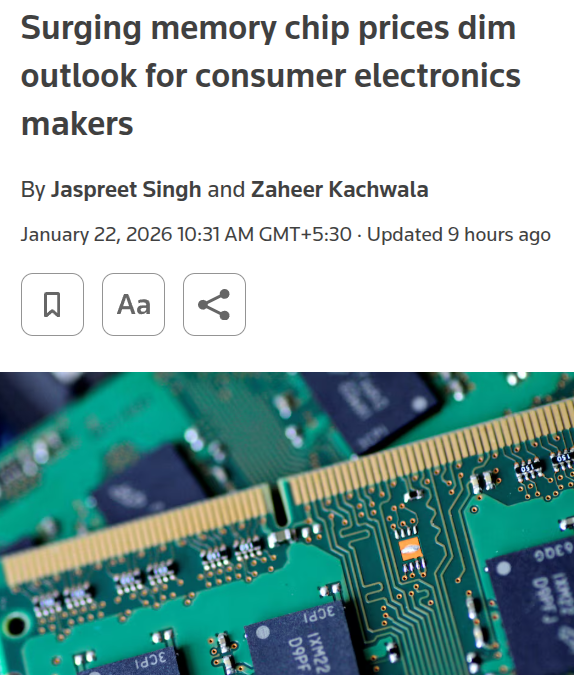
Memory supply (DRAM/NAND): Reporting and circulated projections argue AI datacenter buildouts are absorbing enough DRAM and SSD/NAND capacity to move the entire memory market; one thread cites Q1 memory pricing potentially up 40–50% after a ~50% surge last year, with some specific parts reported as far higher, per the Reuters memory squeeze thread. Trend projections also show a sharp revenue ramp tied to AI servers, as visualized in the TrendForce revenue chart.
• Knock-on effects: the same reporting ties memory allocation and spot-price volatility to weaker shipment outlooks for phones/PCs/consoles, as described in the Reuters memory squeeze thread.
Jensen Huang’s “rent a GPU” test highlights persistent scarcity
GPU availability (NVIDIA): Jensen Huang argues a simple “AI bubble test” is whether you can rent an NVIDIA GPU, implying demand is so high that even older generations are seeing spikes, as summarized in the GPU rental scarcity clip. The subtext is that real-world access constraints remain visible even when public narratives swing between “bubble” and “slowdown.”

US data-center pipeline implies ~10× growth, but grid queues and turbines gate it
US datacenter buildout (Reuters): Reuters reports filed projects could imply ~1,000% growth in US datacenter capacity versus just under ~15 GW today, but warns many filings are aspirational and constrained by utility interconnection queues and long lead times for gas turbines, as described in the Reuters pipeline summary. Separately, Reuters notes residential power prices are already up 16% on average across the 15 states with the largest pipelines, per the power price follow-up.
New bill targets Nvidia H200 export licenses with Congressional review
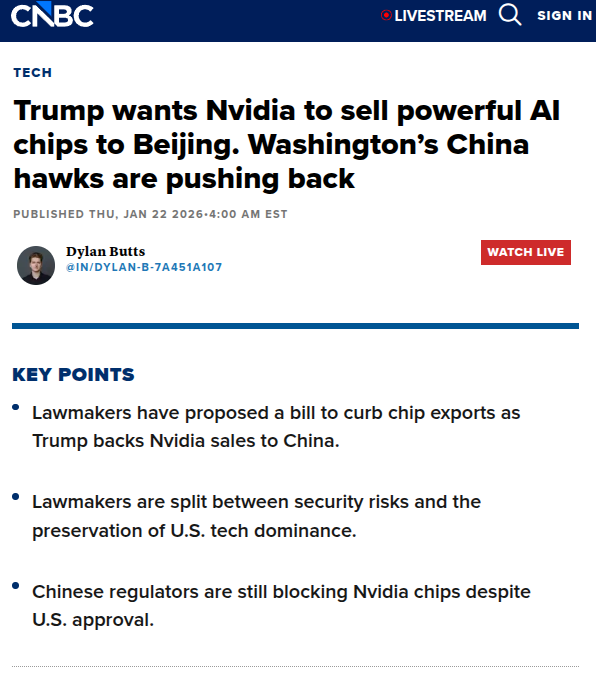
Export controls (US ↔ China): A reported policy fight centers on whether the US should license exports of Nvidia’s H200 AI chips to China; a proposed House bill (“The AI Overwatch Act”) would add a 30-day Congressional committee sign-off window for covered licenses and could pause/revoke approvals, as summarized in the CNBC bill summary. The same report notes China may be slowing/blocking imports at customs even when US approval exists, per the CNBC bill summary.
💼 Enterprise economics & GTM: ARR spikes, mega-rounds, and outcome-based pricing debates
Business signals centered on OpenAI’s revenue acceleration and capital needs, plus new pricing ideas and SaaS market repricing narratives. Excludes Cursor 2.4 (feature).
OpenAI says API revenue added $1B+ ARR in a single month
OpenAI API (OpenAI): OpenAI CEO Sam Altman says the company added more than $1B of ARR in the last month from its API business, emphasizing that OpenAI is “mostly thought of as ChatGPT” even while API growth is doing the heavy lifting, per the API ARR claim. This matters for engineering leaders because it’s a strong signal that model consumption is continuing to migrate into product backends (not just end-user chat), which typically means more pressure on reliability, latency, and throughput.
• Scale context: A separate summary claims OpenAI’s total ARR surpassed $20B by end of 2025 with large cash burn, framing the growth-vs-cost tension for buyers and vendors, as described in the Industry revenue snapshot.
OpenAI’s reported $50B raise is now tied to a 1GW UAE cluster plan
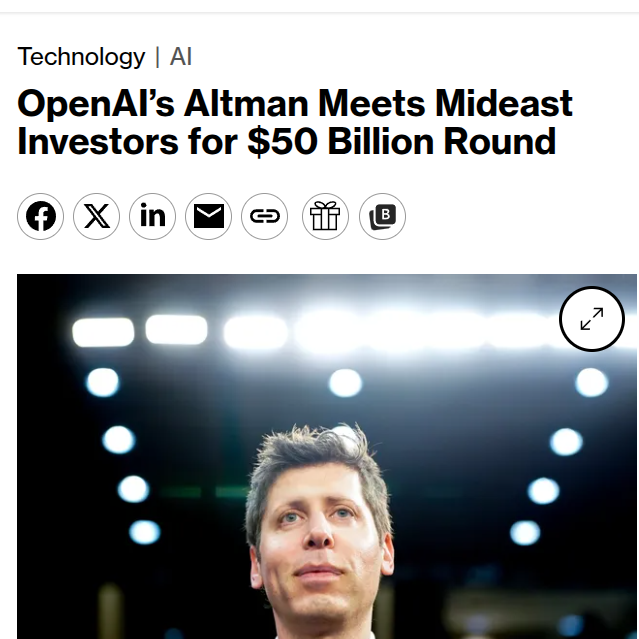
OpenAI funding (OpenAI): Bloomberg reporting says Sam Altman is pitching state-backed Middle East investors on a $50B+ round valuing OpenAI at ~$750B–$830B, and explicitly ties it to regional infrastructure—OpenAI’s announced UAE “Stargate” plan for a 1GW cluster in Abu Dhabi with 200MW expected online in 2026, per the Bloomberg fundraising details following up on funding rumor (the round size/valuation chatter).
The practical engineering read-through is that the “capital raise” story is also an “energy + datacenter siting” story; the 1GW/200MW numbers set expectations for how quickly additional inference capacity could plausibly come online.
OpenAI floats outcome-based licensing for AI-aided discoveries; backlash follows
Outcome-based pricing (OpenAI): Discussion spikes around OpenAI exploring “licensing, IP-based agreements and outcome-based pricing” where enterprise customers could agree to revenue share on downstream wins (example given: drug discovery sales share), with the key clarification that it’s positioned as an optional enterprise deal, not “coming after random people,” per the Clarification thread.
• Why it’s controversial: Critics frame it as OpenAI “taking a cut” of customer breakthroughs and argue it undermines the original nonprofit narrative, as reflected in the Profit-share criticism and the Skeptic response.
• How proponents frame it: Supporters argue this is a sign models are becoming a “discovery engine” worth outcome pricing, as described in the Discovery engine framing.
What’s still unclear from the tweets is how such contracts would be operationalized (measurement, attribution, auditability) without creating perverse incentives or procurement dead-ends.
AI agent narratives drive SaaS repricing: per-seat revenue looks shakier
SaaS repricing (Market signal): A Bloomberg-style summary argues that as AI agents do “glue work” (turning messy inputs into spreadsheets/drafts), investors are repricing traditional per-seat SaaS—citing a Morgan Stanley basket down ~15% in 2026, and pointing to drops like Intuit (-16%) and Adobe/Salesforce (-11%+), per the SaaS selloff summary.
The concrete mechanism described is that if internal agents can build “good enough” bespoke tools and run projects continuously, seat growth and net retention assumptions get weaker, so multiples compress even when the underlying vendors’ near-term fundamentals haven’t yet visibly deteriorated.
OpenAI reorganizes: Barret Zoph leads enterprise push; GM roles across major bets
OpenAI org (OpenAI): A reported internal reshuffle moves Barret Zoph to lead the enterprise AI sales push, while COO Brad Lightcap shifts away from running enterprise product/engineering; OpenAI is also rolling out a “general manager” structure across big product lines (ChatGPT, enterprise, Codex, ads) to tighten the research→product loop, as summarized in the Reorg summary.
This matters operationally because it’s an explicit signal that enterprise adoption and monetization are being treated as a first-class product surface—typically a precursor to more packaging, contract structure changes, and uptime/SLA focus.
🛡️ Safety, governance, and failure modes in agentic systems
Safety work today skewed toward practical audits and governance: open tools for alignment testing, plus papers on epistemic failure in tool-using agents. Excludes Cursor 2.4 (feature).
Anthropic releases Petri 2.0 alignment-audit suite with eval-awareness mitigations
Petri 2.0 (Anthropic): Anthropic shipped Petri 2.0, its open tool for automated alignment/behavior audits; the update targets eval-awareness (models “gaming” audits), expands scenario seeds to cover more behaviors, and refreshes comparisons against newer frontier models, as announced in the release thread and detailed on the Alignment blog post.
For safety teams, the practical change is better out-of-the-box coverage (more scenarios) plus more realistic auditing when models have started learning the shape of popular evals—see the audit update note for what was revised and why.
Semantic laundering paper argues tool boundaries don’t make outputs trustworthy
Semantic laundering (agent epistemics): A new paper argues that many agent architectures accidentally treat LLM-generated content as if it were evidence once it crosses a “tool” boundary—creating false confidence via “observations” that are really rephrased model guesses, as summarized in the paper summary.
A concrete mitigation proposed in the same paper summary is to label tools by evidence role (e.g., observer vs computation vs generator) so downstream reasoning can’t quietly upgrade “generated” outputs into “ground truth.”
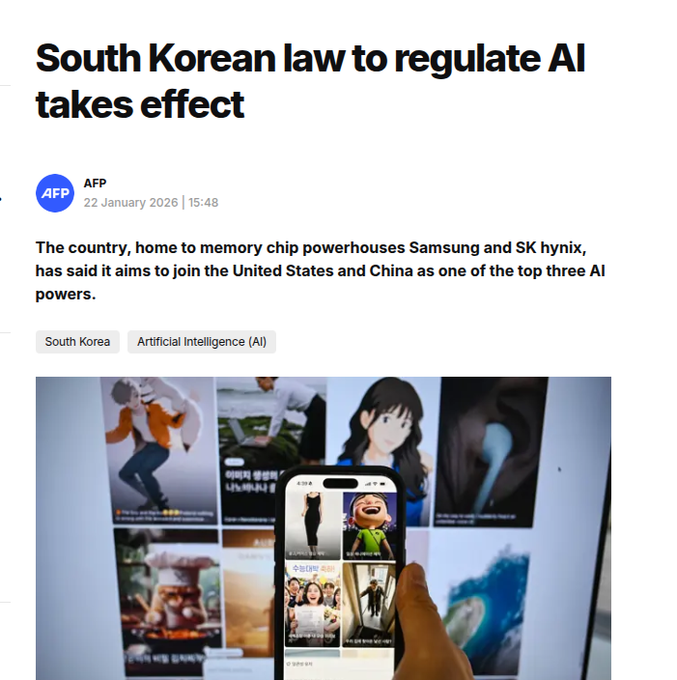
South Korea passes AI Basic Act defining “high-risk AI” and deepfake/disinfo duties
AI regulation (South Korea): South Korea passed the AI Basic Act, described as targeting deepfakes/disinformation responsibilities and introducing obligations around “high-risk AI” systems that could significantly affect safety/lives, according to the law summary.
Operationally, the framing in the law summary points to deployer responsibilities (warnings, investigations, fines) rather than purely model-builder rules, which is a direct pressure point for teams shipping agentic products into Korea.
700+ creators back campaign calling for licensed AI training inputs
Training-data licensing pressure (creators): A new industry statement backed by 700+ actors/writers/creators calls for AI developers to use licensing deals and partnerships (rather than unlicensed web-scale data) as the default path, per the campaign summary.
This is a governance signal more than a technical change: the campaign summary frames dataset provenance as auditable contracts, which maps directly onto enterprise procurement and “rights-clean” model sourcing.
Long-running agents raise “intent drift” accountability and liability questions
Agent liability (intent drift): A legal-risk thread highlights that long-running agents can change behavior over time (“intent drifts”), making it hard to pin accountability on the builder vs deployer vs the agent’s evolving behavior, as laid out in the intent drift thread.
The claim in the intent drift thread is that existing legal concepts assume relatively static intent, which doesn’t map cleanly onto agents that persist, accumulate context, and act over long horizons.
🗣️ Voice agents: realtime speech-to-speech, ultra-low-latency TTS, and platform momentum
Voice progress continues with low-latency models and platform funding signals. Excludes Cursor 2.4 (feature) and keeps Qwen3‑TTS in model releases.
LiveKit raises $100M to push voice-agent infrastructure up the stack
LiveKit (Voice infra): LiveKit says it raised $100M to make building voice AI “as easy as a web app,” positioning voice as the most natural interface and signaling more capital flowing into realtime agent plumbing rather than just models, as stated in the funding announcement and elaborated in the funding blog at funding blog.

For engineers, this is mostly about tooling maturity: better turnkey building blocks for realtime audio transport, turn-taking, and deployment ergonomics—areas that typically become the bottleneck once a team moves beyond toy demos.
Chroma 1.0 claims sub-150ms open speech-to-speech with personalized cloning
Chroma 1.0 (FlashLabs): Following up on Chroma launch (open speech-to-speech), FlashLabs’ Chroma 1.0 is described as an open, native speech-to-speech model (skipping a speech→text→LLM→text→speech pipeline) with <150ms latency claims and personalized voice cloning, plus a reported similarity score of 0.817, as summarized in the model overview clip.

Treat the metrics as provisional—there’s no linked eval artifact in the tweets—but the direction is clear: pushing low-latency voice agents via end-to-end speech modeling rather than stitched pipelines.
Inworld TTS-1.5 adds 15-language coverage and cloning on top of low latency
TTS-1.5 (Inworld): Building on TTS-1.5 launch (sub-250ms voice pricing/latency), Inworld’s TTS-1.5 is now described with sub-250ms (Max) and sub-130ms (Mini) latency, support for 15 languages, “affordable voice cloning via API,” and “on‑prem enterprise options,” alongside a cost claim of $0.005/min, as summarized in the product spec recap.
No API docs or benchmarks are linked in the tweet, so rollout details (limits, streaming protocol, and pricing granularity) remain unclear from today’s sources.
Praktika reports +24% Day-1 retention from a multi-agent voice tutoring stack
Praktika (Voice tutoring workflow): Praktika is described as treating voice as a coordinated multi-agent system—adapting lessons mid-conversation, pulling context dynamically, and adjusting flow in real time—built on OpenAI models, with a reported 24% lift in Day‑1 retention, per the case study note.
The post is light on implementation specifics (turn-taking, barge-in handling, memory layout), but it reinforces a common engineering pattern: retention gains come from system behavior (timing, corrections, continuity), not just higher-quality TTS.
ElevenLabs shows up at Davos amid Europe “tech sovereignty” talk
ElevenLabs (Policy & market signal): ElevenLabs highlights its first Davos appearance as part of the WEF Innovator Community, with its co-founder slated for a panel on “Is Europe’s Tech Sovereignty Feasible?”—a reminder that voice AI vendors are now directly in the conversation about regional dependence and procurement posture, as posted in the Davos announcement.
This is more geopolitical signaling than product detail, but it tends to shape enterprise deal dynamics (on-prem demands, residency, and vendor diversification) over the next few quarters.
📚 Community, meetups, and live demos: camps, workshops, and office hours
The social distribution layer for agentic building is strong today: livestreams, workshops, and office hours centered on hands-on building. Excludes Cursor 2.4 (feature).
Vibe Code Camp pulls thousands live, with an agent-heavy guest lineup
Vibe Code Camp (Every): Following up on Vibe camp (all-day agent workflow marathon), the stream hit “almost 7k people watching live” about two hours in, according to the Viewership update; it’s a concrete signal that long-form, hands-on agent ops is becoming a mainstream learning format. The guest schedule also explicitly mixes “how I build” demos with toolmaker appearances (Notion/Anthropic/etc.), as laid out in the Run of show post.
• Distribution mechanics: The hosting view shows multiple concurrent sessions with large join deltas (e.g., “+11.1K”), as captured in the Hosting screenshot, which hints at “many parallel rooms” being part of the format rather than a single stage.
• Where to find it: The live stream link is shared directly in the YouTube livestream, which matters because it makes the content watchable asynchronously for teams that treat these as internal training material.
Matt Pocock’s Ralph workshop sells out quickly as AFK coding spreads
Ralph / AFK coding (AI Hero): A live, hands-on Ralph workshop (Feb 11, 9AM–1PM PST) was announced with a 40-attendee cap in the Workshop announcement, then quickly flipped to “Sold out!” in the Sold out note. This is a clean demand signal for “run agents unattended” operator patterns rather than one-off prompting.

• What’s being taught: The positioning is explicitly “totally AFK, closing GitHub issues while I work,” as shown in the AFK setup post, which frames Ralph less as a coding assistant and more as a background worker.
• Funnel details: The registration surface is linked from the Workshop page, with the tweet thread showing seats dropping fast (e.g., “10 seats left”) in the Seats remaining update.
A weekly SF “AI Vibe Check” meetup series kicks off with livestreams
AI Vibe Check (community meetup): A new weekly SF-area event series was announced as “AI Vibe Check,” with an RSVP + livestream pipeline described in the Series announcement. It’s an explicit attempt to turn demos and operator workflows into a recurring, local distribution layer.
• Cadence + format: The post frames it as “fully checked each Thursday” with an on-site meetup plus livestream, as stated in the Series announcement and reinforced by the Livestream timing note.
• Where it routes: The livestream episode link is posted in the Livestream link post, which makes it easy for teams outside SF to track what patterns and tools are getting demoed first.
Braintrust’s Trace event advertises agent observability at scale (Feb 25, SF)
Trace (Braintrust): A one-day event talk at Replit (Feb 25) was announced around agent observability at scale, with speakers named and a clear “come in person” hook in the Event announcement. This is one of the few community posts here that explicitly centers observability as the technical theme.

The event’s destination page is linked in the Trace event page, which positions it as an in-person knowledge exchange rather than a product launch.
Firecrawl forms a builder program for early integrations and feedback loops
Firestarters Program (Firecrawl): Firecrawl launched a small builder community offering “early access to new features,” a free plan, and direct team access, as described in the Program announcement. This is a community-layer move: it’s explicitly about accelerating integrations and answering implementation questions.
The application entry point is linked in the Program page, and the follow-up post reiterates the call to apply in the Apply reminder.
SGLang schedules an Office Hour on multi-turn RL rollouts for LLMs/VLMs
SGLang Office Hour (LMSYS/SGLang): An office hour session is scheduled for Jan 27 (7 PM PST) on “Seamless Multi-Turn RL for LLM and VLM,” per the Office hour post. It’s a community teaching surface specifically about training/inference systems plumbing, not app-level prompting.
The same post also ties the talk to production performance work (TTFT/TPOT optimization on H200 clusters) as context, as described in the Office hour post.
vLLM-Omni sets an in-person meetup at AAAI 2026 for its omni serving stack
vLLM-Omni (vLLM project): The team announced an in-person meetup at AAAI 2026 in Singapore (Expo Hall 3, Booth A50; Jan 24, 11:30–12:30) in the AAAI booth post. For engineers, it’s one of the few signals in this feed that focuses on “how to serve” (LLM + vision + diffusion) rather than model releases.
The post frames the content as an overview of “unifying LLM, vision, and diffusion workloads into a single inference stack,” per the AAAI booth post, with a roadmap teaser rather than a single release drop.
A W&B office hangout forms around building self-improving agents
Self-improving agents meetup (W&B / community): A small SF in-person hangout at the Weights & Biases office was floated as a build session for “self-improving agents,” with a stated “couple hundred” attendance expectation in the Office hangout note. It’s a lightweight but specific signal that agent training/feedback-loop builders are clustering in person, not just online.
Kilo Code runs an Anthropic webinar and ties attendance to credits
Kilo Code webinar (Kilo × Anthropic): Kilo Code promoted a live webinar with Anthropic’s Applied AI team and attached a “$1k in credits” giveaway mechanic, as stated in the Webinar giveaway. It’s another example of tooling vendors using live sessions to onboard teams into their agent workflow.
The registration endpoint is provided via the Webinar registration surfaced in the follow-up post Registration post.
🧠 Developer culture shifts: slop backlash, UI/CLI pendulum, and “agents change the job” narratives
Culture discourse is itself the news today: what counts as productivity, how people feel about agent-built output, and where “craft” moves. Excludes Cursor 2.4 (feature).
“Accumulating AI skillset”: experience matters more than people expect
User skill gradient (Model usage): There’s an explicit claim that an “accumulating AI skillset” develops with practice—knowing what models can do, how they fail, and when to trust them—framed as more gradual and predictable than people assume in skillset accumulates.
This is a cultural counterweight to one-shot “model X is magic” discourse: operator experience becomes part of the system.
“MVP in 4 hours, production in 4 days” becomes a common agent-era framing
Shipping reality (Agent-assisted dev): A concise framing is spreading: “time to vibe code an mvp app: 4 hours; time to make it ACTUALLY production ready: 4 days,” as stated in mvp vs prod timeline.
This lands as a cultural correction: agents compress the first draft, but hardening (edge cases, testing, deploy reliability) still dominates calendar time.
Role reframing: “Programming is customer service” for learning PM/arch skills
Skill development (Work in the agent era): The “higher-level skills matter more than syntax” argument gets a concrete prescription: build something for a real person to learn product/architecture/PM skills, not for a hypothetical user, as laid out in build for real customer.
The point is that agentic coding may reduce time spent typing, but it doesn’t remove the need to learn through user adoption failures and iteration.
UI pendulum: “GUIs are back” framing spreads as agents run longer
UI pendulum (Developer tooling): The “CLI is the Stone Age… GUIs are back” quote is getting airtime as a shorthand for how agent supervision is shifting from command entry to managing long-running work and approvals, as captured in GUI back quote.

The subtext is that once agents can run for hours, the bottleneck becomes coordination surfaces (state, review, interruptibility), not the terminal itself.
arXiv “slop” backlash grows as paper volume ramps
Research quality (Publishing): Frustration about low-signal paper output is getting more explicit, with “Level of slop on arxiv is ridiculous” in arXiv slop complaint.
For engineers who treat papers as implementation specs, this raises the cost of separating usable methods from noise—especially when repos and eval artifacts aren’t shipped alongside the claims.
Atlassian CEO: typing speed is a bad proxy for developer efficiency
Productivity measurement (Management): A clip arguing “How quickly you write code is a poor way to measure developer efficiency” is circulating via efficiency metric clip.
In an agent-heavy workflow, this frames the cultural shift: measurement moves toward outcomes and iteration speed, not keystrokes.
Citation hygiene is deteriorating (wrong refs show up in papers)
Research hygiene (Citations): One concrete example claims “9 wrong citations in a single page” in wrong citations post, with follow-on notes describing how advisors now explicitly gate citation formatting and canonical versions as a routine check in citation checklist.
This matters because LLM-assisted writing can propagate plausible-but-wrong bib entries, which then contaminates downstream literature review and benchmarking summaries.
Most users never change default model; “two clicks” can raise outcomes
Model choice behavior (Product UX): Watching real users suggests “essentially zero percent of people change the default model,” and that “clicking twice” can materially improve results, as stated in default model behavior.
This turns model selection from a power-user feature into a mainstream UX concern: defaults quietly define perceived capability.
“10× engineers” discourse returns, now with “AI has created 100×” claims
Talent narratives (Dev culture): The old “10× engineer” argument is resurfacing with an updated twist—claims that AI amplifies output by an order of magnitude beyond that, per the re-shared quote in 10x engineer retweet.
The practical implication is cultural: hiring and performance conversations are being reframed around leverage and orchestration, not raw output volume.
LinkedIn “slop fest” complaints tie into DevRel role shifts
Slop backlash (Social platforms): “LinkedIn is becoming a slop fest” is being used as a proxy complaint about low-effort LLM content flooding professional feeds in LinkedIn slop.
The same thread frames DevRel as especially exposed because a lot of “connector content” is now “a prompt away,” raising the baseline for what counts as useful, per DevRel shift and connector content observation.
🤖 Embodied/world-model progress: 4D perception, VLA+ learning, and real-world autonomy signals
Embodied AI today clustered around perception-to-action and world modeling, with multiple lab updates on 4D/robotics capabilities. Excludes Cursor 2.4 (feature).
DeepMind’s D4RT turns video into 4D scene representations 18×–300× faster
D4RT (Google DeepMind): DeepMind introduced D4RT, a unified model that encodes video into a compressed representation and supports multiple 4D reconstruction queries (space + time) via a lightweight decoder, with claimed 18×–300× speedups and “~1-minute video in ~5 seconds on a single TPU,” as described in the D4RT launch thread and expanded in the performance claim thread.

• What this unlocks: D4RT is positioned as one model for several 4D tasks—predicting per-pixel 3D trajectories and producing “freeze-time” 3D structure—using one representation rather than fragmented pipelines, as outlined in the trajectory and freeze-time post.
• Why it matters for embodied stacks: The pitch is a faster, more scalable motion+geometry substrate for robotics/AR/world-modeling workloads, with the main framing and examples collected in the DeepMind blog post.
Microsoft’s Rho-alpha “VLA+” adds tactile sensing and post-deploy online learning
Rho-alpha (Microsoft Research): Microsoft Research’s Rho-alpha (ρα) is being framed as a VLA+ model—extending vision-language-action by adding tactile sensing and online learning from human corrections after deployment, as summarized in the VLA plus overview.

• Capability surface: The description claims control of dual-arm setups for tasks like BusyBox manipulation, plug insertion, and bimanual packing/arrangement, as listed in the VLA plus overview.
• Why the “plus” matters: The distinguishing bet is adaptability after shipping (teleop corrections → immediate improvement) rather than treating policies as static artifacts, per the VLA plus overview.
Tesla begins unsupervised Robotaxi rides in Austin (no in-car safety monitors)
Robotaxi (Tesla): A report circulating in the tweets says Tesla has started unsupervised Robotaxi rides in Austin, explicitly described as no safety driver/operator in the car, per the launch claim.

This is a concrete autonomy deployment signal (regardless of scale); the tweets don’t include operational details like geofence size, fleet count, disengagement policy, or incident rates.
Physical Intelligence “Robot Olympics” follow-up argues tasks mislead about capability
Robot Olympics evaluation (Physical Intelligence): A response thread highlights why “Olympics”-style robot task showcases can be misleading about capability, and discusses what makes tasks hard under today’s learning methods, per the follow-up discussion.

• Benchmark interpretation: The core point is about aligning task design with what’s actually difficult for current systems (and what’s merely brittle), with the original PI context linked in the PI Olympics post.
This is less about any single model result and more about how teams should read—and build—embodied benchmarks when systems are still patchy across environments and reset conditions.
Motion 3-to-4 proposes 3D motion reconstruction for downstream 4D synthesis
Motion 3-to-4 (research): A new method titled “3D Motion Reconstruction for 4D Synthesis” is shared as “Motion 3-to-4,” positioned around reconstructing 3D motion to enable downstream 4D generation/synthesis tasks, per the paper demo post.

The tweet is light on specs/benchmarks, but the framing matches the current push to turn video into manipulable intermediate representations (motion + geometry) rather than only producing pixels.
🎥 Generative media & creative pipelines: image models, audio→video, and control knobs
Generative media remained active today (image/video/audio tooling), but it’s not the central engineer story versus coding agents. Excludes Cursor 2.4 (feature).
ComfyUI adds Vidu Q2 with multi-reference subject control and faster generation
Vidu Q2 (ComfyUI): ComfyUI says Vidu Q2 is now available with emphasis on character consistency, roughly “~3× faster generation,” and workflows that can use “up to 7 reference subjects,” according to the ComfyUI release post.

• Control surface: “Up to 7 reference subjects” suggests the intended workflow is multi-entity conditioning in a single graph (characters/props/outfits), as stated in the ComfyUI release post.
• Throughput signal: the “~3× faster” claim is directional (no benchmark artifact in the tweet), but it’s a notable knob for teams doing iterative storyboard passes or multi-variant renders, per the ComfyUI release post.
Gemini app leak suggests a music generation tool is being wired into “My Stuff”
Gemini app (Google): A Gemini Android build appears to include a MUSIC_GENERATION_AS_TOOL capability flag plus a TYPE_MY_STUFF_GENERATED_MUSIC content type, implying music outputs could be stored alongside generated images/videos/audio in the “My Stuff” area, as shown in the App strings leak.
The tweets don’t show a public UI or rollout date; what’s concrete here is the internal wiring (tool enum + storage taxonomy) visible in the App strings leak, which usually precedes feature gating/experiments.
LTX Audio-to-Video: creators converge on song-splitting and storyboard grids
LTX Audio-to-Video (LTX Studio): Creators are documenting a repeatable workflow for LTX’s audio-conditioned video generation—pairing prompts+images with segmented audio tracks to drive scene structure—shown in the Workflow walkthrough and extended with “split the song into short tracks” guidance in the Step-by-step setup.

• Pipeline shape: the approach described in the Step-by-step setup is to break a song into shorter stems/clips, upload each with an image, then optionally add prompts per segment.
• Output style: LTX’s most visible “win” in these examples is rhythm/beat alignment and scene coherence tied to the audio track, including instrument/visual sync shown in the Instrument sync clip.
Gemini’s Nano Banana Pro gets a Prompt Off contest and a street-fashion prompt gallery
Nano Banana Pro (Gemini): Google is leaning into community-driven prompt discovery for Nano Banana Pro with a “Prompt Off” image competition in the Gemini Discord, as described in the Prompt Off invite, while also curating “street fashion portraits” as a de facto reference style guide in the Street portrait roundup. This is mostly a signal about which looks are currently stable and repeatable in public access, rather than a new model capability.
• What’s new for builders: the Prompt Off creates a shared prompt+output corpus voted by peers, which tends to converge on reusable prompt patterns (lighting, styling, camera framing) faster than ad hoc tweeting, per the Prompt Off invite.
• What it implies: Gemini’s own highlight reel of outputs becomes an unofficial “known good” distribution for what Nano Banana Pro is expected to handle without post-processing, as shown in the Street portrait roundup.
fal runs a Wan video contest with Alibaba Cloud ahead of the 2026 Winter Olympics
Wan video generation (fal): fal is running a fan-creation contest with Alibaba Cloud where submissions must be 5–15s videos with Wan as the primary model, with a Jan 26 deadline and prizes tied to Milano Cortina 2026 tickets, as described in the Contest announcement.

The operational detail that matters here is the constraint envelope (short clips, landscape 16:9, specific sports prompts), which effectively defines a small “benchmark slice” for how Wan behaves under public-facing creative constraints, per the Contest announcement.