.png&w=3840&q=75&dpl=dpl_8P5vK4vf12zexrDqzD3r2KN8zCZZ)
xAI Colossus 2 hits 1GW – targets 1.5GW in April

Stay in the loop
Free daily newsletter & Telegram daily report
Executive Summary
Posts claim xAI’s Colossus 2 is now a fully operational 1GW training cluster, with a 1.5GW upgrade targeted for April; the same threads frame this as “city-scale” AI infra and juxtapose it with an Epoch-style chart putting global AI data center power near New York State peak (~31GW). A separate clip says xAI brought the site up using gas turbines and Tesla Megapacks despite nearby 300kV lines, underscoring grid interconnect as a gating item; what’s still unclear from tweets is how much of the 1GW figure is steady-state IT load vs provisioned capacity.
• OpenAI/Codex speed race: chatter anchors “very fast Codex” around 500 tok/s to 1,500 tok/s decode expectations; Cerebras is repeatedly implied as the mechanism, but no official tok/s benchmarks appear.
• Anthropic/Claude Code controls: plan acceptance can optionally clear context to improve plan adherence; “thinking” depth is exposed via Option+T, /config, and MAX_THINKING_TOKENS; CLI 2.1.11 fixes excessive MCP HTTP/SSE connection requests.
• Skills as portable artifacts: anthropics/skills circulates at 22.7k stars and 2.2k forks; OpenRouter ships npx add-skill … across 8+ harnesses, while developers complain about fragmented on-disk skill paths and push for standardization.
Top links today
- MemoBrain paper on executive memory for agents
- NoisyBench paper on distractor-robust reasoning
- Paper on private memory for language agents
- MemRec paper on collaborative memory recommenders
- Survey on LLM agents in law
- Paper on human-humanoid interaction learning
- Blind peer review for creative writing agents
- WSJ report on Thinking Machines cofounder firing
- Bloomberg on Tsinghua AI patent dominance
Feature Spotlight
Feature: “Very fast Codex” signals a speed war (Cerebras + tok/s arms race)
OpenAI teases “very fast Codex,” with multiple posts tying it to Cerebras-class throughput (e.g., 500–1,500+ tok/s). If real, it changes agent economics and erodes rivals’ speed advantage.
Cross-account chatter centers on Codex getting dramatically faster—framed as a competitive moat shift versus Claude/Gemini. This section is only about Codex speed + its immediate product impact (excludes ChatGPT ads and other OpenAI topics).
Jump to Feature: “Very fast Codex” signals a speed war (Cerebras + tok/s arms race) topicsTable of Contents
⚡ Feature: “Very fast Codex” signals a speed war (Cerebras + tok/s arms race)
Cross-account chatter centers on Codex getting dramatically faster—framed as a competitive moat shift versus Claude/Gemini. This section is only about Codex speed + its immediate product impact (excludes ChatGPT ads and other OpenAI topics).
Codex speed race sharpens: Cerebras tie-in and 500–1,500 tok/s expectations
Codex (OpenAI): Following up on speed teaser (Altman’s “very fast Codex” line), today’s threads put explicit throughput numbers on what “fast” would mean—ranging from “reasoning at 500 tokens/s” to a view that surpassing 1,500 tokens/s would erase Anthropic’s speed advantage and “bury” Gemini 3, per the throughput wish and 1500 tok/s argument.
The Cerebras partnership keeps getting treated as the implied mechanism for this step-change, with the “OpenAI 🤝 Cerebras” pairing shown alongside the repeated “Very fast Codex coming!” line in the partnership screenshot and echoed by the Altman teaser RT.
• Competitive framing: One take is that higher tok/s isn’t just “nice to have” but a moat shift for coding agents, as argued in the 1500 tok/s argument, while other posts pin hopes on a GPT‑5.3-era jump to “Cerebras level tokens/sec,” per the speed chart post and throughput wish.
Treat the numbers as expectation-setting rather than specs—nothing in today’s tweets includes an official tok/s benchmark artifact.
Codex team says it’s adding compute “at unprecedented pace”
Codex (OpenAI): A widely shared internal-facing sentiment says Codex is “adding compute at unprecedented pace” and that OpenAI is in a “fast evolution phase” as the product co-evolves with Codex’s capabilities, per the Codex compute quote screenshot repost.
That dovetails with the broader “very fast Codex” narrative, but this specific signal is about capacity buildout and iteration cadence—not model architecture claims.
Codex CLI reliability complaint: “gave up again” over basic git operations
Codex CLI (OpenAI): A recurring adoption blocker shows up again: a user says they “gave up on Codex again” and calls out “issues with basic git operations,” per the gave up again thread and the git ops complaint.
This is the kind of non-model failure mode that matters more as tok/s increases—speed doesn’t help if core repo actions are brittle.
Codex teases a plan mode UI after user requests
Codex (OpenAI): A Codex team member posted a teaser implying “plan mode” is landing in Codex—positioned as a response to repeated user asks, per the plan mode teaser.
No details are shared yet on how plans are represented (diff review, approval gates, context handling), so it’s best read as a UX parity signal with other agent harnesses rather than a spec.
GPT‑5.3 “xfast” rumor mill bleeds into Codex expectations
GPT‑5.3 + Codex (OpenAI): Rumor and meme posts are explicitly linking GPT‑5.3 timelines to Codex speed expectations—e.g., “gpt‑5.3‑codex‑xhigh‑xfast wen,” per the xfast meme—while other posts push a “this week or next” release window narrative for GPT‑5.3 more generally, per the Garlic rumor and release window hype.
This is not product confirmation, but it shows the market is now treating “next model” and “next speed tier” as a single bundled expectation for OpenAI’s coding stack.
Codex usage framing: most failures are “asking for what I don’t understand”
Codex driving pattern: One practitioner claims their main failure mode with Codex is operator intent drift—“I only struggle…when I push us in the wrong direction,” and when they ask for something they don’t understand Codex will “do exactly what I asked…even when that’s not what I meant,” per the operator error framing.
It’s a useful lens on why speed increases can amplify both productivity and wrong-turn throughput.
🧠 Claude Code: plan-context reset, thinking controls, and small CLI fixes
Today’s Claude Code discussion is about staying on-track: plan acceptance can clear context to improve adherence, plus operator controls for “thinking” and a minor CLI bug fix. Excludes Cowork and Skills marketplaces (covered elsewhere).
Claude Code adds optional context reset when accepting a plan
Claude Code (Anthropic): Claude Code now offers to clear the conversation context when you accept a plan, with Anthropic saying it “significantly improves plan adherence” and keeps Claude on track longer, as described in the [plan acceptance UI](t:2|plan acceptance UI); the old behavior remains available via an explicit option, so accepting a plan doesn’t have to wipe context.
The change is framed as a control lever for long sessions: take the plan as the durable artifact, then start execution in a clean window while still allowing manual approval modes and non-clearing mode, as shown in the same [plan acceptance UI](t:2|plan acceptance UI).
Claude Code documents three operator controls for “thinking” depth
Claude Code (Anthropic): Claude Code users are being pointed at three concrete ways to change how much the model “thinks”: a keyboard shortcut (Option+T), a config toggle under /config, and a MAX_THINKING_TOKENS setting, as listed in the [thinking controls note](t:34|thinking controls note).
The key here is that “thinking” is treated as an operator-controlled knob (shortcut/config/env), not an implicit model behavior, per the same [thinking controls note](t:34|thinking controls note).
Claude Code is good enough that people are cloning Anthropic API endpoints to integrate it
Claude Code (Anthropic): A notable integration signal: Simon Willison says Claude Code’s closed-source CLI is “so good it’s worth building out an Anthropic API endpoint clone just to integrate with it,” tying the motivation to compatibility with the “Open Responses” standard and related tooling, as argued in the [integration takeaway](t:37|integration takeaway).
This isn’t a feature release, but it is a strong datapoint on how much UX pull the CLI has: builders are willing to add protocol glue to route other backends into the Claude Code UX, per the [integration takeaway](t:37|integration takeaway).
Running 10+ Claude Code agents hits Max rate limits and becomes laptop-bound
Claude Code (Anthropic): Power users are stress-testing multi-agent setups: one report describes “10+ agents collaborate on one task,” quickly burning through Claude Max rate limits while also calling Claude Code “a memory hog” (laptop fans “blaring”), as shown in the [multi-agent clip](t:39|multi-agent clip).

The main concrete takeaway is that the bottleneck isn’t only model-side limits; local resource pressure (RAM/CPU thermals) becomes visible when orchestrating many concurrent agent contexts, per the [multi-agent clip](t:39|multi-agent clip).
Claude Code adoption momentum shows up in “breaking through” note and global meetups
Claude Code (Anthropic): Boris Cherny says Claude Code is “starting to break through” after “a year of very hard work,” in a clear adoption-momentum note in the [progress update](t:10|progress update); separately, he also highlights dialing into community meetups in Istanbul and Tokyo in the [meetup check-in](t:61|meetup check-in).
Taken together, the two posts read like a shift from building to scaling community: public acknowledgment of traction plus explicit investment in user groups, per the [progress update](t:10|progress update) and the [meetup check-in](t:61|meetup check-in).
Claude Code CLI 2.1.11 fixes excessive MCP connection requests (HTTP/SSE)
Claude Code CLI (Anthropic): A small but operationally meaningful fix landed in 2.1.11: “excessive MCP connection requests for HTTP/SSE transports,” as shown in a [changelog screenshot](t:574|changelog screenshot) that circulated alongside user commentary.
This is the sort of bug that tends to show up only once teams are running multiple MCP servers and long-lived sessions; the screenshoted note in the [changelog screenshot](t:574|changelog screenshot) is the only concrete detail provided in the tweet set.
Claude Code CLI 2.1.12 ships with a single message rendering fix
Claude Code CLI (Anthropic): Version 2.1.12 is out with one change—fixing a message rendering bug—per the [release note](t:89|release note) and the upstream [changelog entry](link:306:0|changelog entry).
No new flags or prompt shifts were called out alongside the fix in the [release note](t:89|release note), which makes this a pure UX/terminal-output stability patch.
Gas Town publishes a Claude Code account-switching runbook to cope with session limits
Claude Code workflows (community): Steve Yegge posted a practical runbook for switching Claude accounts because of session limits—log out, force shutdown all workers, authenticate with a new account, then restart workers—spelled out step-by-step in the [account switching steps](t:62|account switching steps).
This is an explicit “limits-aware operations” pattern for agent farms: treat the LLM account as a rotating credential and bake restart choreography into your workflow, as implied by the [account switching steps](t:62|account switching steps).
Claude Code UI nostalgia: calls to bring back “colorful animated letters”
Claude Code (Anthropic): A small UX thread popped up asking about the “colorful animated letters”—Simon Willison says he “really liked” them in the [UI nostalgia note](t:130|UI nostalgia note), and Boris Cherny replies “We’ll find a way to bring them back,” asking for suggestions in the [bring them back reply](t:338|bring them back reply).
It’s minor, but it’s a real signal of daily-use UI feedback arriving alongside the heavier plan/context control work, as seen in the [UI nostalgia note](t:130|UI nostalgia note) and the [bring them back reply](t:338|bring them back reply).
🧵 Agent runners & ops: Ralph/Loom loops, Clawdbot ops, dashboards, and web agents
High-volume ops content today: “Ralph loop” style self-healing verification, Clawdbot operational upgrades, dashboards for monitoring long runs, and agent browser automation. Excludes installable Skills packages (covered in Plugins/Skills).
Clawdbot v2026.1.16-2 ships hooks plus image/audio/video understanding
Clawdbot (Clawdbot): The v2026.1.16-2 release adds a first-class hooks system (bundled hooks + CLI tooling + docs) and “inbound media understanding” for images/audio/video with provider options and CLI fallbacks, as listed in the Release pointer and detailed in the GitHub release notes.
• What else landed: The same notes call out a new Zalo Personal plugin, onboarding/auth improvements, and cross-platform DM session linking via session.identityLinks, per the GitHub release notes.
This is an ops-heavy release: it expands what the runner can observe (media) and how it can be extended (hooks/plugins) without changing the core bot loop.
Loom lands owner-based thread authorization with 193 auth tests passing
Loom (Geoffrey Huntley): Loom merged owner-based authorization for thread APIs (list/get/update/delete/visibility) by extracting authenticated user context and scoping queries by owner ID; the change is shown in a handler diff in the Auth fix photo and backed by the published commit in the GitHub commit.
• What changed: Thread listing now “returns only threads owned by the current user,” with new store methods like list/count/search-for-owner described in the GitHub commit.
• How it’s validated: The commit summary notes 193 authorization tests passing, including previously ignored thread auth tests, as stated in the GitHub commit.
Browser Use shows 1Password-backed cloud logins with MFA handling
Browser Use (Browser Use): Following up on MFA logins—the earlier claim that 1Password “solves” cloud authentication—the team reiterates 2FA/MFA handling and posts a fresh demo sequence in the MFA announcement and Demo video.

• What’s shown: The Demo video clip depicts rapid sign-in flows across multiple services after initiating 1Password authentication.
The tweets still don’t spell out threat model details (where secrets live, isolation boundaries, replay protections), but the operational pitch is “cloud agents can log in like a user would.”
Clawdbot adds real PTY exec so TUIs run without tmux
Clawdbot (Clawdbot): Steinberger says Clawdbot now has a real PTY-based bash/exec tool so it doesn’t need tmux, explicitly framing it as “less token waste,” in the PTY note and clarifying it enables driving Claude/Codex in TUIs in the PTY tool detail.
• Why it matters operationally: PTY support means the runner can interact with full-screen terminal apps directly, instead of paying the token overhead of tmux panes and repeated redraw text, as described in the PTY note.
No performance numbers are shared, but the change is aimed at long-running sessions where terminal UI chatter is a measurable cost.
Ralph Research adds a progress dashboard and starts a control-center build
Ralph Research (omarsar0): A new dashboard surfaces loop progress while the ralph-research run operates inside Claude Code; the author describes it as a way to monitor implementation and experiments, then scale orchestration via Claude Code hooks, as shown in the Dashboard demo.

• Stated target: The follow-up in the Continuation note says the system is already “extremely powerful” and is being aimed at reproducing paper results end-to-end.
The tweets emphasize observability and orchestration, but they don’t include benchmark numbers or a public repo to inspect how the dashboard maps to underlying agent traces.
Wreckit positions a PR-gated loop to tame autonomous coding runs
Wreckit (Wreckit): Wreckit’s site frames the product as an autonomous backlog agent that follows a fixed loop—Research → Plan → Implement → PR → user merge approval—explicitly positioning that human merge gate as the control point for “Ralph Wiggum loops,” per the Site launch and the Product site.
• Implementation surface: The GitHub repo referenced by the author in the Repo link suggests a file-based control plane under a .wreckit folder, but the tweets today don’t include the full spec.
The core operational claim is governance-by-default: the agent can run continuously, but it’s designed to stop before merging.
Agent loops start pulling browser testing into the same run
Loop workflow: A shared screenshot shows a “Claude in Chrome” terminal session executing a Next.js setup flow alongside a Sandstorm UI for creating a new Claude Code agent task, suggesting browser-side testing can be folded into the same long-running loop, as shown in the Browser testing screenshot.
The artifact implies a direction where “system under test” doesn’t stop at CLI checks; it can also drive a real browser to validate UI and flows, but the tweets don’t specify how assertions are recorded (screenshots vs DOM checks vs Playwright traces).
codex-autorunner runs Codex loops across multiple repos with worktrees
codex-autorunner (Git-on-my-level): Aeitroc shares codex-autorunner, a loop runner that operates across many repositories using git worktree support; each loop feeds the next Codex instance the previous run’s final output plus core documents, per the Feature summary and the GitHub repo.
The public description frames it as “run multiple agents on many repositories” with a simple loop driver, but today’s tweets don’t include a demo trace, success metrics, or safety gates beyond the worktree isolation mentioned in the Feature summary.
Loom validates platform kill-switch admin routes in automated tests
Loom (Geoffrey Huntley): As part of hardening the platform control plane, Huntley highlights “kill switches” tested via admin routes (create/list/activate/deactivate) using scripted curl checks, framed as control-systems style safety primitives in the Kill switch test output.
• What’s concrete: The Kill switch test output screenshot shows a “Platform Admin Routes” section with step-numbered checks for kill-switch lifecycle endpoints.
The thread positions this as another artifact that the “system under test” loop can exercise repeatedly, but the tweets don’t yet show policy around who can flip these switches or how they’re audited beyond test logs.
Amp visualizes personal agent usage by cost-per-thread
AmpCode (Amp): Amp’s sqs shares a WIP visualization of recent Amp threads where circle size represents spend and color indicates paid vs free; the screenshot shows 4,214 threads and 53,695 messages, as presented in the Usage visualization.
• What’s in the UI: The same view summarizes net lines-of-code deltas and supports time window selection, as shown in the Usage visualization.
This is an ops/observability move rather than a model change: it makes “agent churn” and cost hotspots legible at a glance, but it’s shared as a preview with a sign-in link in the Usage page.
🧑💻 Claude Cowork + Claude apps: connectors, widgets, and “agentic desktop” UX
Continues the Cowork/agentic-desktop push: users report real file operations working well, plus surface-area expansion via app widgets and mobile connectors. Excludes Claude Code CLI mechanics (covered in Claude Code).
Claude mobile starts rolling out a Health connector (Apple Health + Health Connect)
Claude mobile (Anthropic): Claude’s iOS/Android apps are adding a Health (beta) connector that integrates with Apple Health and Android Health Connect, as spotted in the Health connector beta rollout.
Privacy/usage guardrails show up directly in the permission UX: the dialog says health data “won’t be used to train our models” while still being used “to provide this feature” and “to keep Claude safe and secure” (fraud/abuse prevention), as shown in the Health connector beta screenshot.
Claude Cowork gets another real-world validation for desktop file operations
Claude Cowork (Anthropic): Another hands-on report says Cowork “works like a charm” for practical desktop chores—cleaning up directories, sorting, deleting, renaming, and more—based on initial tests described in the Cowork impressions.
This is still anecdotal, but it’s the kind of confirmation teams look for with computer-using agents: does it handle everyday file operations without constant babysitting?
Claude web app teases search widgets, recipe mode, and early voice-mode changes
Claude web app (Anthropic): New UI strings suggest Anthropic is building richer “search result widgets” (weather, stocks, sports, and map/places cards) plus a guided cooking experience (ingredient scaling + step-by-step timers), per the Widget and recipe mentions leak.
• Voice UI groundwork: The same thread also claims “first visible changes related to voice mode” are appearing, per the Widget and recipe mentions context.
Treat this as pre-release surface area: it’s evidence of product direction, not a shipped feature set yet.
Cowork triggers “skill decay” anxiety in at least one non-technical user reaction
Cowork adoption (Anthropic): A non-technical user reportedly reacted to Claude Cowork with anger rather than awe, arguing that removing day-to-day “friction” via agents could “decay critical skills,” as described in the Non-tech reaction.
This is an early signal of a predictable adoption constraint: even when the tool works, some users will interpret the value prop as deskilling rather than empowerment.
Claude Max subscription sentiment stays strong among heavy terminal users
Claude Max (Anthropic): Users continue to frame Claude Max as a “best decision” for their workflow, as shown in the Claude Max sentiment post.
This is a small signal, but it’s consistent with an “agentic desktop” story: people are paying for higher caps when they’re running long-lived, tool-heavy sessions (even when the UI is just a terminal).
🖱️ Cursor & IDE agents: cloud handoff, skill loading, and debug-mode adoption
Cursor-specific updates and usage: CLI/agent handoffs, editor-side skill loading, and in-person “Cafe Cursor” debugging workflows. Excludes Codex speed (feature) and Claude Code internals.
Cursor CLI rebrands to “agent” and adds handoff to cloud agents
Cursor CLI (Cursor/Anysphere): The Cursor CLI has been rebranded from cursor-agent to agent, and an “handoff to cloud agents” capability is being called out in early user testing, per CLI update note. One practitioner says the CLI is “definitely an improvement” but still not yet competitive with Claude Code or Codex for their workflow, as reflected in Early assessment.
The concrete product signal here is that Cursor is treating local CLI execution and cloud execution as a first-class transition, rather than a separate product surface.
Cafe Cursor Madrid highlights Debug Mode fixing a bug in two prompts
Cafe Cursor Madrid (Cursor/Anysphere): At the Madrid community event, an attendee reportedly resolved a bug using Cursor’s Debug Mode in “2 prompts in Spanish,” with organizers noting discoverability remains an issue, per Event recap.
Beyond the anecdote, the operational signal is that Cursor is pushing in-person “debug with the tool” workflows (including handing out credits), and Debug Mode is being positioned as a repeatable path rather than a hidden power-user feature.
Cursor auto-loads .claude Skills from global and project folders
Cursor (Cursor/Anysphere): Cursor is now auto-loading .claude Skills from both the global and project folders, which reduces friction for people reusing the same skill bundles across repos, as shown in Skills loading demo.

This is a direct portability win for teams already standardizing on skill-shaped instructions and tooling, because it removes a manual “copy skills into this repo” step.
Cursor starts generating inline images for UI mockups in plans
Cursor (Cursor/Anysphere): Some users are seeing Cursor generate images directly in-chat as part of planning or explaining UI changes, rather than only outputting text descriptions, as shown in Generated UI mockup.
The surfaced example is a small UI flow mockup (saved vs saving states), which suggests Cursor is starting to treat “explain with a quick diagram” as a native affordance inside the coding conversation.
A multiplayer game ships in 12 days using Cursor with model-split planning
Cursor (Cursor/Anysphere): A builder reports shipping a real-time multiplayer game in 12 days inside Cursor, using Opus 4.5 for planning and GPT-5.2 for implementation, as described in Build story.

This is another concrete “plan in one model, implement in another” pattern showing up in production-ish work, where Cursor acts as the glue layer for switching models while keeping a single workspace.
🧩 Skills & extensions: Agent Skills repos, sync scripts, and marketplaces
Skills are a major thread today: the Anthropic skills repo, cross-tool skill syncing, and emerging registries/marketplaces. Excludes MCP servers (covered in Orchestration/MCP).
OpenRouter ships `npx add-skill OpenRouterTeam/agent-skills` for 8+ harnesses
OpenRouterTeam/agent-skills (OpenRouter): OpenRouter is pushing a one-command install—npx add-skill OpenRouterTeam/agent-skills—to “optimize OpenRouter calls” across 8+ agent harnesses, as shown in the Install command demo.

The public docs frame it as a way to bake correct SDK usage and patterns into the agent’s context (instead of relying on ad-hoc prompts), as laid out in the Agentic usage docs.
ClawdHub pitches a skills registry with versioning, search, install, and rollback
ClawdHub: A new registry-style site, ClawdHub, is being promoted as “the skill dock” for uploading and discovering AgentSkills bundles—positioned like npm with versioning and rollback, as described in the ClawdHub pointer and on the Project page.
The pitch matters because it treats skills as an ecosystem artifact (publish, version, install) rather than a local prompt snippet, as implied by the ClawdHub pointer.
mirror_cc_skills script mirrors per-repo .claude/skills into ~/.claude/skills
mirror_cc_skills (community script): A small CLI script called mirror_cc_skills is shared as a repeatable way to copy a project’s local .claude/skills/ into the global ~/.claude/skills/ directory, with options for --dry-run and a destructive --sync mode, as documented in the README screenshot.
It’s explicitly rsync-based and aims to solve “skills drift” across many repos without manual copying, per the README screenshot and the source at the Script source.
One-liner rsync copies Claude Code global skills into Codex’s skills folder
Claude Code → Codex skills portability: A single rsync command is being passed around to mirror global Claude Code Skills into Codex’s expected directory, so the same skill bundle can be reused across harnesses, as shown in the rsync one-liner.
The concrete mapping is ~/.claude/skills/ → ${CODEX_HOME:-$HOME/.codex}/skills/, which implicitly treats skills as files-first extensions rather than tool-specific features, per the rsync one-liner.
Claude’s Skills UI adds “Download” to export skills for Cursor/OpenCode reuse
Claude Skills (Anthropic): Claude’s Skills management UI visibly includes a Download action for a skill, and it’s being pitched as a way to reuse the same skill in other skill-aware tools like Cursor or OpenCode, per the Download menu screenshot.
This effectively turns Skills into a portable artifact rather than a Claude-only feature, as implied by the cross-tool reuse framing in the Download menu screenshot.
Cursor auto-loads .claude Skills from global and project folders
Cursor (Anysphere): Cursor is shown auto-loading .claude Skills from both global and project directories, which reduces setup friction for people already maintaining skill bundles in Claude’s format, per the Auto-load demo.
The implied interoperability move is “Claude-format skills become usable elsewhere without conversion,” as suggested by the Auto-load demo.
N‑Skills marketplace posts an “Open Source Maintainer” skill for automated triage
Open Source Maintainer skill (N‑Skills): A marketplace-distributed skill for OSS maintenance is announced, aiming to semantically triage issues/PRs and generate prompts for maintainers, per the Skill release card.
• Operating model: A draft spec shows it wants to analyze issues/PRs/comments/reactions and drive repo stewardship end-to-end—explicitly treating PRs as “intelligence sources” rather than merge candidates, as shown in the Skill spec screenshot.
The design is notable because it encodes a maintainer philosophy directly into a reusable skill artifact, per the Skill spec screenshot.
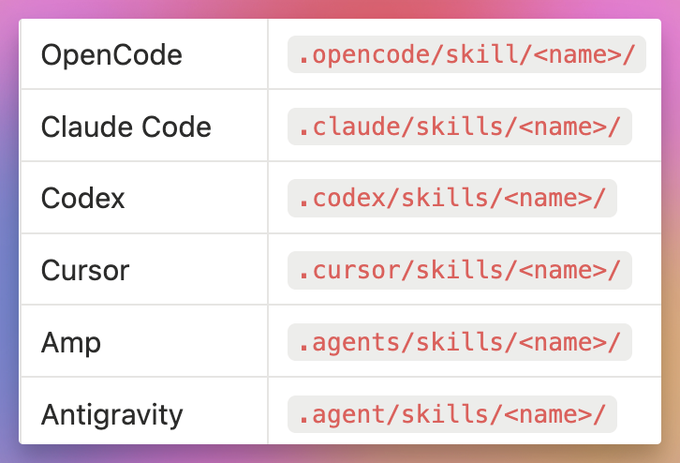
Skills path fragmentation across tools triggers calls for standardization
Skills directory conventions: A concrete pain point is that different harnesses expect different on-disk skill paths (e.g., .claude/skills/, .codex/skills/, .cursor/skills/, .agents/skills/), which makes sharing a skill bundle unnecessarily manual, as summarized in the Directory table.
There’s also a push to converge on ~/.claude/skills support as a de facto common target, per the Support request and the acknowledgement in the Forwarded request.
Developers ask for a simple symlink-style skills sync tool across repos
Skills sync workflow: There’s explicit demand for a tiny ./sync_skills.sh or symlink-based approach to keep skills consistent across projects without re-copying, as captured in the Sync request.
The request signals that teams are accumulating “global vs per-repo skill” sprawl and want a lowest-friction portability mechanism, per the Sync request.
Diagram shows how Claude loads Skills into the context window and triggers them
Skills runtime behavior (Claude): A shared diagram claims Claude loads short metadata for all skills into the context window, then “triggers” a chosen skill by reading its SKILL.md and following references to other files, as illustrated in the Context diagram.
This is a practical mental model for why skills scale better than long bespoke prompts: the system can keep the high-level index always present while lazily expanding only the skill it needs, per the Context diagram.
🛠️ Workflow patterns: backpressure, plan hygiene, and prompt discipline
Practitioner patterns today emphasize tighter feedback loops (“backpressure”), shorter/cleaner plans, and pragmatic minimalism (HTML-first). Excludes product-specific tool updates and installable skills.
Backpressure doctrine: make agents feel fast, automated failure feedback
Angle/Theme: “Backpressure” is being reframed as the core context-engineering primitive for long agent loops—wire in fast, automated signals (tests, types, linters, asserts) so the agent can self-correct instead of drifting.
Huntley points to Moss’ write-up as a concise articulation of this idea, calling it “seminal” for post-loom/gastown engineering, as described in Backpressure framing and expanded in the linked Moss essay. This is the same argument in plainer terms. Capture backpressure or you waste tokens.
• Practical loop design: The emphasis is on shortening the time-to-error and making error output legible so the agent can iterate quickly, as argued in Moss essay.
• Why it matters: The claim is that without reliable backpressure, “context engineering” devolves into babysitting and context resets, per Backpressure framing and Huntley commentary.
Minimal-context start: give agents less, then add context only on failure
Angle/Theme: A “minimum viable context” approach is getting explicit: start with the smallest context that could work, then only add more when the run breaks.
The argument is that as agents get better at discovery, over-provisioning context up front becomes counterproductive, according to Minimal context heuristic. This is a workflow stance. It assumes the agent can ask for what it needs.
Single HTML file first: delay backends and frameworks until forced
Angle/Theme: “One HTML file until you absolutely need a backend” is being positioned as a high-leverage agent workflow—agents can generate the file, inline JS for light interactivity, and scripts to pre-generate static artifacts.
The key point is that the old “gross” approach (static HTML + small scripts) reduces surface area and makes agent edits safer, as laid out in HTML-first workflow. It’s also faster to review. That’s the whole trick.
Delegation converges to project management, not “gamey” agent interfaces
Angle/Theme: A counter-take to “cute agent UIs” is getting clearer: even if tasks aren’t fully automated, delegation patterns will look like project management (tickets, long-running tasks, handoffs).
The argument comes from firsthand experience building a viral game-like agent interface, then calling it a likely dead end, as written in PM-shaped delegation. The workflow claim is about interfaces matching how work already gets coordinated.
Plan hygiene: keep agent plan docs short or they stop being actionable
Angle/Theme: There’s a growing “plans are too long” backlash—shorter plan docs are framed as a reliability primitive, not a style preference.
The distilled heuristic is “do less better,” as stated in Plan length warning. The implied failure mode is that long plans become unreviewable and easy for agents to interpret loosely. Short plans stay concrete.
PRs as prompt requests: rewrite fixes, credit the reporter as co-author
Angle/Theme: A maintainer workflow is emerging where inbound PRs are treated primarily as problem statements and partial solutions, not merge candidates.
The pattern is: extract the signal, implement the fix yourself (often faster with agents), and credit the PR author as a co-author—avoiding long comment threads and “wait dances,” per PRs are prompt requests. It’s a throughput play. It’s also a quality control play.
Experiment-first posture: “No-one knows anything” in coding-agent discourse
Angle/Theme: A social norm is being reinforced: stop treating agent best practices as settled, and treat workflows as provisional experiments.
The PSA framing is blunt—“No-one knows anything… it’s a phenomenal time to experiment,” as stated in Experiment PSA. This sets expectations. It also lowers the social cost of changing your process weekly.
Meta-prompting: have GPT-5.2 Extra High write prompts from guidelines
Angle/Theme: A “don’t write your own prompts” workflow is circulating: ask a strong model to fetch the official prompting guidelines for a target model, then generate the task prompt/agent prompt from that.
The claim is that this yields “superior outcomes” versus ad-hoc prompting, as stated in Meta-prompting claim and defended with “it depends on how you guide it” in Follow-up guidance. It’s a prompting stack. It treats prompts as generated artifacts.
Engineer–artist convergence: AI makes coding feel like creative expression
Angle/Theme: A workflow lens is spreading that “engineers are artists now” (and artists are becoming engineers), because AI collapses execution overhead and shifts the bottleneck to taste, direction, and iteration.
The claim is explicitly framed as positive role convergence in Engineers as artists. It’s not a tooling update. It’s a way to describe how teams allocate time.
💸 Ecosystem dynamics: monetization, pricing arbitrage, and account enforcement
Today’s ecosystem news is about incentives and access: ChatGPT ads details, subscription-vs-API arbitrage, and provider enforcement incidents. Excludes Codex speed (feature) and core coding assistant release notes.
ChatGPT ads test expands with US-only rollout rules and global $8 Go tier
ChatGPT ads (OpenAI): Following up on Ads test—initial US testing plans; OpenAI now says it will start testing ads in ChatGPT Free and Go “in the coming weeks” for logged-in US adults, with ads shown at the bottom of answers and clearly labeled, as laid out in Rollout details and formalized in the Help Center policy. Go is now available globally at $8/month in the US, while Plus/Pro/Business/Enterprise remain ad-free per Rollout details.

• Controls and targeting: Ads can be dismissed and include “why am I seeing this” explanations; personalization can be turned off and ad data cleared, according to the Help Center policy.
• Policy exclusions: OpenAI says ads won’t show for users under (or predicted to be under) 18, and won’t appear near sensitive topics like health, mental health, or politics, as described in Rollout details.
Anthropic reverses Claude Max account bans after a power-user escalation
Claude Max enforcement (Anthropic): A prominent power user claimed Anthropic started banning several of his Claude Max accounts (22 total), saying he pays about $212/month each and was using them to build open-source agent tooling, per Ban complaint. Hours later, he reports the accounts were restored after internal escalation in Unban confirmation, with an Anthropic employee acknowledging outreach in Support response.
• What changes operationally: The user says they’ll “go a little bit slower” and spread requests across machines/IPs after the unban, as stated in Unban confirmation.
Claude Max pricing gap highlighted as ~30× cheaper than token-billed API usage
Claude Max economics (Anthropic): A concrete “subscription vs API” spread is getting circulated: one developer reports that token-billed Claude Code-style requests cost about $0.80 each, implying ~$80/day at a few hundred requests—versus the same workload covered by a $100/month Max subscription, which they frame as ~30× cheaper in effective compute, as shown in Cost math example.
• Competitive implication: The same post argues this spread makes it hard for third-party IDE/harness vendors to match Anthropic’s unit economics without owning a comparable model stack, as quoted in Cost math example.
Power-user pricing expectations shift toward “$2,000 inference for $200” norms
Inference pricing psychology: One thread highlights a growing mismatch between provider cost curves and user expectations: a segment of users is “getting very used to” roughly $2,000/month of inference for $200 and expects ~10× value regardless of “costs going down,” per Value expectation post. This is a demand-side pressure point for any lab subsidizing heavy agent usage via flat-rate plans.
Developers complain Gemini app models lag behind AI Studio quality
Gemini app vs AI Studio (Google): A usage check-in asks how often people use the Gemini app—citing “650m monthly users” as a rumor—per Usage poll prompt and Follow-up note. Replies claim the Gemini 3 Pro/Flash variants in the consumer app are “vastly inferior” to AI Studio versions, with at least one developer saying they uninstalled and unsubscribed per Quality gap claim.
The product split is visible in the app’s “Fast/Thinking/Pro” mode selector shown in Mode menu, which helps explain why teams may treat “Gemini in app” and “Gemini in Studio” as meaningfully different surfaces.
Gemini CLI reported to loop on near-identical reasoning traces
Gemini CLI reliability (Google): A concrete failure mode is being shared where Gemini CLI appears to repeat nearly identical reasoning blocks instead of progressing; one proposed mitigation is to auto-abort/restart when successive traces have near-zero Levenshtein distance, as described in Heuristic suggestion and shown in the Heuristic suggestion.
The underlying cause isn’t established in the tweets, but the pattern is specific enough that teams evaluating Gemini CLI will recognize it when it happens.
Gemini CLI mindshare questioned in public developer threads
Gemini CLI (Google): Public developer chatter includes direct skepticism about whether “anyone even” uses Gemini CLI, as in Usage question. It’s a small signal, but it’s a visible comparison point in the coding-agent CLI ecosystem.
⚖️ OpenAI vs Elon: damages claims, filings, and escalation risk
New legal framing today emphasizes the scale of Musk’s damages demand and the court posture as filings circulate. Excludes broader OpenAI product monetization (covered in Ecosystem).
Musk seeks $79B–$134B damages from OpenAI and Microsoft as lawsuit escalates
OpenAI vs Elon (damages): Musk is now asking for damages in the $79B–$134B range, framing them as “wrongful gains” tied to his early involvement and donations, as shown in the Bloomberg screenshot in Bloomberg screenshot. The filing argument repeats the claim that Musk contributed about $38M (described as ~60% of early seed funding) and is therefore entitled to a share of value creation, as summarized in the damages thread.
• What this changes operationally: The suit’s headline number moves from “governance dispute” vibes to a capital-markets-scale threat; it’s now easy for partners and customers to treat this as a material counterparty risk, because $100B+ remedies imply injunction attempts and extensive discovery pressure.
• Procedural posture in circulation: Threads are also passing around Judge Yvonne Rogers’ order via a court order PDF linked in court order PDF, which keeps the underlying dispute in active motion even as the damages narrative becomes the headline.
OpenAI amplifies Brockman claim that Musk cherry-picked private journal excerpts
OpenAI comms (OpenAI): The official OpenAI account re-amplified Greg Brockman’s complaint that Musk “cherry-picked from my personal journal,” calling it “beyond dishonest,” as reflected in the OpenAI retweet. It’s a small post, but it signals OpenAI is willing to keep litigating in public alongside the court process.
This doesn’t add new legal facts by itself. It does reinforce a narrative that the dispute will keep producing quote-level artifacts (messages, notes, journals) that shape stakeholder sentiment.
Commentary grows that the Musk–OpenAI fight could slow both labs down
Escalation risk (lab competition): Alongside the damages headlines, some commentary is framing the Sam-vs-Elon fight as strategically self-defeating—arguing it will “slow both labs down,” per the slowdown take.
For AI leaders, the practical read is that litigation pressure and public back-and-forth can translate into distraction costs (exec time, PR cycles, and discovery-driven caution), even if model shipping continues in parallel.
🏗️ Compute & energy: gigawatt clusters, grid bottlenecks, and ‘city-scale’ power loads
Infrastructure talk shifts from hype to concrete power numbers: xAI’s gigawatt-scale clusters, buildout timelines, and the grid as a critical constraint. Excludes pricing/funding (covered elsewhere).
xAI says Colossus 2 is fully operational as a 1GW training cluster, targeting 1.5GW in April
Colossus 2 (xAI): Multiple posts claim xAI has crossed the “city-scale” threshold—Colossus 2 is described as the first 1GW AI training cluster, with an upgrade to 1.5GW in April mentioned in the infrastructure note and echoed as “fully operational” in the 1GW online claim. The same thread contextualizes 1GW as roughly “half of Los Angeles’s electricity supply” and lines up other frontier builds (OpenAI Stargate and Anthropic phases) in the hyperscaler comparison.
• Peer set power curves: The Epoch AI-style chart shared in the hyperscaler comparison contrasts xAI Colossus 2 against OpenAI Stargate Abilene and Anthropic–Amazon New Carlisle, and the text calls out OpenAI’s 1.2GW site and Anthropic’s 245MW phase with options scaling higher.
• Operational reality: The Colossus 2 photo collage in the site photo set puts attention on physical constraints—dense cable runs, rack-level infrastructure, and large-site construction artifacts—rather than model-side optimization alone.
What’s still unverified from these tweets is what portion of “1GW” is steady-state IT load vs provisioned capacity, but the repeated numbers and the comparison framing suggest power has become a first-class competitive metric.
Epoch AI chart shows global AI data center power capacity nearing New York State peak (~31GW)
Global AI power capacity (Epoch AI): Following up on 30 GW estimate (global AI data center power at ~30GW), a new chart frames today’s capacity as comparable to New York State peak usage (~31GW), as shown in the power capacity chart. A separate post threads this into the idea that energy becomes the primary bottleneck and name-checks fusion/Helion as the long-run escape hatch in the power capacity chart.
Treat the extrapolated portion as provisional—the chart itself flags incomplete data—yet the scale comparison (nation-state peak load) is the core signal for infra planning, per the power capacity chart.
xAI reportedly powered its GPU site with gas turbines and Tesla Megapacks despite nearby grid lines
Site power bring-up (xAI): A practical constraint surfaced in the powering the site clip—even with 300 kV transmission lines nearby, the post claims xAI initially powered the cluster using gas turbines and Tesla Megapacks, highlighting that “getting electricity onto the GPU cluster site” can be the gating factor.

This is a concrete example of how AI infra timelines can look “software-fast” on the compute side while still being limited by interconnect approvals, substation work, and utility processes, as implied by the powering the site clip.
Demis Hassabis argues scaling still pays off, but needs one or two breakthroughs beyond compute
Scaling laws (Google DeepMind): Demis Hassabis says scaling is “still paying off” but the curve is less steep, positioning progress as “somewhere between no returns and exponential growth,” and adds that reaching AGI likely needs “one or two breakthroughs” beyond scaling, according to the Hassabis clip.

In the context of gigawatt-class clusters becoming normal, this is a reminder that power and compute buildouts can keep moving the frontier, but may not be sufficient on their own—at least per the framing in the Hassabis clip.
🧰 Dev tools shipping around agents: CLIs, usage monitors, and “quiet consumption”
Developer tooling today is heavy on practical utilities: Google-in-terminal CLIs, usage meters across coding assistants, and local summarization/workflow helpers. Excludes full coding assistants and skills packages.
gogcli v0.7.0 ships Google Classroom support
gogcli (steipete): gogcli v0.7.0 expands the “Google in your terminal” surface area with first-class Google Classroom commands plus a batch of Gmail/Calendar/Tasks quality-of-life improvements, as detailed in the Release note and the linked GitHub release.
The release reads like a push from “handy CLI” to “agent-friendly control plane” for Workspace: more structured subcommands, richer attachment metadata, and calendar event types that map to real enterprise usage (Focus Time / OOO / Working Location), per the GitHub release.
CodexBar tracks multi-assistant rate limits from the macOS menu bar
CodexBar (CodexBar): CodexBar is a macOS menu bar utility that surfaces per-provider usage (session vs weekly limits) across multiple coding assistants, with a “how it started / how it’s going” view shown in the Usage panel screenshots and product details in the Project page.
The differentiator is that it’s explicitly multi-provider (Codex, Claude, Cursor, Gemini, etc.) and focuses on reset timing + quota bars rather than cost accounting, as described on the Project page.
summarize.sh leans into “quiet” YouTube consumption with slide-style output
Summarize (summarize.sh): The project is positioning itself as a “quiet consumption” layer for long video—turning a YouTube video into a structured summary with timestamped slide snapshots, as shown in the Terminal slide summaries and described on the Project site.
The on-screen output suggests a workflow where the terminal becomes the review surface (summary + key frames), rather than switching contexts into YouTube—see the Terminal slide summaries.
Amp’s personal usage chart turns thread history into a cost map
Amp (AmpCode): Amp is testing a personal usage visualization that maps recent threads as circles (size = cost; color = paid/free) and shows aggregate volume like 4,214 threads and 53,695 messages, as shown in the Usage chart screenshot and accessible via the Settings page.
The UI is explicitly built for spotting expensive work and usage patterns over time, rather than raw token counters, per the Usage chart screenshot.
Athas IDE embeds DevTools directly in the editor
Athas IDE (Athas): Athas now exposes browser DevTools inside the IDE—console/network inspection in the same workspace as editing—shown in the DevTools demo clip.

This is a small UX change with big leverage for agent-driven or rapid-iteration flows: debugging no longer requires a context switch to an external browser window, as the DevTools demo clip demonstrates.
gogcli “smoke” emails show a pragmatic end-to-end test loop
gogcli (steipete): A simple but telling verification loop shows up in practice: gogcli generates a sequence of “smoke” emails (attach/draft/send) to confirm end-to-end Gmail flows are working, visible directly in the Inbox smoke test view.
This pattern is lightweight observability: the artifact of the test is the same medium the tool operates on (your inbox), which makes failures obvious without extra dashboards, as shown in the Inbox smoke test view.
PDF OCR is still a live tooling problem: edge cases and cost headroom remain
PDF OCR pipelines: There’s renewed “this isn’t done yet” framing around PDF OCR: even strong models don’t reliably one-shot arbitrary PDFs, and there’s still meaningful headroom in making OCR pipelines 2–10× cheaper, as argued in the PDF OCR isn’t solved note and reiterated in the Follow-up on OCR focus.
This lands as a devtools opportunity more than a model story: robust preprocessing, layout handling, and failure-mode routing still matter in production ingestion stacks, per the PDF OCR isn’t solved note.
RepoPrompt can spawn and clean up dedicated workspaces per task
RepoPrompt (RepoPrompt): RepoPrompt’s manage_workspaces tool can open a new, isolated workspace/window for a task and then close/delete it afterward, according to the Workspace automation note and follow-on UX framing in the Orchestrator direction note.
This reads as an attempt to make “task sandboxes” cheap and reversible—especially useful when a single repo needs multiple parallel explorations without manual window/worktree management, as described in the Workspace automation note.
viddy and watch one-liners resurface as “change monitors” for agent runs
Terminal change monitoring: A low-friction pattern is getting reused for agent-heavy edits—continuous diffing of git status -sb via watch, with viddy used as a more capable “watch” alternative, per the One-liner and viddy link and the linked Viddy repo.
The value is not novelty; it’s that these tools provide a fast, local “did anything change?” signal while agents are running, without needing an IDE panel or Git UI, as described in the One-liner and viddy link.
📦 Model watch: GPT‑5.3 “Garlic” rumors and next-month release bingo cards
No confirmed major model launches in this slice; instead, high-volume rumor and roadmap speculation (GPT‑5.3, Grok/DeepSeek/Sonnet/Gemini variants). Excludes Codex speed speculation (feature).
Rumor: GPT-5.3 “Garlic” could land within days
GPT-5.3 “Garlic” (OpenAI): A rumor thread claims GPT-5.3—codenamed “Garlic”—is coming “this week or next,” with the suggestion that 5.2 may have been an earlier checkpoint, as asserted in the [Garlic leak post](t:9|Garlic leak post) and echoed by the [timing hype post](t:92|timing hype post). The same thread frames credibility as a function of historical accuracy (“earning trust”), as implied in the [trust note](t:365|trust note).
Treat this as speculation: there’s no product surface, model card, or official timeline in today’s tweets—only timing claims.
GPT-5.3 rumors start converging on a speed target
GPT-5.3 (OpenAI): Builder chatter is already anchoring expectations around throughput—one post calls “GPT-5.3 reasoning at 500 tokens/s” the headline metric to watch, as stated in the [throughput wish](t:14|throughput wish). Another leak thread frames 5.3 as “something special” and potentially a near-term release, per the [Garlic leak post](t:9|Garlic leak post).
There’s still no evidence trail (benchmarks, hosted endpoints, pricing) in the tweets, so this reads as expectation-setting more than a sourced performance claim.
DeepSeek-V4 is again rumored for next month
DeepSeek-V4 (DeepSeek): One post says it “can’t believe we will finally get DeepSeek‑V4 next month,” as stated in the [DeepSeek timing post](t:132|DeepSeek timing post). A broader prediction list also includes DeepSeek v4 but flags uncertainty, per the [release bingo list](t:38|release bingo list).
There’s no corroborating release signal (HF repo, eval drops, or official comms) in today’s tweets.
Gemini 3 “more RL” refresh gets predicted for February
Gemini 3 (Google): A prediction post suggests a Gemini 3 update “with more RL,” possibly “named after the release date,” as included in the [release bingo list](t:38|release bingo list).
There’s no concrete evidence in these tweets about what changes (model weights, context, tools, pricing), only the claimed timing and naming pattern.
Grok 4.2 gets penciled into a late-Feb window
Grok 4.2 (xAI): A model “release bingo” post predicts Grok 4.2 could arrive before February ends, alongside other major model refreshes, as laid out in the [release bingo list](t:38|release bingo list).
No supporting artifacts (evals, changelogs, or platform rollouts) appear in the tweets beyond this prediction.
Sonnet 4.6/4.7 shows up in the same rumor window
Sonnet 4.6/4.7 (Anthropic): A “before February ends” prediction bundle includes a Sonnet 4.7 (or 4.6) release, as listed in the [release bingo list](t:38|release bingo list).
This is pure roadmap speculation in the tweets—no Anthropic announcement, pricing, or product surface changes are cited here.
Gemini 3 mode picker highlights “Fast vs Pro” tradeoffs
Gemini app modes (Google): A screenshot shows Gemini 3 offering three selectable modes—Fast, Thinking, and Pro—positioned as speed vs deeper reasoning, with a user stating they “never use fast,” as shown in the [mode menu screenshot](t:79|mode menu screenshot).
This is a small UI signal, but it’s a real product knob that shapes how teams interpret “Gemini 3” performance anecdotes (people may be talking about different modes without realizing it).
🧱 Agent frameworks & SDKs: open cowork platforms, agent backends, and tool-calling libs
Framework-layer updates span open-source coworking platforms, storage backends for agent systems, and SDK-level tool-calling improvements. Excludes operational runners/dashboards (Agent Ops).
Z.ai backs Eigent, an open-source alternative to Cowork for desktop agentic work
Eigent (Z.ai / ZAI.org): Z.ai publicly backed Eigent as an open-source “agentic work platform,” positioning it as an alternative to Cowork and emphasizing a multi-agent “workforce architecture” for desktop work, as announced in the [support post](t:16|support post) and echoed by a builder reaction in [donvito’s note](t:302|builder reaction).

• What it is: Eigent is framed as a desktop-capable coworking agent that can automate browser and terminal actions and plug into MCPs, per the [developer docs](link:16:0|Developer docs).
• Why it’s notable: The pitch is “no complex API integrations” and “multi-agent” by default, which maps directly onto the current demand for UI-parity agents that operate where humans do, as described in the [platform overview](link:16:0|Developer docs).
Browser Use can operate inside your logged-in Chrome via synced cookies
Browser Use (BU): Browser Use demonstrated a mode where the agent runs inside a user’s already logged-in browser session by reusing cookies from a synced Chrome profile, as shown in the [feature demo](t:291|cookie-based browser demo).

A follow-on demo shows the same capability applied to navigating X and then finding Polymarket bets tied to trending topics, as shown in the [X-to-Polymarket example](t:396|X explore automation demo). The operational implication is that “login” becomes a non-event for many workflows—because the agent inherits the user’s session state, per the [cookie-based browser demo](t:291|cookie-based browser demo).
OpenAI Agents SDK adds experimental Codex tool support in Python apps
OpenAI Agents SDK (OpenAI): OpenAI’s Agents SDK for Python gained experimental support for using Codex as a tool inside Agents apps, per the [merge announcement](t:563|merge announcement) pointing to the underlying [GitHub PR](link:563:0|GitHub PR).
The PR description indicates this is an “extension/tool” style integration rather than a new top-level runtime, and the PR metadata shows it landed as a substantial change set (thousands of lines), as detailed in the [GitHub PR](link:563:0|GitHub PR).
ai-sdk-llama-cpp 0.7.0 adds tool calling for in-process GGUF models
ai-sdk-llama-cpp (lgrammel): Version 0.7.0 added tool calling support, with the library pitched around loading a GGUF model directly inside a Node process (no separate inference server), as stated in the [release note](t:432|release note) and reflected in the [repo page](link:611:0|GitHub repo).
The key engineering angle is collapsing deployment complexity for tool-using agents into a single process boundary, as described in the [release note](t:432|release note).
LangChain community ships deepagents-backends for production storage layers
deepagents-backends (LangChain community): The LangChain community highlighted deepagents-backends as “production-ready storage backends” for LangChain Deep Agents, per the [project announcement](t:144|project announcement).
This is a framework-layer signal that teams are treating persistence (state, memory, artifacts) as a first-class modular component of agent systems, rather than something each app reinvents ad hoc, as implied by the [announcement](t:144|project announcement).
DSPy gets cited as the fix for model-specific instruction drift
DSPy (framework): A small but telling thread framed DSPy as the practical answer to a recurring problem: different models needing “widely different instructions,” with the punchline “that’s why DSPy exists,” as stated in the [DSPy reference](t:470|DSPy reference).
The underlying engineering claim is that prompt behavior is becoming something teams want to compile/optimize and adapt across models, rather than hand-tune per provider, as implied by the [DSPy reference](t:470|DSPy reference).
🏢 Business & enterprise moves: AI data licensing, lab churn, and IPO celebrations
Business signals today include paid access to high-quality datasets, talent churn at major labs, and companies highlighting milestones (e.g., IPO/anniversaries). Excludes infrastructure power buildouts (Infrastructure).
Thinking Machines fired cofounder Barret Zoph; multiple researchers quit mid all-hands
Thinking Machines Lab: Following up on CTO change (leadership reshuffle), a WSJ-reported account says CEO Mira Murati fired cofounder/CTO Barret Zoph after leaders confronted him over an undisclosed workplace relationship and other conduct issues, as summarized in the WSJ recap. One report claims the timing escalated internal shock: two researchers posted in Slack that they were quitting during the same all-hands meeting where the firing was announced, as shown in the article screenshot.
The same thread says OpenAI hired Zoph plus Luke Metz and Sam Schoenholz (with more departures later), per the WSJ recap, raising questions about retention risk for labs trying to close mega-rounds (a $50B valuation goal is referenced in the article screenshot).
Wikipedia starts charging major AI firms for clean, human-verified data access
Wikipedia / Wikimedia Enterprise: Following up on API partners (new AI-company licensing partners), new chatter frames the shift more bluntly as Wikipedia “monetizing AI data access,” with Meta, Microsoft, and Perplexity explicitly named as paying customers in the monetization claim. The business signal is that “clean, human‑verified” corpora are getting priced like scarce inputs as training demand rises, per the monetization claim.
The tweets don’t include pricing, deal structure, or whether access is real-time dumps vs. query APIs, so the operational implications (cost models and caching strategy) remain unclear.
Self-help influencers sell $39–$99/month AI chatbots; Delphi cited as a platform
Creator AI chatbots (Delphi and influencers): A WSJ-style summary claims self-help creators are productizing “talk to me” as subscription chatbots—e.g., “Matthew AI” at $39/month with “1M+ chats,” and a Tony Robbins AI coaching app at $99/month—while describing Delphi as a builder platform backed by a $16M Sequoia-led round, per the pricing and traction thread.
The same thread flags enforcement pressure: it cites a lawsuit where an unauthorized “Tony Robbins” chatbot site allegedly paid $1M and shut down, according to the pricing and traction thread.
Sequoia quote circulates claiming an AI-driven go-to-market era is ending
Sequoia (go-to-market thesis): A widely reshared line claims Sequoia “called the end of an entire go-to-market era,” with the punchline that many SaaS companies “won’t realize what hit them for 18 months,” per the Sequoia quote RT.
The tweet excerpt doesn’t include the underlying memo or specifics (channel, pricing, or product-led vs. sales-led mechanics), so it reads as a directional sentiment signal rather than an actionable, sourceable strategy update.
MiniMax says it went public last week and marks its 4th anniversary
MiniMax (MiniMax): MiniMax posted a celebration video saying it “went IPO last week” and held its 4th anniversary party, positioning the milestone as “4 years in… still building,” per the IPO anniversary post.

The post doesn’t include ticker, exchange, proceeds, or updated financials, so the concrete market impact and capital position can’t be verified from the tweets alone.
Gas Town creator says viral growth is consuming time and money
Gas Town (Steve Yegge): The creator says he’s the “sole maintainer” of Gas Town and that it’s “going viral,” but the load is a “tremendous burden” consuming most of his day and money, driving him to reduce broader community participation, per the maintainer burden note.
A related operational detail is that he describes switching accounts due to repeatedly hitting session limits, which implies meaningful ongoing inference spend and friction at scale, as laid out in the account switching steps.
📊 Evals & real-world measurements: SWE tasks, token volumes, and math milestones
Evaluation and measurement today includes fresh SWE task sets, usage-at-scale signals, and notable math problem-solving reports. Excludes standalone research-paper summaries (covered in Research).
GPT-5.2 Pro racks up another Erdős problem, with human+Lean in the loop
GPT-5.2 Pro (OpenAI): Another open Erdős problem is being credited to GPT‑5.2 Pro, with a verification claim attributed to Terence Tao in the Tao confirmation and additional hype from practitioners in the Erdős claim. This is showing up as a repeatable “model + formalization” workflow rather than a one-off stunt.
What’s consistent across the threads is the caveat that the model isn’t operating independently: it’s prompted and iterated with formal tooling, as emphasized in the Lean clarification and reiterated in the Not autonomous note.
Agent Zero hits 3.48B tokens/day and reaches #15 usage on OpenRouter
Agent Zero (Agent0ai/OpenRouter): OpenRouter reports Agent Zero as the #15 most used AI app on the platform, with 3.48B tokens in a single day, per the OpenRouter usage stats. As a measurement signal, it’s a concrete datapoint that “agentic app” traffic can dominate plain chat workloads at scale.
SWE-rebench refreshes with December tasks to keep SWE evals current
SWE-rebench (SWE-rebench): The live SWE benchmark SWE‑rebench has been updated with a new set of December tasks, extending the rolling pool of fresh “issue + PR” problems, as announced in the December tasks update. This keeps model comparisons closer to current OSS maintenance reality instead of static, overfitted task sets.
CoreWeave and W&B push “time-to-serve” as an inference availability KPI
Inference ops metrics: Weights & Biases spotlights “time‑to‑serve” spent inside the GPU as a first-order metric for capacity planning and burst availability in inference stacks, pointing to CoreWeave’s framing in the Metric emphasis. The point is that utilization isn’t just “GPU busy %”—it’s how much of each request is actually spent doing useful GPU work versus overhead (routing, batching, queueing, memory moves).
Late-interaction retrieval advocates claim a Transformer-sized leap over dense
Late-interaction retrieval: A prominent retrieval practitioner claims the advantage of late‑interaction models over standard dense embeddings is comparable to the jump from vanilla RNNs to Transformers, as stated in the Retrieval gap claim. Treat it as directional—no single benchmark artifact is provided in the tweet—but it’s a crisp way people are summarizing the perceived headroom in retrieval quality.
🧷 Hardware pressure: DRAM shocks and mixed-precision transformer kernels
Hardware news today is mostly about memory economics and precision tricks that keep transformers stable on cheaper math. Excludes runtime/framework support (covered in Dev Tools / Research).
Citibank forecasts 2026 DRAM prices +88% amid AI-driven supply constraints
DRAM pricing (memory supply chain): Industry analysts now peg a much sharper 2026 DRAM upswing—Citibank reportedly revising its outlook to +88% in 2026 (vs +53% previously), alongside Micron warning constraints persist beyond 2026 and consumer PC brands bracing for 15–20% higher retail prices in 2026, as summarized in the DRAM forecast thread.
A key mechanism in the same thread is mix shift: manufacturers are prioritizing higher-margin AI/server memory production, which tightens availability for “everyday” DRAM/NAND used in PCs and consumer devices, per the DRAM forecast thread.
Apple docs show “Foundation Models” framework with on-device tool calling (iOS 26+)
Foundation Models framework (Apple): Apple’s developer docs now show a first-party Foundation Models framework for an on-device model that supports language understanding, structured output, and tool calling, with availability listed as iOS 26.0+ / macOS 26.0+ / visionOS 26.0+, as seen in the Docs screenshot.
The doc framing implies Apple is standardizing a local tool-calling surface (vs “bring your own model + wrapper”)—that’s the operational shift engineers will care about when deciding where to run agentic logic, per the Docs screenshot.
Tesla patent details mixed-precision RoPE to keep 8-bit transformers stable
RoPE mixed precision (Tesla): A Tesla patent writeup claims a way to preserve “32-bit-like” accuracy for a sensitive transformer math path (RoPE angle math) while keeping most of the pipeline in 8-bit compute, as described in the Patent breakdown.
The approach described in the same thread is selective precision spending: keep the cheap path in an 8-bit MAC, carry angle information in a representation like log(θ) to reduce quantization pain, then reconstruct and compute sine/cosine in a wider ALU only where needed, per the Patent breakdown. The framing is explicitly edge-centric (AV/robotics-style power and thermals), as stated in the Patent breakdown.
Builders debate why inference latency still hinges on single-node FLOPs, not scale-out
Inference latency constraints (systems debate): A recurring frustration shows up in a direct question about why we can scale out to run larger models, but making a model faster still tends to require higher single-node FLOPs—with skepticism about needing massive NVL72-class nodes just to improve latency, as raised in the Single-node speed question.
The point is about the mismatch between throughput scaling and per-request responsiveness (time-to-first-token / decode speed) that shows up for interactive agent loops, as implied by the Single-node speed question.
📄 Research papers: memory control, noisy context robustness, and interaction structure
Paper discussion today clusters around agent coherence under noise, explicit memory systems, and interaction protocols (peer review, recommender memory graphs). Excludes any bioscience content entirely.
MemoBrain proposes executive memory to compress tool traces for long tasks
MemoBrain (arXiv): MemoBrain splits an agent into a main solver plus an “executive memory” sidecar that turns long tool/action traces into dependency-aware notes—claiming about 10× shorter memory than raw logs, as outlined in the [paper thread](t:267|paper thread).
• Mechanism: After each chunk of work, the memory model writes compact “thought” notes (subproblem, evidence, outcome) and links them via dependencies, as shown in the [paper screenshot](t:267|paper screenshot).
• Context budgeting: When the window fills, it folds completed chains into one summary and prunes dead ends, per the [paper summary](t:267|paper summary).
It’s positioned as a practical answer to agent drift when tool logs dominate the prompt.
NoisyBench + RARE targets distractor-driven failures in long contexts
Lost in the Noise (arXiv): A new paper argues that messy context (irrelevant docs, stale chat history, hard-negative passages) can crater reasoning—reporting accuracy drops of up to 80% when distractors are injected, as summarized in the [paper thread](t:361|paper thread).
• Benchmark: NoisyBench takes existing tasks and systematically adds different noise types to measure robustness, as described in the [paper abstract](t:361|paper abstract).
• Training method: RARE (Rationale-Aware Reward) rewards models for grounding their rationale in relevant context instead of “chasing” distractors, per the [paper thread](t:361|paper thread).
The takeaway is less about “bigger context windows” and more about context selection as a learned skill under realistic RAG/tool logs.
MemRec separates memory management from ranking in LLM recommenders
MemRec (arXiv): MemRec proposes splitting “memory work” from “ranking work” in LLM-based recommenders; a fast component selects useful graph neighbors and writes compact preference themes, then the LLM ranks items using those themes—reporting +28.98% top-1 accuracy on Goodreads, as described in the [paper thread](t:366|paper thread).
• Why split: The paper argues that stuffing neighbor histories into prompts adds noise and makes per-interaction updates expensive, per the [paper summary](t:366|paper summary).
This is another example of “agent architecture beats raw context dumping,” but in recommender memory graphs rather than tool logs.
Private working memory is necessary for agents to keep secrets across turns
LLMs Can’t Play Hangman (arXiv): This paper claims a structural limitation in chat-only agents: if private state isn’t persisted, agents can’t reliably maintain a hidden choice (e.g., a Hangman word) without either leaking it or “changing it” later; the authors report 100% on Hangman only when using a workflow-style agent with private working memory, as described in the [paper thread](t:462|paper thread).
• Argument: When multiple secrets are consistent with the public transcript, the agent can’t prove it committed to one; the [paper abstract](t:462|paper abstract) frames this as an impossibility result for public-chat-only interfaces.
This maps directly onto multi-turn tool agents that need durable hidden state (diagnosis, negotiations, games).
Blind peer review beats groupthink for multi-agent creative writing
LLM Review (arXiv): A Harvard/Stanford/CMU paper reports that multi-agent “open drafting” causes style/idea copying over iterations, and proposes a blind peer-review setup—agents critique each other’s drafts, then rewrite privately so feedback improves quality without homogenizing outputs, as summarized in the [paper thread](t:436|paper thread).
• Dataset + eval: The paper introduces SciFi-100 (100 prompts for ~300-word stories) and uses LLM-judge scoring plus human checks, per the [paper abstract](t:436|paper abstract).
It’s a concrete interaction protocol tweak: isolate revised drafts, share only critique.
RePo learns to reorder context for better in-context learning under noise
RePo (Sakana AI Labs): A new mechanism called RePo (context re-positioning) is being shared as an alternative to the usual rigid “1-2-3” context ordering; it learns positions based on context structure so related items sit closer in the effective sequence, according to the [RePo overview](t:629|RePo overview).
The claim is improved in-context learning behavior—less wasted attention and better handling of noisy/long inputs—though the tweets don’t include a single canonical metric artifact yet, as noted in the [Sakana mention](t:225|Sakana mention).
ASCII characters are not pixels: shape-aware rendering lessons for representation
ASCII rendering (Alex Harri): A widely shared deep dive argues that high-quality ASCII art requires treating characters as shapes (not pixels), with a practical walkthrough of edge preservation and contrast tricks; it’s being held up as unusually clear technical writing, per the [endorsement post](t:136|endorsement post) linking the ASCII rendering article via technical deep dive.
The core constraint is the fixed set of 95 printable characters, and the article’s point is that mapping needs to be contour-aware rather than intensity-only—an intuition that transfers to tokenization/representation problems even outside ASCII.
🗓️ Community & events: hackathons, meetups, and “compare notes” sessions
Community distribution is active today via hackathons and meetups focused on agentic coding workflows and tool comparisons. Excludes product release notes unless the event itself is the artifact.
London xAI Grokathon kicks off with onsite vendor support
xAI Grokathon (London): The London Grokathon kicked off with an in-room “Show Us What You Built” agenda, as shown in the Kickoff photo.
KiloCode also showed up as hands-on support for participants, noting they were “helping hackers” alongside TobyPhln in the Helper team photo. The tweets don’t surface winners or projects yet, but the physical turnout and vendor presence suggest this is being run as a build-and-demo day rather than a marketing livestream.
Cafe Cursor Madrid highlights Debug Mode in a crowded community meetup
Cafe Cursor (Madrid): Cursor staff report a packed Madrid meetup (they “needed 2 floors”), where a participant fixed a bug using Debug Mode in “2 prompts in Spanish,” per the Event recap.
The same post flags discoverability as an issue (“we are working on the discoverability…”), which is a useful signal: the community event is being used both for adoption and for surfacing UX gaps in the tool.
SF “AI Vibe Check” meetup set to compare Claude Code, Cursor, Codex and Vibecode
AI Vibe Check (San Francisco): RayFernando announced an in-person + livestream session focused on side-by-side tool comparison—Claude Code, Cursor, GPT‑5.2 Codex, and Vibecode—framed as “comparing notes,” as described in the Event announcement and reiterated in the Tool list post.
The event details and registration live on the event page linked in Event page.
The tweets position it less as a product demo and more as a “broken prompts + what actually works” working session, which tends to be the format engineers copy locally.
Claude Code community calls expand to Istanbul and Tokyo
Claude Code (Anthropic): Anthropic’s Boris Cherny says he dialed into Claude Code community sessions in Istanbul and Tokyo, and expects to do “a bunch more” to meet users globally, per the Meetup check-in.
The update is light on logistics (no event pages or recordings in the tweets), but it’s a clear signal that Claude Code is being pushed through local meetups in multiple regions—not just SF/NY style hubs.
Dev Interrupted publishes a Ralph/Loom/Gas Town episode
Dev Interrupted (podcast): Geoffrey Huntley points to a new podcast episode that focuses on “ralph/loom and gastown,” with the player screenshot shown in the Podcast screenshot.
The framing in the episode title (“Ralph Wiggum goes to Gas Town…”) suggests it’s aimed at practitioners trying to understand the emerging agent-loop workflow culture, rather than a purely technical deep dive.
Fireside chat: Ralph Wiggum vs Claude Code’s implementation
Ralph loop discourse (community video): A longform YouTube discussion featuring Geoffrey Huntley and Dexter Horthy on “Ralph Wiggum (and why Claude Code’s implementation isn’t it)” is being shared as a reference watch, per the Video share.
The session link is in the YouTube recording cited as YouTube talk.
It’s notable as a community artifact because it’s positioned as methodology critique (what to copy vs what not to copy), not a tool launch.
“Open Source Friday with Clawdbot” livestream circulates
Clawdbot (community livestream): A YouTube live session titled “Open Source Friday with Clawdbot” is being rediscovered and reshared, as shown in the Livestream mention.
The recording page is linked in YouTube livestream.
No agenda is quoted in the tweet snippet, but the context implies an “agent + OSS contribution” live workflow, which is becoming a repeatable community format for tool-driven maintenance.
NYC hosts an official Claude community meetup
Claude community (New York): A post shared via Every says it hosted the “first official Claude community meetup in New York,” with people still “huddling” hours into the event, as stated in the Meetup note.
The tweets included here don’t provide a recap deck or project list, but it’s another data point that Claude/agent coding meetups are being operationalized as repeat events, not one-off conferences.
🎬 Generative media: AI video stacks, Lovable workflows, and daily game demos
Creator/tooling chatter today is heavy on practical pipelines (ComfyUI/LTX‑2, Freepik+Kling) and AI-built interactive demos. Excludes robotics footage unless it’s primarily a media-generation workflow.
TechHalla publishes a from-scratch ComfyUI + Manager setup for LTX-2
ComfyUI + LTX-2 (TechHalla): Following up on Local run (local LTX-2 usage), TechHalla posted a three-part “from scratch” setup for running LTX-2 via ComfyUI + ComfyUI-Manager, including prerequisites like Python 3.10+, Git, and updated NVIDIA/CUDA drivers as shown in the Setup checklist.

The same post includes a compact run path—clone, venv, install PyTorch, add Manager, then launch at 127.0.0.1:8188—captured in the
.
AI-built browser game demo uses Jira tickets as the UI for an apocalypse plot
Daily AI game demos (Workflow): Ethan Mollick shared a new “weird game demo a day” artifact—“prevent the apocalypse, but the interface is just Jira tickets”—with most text and branching story beats authored by AI with minor feedback, per the Game demo post.
He highlights that the AI contributed surprising narrative structure (including an “insider working against you” twist) as described in the Plot twist note, and points to specific funny NPC responses as noted in the Writing quality note.
Creator demo removes an AI watermark using Google’s Magic Eraser after generation
Content integrity (Google tools): A short demo shows a two-step pipeline: generate an image with “nano-banana pro,” then remove the watermark using Magic Eraser, as shown in the Watermark removal demo.

This is presented as a practical workflow rather than a theoretical risk discussion, but it directly illustrates how provenance signals can be stripped in routine creator tooling, as shown in the Watermark removal demo.
TechHalla’s Freepik-to-Kling workflow for generating music videos
Freepik + Kling (Workflow): TechHalla outlines a creator pipeline for “pocket MTV” style clips: generate stills in Freepik, then turn them into clips with Kling—including motion control for performance-driven shots—anchored by the Workflow description.

The emphasis is on chaining image generation and clip synthesis as a repeatable workflow rather than a single prompt-to-video step, as demonstrated in the Workflow description.
Creators report switching all slide decks from PowerPoint to Lovable
Lovable (Workflow): A workflow displacement claim is getting traction: one creator says they’ve “completely shifted from PowerPoint to Lovable for 100% of my slide decks,” framing Lovable as the default surface for deck creation rather than a side tool, per the Deck replacement claim.
The tweet doesn’t include throughput, pricing, or quality comparisons, but it’s a clear signal of “deck authoring” migrating into AI-native editors, as stated in the Deck replacement claim.
Freepik Variations + Veo 3.1 start/end-frame iteration pattern for short clips
Freepik Variations + Veo 3.1 (Workflow): ProperPrompter describes an iteration loop focused on selecting start/end frames in Freepik Variations and animating them with Veo 3.1, reporting they’re getting “amazing clips” from that pairing, per the Iteration clip.

The noteworthy part is the control surface: instead of prompt-only motion, the workflow emphasizes frame anchoring (start/end) as the main steering mechanism, as described in the Iteration clip.
Nano Banana + Google Flow + Lovable shown as a prompt-driven motion website stack
Lovable + Google Flow + Nano Banana (Workflow): A demo thread shows a “prompted” motion website build that chains Nano Banana, Google Flow, and Lovable, positioning the trio as a lightweight motion-design pipeline for the web, as shown in the Motion site demo.

The clip is presented as a composition-first workflow (animated reveal + typography + transitions) rather than a code-centric one, according to the Motion site demo.
🤖 Robotics & drones: real deployments, firefighting robo-dogs, and swarm demos
Embodied AI content today focuses on near-term field deployments: robot dogs in harsh environments and large-scale drone demonstrations. Excludes bioscience-linked robotics content entirely.
China’s DJI share estimates resurface: ~70% global drones and >90% consumer share
DJI market share (China): A claim making the rounds pegs DJI at ~70% of the global drone market, with “>90% of consumer drones worldwide” and “>90% of U.S. commercial drones,” plus complaints that non-DJI alternatives are pricier and less reliable, as summarized in the Market share thread.
These numbers are being tied back to policy and supply-chain discussions using a U.S. government-facing source, as linked in the Commission report. The core implication for robotics builders is competitive gravity: if capability and reliability concentrate in one vendor ecosystem, downstream autonomy stacks (inspection, public safety, industrial) tend to standardize around that hardware baseline, which is the subtext of the Market share thread.
Deep Robotics firefighting robot dog demo highlights smoke-filled indoor operation
Firefighting quadruped (Deep Robotics): A demo video highlights a robot dog moving through a dark, smoke-filled interior and spraying water directly onto flames, with the claim that Deep Robotics has built the “first reliable firefighting robots,” as stated in the Firefighting demo thread.

The practical signal here is the task framing: this isn’t “general autonomy,” it’s a narrow, high-value workflow (navigate + aim nozzle + keep operating under low visibility), consistent with how the Firefighting demo positions “immediate use case” robots. The earlier CNBC clip share about the same class of robot supports the context that these are being pitched as operational tools, not prototypes, in the CNBC robot clip.
China “bird drone” demo shows biomimetic flight designed to evade detection
Bird drone (China): A short demo shows a flapping-wing drone designed to look and fly like a bird, with the explicit positioning that it’s “hard to detect,” according to the Bird drone clip description.

This matters for analysts because the payload isn’t the airframe—it’s the intention: camouflage plus plausible motion patterns, as framed in the Bird drone clip. It also lands amid broader discussion about drone misuse risks, which is being raised explicitly elsewhere in the timeline, per the Domestic drone risk note.
DEEP Robotics Lynx M20 robot dog shown in extreme cold-weather testing
Lynx M20 (DEEP Robotics): Footage circulating today shows the Lynx M20 wheeled-legged robot dog operating in deep snow during cold-weather testing, framed as an “industrial robot” with near-term field use cases in mind, per the Cold testing clip commentary.

The clip matters because it’s less about lab demos and more about reliability in bad conditions—traction, gait recovery, and continued motion after stumbles, as shown in the Cold testing clip. It’s also a reminder that ruggedization (weather, debris, battery performance) is a big part of the timeline from “cool robot” to “deployable robot,” as implied by the Cold testing clip framing.
China drone swarm show goes viral for large-scale coordinated aerial choreography
Drone swarms (China): A large coordinated drone-light show clip is trending again, emphasizing the scale and precision of synchronized motion and shape formation, as shown in the Drone swarm video post.

For AI and robotics teams, the interesting part is what’s implied operationally: high-reliability fleet control, communications, and choreography under outdoor conditions, as visible in the Drone swarm video. The same clip is being re-shared alongside other “threshold crossed” narratives, which increases its reach even when the underlying tech is more control-systems than frontier ML, per the Repost with context.
🛡️ Security & trust: unsafe outputs, cognitive security, and platform misuse risks
Safety discourse today includes examples of harmful instruction leakage, worries about weight-level manipulation (“cognitive security”), and general trust/abuse concerns around agentic systems. Excludes the OpenAI–Musk lawsuit (covered separately).
Screenshot alleges Claude “GODMODE” gave illicit drug synthesis guidance
Claude Sonnet 4.5 “GODMODE” (Anthropic): A circulating screenshot shows Claude Sonnet 4.5 in a “GODMODE” state responding to a prompt about making MDMA with an apparently detailed synthesis-style answer, per the GODMODE screenshot. This is a high-severity trust/safety signal. It’s also unverified from the outside.
The main takeaway is operational: teams relying on hosted models need stronger monitoring for “policy bypass” failure modes and clearer provenance on any privileged modes or wrappers that could change safety behavior, as suggested by the content shown in GODMODE screenshot.
“Cognitive security” warning ties weight steering to ad influence risk
Cognitive security: Geoffrey Huntley argues that “dark LLM weights” and future influence operations are a real risk, and says the only model he’ll trust long-term is one he trains himself, per the Cognitive security chat. It’s a direct warning about subtle behavior shaping.
He explicitly points to the idea of external actors (including advertisers) having “levers to adjust model weights,” referencing Anthropic’s earlier interpretability demo—see the Golden Gate demo that showed concept-level behavior steering. The claim is about trust boundaries: if weights or serving stacks become malleable, users may not notice they’re being guided, as framed in Cognitive security chat.
Engineers raise drone-enabled domestic terrorism as a near-term risk
Drone misuse risk: A developer warns that drones used for domestic terrorism “keeps me up at night,” and explicitly asks engineers to work on defensive solutions rather than amplifying tactics, per the Threat warning and the Clarifying follow-up. This is an applied-security concern adjacent to AI because autonomy, navigation, and targeting are increasingly software-defined.
The trust angle is about preparedness: the post frames this as a problem worth reallocating engineering effort toward, even without claiming a specific new technical breakthrough in the Threat warning.
Claude Code called out as a tool for generating AI PR spam
Claude Code (Anthropic): A thread notes that “AI PR spam is sometimes done with Claude Code,” tying credibility erosion in technical comms directly to mainstream agent tooling, as stated in the PR spam remark. This is a trust issue, not a capability issue.
The implication is measurable in workflow terms: the same harness used for legitimate repo work can also mass-produce authoritative-sounding posts, which increases verification load for engineers and analysts trying to separate real updates from synthetic promotion, as suggested by the PR spam remark.